Hubbry Logo
Pandanus languagePandanus languageMain
Open search
Pandanus language
Community hub
Pandanus language
logo
8 pages, 0 posts
0 subscribers
Be the first to start a discussion here.
Pandanus language
Pandanus language
from Wikipedia

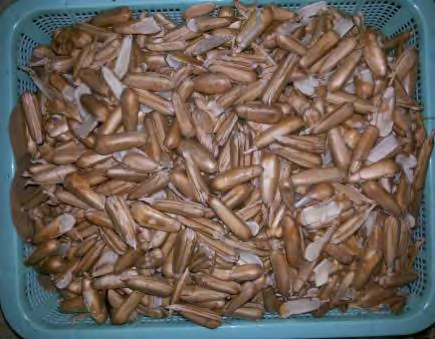
Karuka nuts (Pandanus julianettii)

A pandanus language is an elaborate avoidance language among several of the peoples of the eastern New Guinea Highlands, used when collecting Pandanus nuts.

Use

[edit]

Annually, people camp in the forest to harvest and cook the nuts of karuka (both Pandanus julianettii and Pandanus brosimos). Many normal words are thought to be unhealthy for the plants, as they carry associations inimical to the proper growth of the nuts. An elaborate vocabulary of up to a thousand words and phrases has developed to replace the taboo vocabulary. The new vocabulary focuses on words involved with trips to harvest karuka nuts, and changes as words become known outside an area.[1] The language is often spoken to control the claimed magical properties of the higher elevations where the karuka grows, and to placate dangerous nature spirits like Kita-Menda (also called Giluwe yelkepo),[2] the ritual keeper of the feral dogs. Pandanus language generally should never be used outside the area where the trees grow, for fear of mountain spirits hearing it and coming down to investigate.[1]

All ages and genders are expected to know the ritual language before entering the taboo areas, but outsiders who do not know the language may be allowed to speak Tok Pisin instead.[1] As Tok Pisin has become more widely spoken in the area, Pandanus languages have been spoken less. Newer generations also seem to be less afraid of the deep forest, and do not see much need for the protective talk. The Kewa and Imbongu pandanus languages were thought to be dying out already by the 1990s.[2]

Structure

[edit]

The grammar and vocabulary of pandanus language is based on the mother tongue, but a restricted and consolidated form, especially for names of living organisms.[1] Often words are grouped into umbrella terms which do not have an equivalent concept in ordinary speech. Pandanus language words can also be loanwords from other languages.[3]

'Karuka,' as a term, is not treated consistently across all Pandanus languages. For example, in ordinary Kewa language it is aga,[4][5][1] but in the Kewa Pandanus language it is rumala agaa.[1][2] Conversely, in both ordinary Kalam language and its Pandanus register, the word is the same: alŋaw.[3]

Languages with Pandanus registers

[edit]

Pandanus registers have been best documented for:

The Kalam Pandanus language, called alŋaw mnm (pandanus language) or ask-mosk mnm (avoidance language), is also used when eating or cooking cassowary,[6] as opposed to speaking monmon mnm (ordinary/free language). It is not spoken out of fear of spirits, but to prevent the nuts from being watery, tough, or rotten; or in the case for cassowaries, to show respect to the bird. Kalam Pandanus language may also be used outside the forest without penalty unlike other versions. This register is possibly thousands of years old, and may be inspired by older Pandanus languages.[3]

The Huli language has an avoidance register called tayenda tu ha illili (bush divide taboo) used for collecting Pandanus as well as hunting or traveling. Tayenda, like many of the above, is used to evade malevolent bush spirits.[7]

Citations

[edit]
  1. ^ a b c d e f g h i j k Franklin, Karl J. (September 1972). "A Ritual Pandanus Language of New Guinea". Oceania. 43 (1): 66–76. doi:10.1002/j.1834-4461.1972.tb01197.x. OCLC 883021898.
  2. ^ a b c d e f g h Franklin, Karl J.; Stefaniw, Roman (1992). "The 'Pandanus Languages' of the Southern Highlands Province, Papua New Guinea – a further report" (PDF). In Dutton, Tom (ed.). Culture change, language change – case studies from Melanesia. Pacific Linguistics. Vol. C-120. Canberra: Department of Linguistics Research School of Pacific Studies THE AUSTRALIAN NATIONAL UNIVERSITY. pp. 1–6. doi:10.15144/PL-C120.1. ISBN 978-0858834118. ISSN 0078-7558. OCLC 260177442. Retrieved 25 October 2018.
  3. ^ a b c d e f Pawley, Andrew (1992). "Kalam Pandanus Language: An Old New Guinea Experiment in Language Engineering". In Dutton, Tom E.; Ross, Malcolm; Tryon, Darrell (eds.). The Language Game: Papers in Memory of Donald C. Laycock. Pacific Linguistics Series C. Vol. 110. Memory of Donald C. Laycock. Canberra: Department of Linguistics, Research School of Pacific Studies, Australian National University. pp. 313–334. ISBN 0858834006. ISSN 0078-7558. OCLC 222981840.
  4. ^ Lim, Tong Kwee (2012). "Pandanus julianettii". Edible Medicinal and Non-Medicinal Plants. Vol. 4. Springer. pp. 128–130. doi:10.1007/978-94-007-4053-2_17. ISBN 978-94-007-4053-2. OCLC 822591349.
  5. ^ French, Bruce R. (1982). Growing food in the Southern Highlands Province of Papua New Guinea (PDF). AFTSEMU (Agricultural Field Trials, Surveys, Evaluation and Monitoring Unit) of the World Bank funded project in the Southern Highlands of Papua New Guinea. pp. 64–71. Retrieved 20 September 2018.
  6. ^ Majnep, Ian Saem; Bulmer, Ralph (1977). Birds of my Kalam Country [Mn̄mon Yad Kalam Yakt]. illustrations by Christopher Healey. New Zealand: Auckland University Press. pp. 150, 152. ISBN 9780196479538. OCLC 251862814.
  7. ^ Goldman, Laurence (1983). "Talking about talk". Talk Never Dies: The Language of Huli Disputes. London and New York: Tavistock Publications. pp. 254–257. ISBN 978-0422782104. OCLC 993340993.

References

[edit]

See also

[edit]
Revisions and contributorsEdit on WikipediaRead on Wikipedia
from Grokipedia
The pandanus languages are specialized avoidance registers employed by indigenous communities in the eastern highlands of , particularly during the ritual collection of pandanus nuts from the genus , such as Pandanus julianettii (mountain pandanus or ). These linguistic varieties function as secret codes to ward off malevolent forest spirits believed to guard the nuts, ensure a bountiful harvest, and demarcate sacred territories, with usage restricted to high-altitude forests near areas like . Spoken by groups including the Kewa, , Mendi, and others across branches of the , such as Engan and Madang, pandanus languages share the grammatical structure of their base languages but feature systematically altered vocabularies—often through lexical substitution, metaphorical extensions, or phonetic shifts—to obscure meaning from outsiders and supernatural entities. For instance, in Kewa pandanus talk, the word repana (meaning "tree" or "fire" in everyday speech) becomes palaa, while in , a sentence like "the has laid eggs" (yakt magi ki-p in standard Kalam) transforms to wjblp mdup yok-p. These registers, potentially dating back millennia to early foraging practices, extend beyond nut harvesting in some communities; among the , a similar is used when preparing meat to avoid invoking taboos. Documented since the mid-20th century by linguists like Karl J. Franklin and Andrew Pawley, the highlight innovative "language engineering" in Papuan cultures, serving not only practical purposes but also reinforcing social identity and linguistic creativity amid the region's extreme diversity of over 800 .

Overview

Definition and Etymology

Pandanus languages are elaborate avoidance registers or special speech varieties used by several ethnic groups of the eastern New Guinea Highlands during the collection of pandanus nuts. These linguistic practices involve systematic substitution of everyday vocabulary to observe ritual prohibitions believed necessary for a successful harvest. The term "pandanus language" derives from the genus Pandanus in the screw-pine family (Pandanaceae), named for the pandanus trees whose nuts are central to the cultural activity prompting its use. It specifically relates to highland species such as Pandanus julianettii (karuka), a cultivated tree yielding large, protein-rich nuts, and Pandanus brosimos (wild karuka), its close relative found in montane forests. Distinct from full-fledged languages, languages operate as restricted lexical overlays on the speakers' mother tongues, replacing common words with ritual alternatives while retaining core and . They do not form independent linguistic systems but serve as temporary, context-bound adaptations to enforce cultural taboos. Initial documentation of pandanus languages occurred within in the mid-20th century, with Karl J. Franklin providing the first detailed description based on fieldwork among the Kewa people in the 1960s, published in 1972. Subsequent studies, such as those by Andrew Pawley on the variant, further illuminated their structure and regional variations.

Primary Purpose and Cultural Role

The primary purpose of pandanus languages is to serve as avoidance registers that replace everyday vocabulary with specialized terms to prevent harm to the nut or provocation of forest spirits during collection expeditions in the highland forests of . In Kewa communities, for instance, up to around 1,000 words are substituted to avoid angering spirits like Kita-Menda, a guardian entity associated with wild dogs on believed to endanger harvesters and crops if ordinary speech is used. This linguistic shift is rooted in the conviction that profane language could spoil the growth of key species such as (Pandanus julianettii) or invite spiritual retribution, thereby ensuring the nuts ripen fully and the expedition proceeds safely. Culturally, languages function as secret codes among highland groups, enabling participants to harness the perceived magical properties of elevated environments while placating nature spirits and securing abundant yields. They reinforce social taboos integral to seasonal s, where the language acts as a ritual boundary that heightens communal focus on harmony with the natural world during nut-gathering, a vital subsistence activity. By invoking spiritual protection through coded speech, they underscore the animistic prevalent in these societies, where linguistic restraint is seen as a form of toward ancestral forces governing forest bounty. Usage restrictions vary by community; in many, such as Kewa, it is primarily limited to initiated adult men on expeditions to preserve sanctity, while in others like , all participants including women and children are expected to use it. This aligns with broader highland traditions of esoteric knowledge transmission in some groups. Symbolically, pandanus languages embody deep respect for the environment and continuity of ancestral traditions, encapsulating an animistic ethic where human speech must align with natural and spiritual orders to sustain ecological balance and . Through their employment, they affirm the interdependence of language, , and survival in highland animistic systems, highlighting the profound cultural value placed on harmonious interaction with the forest realm.

Historical and Cultural Context

Origins in Highland Societies

The Pandanus languages emerged within the socio-cultural contexts of highland societies in eastern , primarily among diverse speakers of the Trans-New Guinea phylum with some instances in other Papuan families, closely tied to ancient practices that exploited the seasonal abundance of nuts as a vital food source. These specialized registers likely developed as adaptations to the ecological demands of gathering in remote, high-altitude forests, where Pandanus species such as Pandanus brosimos and Pandanus julianettii grow at high elevations, typically between 1,500 and 3,100 meters depending on the species. Archaeological evidence indicates that such foraging activities date back at least 40,000 years in the highlands, suggesting a deep historical foundation for the cultural practices that gave rise to these linguistic forms, though the languages themselves are inferred to have a very long history based on their integration with longstanding traditions. These registers evolved among diverse speakers of the Trans-New Guinea phylum, transforming broader Melanesian patterns—used in contexts like kinship taboos—into highly specialized forms dedicated to -related activities. In groups such as the and Kewa, the languages represent an advanced stage of this evolution, featuring complete lexical replacement while preserving the underlying and of everyday speech, a design that underscores their role in ritualized expeditions through spirit-inhabited terrains. Linguistic analyses suggest that the register has a long history, reflecting gradual refinements in response to ecological and spiritual imperatives over millennia. The first systematic anthropological documentation of these registers occurred during the 1960s and 1970s, amid growing interest in highland linguistics. Karl J. Franklin conducted pioneering fieldwork on the Kewa Pandanus language in the Southern Highlands, publishing detailed accounts of its ritual structure and cultural significance in 1972. Concurrently, John A. Z'graggen's classificatory studies of languages, including , laid groundwork for later analyses, with Andrew Pawley's 1992 examination of the Kalam register providing deeper insights into its engineered lexicon and historical depth.

Association with Pandanus Nut Harvesting

The Pandanus language is employed exclusively during the annual expeditions to harvest nuts ( julianettii), a vital protein-rich staple in the diets of highland communities in Papua New Guinea's . These expeditions typically occur from June to August, coinciding with the when the nuts ripen in the montane forests at elevations of 2,000 to 3,000 meters. Men from participating clans undertake multi-week treks to remote areas, such as the slopes of , camping in the forest to collect and process the nuts, which are then roasted into kernels or ground into nutrient-dense pastes for preservation and transport back to villages. Ritual procedures are strictly observed to ensure a successful harvest and safe return. Participants form all-male groups, donning traditional attire including bark cloaks and elaborate headdresses adorned with feathers and plant fibers to signify their entry into the sacred forest domain. Upon crossing into the harvesting grounds, ordinary speech is , and all communication must occur in the , a specialized register that replaces everyday vocabulary to prevent invoking misfortune. This includes chants recited during nut collection and , which invoke and are believed to ward off malevolent spirits, such as the Kewa spirit Kita-Meda, guardian of the mountains; brief references to such spirit names are permissible only in encoded Pandanus forms. Violations of these speech rules, such as uttering prohibited words related to or fire, are thought to anger spirits and result in crop spoilage or personal illness. The language integrates deeply with the environmental challenges of the expeditions, serving as a tool for safe through steep, rugged terrains riddled with cliffs and dense undergrowth. By using Pandanus terms for landmarks, tools, and actions, participants are believed to appease spirits, ensuring the nuts ripen fully and remain unspoiled during ; this linguistic is maintained until the group returns to settled areas, after which normal speech resumes. Socially, these rituals foster strong camaraderie among the men, reinforcing bonds through shared secrecy and discipline, while the collective observance underscores the cultural value placed on the karuka harvest as a communal rite of renewal and survival.

Linguistic Characteristics

Vocabulary Replacement and Taboos

In the Pandanus language, a core mechanism involves the systematic replacement of everyday vocabulary with specialized terms to maintain ritual purity during sacred activities. Common words denoting body parts, animals, actions, and natural elements are substituted with archaic forms, metaphors, or circumlocutions, creating a distinct that avoids "polluting" the context with profane language. Among the Kewa, this results in an elaborate vocabulary of up to 1,000 such substitutions, transforming ordinary speech into a coded register. These replacements stem from specific types of linguistic taboos, which prohibit words that evoke danger, sexuality, death, or other disruptive forces believed to attract harmful spirits. Instead, speakers employ umbrella terms that generalize categories—such as a single generic label for multiple species of birds—or borrow words from neighboring languages to circumvent restrictions. This approach ensures that direct references to potentially ominous elements are neutralized, preserving the sanctity of the ritual environment. The primary purpose of these substitutions is to mitigate spiritual risks by deceiving or appeasing entities associated with the , thereby safeguarding the harvest and participants. By rendering the language opaque and ritualistic, the register also excludes non-initiates, reinforcing social hierarchies and within highland communities. This practice is briefly integrated into pandanus nut harvesting rituals, where the specialized speech accompanies the collection and preparation of the nuts. Representative examples illustrate the transformation: in Kalam, the ordinary term for "bird," yakt, is replaced by the Pandanus form wjblp, which serves as an umbrella term for various bird species. A full sentence like "the bird has laid eggs," rendered in standard Kalam as yakt magi ki-p ("bird egg excrete-it"), becomes wjblp mdup yok-p ("bird egg put-it") in the ritual register, employing a euphemistic verb to avoid direct connotations of bodily functions.

Structural Adaptations and Examples

Pandanus registers generally retain the core syntax and grammatical structure of their base languages while imposing restrictions on lexical categories such as , , and to enforce avoidance of terms. In the register, for instance, the grammar mirrors that of ordinary Kalam, including serial constructions and ordering, but the is almost entirely replaced, leading to circumlocutory expressions formed by combining a small set of approximately nine to convey complex actions. Similarly, the Kewa register preserves the polysynthetic morphology and basic sentence structure of standard Kewa, with restrictions primarily affecting rather than function words or inflections. Though these do not fundamentally alter the underlying syntax. Phonological features in Pandanus registers typically align closely with those of the base language, showing no systematic differences in or inventories. However, in performative contexts like chants, speakers may employ elongated s or distinct intonations to heighten ritual effect, drawing on archaic prosodic patterns not prominent in everyday speech. Illustrative sentence-level examples demonstrate these adaptations through lexical substitution and while maintaining syntactic parallelism. In , the ordinary sentence for "we are eating bananas," kañm ñb-sp-un, transforms into the equivalent sml ñab g-sp-un, where nouns and verbs are replaced but the serial verb structure and tense marking persist. Another example contrasts "the bird has laid eggs," rendered as yakt magi ki-p in everyday speech, with the version wjblp mdup yok-p, preserving the subject-verb-object order and completive aspect suffix -p. In Huli, the register known as tayenda tu ha illili ("bush divide ") employs similar substitutions, such as ritual phrases that replace direct terms with metaphorical ones, though full sentence parallels follow the base language's verb-final syntax. To fill lexical gaps created by taboos, registers often incorporate borrowings from distant languages or invent neologisms, enhancing their secrecy and exclusivity. For example, terms like for specific pandanus varieties appear inconsistently across registers, sometimes as loans from neighboring , allowing speakers to denote prohibited concepts indirectly. These innovations, driven by the need to avoid direct references during nut harvesting, result in a highly engineered that prioritizes metaphorical and associative derivations over standard vocabulary.

Specific Registers by Language Group

Kewa and Imbongu Registers

The Kewa register is spoken by the Kewa people in the of , where it serves as a specialized avoidance language employed exclusively during the seasonal harvesting of pandanus nuts. This register features an extensive vocabulary of words that replace everyday terms to maintain ritual purity and avert spiritual dangers associated with the forest expedition. It relies heavily on metaphorical substitutions, such as the ordinary Kewa word repana for "tree" or "fire" being rendered as palaa in the register. Documented extensively by linguist Karl J. Franklin in the 1970s, the register preserves the underlying grammar of standard Kewa while transforming its to create a distinct mode of communication limited to these expeditions. The Imbongu register, used by speakers of the closely related Imbongu language in the same region, functions in analogous harvesting contexts and belongs to the Enga-Huli subgroup of the Trans-New Guinea phylum, just like Kewa. It incorporates unique terminology tailored to the practical and spiritual demands of pandanus gathering, including expressions for navigating dense forest terrain and performing rites to appease forest spirits. Franklin and collaborator Roman Stefaniw described this register in the early , noting its role in maintaining secrecy and observance during all-male expeditions that could last several weeks. Both the Kewa and Imbongu registers emphasize exclusively male participation in rituals, where ordinary speech is forbidden to prevent misfortune, reflecting broader avoidance principles in highland societies. For instance, in Kewa ritual speech, the everyday term repana ( or ) shifts to palaa, illustrating a shared pattern of lexical substitution to denote sacred contexts. These registers have experienced significant decline since the , attributed to cultural changes such as reduced traditional harvesting due to modernization and mission influence.

Kalam and Huli Registers

The register is employed by speakers of the Kalam language, a Trans-New Guinea tongue spoken in the Bismarck-Schrader mountain ranges of , . Beyond its primary association with pandanus nut harvesting expeditions—where participants use it to ward off spirits and ensure a bountiful yield—it extends to hunting s, demonstrating its multi-purpose role in maintaining ritual secrecy and social cohesion. A distinctive structural feature is the systematic replacement of vocabulary, including verbs, with broader terms while preserving grammatical integrity. In contrast, the Huli register is used among the of the to invoke spiritual protection during forest ventures, including the collection of nuts. This variety emphasizes phonetic secrecy through systematic sound substitutions and distortions, rendering ordinary speech unintelligible to outsiders and facilitating direct communication with ancestral spirits. songs form a core component, often extending into prolonged chants that layer metaphorical references to natural elements, such as substituting multiple archaic terms for "" to evoke atmospheric and spiritual barriers. What sets the Kalam register apart is its adaptability across rituals, allowing seamless integration into diverse ceremonial contexts without strict phonetic constraints. The Huli register, however, uniquely intertwines linguistic elements with visual and performative arts, including elaborate body decorations using clay and pigments, alongside extended chant cycles that can last hours and reinforce communal bonds during expeditions. Documentation of the Kalam register draws from field studies conducted by linguist Andrew Pawley. For the Huli register, key examples emerge from 1970s ethnographies, particularly those by anthropologist Laurence Goldman, who analyzed its role in dispute resolution and spiritual invocation through transcribed songs and narratives.

Contemporary Status and Challenges

Factors Contributing to Decline

The rise of as Papua New Guinea's primary has diminished the practical need for Pandanus languages, which traditionally served to maintain secrecy during group harvesting expeditions in the highlands. As inter-clan interactions increase, speakers rely on for communication in forest settings, reducing opportunities to practice these specialized registers. Younger generations, exposed to through education and media, show a marked preference for the creole, accelerating the shift away from ritual-specific vocabularies in languages like Kewa and Imbongu. Socio-economic transformations, including widespread urban migration and the expansion of cash-based economies, have further eroded the contexts for Pandanus language use. Many highlanders now seek wage labor in coastal towns or areas, shortening or eliminating multi-day karuka nut expeditions that once necessitated the registers. The growing availability of imported processed foods has decreased dependence on as a seasonal staple, limiting frequency and associated rituals among groups such as the Kewa and Imbongu. Cultural changes driven by and formal education have contributed to the loss of traditional beliefs underpinning languages, including the fear of forest spirits that enforced observance. Missionary activities since the mid-20th century have promoted abandonment of pre-Christian rituals, viewing them as pagan, which has weakened the motivational framework for using avoidance registers during nut gathering. By the , these registers had become nearly obsolete among youth in Kewa and Imbongu communities, based on earlier linguistic documentation. Environmental pressures, including , are restricting habitats and further reducing harvest opportunities. Logging and in the highlands have fragmented groves, particularly in the , limiting access to the montane forests where expeditions occur. Shifting temperature and rainfall patterns associated with have also impacted fruiting cycles, with reports of frost damage and altitudinal shifts in growth zones exacerbating habitat loss for this key species.

Documentation and Preservation Efforts

Documentation of Pandanus languages has been spearheaded by linguists affiliated with the Summer Institute of Linguistics (SIL International) and academic institutions in . Karl J. Franklin's seminal 1972 study, "A Ritual Pandanus Language of New Guinea," offered the first comprehensive analysis of the Kewa pandanus register, detailing its lexical innovations, phonological features, and role in avoidance during nut harvesting expeditions in the Southern Highlands. This work built on earlier anthropological observations and established a foundation for understanding the register's systematic replacement of everyday vocabulary to evade spiritual detection. Subsequent documentation extended to other language groups. For the Kalam, Andrew Pawley's 1992 publication, "Kalam Pandanus Language: An Old Experiment in Language Engineering," examined the register's engineered structure, highlighting its morphological and semantic adaptations as a culturally embedded linguistic innovation in . Franklin and Roman Stefaniw's 1992 report, "The 'Pandanus Languages' of the , – A Further Report," provided additional data on variants among the Huli, Imbongu, and related groups, including comparative vocabularies and contextual usage. These studies, published through Pacific Linguistics series at the Australian National University, emphasized the registers' ties to ecological and spiritual practices. In the 2000s and 2010s, SIL International conducted extensive sociolinguistic surveys across Papua New Guinea's highlands, assessing language vitality and documenting minority varieties, including ritual forms like registers, to inform conservation priorities. These efforts involved fieldwork with communities to record oral traditions and vocabularies, contributing to broader inventories of the country's 800+ languages. has advanced through repositories such as the Australian National University's Open Research Repository, which archives key texts, glossaries, and select audio recordings from these surveys, ensuring accessibility for future researchers and communities. As of the 2020s, languages face ongoing endangerment alongside broader trends in , where 32% of indigenous languages are classified as endangered, largely due to shifts toward . However, no specific post-2020 documentation or revival initiatives for these registers were identified in recent surveys. Preservation faces challenges from cultural shifts and declining speaker numbers, with partial successes in Huli communities where oral histories maintain some register knowledge during traditional ceremonies. However, revival in smaller groups like Imbongu remains limited, underscoring the need for targeted initiatives amid calls to recognize pandanus languages as endangered intangible heritage.

References

Add your contribution
Related Hubs
User Avatar
No comments yet.