


Community hub
Recent from talks
Contribute something
Nothing was collected or created yet.
Pando (tree)
View on Wikipedia

Key Information


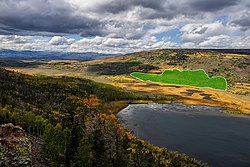
Pando (from Latin pando 'I spread')[1] is the name of a quaking aspen (Populus tremuloides) clone located in Sevier County, Utah, United States, in the Fishlake National Forest. A male clonal organism, Pando has an estimated 47,000 stems (ramets) that appear to be individual trees but are not, because those stems are connected by a root system that spans 42.8 ha (106 acres). As a multi-stem tree, Pando is the world's largest tree by measures of weight and landmass each.[2]
Systems of classification used to define large trees vary considerably, leading to some confusion about Pando's status. Within the United States, the Official Register of Champion Trees defines the largest trees in a species-specific way; in this case, Pando is the largest aspen tree (Populus tremuloides). In forestry, the largest trees are measured by the greatest volume of a single stem, regardless of species. In that case, the General Sherman Tree is the largest unitary (single-stem) tree. While many emphasize that Pando is the largest clonal organism, other large trees, including Redwoods can also reproduce via cloning. Pando being the heaviest tree and the largest tree by landmass, while also being the largest aspen clone, leaves the Pando Tree in a class of its own.
Since the early 2000s, little information has been adequately corroborated about Pando's origins and how its genetic integrity has been sustained over a long period of time, conservatively between 9,000 and 16,000 years old-by the latest (2024) estimate.[3] Researchers have argued that Pando's future is uncertain due to a combination of factors including drought, cattle grazing, and fire suppression.[4][5] In terms of drought, Pando's long lived nature suggests it has survived droughts that have driven out human societies for centuries at a time. In terms of grazing, a majority of Pando's land mass is fenced for permanent protection and management as a unique tree. Cattle grazing ended in Pando in 2024, but previously, was permitted on a volume basis for 10 days a year in October, weather permitting, in a small edge of Pando's southeastern expanse. Additionally, between 2015 and 2022, the local grazers group, 7-Mile Grazers Association, who rely on Pando's forage and biomass to sustain the landscape, signed off on a long-term protection plan working with Fishlake National Forest and Friends of Pando, and also wrote letters of support for the "Pando Protection Plan", a plan to bring nearly 34 hectares (84 acres) of the tree into protective care. In terms of fire suppression, research indicates[6] Pando has survived fires that would have likely leveled the tree many times, after which Pando regenerated itself from the root system. The same research also indicates large-scale fire events are infrequent, which may be owed to the fact that aspen are water-heavy trees and thus, naturally fire resistant, earning them the name "asbestos forests" among wildfire scientists.[7] Concerns aside, there is a broad consensus that wildlife controls to protect Pando from overbrowsing by deer and elk are critical to the Pando's Tree's sustainability and care. Protection systems coupled with ongoing monitoring and restoration efforts have been shown to be effective dating back to the late 1980s and early 1990s, with new projects under way.[8]
Friends of Pando[9] and the Fishlake National Forest partners to study and protect the Pando Tree working alongside Utah Division of Wildlife Resources.[10] Notable organizations that also study and advocate to protect Pando's care include Western Aspen Alliance[11] and Grand Canyon Trust.[12]
Discovery, naming and verification
[edit]The Pando tree was identified in 1976 by Jerry Kemperman and Burton V. Barnes.[13][14] A posthumous biography by Barnes' colleague, Daniel Kashian,[15] details Pando's discovery:
As a part of his aspen work in the West, Burt began to examine an extremely large trembling aspen clone southwest of Fish Lake, Utah, in the late 1960s and early 1970s. Using aerial photography and the same morphological differentiation techniques he developed for aspen at UMBS for his dissertation, Burt concluded that the aspen forest that covered about 106 acres was a single aspen clone, quite possibly the "world's largest organism." Other than a single publication about aspen clone size and another great story to tell his students, Burt's studies on the Fish Lake clone were relatively obscure.
— Daniel M. Kashian, Burton V. Barnes (1930–2014)
Work by Fishlake National Forest to understand and protect the tree began in 1987, according to interviews and articles written by Fishlake Forest as well as accounts gathered by Friends of Pando.[16] Based on Barnes and Kempermans's 1976 paper noting Pando's discovery, Michael Grant, Jeffrey Mitton, and Yan Linhart of the University of Colorado at Boulder re-examined the clone in 1992 and described Pando as a single male aspen clone based on its morphological characteristics such as pollen production, leaves, and root structure. Michael Grant named the tree "Pando" which is Latin for "I spread" in an editorial which was later published in Discover Magazine.[17] A large-scale genetic sampling and analysis was published in 2008 by Jennifer DeWoody, Karen Mock, Valerie Hipkins, and Carol Rowe.[18] The research team's genetic study confirmed morphological analysis by Barnes and Kemperman as well as Mitton, Grant and Linhart thus, verifying Pando's size and scale of operation.

Research and protection
[edit]In late 1987, Fishlake National Forest began work to remove diseased trees and promote new growth using coppicing (a form of mechanical stimulation),[19] which works by simultaneously removing diseased stems, and in the process, stimulating the hormone response that spurs new growth.[20] In 1993, Fishlake National Forest began work on the "Aspen Regeneration Project",[16] installing fences to help control deer and elk who threatened to destroy the productive results of work to spur and protect new growth. Today, acres of Pando is protected by 8-foot fences to control populations of mule deer (Odocoileus hemionus) and elk (Cervus canadensis), and to control human uses, such as permitted grazing by domestic cattle (Bos taurus). Additional fencing protections were added in 2025 bringing approximately 80% of Pando's landmass into protective care while also creating two wildlife management bulwarks with Utah Highway 25 which bisects the tree, as a focal point for additional measures in future projects via the use of cattle guards and other non-violent hazing methods.[21]
Historically, regeneration rates in portions of the "Aspen Regeneration Project" which started in the 1990s, showed promise based on photographic evidence and repeated survey plots by land managers, scientists and conservation groups between 1993 and today.[22] Despite this, many have argued more work needs to be done to control wildlife, as the Pando Tree is surrounded by 700 square miles of de facto wildlife preserve managed by people, groups and agencies who do not have Pando's sustainability as a central concern in their land management policies. Paul Rogers and Darren McAvoy of Utah State University completed an assessment of Pando's status in 2018 and stressed the importance of reducing herbivory by mule deer and elk as critical to conserving Pando.[5] In 2019, Rogers and Jan Šebesta surveyed other vegetation within Pando besides aspen, finding additional support for their 2018 conclusions and found that interactions between browsing and management strategy may have had adverse effects on Pando's long-term resilience to change.[23] In 2023, a team of researchers, land managers, wildlife biologists and citizen scientists groups began long-term programs to monitor deer and elk using GPS collars and wildlife cameras to better understand wildlife, as well as deer and elk browsing on the tree.[24] In 2022, Executive Order 14702 directed the US Forest Service to inventory old growth and mature forest as part of a plan to protect mature and old growth forest. Data submitted by Fishlake National Forest defined Pando's landmass as "mature" meaning it could be eligible for special care and protections under that Executive order.[25]
2024 Pando Protection Plan
[edit]
Between 2015 and 2022, Fishlake National Forest, Pando's federal land steward, developed a plan and gathered public feedback for work to expand wildlife controls and protections of the Pando Tree as part of the Fishlake Basin Recreation Improvement Plan.[26] Work to develop the plan involved gathering formal and informal feedback from community, regional, and state organizations in Land Management, Agriculture, Conservation, and Recreation between 2015 and 2019, followed by a public comment period which ran from March 2021 through March 2022. The plan was approved in June 2022 by Fishlake National Forest Supervisor Michael Elson. In 2023, Friends of Pando worked to gather letters of support for the plan and was invited by Representative Carl Albrecht[27] to give a brief presentation about the plan to the Utah Legislature.(PDF of Presentation)[28] Based on recommendations and community support, Representative Albrecht secured a $250,000 allocation for the Utah Department of Transportation to develop plans and contract work to expand wildlife controls to bring the majority of Pando's landmass into protective care.[29] Between May 2024 and September 2024, Friends of Pando and community organizations worked to organize a series of talks and meetings to finalize the plan.[30] Based on wildlife behavior data gathered by Friends of Pando, Fishlake National Forest and Utah Division of Wildlife Resources[31] the final plan was mapped to maximize wildlife management in and around the tree. Work was completed in September of 2025[32].
Size and age
[edit]
Most agree, based on Barnes' work and later work, that Pando encompasses 42.89 hectares (106 acres), weighs an estimated 6,000 metric tons (6,600 short tons) or 13.2 million pounds, and features an estimated 47,000 stems, which die individually and are replaced by genetically identical stems that are sent up from the tree's vast root system, a process known as "suckering".[2][33] The root system is estimated to be several thousand years old, with habitat modeling suggesting a maximum age of 14,000 years[34][35] and 16,000 years by the latest (2024) estimate.[3] Individual stems do not typically live more than 100–130 years. Pando's landmass spreads from 2,700 m (8,900 ft) above sea level to approximately 2,773 m (9,098 ft) above sea level along the western side of a steep basin wall.[36]
Mitton and Grant summarize the development of stems in aspen clones:[37]
... quaking aspen regularly reproduces via a process called suckering. An individual stem can send out lateral roots that, under the right conditions, send up other erect stems; from all above-ground appearances the new stems look just like individual trees. The process is repeated until a whole stand, of what appear to be individual trees, forms. This collection of multiple stems, called ramets, all form one, single, genetic individual, usually termed a clone.
Range of age estimates
[edit]Due to the progressive replacement of stems and roots, the overall age of an aspen clone cannot be determined from tree rings. Speculations on Pando's age have ranged between 80,000 and 1 million years.[37] Many news sources list Pando's age as 80,000 years, but this claim derives from a now-removed National Park Service web page, which redacted that claim in 2023 and was inconsistent with the Forest Service's post ice-age estimate.[38] Glaciers repeatedly formed on the Fish Lake Plateau[39] over the past several hundred thousand years and the mountains above Pando's landmass were crowned by glaciers as recently as the last glacial maximum.[40] Ages greater than approximately 16,000 years therefore require Pando to have survived climate conditions during the Pinedale glaciation, something that appears unlikely under current estimates of Pando's age and modeling of variations in local climate.[34][35] A 2017 paper by Chen Ding et al. seems to support US Forest Service claims that Pando could not be older than the last Glacial Maximum in the area based on paleo-climate models and genetic traits of aspen sites throughout North America.[41] A 2024 paper indicates the age could be between 16,000 and 80,000 years based on the first somatic mutation model of the tree, but, that research has not finished peer review and also relies on older material and testing methods. Thus, charcoal studies published in 2022 place the lower end of Pando's potential age range at around 9,000 years, while the somatic mutation models' most conservative estimate of 16,000 years of age awaits replication using new material and methods, and will also require climate models to prove conditions were favorable to the Pando seed being able to germinate and establish itself during this period.
Estimates of Pando's age have also been influenced by changes in the understanding of establishment of aspen clones in western North America. Earlier sources argued germination and successful establishment of aspen on new sites was rare in the last 10,000 years, and that Pando's root system was therefore likely greater than 10,000 years old.[37] More recent observations, however, have shown seedling establishment of new aspen clones is a regular occurrence and can be abundant on sites exposed by wildfire.[42] These findings are summarized in the U.S. Forest Service's Fire Effects Information System:[43]
Kay documented post-fire quaking aspen seedling establishment following 1986 and 1988 fires in Grand Teton and Yellowstone National Parks, respectively. He found seedlings were concentrated in kettles and other topographic depressions, seeps, springs, lake margins, and burnt-out riparian zones. A few seedlings were widely scattered throughout the burns. In Grand Teton National Park, establishment was greatest (950–2,700 seedlings/ha) in 1989, a wet year, but hundreds to thousands of seedlings established each year despite drought conditions in 1986–1988 and 1990–1991. Seedlings surviving past one season occurred almost exclusively on severely burned surfaces.
In popular culture
[edit]- In 2006, the United States Postal Service published a stamp in commemorating Pando which was designed by artist Lonnie Busch, calling it one of the forty "Wonders of America".[44][45]
- In 2013, Pando featured as the backdrop and the subject of a music video for a successful campaign led by 4th graders of nearby Monroe, Utah, United States, to have the State of Utah's Tree be changed from Colorado Spruce to the Quaking Aspen.[46][47] The song the children sang was written by Utah folk artist and songwriter, Clive Romney.[48]
- In 2018, the Pando Aspen Clone figures as a central figure in the life of the character Patricia Westerford in Richard Powers' novel The Overstory.
- In 2021, children's book author Kate Allen Fox published "Pando: A Living Wonder of Trees" earning her a School Library Journal Award[49] for the work.
- In 2022, an episode of NBC TV Show "The Blacklist" entitled "The Trembling Giant"[50] (a nickname for Pando) features a scene where central character Raymond 'Red' Reddington details the tree's operation.
- In 2022, Friends of Pando published audio works by sound conservationist and artist Jeff Rice documenting the tree's subterranean workings for the first time.[51][52][53]
- In 2022, Pando was the subject of an issue of the webcomic xkcd published on December 23, which facetiously suggests adding to Pando's many world records that of world's largest Christmas tree by running a 9,300-foot-long string of Christmas lights through the branches along its perimeter.[54]
- In 2024, the Hallmark Channel had a movie titled Branching Out, set in Utah, in which a young girl searches for the paternal side of her family, as her mom had used a donor for an IVF conception. The girl's mom and the donor fall in love. At the film's conclusion, as the girl presents her "family tree" project to her class, she explains her family tree is a Pando, as the newfound family and her are all interconnected, like the Pando tree.
- In 2024, Intel Computer Chip Corporation named a novel quantum computing control chip "Pando Tree"[1]. While many technology organizations have utilized "Pando" in terms of its Latin meaning for "spread", the naming is the first to explicitly honor the Pando Tree itself.
- In the 2024 book Beautyland[55] by Marie-Helene Bertino, the main character Adina learns about the Pando Tree, which serves as a symbol of connection and resilience, large things that are one thing, and her unfolding role as a planetary traveler with unique powers and skills.
See also
[edit]References
[edit]- ^ Grant, Michael C. (October 1993). "The Trembling Giant". Discover. Vol. 14, no. 10. Chicago. pp. 82–89. Retrieved May 8, 2008.
- ^ a b DeWoody, Jennifer; Rowe, Carol A.; Hipkins, Valerie D.; Mock, Karen E. (2008). ""Pando" Lives: Molecular Genetic Evidence of a Giant Aspen Clone in Central Utah". Western North American Naturalist. 68 (4): 493–497. Bibcode:2008WNAN...68..493D. doi:10.3398/1527-0904-68.4.493. S2CID 59135424.
- ^ a b Pineau, Rozenn M.; Mock, Karen E.; Morris, Jesse; Kraklow, Vachel; Brunelle, Andrea; Pageot, Aurore; Ratcliff, William C.; Gompert, Zachariah (2024). "Mosaic of Somatic Mutations in Earth's Oldest Living Organism, Pando" (PDF). bioRxiv. doi:10.1101/2024.10.19.619233. PMC 11526904. PMID 39484516.
- ^ Rogers, Paul C.; Gale, Jody A. (2017). "Restoration of the iconic Pando aspen clone: Emerging evidence of recovery". Ecosphere. 8 (1): 1–15. Bibcode:2017Ecosp...8E1661R. doi:10.1002/ecs2.1661.
- ^ a b Rogers, Paul C.; McAvoy, Darren J. (October 17, 2018). "Mule deer impede Pando's recovery: Implications for aspen resilience from a single-genotype forest". PLOS ONE. 13 (10) e0203619. Bibcode:2018PLoSO..1303619R. doi:10.1371/journal.pone.0203619. ISSN 1932-6203. PMC 6192553. PMID 30332420.
- ^ Novák, Jan; Kusbach, Antonín; Šebesta, Jan; Rogers, Paul C. (October 1, 2022). "Soil macrocharcoals reveal millennial-scale stability at the Pando aspen clonal colony, Utah, USA". Forest Ecology and Management. 521 120436. Bibcode:2022ForEM.52120436N. doi:10.1016/j.foreco.2022.120436. ISSN 0378-1127.
- ^ Lindsay, Bethany (November 17, 2018). "'It blows my mind': How B.C. destroys a key natural wildfire defence every year". Canadian Broadcast Corporation. Retrieved April 12, 2024.
- ^ Walton, Richard Elton (September 28, 2024). "Earth's Largest Organism Is Slowly Being Eaten, Scientist Says". The Conversation. Retrieved September 28, 2024 – via ScienceAlert.
- ^ "Friends of Pando". Friends of Pando. Retrieved November 2, 2023.
- ^ Harkins, Paighten (August 14, 2023). "Once given a death sentence, Utah's Pando aspen grove has 'come a long way'". The Salt Lake Tribune. Retrieved December 20, 2023.
- ^ Utah State University. "Western Aspen Alliance". qcnr.usu.edu. Retrieved November 2, 2023.
- ^ "Pando Clone Recovery". Grand Canyon Trust. March 5, 2020. Retrieved November 2, 2023.
- ^ Kemperman, Jerry A.; Barnes, Burton V. (November 15, 1976). "Clone size in American aspens". Canadian Journal of Botany. 54 (22): 2603–2607. Bibcode:1976CaJB...54.2603K. doi:10.1139/b76-280. ISSN 0008-4026. S2CID 85891968.
- ^ Mock, K. E.; Rowe, C. A.; Hooten, M. B.; Dewoody, J.; Hipkins, V. D. (2008). "Clonal dynamics in western North American aspen (Populus tremuloides)". Molecular Ecology. 17 (22): 4827–4844. Bibcode:2008MolEc..17.4827M. doi:10.1111/j.1365-294X.2008.03963.x. PMID 19140975. S2CID 1425039. Archived from the original on September 19, 2018. Retrieved November 17, 2018.
- ^ Dick, Christopher W.; Penskar, Michael R.; Reznicek, Anton A. "Burton v. Barnes as a Forest Botanist" (PDF). The Michigan Botanist. 54: 46–52.
- ^ a b "History of Land Management in Pando". Friends of Pando. Retrieved October 31, 2023.
- ^ Grant, Michael C. (November 11, 2019) [October 1, 1993]. "The Trembling Giant". Discover Magazine. Retrieved April 12, 2024.
- ^ DeWoody, Jennifer; Rowe, Carol; Hipkins, Valerie; Mock, Karen (January 1, 2008). "Pando lives: molecular genetic evidence of a giant aspen clone in central Utah". Western North American Naturalist. 68 (4): 493–497. Bibcode:2008WNAN...68..493D. doi:10.3398/1527-0904-68.4.493.
- ^ Shepperd, Wayne D. (2001). "Manipulations to regenerate aspen ecosystems". In: Shepperd, Wayne D.; Binkley, Dan; Bartos, Dale L.; Stohlgren, Thomas J.; Eskew, Lane G., Comps. Sustaining Aspen in Western Landscapes: Symposium Proceedings; 13–15 June 2000; Grand Junction, CO. Proceedings RMRS-P-18. Fort Collins, CO: U.S. Department of Agriculture, Forest Service, Rocky Mountain Research Station. P. 355-366. 18: 355–366.
- ^ "History of Land Management in Pando". Friends of Pando. Retrieved November 2, 2023.
- ^ Lundgren, Alysha (September 11, 2024). "$250K project slated to protect south-central Utah's 'trembling giant'". St. George News. Retrieved September 25, 2024.
- ^ "Pando Clone Recovery". Grand Canyon Trust. March 5, 2020. Retrieved November 15, 2023.
- ^ Rogers, Paul C.; Šebesta, Jan (December 2019). "Past Management Spurs Differential Plant Communities within a Giant Single-Clone Aspen Forest". Forests. 10 (12): 1118. Bibcode:2019Fore...10.1118R. doi:10.3390/f10121118.
- ^ "Once given a death sentence, Utah's Pando aspen grove has 'come a long way'". The Salt Lake Tribune. Retrieved October 31, 2023.
- ^ "Mature and Old-Growth Forests". ArcGIS StoryMaps: Old Growth and Mature Forest, US Forest Service Inventory. August 13, 2024. Retrieved September 25, 2024.
- ^ "Fishlake Basin Recreation Improvement Plan". Fishlake National Forest. 2022. Retrieved June 10, 2025.
- ^ "Utah State Representative Carl Albrecht". Utah Legislature.
- ^ "PANDO - Protecting Utah's natural wonder while improving highway safety" (PDF). Archived from the original (PDF) on December 17, 2024.
- ^ Lundgren, Alysha (September 11, 2024). "$250K project slated to protect south-central Utah's 'trembling giant'". St George News. Retrieved June 10, 2025.
- ^ "Pando Protection Plan Underway". Friends of Pando, Facebook. September 30, 2024. Retrieved June 10, 2025.
- ^ "Pando Science and Data Monitoring Store". Friends of Pando Data and Monitoring Store. Retrieved June 10, 2025.
- ^ Maxwell, Aimee (October 10, 2025). "Eight Percent of Pando Now Under protective Wildlife fencings Thanks to Large Local Effort". The Insider. Retrieved October 14, 2025.
- ^ "Pando". USDA Forest Service. Retrieved August 24, 2013.
- ^ a b Mock, K. E.; Rowe, C. A.; Hooten, M. B.; Dewoody, J.; Hipkins, V. D. (November 2008). "Clonal dynamics in western North American aspen ( Populus tremuloides )". Molecular Ecology. 17 (22): 4827–4844. Bibcode:2008MolEc..17.4827M. doi:10.1111/j.1365-294X.2008.03963.x. PMID 19140975. S2CID 1425039.
- ^ a b Ding, Chen; Schreiber, Stefan G.; Roberts, David R.; Hamann, Andreas; Brouard, Jean S. (July 5, 2017). "Post-glacial biogeography of trembling aspen inferred from habitat models and genetic variance in quantitative traits". Scientific Reports. 7 (1): 4672. Bibcode:2017NatSR...7.4672D. doi:10.1038/s41598-017-04871-7. ISSN 2045-2322. PMC 5498503. PMID 28680120.
- ^ Google earth
- ^ a b c Mitton, Jeffry B.; Grant, Michael C. (1996). "Genetic Variation and the Natural History of Quaking Aspen". BioScience. 46 (1): 25–31. doi:10.2307/1312652. JSTOR 1312652.
- ^ United States Forest Service. "Pando - (I Spread)".
- ^ "A Geologic History of Fishlake, Pando's Home". Friends of Pando. Retrieved November 15, 2023.
- ^ Marchetti, David W.; Harris, M. Scott; Bailey, Christopher M.; Cerling, Thure E.; Bergman, Sarah (January 2011). "Timing of glaciation and last glacial maximum paleoclimate estimates from the Fish Lake Plateau, Utah". Quaternary Research. 75 (1): 183–195. Bibcode:2011QuRes..75..183M. doi:10.1016/j.yqres.2010.09.009. ISSN 0033-5894. S2CID 128684169.
- ^ Ding, Chen (July 5, 2017). "Post-glacial biogeography of trembling aspen inferred from habitat models and genetic variance in quantitative traits". Scientific Reports. 7 (1) 4672. Bibcode:2017NatSR...7.4672D. doi:10.1038/s41598-017-04871-7. PMC 5498503. PMID 28680120.
- ^ Kay, Charles E. (1993). "Aspen seedlings in recently burned areas of Grand Teton and Yellowstone National Parks" (PDF). Northwest Science. 67 (2): 94–104. Archived from the original (PDF) on November 17, 2018. Retrieved November 17, 2018.
- ^ Howard, Janet L. (1996). "Populus tremuloides". Fire Effects Information System. U.S. Department of Agriculture, Forest Service, Rocky Mountain Research Station, Fire Sciences Laboratory. Retrieved November 17, 2018.
- ^ Sussman, Rachel (2014). "Pando". The Oldest Living Things in the World. University of Chicago Press. p. 59. doi:10.7208/chicago/9780226057644.001.0001. ISBN 978-0-226-05764-4.
- ^ "Wonders of America: Land of Superlatives". Archived from the original on December 2, 2008.
- ^ Utah's State Tree: The Quaking Aspen, by Monroe Elementary, November 21, 2014, retrieved October 31, 2023
- ^ Wood, Benjamin (March 26, 2014). "Utah state tree changes thanks to elementary students". www.ksl.com. Retrieved October 31, 2023.
- ^ "Clive Romney: Mormon Musician - Mormonism, The Mormon Church, Beliefs, & Religion - MormonWiki". www.mormonwiki.com. Archived from the original on October 31, 2023. Retrieved October 31, 2023.
- ^ Fox, Kate Allen. "Pando: A Living Wonder of Trees". School Library Journal.
- ^ Watch The Blacklist Clip: The Trembling Giant | NBC's The Blacklist - NBC.com, retrieved October 31, 2023
- ^ "Pando's voice: Unveiling the acoustic wonders of Southern Utah's most famous tree". August 30, 2023. Retrieved October 31, 2023.
- ^ "The Sweet Song Of The Largest Tree On Earth". Science Friday. Retrieved October 31, 2023.
- ^ Listening to the Largest Tree on Earth, May 27, 2023, retrieved October 31, 2023
- ^ "xkcd: Pando". xkcd. December 23, 2021. Retrieved December 9, 2023.
- ^ Bertino, Marie-Helene (January 16, 2024). Beautyland (1st ed.). Farrar, Straus and Giroux. (published January 16, 2024).
Additional references
[edit]- Barnes, Burton V. (1966). "The Clonal Growth Habit of American Aspens". Ecology. 47 (3): 439–447. Bibcode:1966Ecol...47..439B. doi:10.2307/1932983. JSTOR 1932983.
- Barnes, Burton V. (1975). "Phenotypic variation of trembling aspen in western North America". Forest Science. 21 (3): 319–328. doi:10.1093/forestscience/21.3.319 (inactive July 1, 2025).
{{cite journal}}: CS1 maint: DOI inactive as of July 2025 (link) - Einspahr, Dean W.; Winton, Lawson L. (1977) [1976]. Genetics of quaking aspen. Research Paper. Vol. WO-25. USDA Forest Service.
- Kemperman, Jerry A.; Barnes, Burton V. (1976). "Clone size in American aspens". Canadian Journal of Botany. 54 (22): 2603–2607. Bibcode:1976CaJB...54.2603K. doi:10.1139/b76-280.
- McDonough, W.T. (1985). "Sexual reproduction, seeds and seedlings". In DeByle, N.V.; Winokur., R.P. (eds.). Aspen: ecology and management in the western United States. Gen. Tech. Rep. Vol. RM-119. Fort Collins, CO: USDA Forest Service. pp. 25–28.
External links
[edit] Media related to Pando (tree) at Wikimedia Commons
- Friends of Pando "A Guide to All Things Pando"

