Hubbry Logo
search
logo
Panicum
Panicum
current hub
1999685

Panicum

logo
Community Hub0 Subscribers
Read side by side
from Wikipedia

Panicum
P. virgatum
Scientific classification Edit this classification
Kingdom: Plantae
Clade: Tracheophytes
Clade: Angiosperms
Clade: Monocots
Clade: Commelinids
Order: Poales
Family: Poaceae
Subfamily: Panicoideae
Supertribe: Panicodae
Tribe: Paniceae
Subtribe: Panicinae
Genus: Panicum
L.
Synonyms[1]
  • Aconisia J.R.Grande
  • Arthragrostis Lazarides
  • Chasea Nieuwl.
  • Eatonia Raf.
  • Eriolytrum Desv. ex Kunth, not validly publ.
  • Monachne P.Beauv.
  • Phanopyrum (Raf.) Nash
  • Polyneura Peter 1930, illegitimate homonym not Kylin 1924
  • Psilochloa Launert
  • Talasium Spreng.
  • Yakirra Lazarides & R.D.Webster

Panicum (panicgrass)[2] is a large genus of about 250 species of grasses mostly native to tropical regions.

Description

[edit]

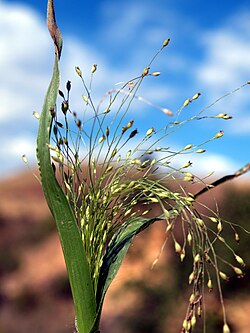
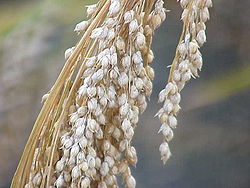
The flowers are produced in a well-developed panicle often up to 60 cm (24 in) in length with numerous seeds, which are 1–6 mm (0.04–0.24 in) long and 1–2 mm (0.04–0.08 in) broad. The fruits are developed from a two-flowered spikelet. Only the upper floret of each spikelet is fertile; the lower floret is sterile or staminate. Both glumes are present and well developed.[3][4][5][6][7][8]

Taxonomy

[edit]

Phylogenetic studies found the genus as previously circumscribed was polyphyletic, and several species have been reassigned to other genera. Most species in section Stolonifera of subgenus Phanopyrum were transferred to Ocellochloa, while P. venezuelae was placed in the new monotypic genus Drakkaria.[9]

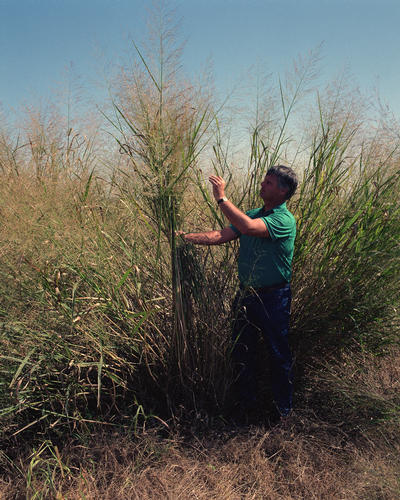
Well-known species include P. miliaceum (proso millet) and P. virgatum (switchgrass).

Selected species

[edit]

Formerly placed here

[edit]

Species formerly classified in genus Panicum include:

Distribution

[edit]

The genus is native throughout the tropical regions of the world, with a few species extending into the northern temperate zone.[1] They are often large, annual or perennial grasses, growing to 1–3 m (3–10 ft) tall.[11][12]

Australia has 29 native and 9 introduced species of Panicum.[13][14][15]

[edit]

References

[edit]
[edit]
Revisions and contributorsEdit on WikipediaRead on Wikipedia
from Grokipedia
Panicum is a genus of approximately 250 species of grasses in the family Poaceae, predominantly distributed in tropical and subtropical regions worldwide.[1] These annual or perennial plants exhibit variable habits, with culms ranging from 2 to 300 cm in height, often herbaceous but sometimes woody at the base, and featuring solid, spongy, or hollow internodes.[2] Leaves are cauline or basal, with membranous ligules that may be ciliate or fringed with hairs, and blades that are filiform to broadly ovate, typically rolled in the bud and sometimes bearing tubercle-based hairs.[3][2] The inflorescences of Panicum species are terminal panicles that are compact or open, occasionally reduced to a primary axis bearing racemes, with spikelets that are solitary or paired, dorsally compressed, 1–8 mm long, and unawned, falling entire at maturity and containing two florets—the lower male or sterile and the upper bisexual.[3][2] Most species employ C4 photosynthesis via NAD-ME or NADP-ME types, though some exhibit C3 anatomy, and reproductive strategies include apomixis, polyploidy, and autogamy in various taxa.[2] Taxonomically, Panicum belongs to the tribe Paniceae and has undergone significant revision as of the 2020s, with subgenera including Panicum, Agrostoidea, and Phanopyrum; many former North American species have been segregated into genera such as Dichanthelium and Coleataenia based on phylogenetic studies.[2][4] Economically and ecologically important, the genus includes forage crops like P. virgatum (switchgrass), used for hay, range improvement, biofuel production, and erosion control, and P. miliaceum (proso millet), a prehistoric cereal grain still cultivated for food and birdseed.[2][5] Species are cosmopolitan but native primarily to the Americas, Africa, Asia, and Australia, with about 34 taxa in North America (25 native) playing roles in prairies, wetlands, and disturbed habitats.[2][3]

Description

Morphological Characteristics

Panicum species are annual or perennial grasses with a variable habit, typically growing to heights of 0.02–3 m.[2] The culms are erect or decumbent, often rooting and branching at lower nodes, round, and hollow or sometimes solid and spongy, with internodes that can be herbaceous to hard and woody.[2] Basal leaves may be present but do not form persistent winter rosettes.[2] Leaves are cauline, basal, or both, with flat to involute blades that are filiform to ovate, glabrous or pubescent.[2] Ligules consist of membranous tissue, often ciliate, or short hairs.[2] The sheaths are typically shorter than the internodes.[2] The inflorescence is a terminal panicle, open or contracted, sometimes with axillary branches, appearing post-midsummer and lacking sterile branches or bristles.[2] Spikelets are pedicellate, 1–8 mm long, ellipsoid to lanceolate or ovate, dorsally compressed or sometimes subterete, unawned, and two-flowered, with the lower floret sterile or staminate and the upper floret fertile and bisexual.[2] Glumes are well-developed, unequal, and herbaceous, glabrous or pubescent; the lower glume is 1/4 to 1/2 the spikelet length with 1–9 veins, while the upper glume is longer, nearly equaling the spikelet, with 3–15 veins.[2] The upper lemma is rigid, chartaceous to indurate, shiny, and glabrous or pubescent, often stipitate.[2] Fruits are caryopses, ellipsoid, smooth or slightly textured, with a thin pericarp, hard endosperm, and punctiform or round to oval hilum.[2] Morphological variation, such as in culm height and panicle size, occurs across species but maintains the core anatomical uniformity of the genus.[2]

Growth and Reproduction

Panicum species exhibit diverse life cycles, as annuals or perennials, with some forming rhizomatous or stoloniferous growth habits that facilitate vegetative spread. Most species use C4 photosynthesis via NAD-ME or NADP-ME types, though some exhibit C3 anatomy.[2] Annual species, such as Panicum capillare (witchgrass), complete their cycle in 80–105 days under favorable conditions, germinating in spring or summer and producing seeds before senescence.[6] Perennial forms, like Panicum virgatum (switchgrass), persist for multiple years through robust tillering and rhizome production, achieving 60–70% of their biomass accumulation after early summer in temperate regions.[7] Reproduction in Panicum occurs primarily through seeds produced by wind-pollinated inflorescences, with many species capable of self-pollination via cleistogamous florets, although cross-pollination predominates in others such as P. virgatum.[8] Spikelets typically disarticulate above the glumes upon maturity, aiding seed dispersal by wind or gravity. Vegetative propagation is common in perennial species, occurring via tillering from basal nodes or rhizomes, as seen in P. virgatum and P. repens (torpedo grass), which produce long, scaly rhizomes for clonal expansion.[2][9] Seed germination requires warm soil temperatures of 20–30°C, consistent moisture, and often light exposure to promote seedling establishment, with optimal rates observed under alternating day-night regimes such as 30/15°C.[10][6] Many species exhibit physiological dormancy at shedding, broken by 4–5 months of dry after-ripening or 2 weeks of cold, moist stratification at around 5°C, lasting 1–2 years in the soil for species like P. capillare.[11] Seed viability under controlled storage can extend up to 5 years, though burial in soil reduces it by 47–68% after 12 months, with persistence beyond 4 years at depths of 10 cm.[6][12]

Taxonomy

Classification History

The genus Panicum was established by Carl Linnaeus in his 1753 work Species Plantarum, where it was described as a broad assemblage encompassing over 400 species of grasses, primarily based on spikelet morphology and general habit, reflecting the limited taxonomic tools available at the time. This initial circumscription included a diverse array of tropical and temperate species, many of which were later found to be unrelated, setting the stage for extensive revisions as botanical knowledge expanded.[13] During the 19th and early 20th centuries, botanists such as A. S. Hitchcock expanded the understanding of Panicum through detailed monographic treatments, notably in his 1910 collaboration with Agnes Chase on North American species, where subgenera were recognized to accommodate morphological variation, including differences in inflorescence structure and lemma features.[14] However, even then, hints of polyphyly emerged, as Hitchcock noted inconsistencies in character distributions across purported sections, though the genus was still treated as largely cohesive with hundreds of species.[15] These efforts highlighted the challenges of relying solely on morphology in a group with high phenotypic plasticity. Significant revisions began in the 1980s with Fernando O. Zuloaga and Thomas R. Soderstrom's 1985 study, which reclassified outlying New World species of Panicum based on anatomical and spikelet traits, transferring several to other genera like Paspalum and proposing new ones such as Tatianyx, thereby narrowing the genus's scope.[15] Molecular phylogenetic analyses in the early 2000s, particularly Aliscioni et al.'s 2003 investigation using the chloroplast ndhF gene, definitively confirmed the polyphyletic nature of Panicum sensu lato, leading to the segregation of major groups like Dichanthelium in the 2000s to reflect monophyletic clades within the Paniceae tribe.[13] Post-2010 updates have further refined the classification, with Plants of the World Online (POWO) in 2023 recognizing approximately 251 species in the core Panicum, focusing on C4 photosynthetic types with specific anatomical synapomorphies.[1] A 2024 study in the Botanical Journal of the Linnean Society continued this trend by erecting the new segregate genus Drakkaria for certain Neotropical species previously in Panicum, based on integrated morphological and molecular evidence, thus tightening tribe Paniceae boundaries.[16] Persistent challenges in classification stem from high morphological similarity among species, often resulting in misidentifications; these have been mitigated through DNA barcoding approaches employing genes like matK and ndhF, which provide higher resolution for distinguishing cryptic taxa.[17]

Phylogenetic Relationships

Panicum belongs to the subfamily Panicoideae within the grass family Poaceae, specifically in the tribe Paniceae and subtribe Panicinae.[18] The core Panicum, or Panicum sensu stricto, forms a monophyletic clade characterized by C4 photosynthesis and lax panicles with reduced lower glumes on spikelets.[19] This clade is sister to subtribe Cenchrinae, which encompasses genera such as Setaria and Cenchrus, together comprising part of the broader "bristle clade" distinguished by modified inflorescences with sterile branches. The shared C4 photosynthetic pathway across Paniceae supports adaptations to warm, open environments, reflecting an ancestral trait in the tribe.[20] Molecular phylogenetic analyses have been pivotal in resolving relationships within Panicum. Early studies utilized plastid markers such as rbcL and ndhF, along with nuclear internal transcribed spacer (ITS) regions, to test monophyly.[13] A seminal 2003 investigation by Aliscioni, Giussani, Zuloaga, and Kellogg analyzed ndhF sequences from 123 taxa, revealing that Panicum sensu lato was polyphyletic and resolving it into four major monophyletic lineages: the core Panicum (subgenus Panicum), Dichanthelium (excluding section Cordovensia), Steinchisma, and Megathyrsus.[13] This framework prompted taxonomic revisions, including the segregation of lineages into distinct genera; for instance, species formerly in subgenus Megathyrsus were transferred to Urochloa, while others formed new genera like Parodiophyllochloa (2008) and Morronea (2013).[21] More recent segregates include Ocellochloa (2009), distinguished by unilateral spikelets and C3 photosynthesis, and Drakkaria (2024), placed in tribe Paspaleae based on molecular evidence.[22] Overall, roughly half of the original ~470 species in Panicum sensu lato have been reassigned to over 20 segregate genera, leaving approximately 251 species in the core genus as of 2025, with Dichanthelium accommodating many North American taxa.[1] The evolutionary origins of Panicum trace back to the tribe Paniceae, which arose in the tropical Old World, likely eastern Africa or Southeast Asia, during the Miocene.[20] Core Panicum underwent diversification primarily in the Neotropics starting in the Early-Mid Miocene, with subsequent dispersals to other continents facilitated by C4 physiology and shifts in life history traits like annual habit.[19] Recent genomic studies (2023–2024) using whole-genome sequencing have illuminated hybrid speciation events; for example, P. virgatum (switchgrass), an allotetraploid, exhibits high homoeologous gene retention without subgenome dominance, confirming its hybrid origins from distinct progenitors approximately 1.3 million years ago.[23] These insights underscore reticulate evolution as a key driver in Panicum's adaptability and diversification.

Species Diversity

The genus Panicum currently comprises approximately 251 accepted species, a significant reduction from earlier estimates of around 470–500 due to extensive taxonomic revisions recognizing its polyphyly and reassigning numerous taxa to other genera.[1][13] These revisions, informed by molecular phylogenetic studies since the early 2000s, have narrowed the circumscription to a core group primarily characterized by specific inflorescence and lemma features.[19] No formal subgenera are universally accepted in contemporary classifications, though the concept of a "core Panicum" persists informally, encompassing species like those in the P. miliaceum group with annual habits and paniculate inflorescences adapted to arid or disturbed environments.[13] Remnants of former subgenera, such as Phanopyrum and Dichanthelium, have largely been elevated to separate genera, reflecting convergent evolution across the Paniceae tribe.[19] Notable species within Panicum illustrate its morphological and ecological diversity. Panicum miliaceum, proso millet, is an annual grass of Old World origin, cultivated for its edible grains and tolerant of poor soils. Panicum virgatum, known as switchgrass, is a perennial rhizomatous species native to North America, valued for its tall stature and role in prairie ecosystems.[24] In tropical regions, Megathyrsus maximus (Guinea grass, formerly Panicum maximum) serves as a robust perennial forage grass, forming dense tufts up to 2 meters high.[25] Conversely, Panicum repens (torpedograss) is a stoloniferous perennial that acts as an invasive wetland species, spreading aggressively via rhizomes.[26] Taxonomic reassignments have affected around 300 former Panicum species, with many now placed in segregate genera; for instance, Panicum clandestinum is recognized as Dichanthelium clandestinum, a creeping perennial adapted to shaded understories.[13] Similarly, Setaria viridis (green foxtail), previously known as Panicum viride, has been transferred to Setaria based on its bristly inflorescences and annual weedy habit. Diversity hotspots for Panicum include the Neotropics, where numerous endemics thrive in seasonally dry forests and savannas, contributing to high regional richness.[1] The genus also exhibits invasive potential in temperate zones outside its native range, facilitated by human-mediated dispersal and adaptability to altered habitats.[27]

Distribution and Ecology

Global Distribution

The genus Panicum is primarily native to tropical and subtropical regions worldwide, with significant species diversity concentrated in Africa, Asia, and the Americas. Due to phylogenetic revisions since the early 2000s, the genus now includes approximately 250 accepted species worldwide, with many former taxa segregated into other genera such as Dichanthelium. Africa is a center of origin for many species, with notable diversity (e.g., about 62 taxa in southern Africa). Asia has substantial representation, particularly in South and Southeast Asia (e.g., 21 species in China, including 4 introduced). The Americas show high diversity, especially in the New World tropics, with about 34 species in North America (25 native) and numerous endemics in regions like Mexico and Brazil.[1][2][28][29] Several species extend into temperate zones, demonstrating adaptability beyond strictly tropical climates. In North America, P. virgatum (switchgrass) ranges natively from southern Canada southward to northern Mexico, thriving in prairies and open woodlands. Australia supports 24 native species alongside 9 introduced ones, primarily in arid and semi-arid interiors. These extensions highlight the genus's capacity for colonization in transitional climates, though diversity diminishes poleward.[2][30][31][32] Human activities have facilitated global introductions of Panicum species through trade, agriculture, and inadvertent dispersal, resulting in established populations far from native ranges. For instance, P. miliaceum (proso millet), domesticated in northern China around 10,000 years ago, spread to Europe by the Bronze Age (ca. 2000 BCE) and was introduced to North America in the 18th century as a staple crop, now naturalized across temperate continents. This pantropical distribution features notable disjunctions, such as between Old and New World lineages, with the highest endemism in Neotropical regions reflecting ancient diversification patterns. As warm-season C4 grasses, Panicum species generally thrive in USDA hardiness zones 5–11, though some like P. virgatum exhibit cold tolerance down to zone 3.[33][34][13][35]

Habitat Preferences

Species of the genus Panicum primarily inhabit open, disturbed environments across tropical and subtropical regions, with preferences varying by species but generally favoring warm climates and well-drained conditions.[6] Many thrive in grasslands, savannas, roadsides, and agricultural fields as pioneer species, often colonizing bare or degraded areas.[6] Panicum species prefer well-drained loamy or sandy soils with a pH range of 5.5–7.5, though adaptability allows growth in a variety of textures from clay to sand.[36] Certain species, such as P. virgatum, demonstrate tolerance to poor, compacted, saline, or acidic soils (pH as low as 4.5).[7] Moisture regimes span mesic to hydric, with numerous species occupying wetlands, floodplains, and seasonally inundated sites; for instance, P. virgatum favors lowlands with adequate moisture and tolerates periodic flooding.[7] Conversely, xerophytic species like P. antidotale persist in arid and semi-arid zones, including dry riverbeds and sandy dunes.[37] These grasses require full sun for optimal growth, performing best in unshaded, open habitats where light exposure supports vigorous development.[38] They are warm-season C4 plants with a growing season optimized at temperatures between 15°C and 35°C, where annual species are frost-sensitive while perennials exhibit resilience to cooler periods.[39] Association with disturbances is prominent, as many act as early successional species in prairies and fields, with fire adaptation enhancing regrowth in species like P. virgatum following dormant-season burns.[7] Altitudinal distribution extends from sea level to approximately 3,000 m in tropical regions, allowing occupation of diverse elevational gradients within their native ranges.[40]

Ecological Roles

Panicum species play significant roles in supporting wildlife as a food source and habitat provider. The seeds of Panicum virgatum (switchgrass) are consumed by ground-feeding songbirds and game birds, while its dense foliage offers cover for nesting, loafing, roosting, and predator escape for upland game birds such as northern bobwhite and greater prairie-chicken, as well as small mammals.[41][7] Foliage serves as forage for mammals and hosts a variety of herbivorous insects, including aphids and armyworms, contributing to food webs in grassland ecosystems.[42][43] Rhizomatous species within the genus, such as P. virgatum and P. amarum (bitter panicgrass), stabilize soils in wetlands and riparian zones through extensive root systems that bind sediment and reduce erosion, particularly on coastal dunes and disturbed waterways.[7][44] Some Panicum species, notably P. virgatum, form associations with nitrogen-fixing bacteria (e.g., Rhizobium and Burkholderia species) in roots and shoots, enhancing soil nitrogen availability and supporting ecosystem productivity in nutrient-poor prairies.[45] Certain Panicum species exhibit invasive tendencies that disrupt native ecosystems. P. repens (torpedograss) forms dense floating mats in Florida wetlands including the Everglades, outcompeting submerged aquatic vegetation like spikerush and reducing biodiversity by displacing over 16,000 acres of native marsh communities in Lake Okeechobee.[46][47] In African savannas, P. maximum (guinea grass) alters dynamics by rapidly colonizing disturbed areas under tree canopies post-fire, increasing grass biomass and potentially shifting forest-savanna transitions while favoring nitrophilous growth that outpaces less shade-tolerant natives.[48][49] As a key component of biodiversity, Panicum functions as a codominant or keystone species in tallgrass prairies, often comprising 10-20% canopy cover alongside big bluestem and indiangrass, which supports overall plant diversity in mesic lowlands.[7] Its wind-pollinated flowers exhibit minimal dependence on specialist pollinators, relying instead on anemophily for reproduction across diverse grassland communities.[41] The C4 photosynthetic pathway in Panicum enhances drought resistance by improving water-use efficiency, enabling persistence in arid conditions and facilitating carbon sequestration through high biomass production, with P. virgatum yielding up to 10-21 t/ha/year of aboveground dry matter that contributes to soil carbon storage.[50][51][52]

Uses and Cultivation

Economic Importance

Species of the genus Panicum hold significant economic value primarily through their roles in food production, forage for livestock, bioenergy, and other applications such as soil conservation. These grasses are valued for their adaptability to marginal lands, contributing to sustainable agriculture in regions prone to drought and poor soils. Globally, millets derived from Panicum species, mainly proso millet (P. miliaceum) and little millet (P. sumatrense), account for approximately 1.3 million tons of annual production as of 2022, representing a modest but vital portion of the broader millet sector that supports food security in arid and semi-arid areas.[53] As a food crop, Panicum miliaceum (proso millet) is a key staple in parts of Asia and Africa, where it serves as a gluten-free grain suitable for human consumption in porridges, breads, and beverages. Its drought tolerance allows cultivation in low-rainfall environments with minimal inputs, yielding 400–600 kg/ha under rainfed conditions.[54] Proso millet contributes to nutritional security, providing high-quality protein and micronutrients, and constitutes about 10% of production among small-seeded millet varieties as of 2022.[53] The 2023 International Year of Millets, designated by the United Nations, has further promoted Panicum millets, leading to increased cultivation and awareness for climate-resilient agriculture in Asia and Africa.[55] In forage and fodder systems, Panicum maximum (Guinea grass) is widely used in tropical regions for grazing and hay production, offering high biomass yields of 20–40 t/ha dry matter under fertilized conditions. This perennial grass supports livestock productivity in Africa and Asia, enabling stocking rates up to 1000 kg liveweight/ha with annual gains of 450 kg/ha. In the United States, Panicum virgatum (switchgrass) serves as a valuable forage for cattle, providing nutritious feed while enhancing soil health on marginal lands.[56][57] For bioenergy, Panicum virgatum stands out as a leading biofuel feedstock, producing 10–15 t/ha of biomass that can be converted to ethanol at yields of 300–400 L/t through cellulosic processes. Its perennial nature and low input requirements make it a carbon-neutral option, sequestering more CO2 than emitted during production and harvest. Switchgrass cultivation has expanded in the U.S. for renewable energy, reducing reliance on fossil fuels while supporting rural economies.[58][59][60] Other Panicum species contribute to traditional medicines and conservation practices; for instance, Panicum sumatrense (little millet) is used in indigenous remedies for digestive and joint issues due to its bioactive compounds. Additionally, various Panicum grasses aid erosion control in conservation farming by stabilizing soils on slopes and in arid regions, promoting sustainable land management.[61][62]

Cultivation Practices

Panicum species are propagated primarily through direct seeding or transplants, depending on the cultivated variety and purpose. For perennial species like switchgrass (P. virgatum), direct seeding rates typically range from 5 to 12 pounds per acre (approximately 5.6–13.4 kg/ha) of pure live seed, planted in late spring when soil temperatures exceed 60°F (15.6°C), either broadcast or drilled at a depth of ½ to 1 inch.[63] Annual species such as proso millet (P. miliaceum) are seeded at 20–40 pounds per acre (22–45 kg/ha), drilled ½–¾ inches deep in rows of 7–12 inches, with optimal soil temperatures of 55–65°F (13–18°C).[64] Transplants may be used for perennials to improve establishment, spaced 30–60 cm apart to allow for tillering and root development.[65] Soil and site preparation vary by species and growth habit. Annuals like proso millet benefit from conventional tillage to create a firm seedbed, while perennials such as switchgrass can be established using no-till methods into crop residues to minimize erosion and preserve soil structure.[66][64] Fertilization focuses on nitrogen, with 50–100 kg N/ha applied post-establishment for switchgrass to support biomass production, based on soil tests; excess phosphorus should be avoided to prevent nutrient imbalances.[63] Proso millet requires modest inputs, often relying on residual nitrogen from prior crops like winter wheat, with adjustments per soil analysis.[64] Management practices emphasize establishment and maintenance for optimal yields. Irrigation during the first year provides 500–800 mm of water annually for switchgrass to ensure rooting, though mature stands are drought-tolerant; proso millet thrives as a dryland crop with high water-use efficiency and minimal supplemental irrigation.[63][64] Rotational mowing or grazing every 4–6 weeks maintains stand vigor in perennials, while annuals like proso require monitoring for maturity in 60–90 days. Pest control targets aphids, which can vector viruses in young plants, and rust fungi (Puccinia spp.), managed through resistant varieties and timely fungicide applications if thresholds are met.[67][68] Recommended cultivars include 'Cave-in-Rock' switchgrass, an upland type valued for high biomass yields (up to 6 tons/acre) and cold tolerance in bioenergy production.[63] For grain, 'Early Fortune' proso millet offers early maturity and reliable seed production in short-season areas.[69] Challenges in cultivation include intense weed competition during early growth stages, particularly in the first year for switchgrass, necessitating pre-emergent herbicides or cover crops.[65] Harvest timing is critical for seeds, aiming for 15–20% moisture to minimize shattering in proso millet. Sustainability practices, such as intercropping switchgrass with legumes like alfalfa, enhance soil nitrogen and reduce greenhouse gas emissions by up to 5–27%.[70] Harvesting methods differ by use: grains from proso millet are mechanically combined at 15% moisture, while switchgrass biomass is baled using hay equipment after frost in winter or early spring to optimize quality and stand longevity.[64][63]

References

User Avatar
No comments yet.