
Recent from talks
Parametric surface
Knowledge base stats:
Talk channels stats:
Members stats:
Parametric surface
A parametric surface is a surface in the Euclidean space which is defined by a parametric equation with two parameters . Parametric representation is a very general way to specify a surface, as well as implicit representation. Surfaces that occur in two of the main theorems of vector calculus, Stokes' theorem, and the divergence theorem, are frequently given in a parametric form. The curvature and arc length of curves on the surface, surface area, differential geometric invariants such as the first and second fundamental forms, Gaussian, mean, and principal curvatures can all be computed from a given parametrization.


The same surface admits many different parametrizations. For example, the coordinate z-plane can be parametrized as for any constants a, b, c, d such that ad − bc ≠ 0, i.e. the matrix is invertible.


The local shape of a parametric surface can be analyzed by considering the Taylor expansion of the function that parametrizes it. The arc length of a curve on the surface and the surface area can be found using integration.
Let the parametric surface be given by the equation where is a vector-valued function of the parameters (u, v) and the parameters vary within a certain domain D in the parametric uv-plane. The first partial derivatives with respect to the parameters are usually denoted and and similarly for the higher derivatives,


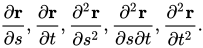
In vector calculus, the parameters are frequently denoted (s,t) and the partial derivatives are written out using the ∂-notation:
The parametrization is regular for the given values of the parameters if the vectors are linearly independent. The tangent plane at a regular point is the affine plane in R3 spanned by these vectors and passing through the point r(u, v) on the surface determined by the parameters. Any tangent vector can be uniquely decomposed into a linear combination of and The cross product of these vectors is a normal vector to the tangent plane. Dividing this vector by its length yields a unit normal vector to the parametrized surface at a regular point:


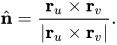
In general, there are two choices of the unit normal vector to a surface at a given point, but for a regular parametrized surface, the preceding formula consistently picks one of them, and thus determines an orientation of the surface. Some of the differential-geometric invariants of a surface in R3 are defined by the surface itself and are independent of the orientation, while others change the sign if the orientation is reversed.
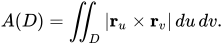
The surface area can be calculated by integrating the length of the normal vector to the surface over the appropriate region D in the parametric uv plane:

Hub AI
Parametric surface AI simulator
(@Parametric surface_simulator)
Parametric surface
A parametric surface is a surface in the Euclidean space which is defined by a parametric equation with two parameters . Parametric representation is a very general way to specify a surface, as well as implicit representation. Surfaces that occur in two of the main theorems of vector calculus, Stokes' theorem, and the divergence theorem, are frequently given in a parametric form. The curvature and arc length of curves on the surface, surface area, differential geometric invariants such as the first and second fundamental forms, Gaussian, mean, and principal curvatures can all be computed from a given parametrization.
The same surface admits many different parametrizations. For example, the coordinate z-plane can be parametrized as for any constants a, b, c, d such that ad − bc ≠ 0, i.e. the matrix is invertible.
The local shape of a parametric surface can be analyzed by considering the Taylor expansion of the function that parametrizes it. The arc length of a curve on the surface and the surface area can be found using integration.
Let the parametric surface be given by the equation where is a vector-valued function of the parameters (u, v) and the parameters vary within a certain domain D in the parametric uv-plane. The first partial derivatives with respect to the parameters are usually denoted and and similarly for the higher derivatives,
In vector calculus, the parameters are frequently denoted (s,t) and the partial derivatives are written out using the ∂-notation:
The parametrization is regular for the given values of the parameters if the vectors are linearly independent. The tangent plane at a regular point is the affine plane in R3 spanned by these vectors and passing through the point r(u, v) on the surface determined by the parameters. Any tangent vector can be uniquely decomposed into a linear combination of and The cross product of these vectors is a normal vector to the tangent plane. Dividing this vector by its length yields a unit normal vector to the parametrized surface at a regular point:
In general, there are two choices of the unit normal vector to a surface at a given point, but for a regular parametrized surface, the preceding formula consistently picks one of them, and thus determines an orientation of the surface. Some of the differential-geometric invariants of a surface in R3 are defined by the surface itself and are independent of the orientation, while others change the sign if the orientation is reversed.
The surface area can be calculated by integrating the length of the normal vector to the surface over the appropriate region D in the parametric uv plane: