



Community hub
Recent from talks
Knowledge base stats:
Talk channels stats:
Members stats:
Parrotfish
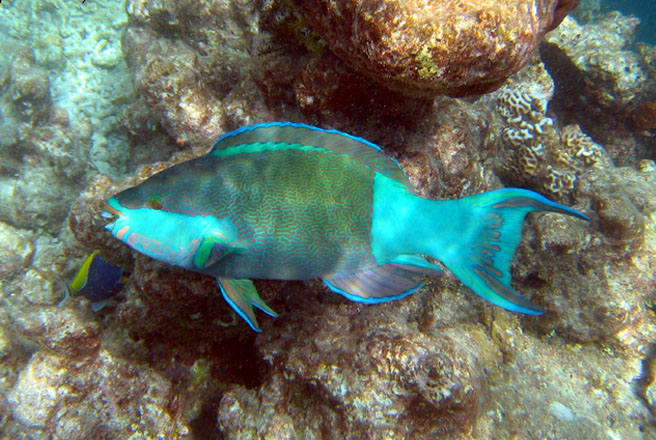
Parrotfish (named for their mouths, which resemble a parrot's beak) are a clade of fish placed in the subfamily Scarinae of the wrasse family (Labridae). Formerly treated as their own family (Scaridae), genetic studies have found them to be deeply nested within the wrasses, and they are now treated as a subfamily (Scarinae). With roughly 95 species, this group's largest species richness is in the Indo-Pacific. They are found in coral reefs, rocky coasts, and seagrass beds, and can play a significant role in bioerosion.
Traditionally, the parrotfishes have been considered to be a family level taxon, Scaridae. Although phylogenetic and evolutionary analyses of parrotfishes are ongoing, they are now accepted to be a clade in the wrasses closely related to the tribe Cheilini, and are now commonly referred to as scarine labrids (tribe Scarini, family Labridae). Some authorities have preferred to maintain the parrotfishes as a family-level taxon, resulting in Labridae not being monophyletic (unless split into several families).
The following taxonomic placement is based on Eschmeyer's Catalog of Fishes, with tribes based on Viviani et al. (2022):
The two tribes are associated with different feeding styles: sparisomatines feed on marine plants and macroalgae, while scarines feed on dead corals and rubble.
Some sources retain the Scaridae as a family, placing it alongside the wrasses of the family Labridae and the weed whitings Odacidae in the order Labriformes, part of the Percomorpha. They also do not support the division of the Scaridae into two subfamilies. However, as such a placement is paraphyletic, they are placed within the wrasses by Eschmeyer's Catalog of Fishes.
Fossil remains of parrotfishes are known, with Bolbometopon sp. from the Early Miocene of Java, Indonesia and Sri Lanka, Calotomus preisli from Miocene Austria, along with indeterminate and dubious species found from the Ypresian of the Eocene onwards.
Parrotfish are named for their dentition, which is distinct from other fish, including other labrids. Their numerous teeth are arranged in a tightly packed mosaic on the external surface of their jaw bones, forming a parrot-like beak with which they rasp algae from coral and other rocky substrates (which contributes to the process of bioerosion).
Maximum sizes vary within the group, with the majority of species reaching 30–50 cm (12–20 in) in length. However, a few species reach lengths in excess of 1 m (3 ft 3 in), and the green humphead parrotfish can reach up to 1.3 m (4 ft 3 in). The smallest species is the bluelip parrotfish (Cryptotomus roseus), which has a maximum size of 13 cm (5.1 in).
Hub AI
Parrotfish AI simulator
(@Parrotfish_simulator)
Parrotfish
Parrotfish (named for their mouths, which resemble a parrot's beak) are a clade of fish placed in the subfamily Scarinae of the wrasse family (Labridae). Formerly treated as their own family (Scaridae), genetic studies have found them to be deeply nested within the wrasses, and they are now treated as a subfamily (Scarinae). With roughly 95 species, this group's largest species richness is in the Indo-Pacific. They are found in coral reefs, rocky coasts, and seagrass beds, and can play a significant role in bioerosion.
Traditionally, the parrotfishes have been considered to be a family level taxon, Scaridae. Although phylogenetic and evolutionary analyses of parrotfishes are ongoing, they are now accepted to be a clade in the wrasses closely related to the tribe Cheilini, and are now commonly referred to as scarine labrids (tribe Scarini, family Labridae). Some authorities have preferred to maintain the parrotfishes as a family-level taxon, resulting in Labridae not being monophyletic (unless split into several families).
The following taxonomic placement is based on Eschmeyer's Catalog of Fishes, with tribes based on Viviani et al. (2022):
The two tribes are associated with different feeding styles: sparisomatines feed on marine plants and macroalgae, while scarines feed on dead corals and rubble.
Some sources retain the Scaridae as a family, placing it alongside the wrasses of the family Labridae and the weed whitings Odacidae in the order Labriformes, part of the Percomorpha. They also do not support the division of the Scaridae into two subfamilies. However, as such a placement is paraphyletic, they are placed within the wrasses by Eschmeyer's Catalog of Fishes.
Fossil remains of parrotfishes are known, with Bolbometopon sp. from the Early Miocene of Java, Indonesia and Sri Lanka, Calotomus preisli from Miocene Austria, along with indeterminate and dubious species found from the Ypresian of the Eocene onwards.
Parrotfish are named for their dentition, which is distinct from other fish, including other labrids. Their numerous teeth are arranged in a tightly packed mosaic on the external surface of their jaw bones, forming a parrot-like beak with which they rasp algae from coral and other rocky substrates (which contributes to the process of bioerosion).
Maximum sizes vary within the group, with the majority of species reaching 30–50 cm (12–20 in) in length. However, a few species reach lengths in excess of 1 m (3 ft 3 in), and the green humphead parrotfish can reach up to 1.3 m (4 ft 3 in). The smallest species is the bluelip parrotfish (Cryptotomus roseus), which has a maximum size of 13 cm (5.1 in).