


Partition of a set
View on Wikipedia


In mathematics, a partition of a set is a grouping of its elements into non-empty subsets, in such a way that every element is included in exactly one subset.
Every equivalence relation on a set defines a partition of this set, and every partition defines an equivalence relation. A set equipped with an equivalence relation or a partition is sometimes called a setoid, typically in type theory and proof theory.
Definition and notation
[edit]A partition of a set X is a set of non-empty subsets of X such that every element x in X is in exactly one of these subsets[2] (i.e., the subsets are nonempty mutually disjoint sets).
Equivalently, a family of sets P is a partition of X if and only if all of the following conditions hold:[3]
- The family P does not contain the empty set (that is ).
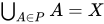
- The union of the sets in P is equal to X (that is ). The sets in P are said to exhaust or cover X. See also collectively exhaustive events and cover (topology).
- The intersection of any two distinct sets in P is empty (that is ). The elements of P are said to be pairwise disjoint or mutually exclusive. See also mutual exclusivity.


The sets in are called the blocks, parts, or cells, of the partition.[4] If then we represent the cell containing by . That is to say, is notation for the cell in which contains .


![{\displaystyle [a]}](https://wikimedia.org/api/rest_v1/media/math/render/svg/ea82bc70a8e322f13a3c4e5b9d5d69e8ef097ad8)
Every partition may be identified with an equivalence relation on , namely the relation such that for any we have if and only if (equivalently, if and only if ). The notation evokes the idea that the equivalence relation may be constructed from the partition. Conversely every equivalence relation may be identified with a partition. This is why it is sometimes said informally that "an equivalence relation is the same as a partition". If P is the partition identified with a given equivalence relation , then some authors write . This notation is suggestive of the idea that the partition is the set X divided into cells. The notation also evokes the idea that, from the equivalence relation one may construct the partition.


![{\displaystyle a\in [b]}](https://wikimedia.org/api/rest_v1/media/math/render/svg/8abb5047c33633d5a0697408f3df2aead151e4ea)
![{\displaystyle b\in [a]}](https://wikimedia.org/api/rest_v1/media/math/render/svg/cd1c441d4221216c8947ac50d43331042f72672b)


The rank of is , if is finite.

Examples
[edit]- The empty set has exactly one partition, namely . (Note: this is the partition, not a member of the partition.)
- For any non-empty set X, P = { X } is a partition of X, called the trivial partition.
- Particularly, every singleton set {x} has exactly one partition, namely { {x} }.
- For any non-empty proper subset A of a set U, the set A together with its complement form a partition of U, namely, { A, U ∖ A }.
- The set {1, 2, 3} has these five partitions (one partition per item):
- { {1}, {2}, {3} }, sometimes written 1 | 2 | 3.
- { {1, 2}, {3} }, or 1 2 | 3.
- { {1, 3}, {2} }, or 1 3 | 2.
- { {1}, {2, 3} }, or 1 | 2 3.
- { {1, 2, 3} }, or 1 2 3.
- The following are not partitions of {1, 2, 3}:
- { {}, {1, 3}, {2} } is not a partition (of any set) because one of its elements is the empty set.
- { {1, 2}, {2, 3} } is not a partition (of any set) because the element 2 is contained in more than one block.
- { {1}, {2} } is not a partition of {1, 2, 3} because none of its blocks contains 3; however, it is a partition of {1, 2}.

Partitions and equivalence relations
[edit]For any equivalence relation on a set X, the set of its equivalence classes is a partition of X. Conversely, from any partition P of X, we can define an equivalence relation on X by setting x ~ y precisely when x and y are in the same part in P. Thus the notions of equivalence relation and partition are essentially equivalent.[5]
The axiom of choice guarantees for any partition of a set X the existence of a subset of X containing exactly one element from each part of the partition. This implies that given an equivalence relation on a set one can select a canonical representative element from every equivalence class.
Refinement of partitions
[edit]
A partition α of a set X is a refinement of a partition ρ of X—and we say that α is finer than ρ and that ρ is coarser than α—if every element of α is a subset of some element of ρ. Informally, this means that α is a further fragmentation of ρ. In that case, it is written that α ≤ ρ.
This "finer-than" relation on the set of partitions of X is a partial order (so the notation "≤" is appropriate). Each set of elements has a least upper bound (their "join") and a greatest lower bound (their "meet"), so that it forms a lattice, and more specifically (for partitions of a finite set) it is a geometric and supersolvable lattice.[6][7] The partition lattice of a 4-element set has 15 elements and is depicted in the Hasse diagram on the left.
The meet and join of partitions α and ρ are defined as follows. The meet is the partition whose blocks are the intersections of a block of α and a block of ρ, except for the empty set. In other words, a block of is the intersection of a block of α and a block of ρ that are not disjoint from each other. To define the join , form a relation on the blocks A of α and the blocks B of ρ by A ~ B if A and B are not disjoint. Then is the partition in which each block C is the union of a family of blocks connected by this relation.


Based on the equivalence between geometric lattices and matroids, this lattice of partitions of a finite set corresponds to a matroid in which the base set of the matroid consists of the atoms of the lattice, namely, the partitions with singleton sets and one two-element set. These atomic partitions correspond one-for-one with the edges of a complete graph. The matroid closure of a set of atomic partitions is the finest common coarsening of them all; in graph-theoretic terms, it is the partition of the vertices of the complete graph into the connected components of the subgraph formed by the given set of edges. In this way, the lattice of partitions corresponds to the lattice of flats of the graphic matroid of the complete graph.

Another example illustrates refinement of partitions from the perspective of equivalence relations. If D is the set of cards in a standard 52-card deck, the same-color-as relation on D – which can be denoted ~C – has two equivalence classes: the sets {red cards} and {black cards}. The 2-part partition corresponding to ~C has a refinement that yields the same-suit-as relation ~S, which has the four equivalence classes {spades}, {diamonds}, {hearts}, and {clubs}.
Noncrossing partitions
[edit]A partition of the set N = {1, 2, ..., n} with corresponding equivalence relation ~ is noncrossing if it has the following property: If four elements a, b, c and d of N having a < b < c < d satisfy a ~ c and b ~ d, then a ~ b ~ c ~ d. The name comes from the following equivalent definition: Imagine the elements 1, 2, ..., n of N drawn as the n vertices of a regular n-gon (in counterclockwise order). A partition can then be visualized by drawing each block as a polygon (whose vertices are the elements of the block). The partition is then noncrossing if and only if these polygons do not intersect.
The lattice of noncrossing partitions of a finite set forms a subset of the lattice of all partitions, but not a sublattice, since the join operations of the two lattices do not agree.
The noncrossing partition lattice has taken on importance because of its role in free probability theory.
Counting partitions
[edit]The total number of partitions of an n-element set is the Bell number Bn. The first several Bell numbers are B0 = 1, B1 = 1, B2 = 2, B3 = 5, B4 = 15, B5 = 52, and B6 = 203 (sequence A000110 in the OEIS). Bell numbers satisfy the recursion
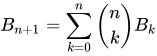
and have the exponential generating function
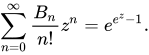

The Bell numbers may also be computed using the Bell triangle in which the first value in each row is copied from the end of the previous row, and subsequent values are computed by adding two numbers, the number to the left and the number to the above left of the position. The Bell numbers are repeated along both sides of this triangle. The numbers within the triangle count partitions in which a given element is the largest singleton.
The number of partitions of an n-element set into exactly k (non-empty) parts is the Stirling number of the second kind S(n, k).
The number of noncrossing partitions of an n-element set is the Catalan number

See also
[edit]Notes
[edit]- ^ Knuth, Donald E. (2013), "Two thousand years of combinatorics", in Wilson, Robin; Watkins, John J. (eds.), Combinatorics: Ancient and Modern, Oxford University Press, pp. 7–37
- ^ Halmos, Paul (1960). Naive Set Theory R. Springer. p. 28. ISBN 9780387900926.
{{cite book}}: ISBN / Date incompatibility (help) - ^ Lucas, John F. (1990). Introduction to Abstract Mathematics. Rowman & Littlefield. p. 187. ISBN 9780912675732.
- ^ Brualdi 2004, pp. 44–45.
- ^ Schechter 1997, p. 54.
- ^ Birkhoff, Garrett (1995), Lattice Theory, Colloquium Publications, vol. 25 (3rd ed.), American Mathematical Society, p. 95, ISBN 9780821810255.
- ^ *Stern, Manfred (1999), Semimodular Lattices. Theory and Applications, Encyclopedia of Mathematics and its Applications, vol. 73, Cambridge University Press, doi:10.1017/CBO9780511665578, ISBN 0-521-46105-7
References
[edit]- Brualdi, Richard A. (2004). Introductory Combinatorics (4th ed.). Pearson Prentice Hall. ISBN 0-13-100119-1.
- Schechter, Eric (1997). Handbook of Analysis and Its Foundations. Academic Press. ISBN 0-12-622760-8.

Partition of a set
View on GrokipediaBasic Concepts
Definition
A partition of a set $ S $ is a collection of non-empty subsets of $ S $ that are pairwise disjoint and whose union equals $ S $. This means the subsets divide $ S $ into distinct, non-overlapping parts that together cover every element exactly once. Formally, if $ P = { A_i \mid i \in I } $ is a partition of $ S $, where $ I $ is an indexing set, then $ A_i \cap A_j = \emptyset $ for all distinct $ i, j \in I $, $ \bigcup_{i \in I} A_i = S $, and each $ A_i \neq \emptyset $. The non-emptiness condition ensures that no subset is trivial or redundant in covering $ S $, while the disjointness prevents any element from belonging to multiple subsets, and the union requirement guarantees exhaustiveness, so no element of $ S $ is omitted. The requirement for non-empty subsets arises because including the empty set would not affect the union but would violate the principle of a proper division into meaningful parts; similarly, exhaustiveness ensures the partition fully accounts for $ S $ without gaps.[10] This structure underpins the correspondence between partitions and equivalence relations, where each part corresponds to an equivalence class.Notation and Terminology
In standard mathematical notation, the collection of all partitions of a finite set is often denoted by or .[11] For a partition of , the cardinality represents the number of blocks in , while the type of is defined as the multiset of the sizes of its blocks, providing a way to classify partitions up to the specific elements involved.[11] The fundamental components of a partition are its blocks, which are the non-empty, pairwise disjoint subsets whose union is exactly . A block containing a single element is termed a singleton. Partitions are partially ordered by the refinement relation: a partition is finer than another partition (or equivalently, is coarser than ) if every block of is a subset of some block of ; this ordering forms the partition lattice.[11] Given a partition of and a subset , the restriction of to , denoted or , is the partition of induced by taking the non-empty intersections of the blocks of with .[11] It is important to distinguish set partitions from integer partitions in combinatorics: while integer partitions represent ways of writing a positive integer as a sum of positive integers (disregarding order), set partitions divide a set into unlabeled, unordered blocks without regard to the elements' labels or the blocks' arrangement, focusing instead on the grouping structure.[12]Examples
Simple Examples
To illustrate the concept of a set partition, consider the smallest non-trivial case: a set with two elements, such as $ S = {a, b} $. There are exactly two possible partitions of this set. The first is the trivial partition consisting of a single block containing all elements: $ {{a, b}} $. The second is the discrete partition into singletons: $ {{a}, {b}} $.[12] For a three-element set, such as $ S = {1, 2, 3} $, there are five distinct partitions, reflecting the Bell number $ B_3 = 5 $, which counts the total number of partitions of a set with three elements. These are:- The single-block partition: $ {{1, 2, 3}} $
- The partitions into one doubleton and one singleton: $ {{1, 2}, {3}} $, $ {{1, 3}, {2}} $, and $ {{2, 3}, {1}} $
- The discrete partition into three singletons: $ {{1}, {2}, {3}} $
Block 1: {1, 2}
Block 2: {3}
Block 1: {1}
Block 2: {2}
Block 3: {3}
Partitions of Larger Sets
To illustrate the diversity of partitions for larger sets, consider the set $ S = {a, b, c, d} $. One partition consists of all singletons: $ {{a}, {b}, {c}, {d}} $, where each element forms its own block. Another type features one doubleton and two singletons, such as $ {{a, b}, {c}, {d}} $, emphasizing how elements can be paired while leaving others isolated. A further variation includes two doubletons, like $ {{a, b}, {c, d}} $, pairing all elements into equal-sized blocks.[14] Partitions of such sets exhibit patterns based on block sizes, distinguishing balanced structures—where blocks are as equal in size as possible, such as the two doubletons example above—from unbalanced ones, like a tripleton with a singleton $ {{a, b, c}, {d}} $, which creates disparity in block cardinalities. These patterns highlight the flexibility in grouping elements while maintaining disjointness and coverage.[15] For intuition, partitions resemble dividing a class of four students into study groups by skill levels: all individuals working alone (singletons), two pairing up while others remain solo (one doubleton and singletons), or two pairs forming balanced teams (two doubletons), ensuring every student is assigned without overlap. The following table enumerates all partitions of $ {a, b, c, d} $, grouped by block size compositions (in nonincreasing order), using set notation for clarity:| Block Sizes | Partitions |
|---|---|
| 4 | $ {{a, b, c, d}} $ |
| 3+1 | $ {{a, b, c}, {d}} {{a, b, d}, {c}} {{a, c, d}, {b}} {{b, c, d}, {a}} $ |
| 2+2 | $ {{a, b}, {c, d}} {{a, c}, {b, d}} {{a, d}, {b, c}} $ |
| 2+1+1 | $ {{a, b}, {c}, {d}} {{a, c}, {b}, {d}} {{a, d}, {b}, {c}} {{b, c}, {a}, {d}} {{b, d}, {a}, {c}} {{c, d}, {a}, {b}} $ |
| 1+1+1+1 | $ {{a}, {b}, {c}, {d}} $ |
Equivalence Relations and Partitions
The Correspondence
A fundamental connection exists between equivalence relations and partitions of a set. Given a nonempty set and an equivalence relation on , the equivalence classes for each form the blocks of a partition of . These classes are nonempty by reflexivity, disjoint by the properties of equivalence (if two classes overlapped, transitivity would merge them), and their union covers by totality of the relation.[16] Conversely, for any partition of , consisting of nonempty disjoint subsets whose union is , one can define an equivalence relation on by declaring if and only if and belong to the same block in . This relation is reflexive (each element is in its own block), symmetric (blocks are undirected), and transitive (elements in the same block stay within it).[16] These constructions establish a bijection between the set of all equivalence relations on and the set of all partitions of . The map sending an equivalence relation to its partition of equivalence classes is injective, as distinct relations yield distinct class collections (different groupings imply different relations), and surjective, as every partition arises from its induced relation. Similarly, the reverse map is bijective by construction, confirming the one-to-one correspondence. This duality underscores that equivalence relations and partitions are theoretically interchangeable representations of the same clustering structure on .[16] The recognition of this bijection as a core principle in set theory developed in the early 20th century, building on Georg Cantor's foundational work on set equivalence in the 1890s, with explicit terminology and formalization appearing in modern texts from the 1930s onward, such as those standardizing "equivalence relation" around that period.[17]Constructing Partitions from Relations
Given an equivalence relation on a set , the partition induced by consists of the equivalence classes for each . To construct this partition explicitly, begin with the set and select an arbitrary element ; form the equivalence class by identifying all elements in that are related to via (accounting for reflexivity, symmetry, and transitivity to ensure completeness). Remove and all its elements from consideration, then repeat the process with a remaining element until is exhausted; the resulting collection of disjoint equivalence classes forms the partition. For instance, consider with the relation specified by and ; applying the transitive closure yields , so the single equivalence class [1] = [2] = [3] = \{1, 2, 3\}, producing the partition . In the reverse direction, starting from the partition on , define the relation by if and only if and belong to the same block of . This relation is reflexive (each is in its own block), symmetric (blocks are unordered), and transitive (elements in the same block remain so under chaining), confirming is an equivalence relation whose classes recover .[18] This construction establishes a bijection between equivalence relations on and partitions of , as detailed in the correspondence between the two structures. Furthermore, the lattice of all partitions of (ordered by refinement, where finer partitions are below coarser ones) is isomorphic to the lattice of all equivalence relations on (or congruences), with the meet and join operations corresponding via the blocks and transitive closures, respectively.[19]Operations on Partitions
Refinement
In the theory of set partitions, a partition $ Q $ of a set $ S $ is a refinement of another partition $ P $ of $ S $, written $ Q \preceq P $, if every block of $ Q $ is contained as a subset in some block of $ P $. This means that $ Q $ can be obtained from $ P $ by further subdividing the blocks of $ P $, resulting in a finer grouping of the elements of $ S $. The refinement relation defines a partial order on the set of all partitions of $ S $, turning it into a partially ordered set (poset), often called the partition lattice $ \Pi_{|S|} $.[11] The partial order induced by refinement is reflexive, as every partition refines itself, since each of its blocks is contained in itself. It is also transitive: if $ Q \preceq P $ and $ P \preceq R $, then every block of $ Q $ is contained in a block of $ P $, which in turn is contained in a block of $ R $, so every block of $ Q $ is contained in a block of $ R $. Additionally, the order is antisymmetric, ensuring that if $ Q \preceq P $ and $ P \preceq Q $, then $ Q = P $. These properties make the refinement poset a lattice structure with well-defined meets and joins corresponding to common coarsenings and refinements, respectively.[11] In the refinement poset, the minimal element is the discrete partition, which consists of $ |S| $ singleton blocks $ {{x} \mid x \in S} $, as no finer partition exists. The maximal element is the indiscrete partition $ {{S}} $, the coarsest possible grouping with a single block containing all elements. For a concrete illustration, consider $ S = {1,2,3,4} $, with $ P = {{1,2}, {3,4}} $ and $ Q = {{1}, {2}, {3,4}} $. Here, $ Q \preceq P $ holds because $ {1} \subseteq {1,2} $, $ {2} \subseteq {1,2} $, and $ {3,4} = {3,4} $, but the reverse does not, since $ {1,2} $ is not contained in any single block of $ Q $. This example demonstrates how refinement captures the idea of splitting blocks to achieve greater detail in partitioning.[11]Coarsening
In the theory of set partitions, a partition of a set is a coarsening of another partition of (denoted ) if every block of is a union of one or more blocks of .[20] This operation merges blocks of to form larger blocks in , reducing the number of blocks while preserving the underlying set .[20] Coarsening is the dual operation to refinement in the partially ordered set (poset) of all partitions of , ordered by refinement where if refines (every block of is contained in some block of ). This poset is a lattice, with the meet of two partitions being their coarsest common refinement (the partition formed by taking all nonempty intersections of blocks from the two partitions) and the join being their finest common coarsening (the partition generated by the transitive closure of the union of the corresponding equivalence relations). For example, the partition is a coarsening of because the single block is the union of the two blocks in the finer partition.[20] To obtain a coarsening of a partition , select compatible groups of blocks from (subsets of blocks whose elements can be merged without violating the partition structure) and replace each group with their union, ensuring the resulting collection remains a partition of .[20]Special Partitions
Noncrossing Partitions
A noncrossing partition of a linearly ordered set $ S = {1 < 2 < \dots < n} $ is a partition where no two blocks cross, meaning there do not exist elements $ a < b < c < d $ such that either $ a $ and $ c $ are in one block and $ b $ and $ d $ are in another block, or $ a $ and $ d $ are in one block and $ b $ and $ c $ are in another block.[21] This condition ensures that the blocks respect the linear order without interleaving.[22] Geometrically, noncrossing partitions can be visualized by placing the elements $ 1 $ to $ n $ consecutively around a circle and connecting elements within the same block by chords; the partition is noncrossing if these chords do not intersect except possibly at the vertices.[21] This representation highlights their combinatorial significance, as the non-intersecting chords correspond to planar embeddings, linking noncrossing partitions to other Catalan structures like polygon triangulations.[22] For $ n=4 $, the partition $ {{1,2}, {3,4}} $ is noncrossing, as the blocks are contiguous and non-interleaving in the order.[21] In contrast, $ {{1,3}, {2,4}} $ is crossing, since $ 1 < 2 < 3 < 4 $ with $ 1 \sim 3 $ and $ 2 \sim 4 $, violating the noncrossing condition.[21] The number of noncrossing partitions of an $ n $-element set is given by the $ n $-th Catalan number $ C_n = \frac{1}{n+1} \binom{2n}{n} $.[22] This enumeration satisfies the recurrence relation $ C_n = \sum_{i=0}^{n-1} C_i C_{n-1-i} $, with $ C_0 = 1 $.[22]Interval Partitions
In the context of set partitions, an interval partition of the linearly ordered set $ S = {1 < 2 < \dots < n} $ is a partition whose blocks are nonempty intervals of consecutive elements, meaning each block takes the form $ {k, k+1, \dots, m} $ for integers $ 1 \leq k \leq m \leq n $.[23] This restricts the blocks to contiguous segments, preserving the natural order of the elements.[24] For example, with $ n=5 $, the collection $ {{1,2,3}, {4}, {5}} $ forms an interval partition, as each block consists of consecutive integers.[24] Interval partitions correspond bijectively to the integer compositions of $ n $, where the sizes of the blocks match the parts of the composition; for instance, the above example corresponds to the composition $ (3,1,1) $.[23] Consequently, the total number of interval partitions of $ [n] $ is $ 2^{n-1} $, obtained by choosing whether to place a separator in each of the $ n-1 $ gaps between the elements.[24] All interval partitions are noncrossing, since their disjoint consecutive blocks cannot interleave in a way that violates the noncrossing condition (no four elements $ i < j < k < l $ with $ i \sim l $ and $ j \sim k $ in different blocks).[25] However, the reverse does not hold, as noncrossing partitions may include blocks that are non-consecutive yet non-interleaving.[24] The collection of all interval partitions forms a sublattice of the full partition lattice under the refinement order, where one partition refines another if every block of the former is contained in some block of the latter.[23] Interval partitions find applications in areas requiring segmentation of ordered data, such as time series analysis, where partitioning a sequence into consecutive segments identifies regimes or changes in behavior.[26] For instance, optimal algorithms for dividing data points on an interval into subintervals often rely on dynamic programming tailored to interval structures, enabling efficient computation for tasks like signal processing or forecasting.[26]Enumeration
Stirling Numbers of the Second Kind
The Stirling numbers of the second kind, denoted $ S(n,k) $, count the number of ways to partition a set of $ n $ elements into exactly $ k $ nonempty unlabeled subsets.[27][28] These numbers satisfy the recurrence relation| $ n \setminus k $ | 1 | 2 | 3 | 4 | 5 |
|---|---|---|---|---|---|
| 1 | 1 | ||||
| 2 | 1 | 1 | |||
| 3 | 1 | 3 | 1 | ||
| 4 | 1 | 7 | 6 | 1 | |
| 5 | 1 | 15 | 25 | 10 | 1 |
Bell Numbers
The Bell number $ B_n $ denotes the total number of partitions of a set with $ n $ elements and is defined as $ B_n = \sum_{k=0}^n S(n,k) $, where $ S(n,k) $ counts the partitions into exactly $ k $ nonempty subsets (Stirling numbers of the second kind).[30] This summation aggregates all possible block sizes, providing the overall enumeration of set partitions.[31] The sequence of Bell numbers begins 1, 1, 2, 5, 15, 52, ... and grows rapidly. The values up to $ n=10 $ are presented in the following table:| $ n $ | $ B_n $ |
|---|---|
| 0 | 1 |
| 1 | 1 |
| 2 | 2 |
| 3 | 5 |
| 4 | 15 |
| 5 | 52 |
| 6 | 203 |
| 7 | 877 |
| 8 | 4140 |
| 9 | 21147 |
| 10 | 115975 |