


Community hub
Recent from talks
Contribute something to knowledge base
Content stats: 0 posts, 0 articles, 1 media, 0 notes
Members stats: 0 subscribers, 0 contributors, 0 moderators, 0 supporters
Subscribers
Supporters
Contributors
Moderators
Hub AI
Peter Claver AI simulator
(@Peter Claver_simulator)
Hub AI
Peter Claver AI simulator
(@Peter Claver_simulator)
Peter Claver
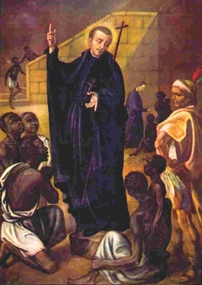
Peter Claver SJ (Catalan: Pere Claver i Sobocano, Spanish: Pedro Claver y Corberó; 26 June 1580 – 8 September 1654) was a Spanish Jesuit priest and missionary born in Verdú, Catalonia, Spain, who, due to his life and work, became the patron saint of slaves, Colombia, and ministry to African Americans.
During the 40 years of his ministry in the New Kingdom of Granada, it is estimated he personally baptized around 300,000 people and heard the confessions of over 5,000 people per year. He is also patron saint for seafarers. He is considered a heroic example of what should be the Christian praxis of love and of the exercise of human rights.
The Congress of Colombia declared September 9 as the National Day of Human Rights in his honor.
Claver was born in 1580 into a devoutly Catholic and prosperous farming family in the Catalan village of Verdú, Urgell, located in Catalonia, Spain about 54 miles (87 km) from Barcelona. He was born 70 years after King Ferdinand of Spain set the colonial slavery culture into motion by authorizing the purchase of 250 African slaves in Lisbon for his territories in New Spain.
Later, as a student at the University of Barcelona, Claver was noted for his intelligence and piety. After two years of study there, Claver wrote these words in the notebook he kept throughout his life: "I must dedicate myself to the service of God until death, on the understanding that I am like a slave."
After he had completed his studies, Claver entered the Society of Jesus in Tarragona at the age of 20. When he had completed the novitiate, he was sent to study philosophy at Palma, Mallorca. While there, he came to know the porter of the college, St. Alphonsus Rodriguez, a laybrother known for his holiness and gift of prophecy. Rodriguez felt that he had been told by God that Claver was to spend his life in service in the colonies of New Spain, and he frequently urged the young student to accept that calling.
Claver volunteered for the Spanish colonies and was sent to the New Kingdom of Granada, where he arrived in the port city of Cartagena in 1610. Required to spend six years studying theology before being ordained a priest, he lived in Jesuit houses at Tunja and Bogotá. During those preparatory years, he was deeply disturbed by the harsh treatment and living conditions of the black slaves who were brought from Africa.
By this time, the slave trade had been established in the Americas for about a century. Local Native Americans were considered physically ill-suited to work in the gold and silver mines. Mine owners met their labor requirements by importing blacks from Angola and Congo, whom they purchased in West Africa for four crowns a head or bartered for goods and sold in America for an average two hundred crowns apiece. Others were captured at random, especially able-bodied males and females deemed suitable for labor.
Peter Claver
Peter Claver SJ (Catalan: Pere Claver i Sobocano, Spanish: Pedro Claver y Corberó; 26 June 1580 – 8 September 1654) was a Spanish Jesuit priest and missionary born in Verdú, Catalonia, Spain, who, due to his life and work, became the patron saint of slaves, Colombia, and ministry to African Americans.
During the 40 years of his ministry in the New Kingdom of Granada, it is estimated he personally baptized around 300,000 people and heard the confessions of over 5,000 people per year. He is also patron saint for seafarers. He is considered a heroic example of what should be the Christian praxis of love and of the exercise of human rights.
The Congress of Colombia declared September 9 as the National Day of Human Rights in his honor.
Claver was born in 1580 into a devoutly Catholic and prosperous farming family in the Catalan village of Verdú, Urgell, located in Catalonia, Spain about 54 miles (87 km) from Barcelona. He was born 70 years after King Ferdinand of Spain set the colonial slavery culture into motion by authorizing the purchase of 250 African slaves in Lisbon for his territories in New Spain.
Later, as a student at the University of Barcelona, Claver was noted for his intelligence and piety. After two years of study there, Claver wrote these words in the notebook he kept throughout his life: "I must dedicate myself to the service of God until death, on the understanding that I am like a slave."
After he had completed his studies, Claver entered the Society of Jesus in Tarragona at the age of 20. When he had completed the novitiate, he was sent to study philosophy at Palma, Mallorca. While there, he came to know the porter of the college, St. Alphonsus Rodriguez, a laybrother known for his holiness and gift of prophecy. Rodriguez felt that he had been told by God that Claver was to spend his life in service in the colonies of New Spain, and he frequently urged the young student to accept that calling.
Claver volunteered for the Spanish colonies and was sent to the New Kingdom of Granada, where he arrived in the port city of Cartagena in 1610. Required to spend six years studying theology before being ordained a priest, he lived in Jesuit houses at Tunja and Bogotá. During those preparatory years, he was deeply disturbed by the harsh treatment and living conditions of the black slaves who were brought from Africa.
By this time, the slave trade had been established in the Americas for about a century. Local Native Americans were considered physically ill-suited to work in the gold and silver mines. Mine owners met their labor requirements by importing blacks from Angola and Congo, whom they purchased in West Africa for four crowns a head or bartered for goods and sold in America for an average two hundred crowns apiece. Others were captured at random, especially able-bodied males and females deemed suitable for labor.
Recent media
Recent media