



Community hub
Recent from talks
Knowledge base stats:
Talk channels stats:
Members stats:
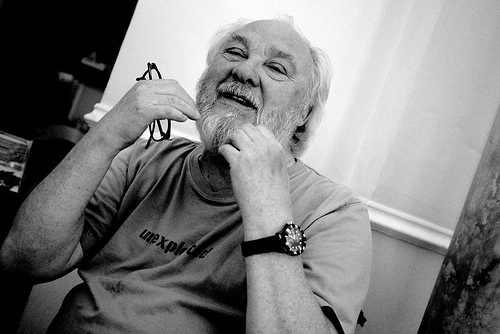
Peter Sinfield
Peter John Sinfield (27 December 1943 – 14 November 2024) was an English poet and songwriter. He was best known as a co-founder and lyricist of King Crimson. Their debut album In the Court of the Crimson King is considered one of the first and most influential progressive rock albums ever released.
Sinfield's lyrics are known for their surreal imagery, often involving common fantasy concepts, nature, or the sea. They often also deal with emotional concepts and, sometimes, storyline concepts. Later in his career, he adapted his songwriting to better suit pop music, and wrote a number of successful songs for artists such as Celine Dion, Cher, Cliff Richard, Leo Sayer, Five Star, and Bucks Fizz.
Paul Stump, in his 1997 History of Progressive Rock, called Sinfield "the premier littérateur of Progressive". In 2005, Sinfield was referred to as a "prog rock hero" in Q magazine for his lyrical work and influence in the music industry.
Sinfield was born in Fulham, London, to mixed English-Irish ancestry and a bohemian activist mother Deidre (also known as Joey or Daphne). He seldom had contact with his father Ian. Up until the age of eight, he was raised largely by his mother's German housekeeper Maria Wallenda, a high wire walker from the circus act the Flying Wallendas, after which he was sent to Danes Hill School in Oxshott. It was there that Sinfield discovered a love of words and their uses and meanings, with the guidance of his tutor John Mawson. He began to read literature of all kinds, particularly poetry. He later attended Ranelagh Grammar School in Bracknell, Berkshire. He left school at sixteen and worked briefly as a travel agent, believing that this would "allow him to see the world".
After his stint as a travel agent, Sinfield secured a job in the computer industry. To compete with his art school friends, Sinfield learned to play the guitar. He wrote poetry beginning in the mid 1960s and made a living on market stalls selling handmade kites, lampshades, paintings and customised clothing. Sinfield spent a number of years drifting around Morocco and Spain before returning to England. In 1967, he formed the Creation (which was not the '60s British band with the same name), a band he said he envisioned as a cross between Donovan and the Who. One of the members, Ian McDonald, convinced Sinfield to switch from singer/guitarist to lyricist.
In 1968, Ian McDonald joined Giles, Giles and Fripp, a progressive pop trio consisting of Michael Giles, Peter Giles, and Robert Fripp, who were looking to do more with music than their three-man line-up could manage. McDonald let the others know that he was already working with someone who could write lyrics. In their primordial form, Giles, Giles & Fripp, augmented by McDonald and ex-Fairport Convention vocalist Judy Dyble, recorded an early version of the McDonald-Sinfield song "I Talk to the Wind", which later became part of King Crimson's repertoire.
Peter Giles left the group at about this time, to be replaced by Greg Lake, and Sinfield joined around the same time. In his own words, "I became their pet hippie, because I could tell them where to go to buy the funny clothes that they saw everyone wearing". Sinfield also came up with the name King Crimson. Sinfield loved working with the band and, in addition to writing the phantasmagorical lyrics that came to be part of King Crimson's trademark, he also ran the group's light-show and mixed the sound at their concerts, and offered advice on artwork, album design, and other details of the band's releases. Sinfield's performance role in the band was limited to occasionally producing sound effects using an EMS VCS 3 synthesizer.
Fripp became involved with other projects including production work for Septober Energy and Matching Mole's Little Red Record, which left Sinfield with much of the responsibility for the final version and design of Islands including the album jacket. The relationship between Sinfield and Fripp became increasingly strained as the band progressed. On their fourth album, Islands, Sinfield began exploring new lyrical territory, with more sexual imagery juxtaposed with the languidly surreal title track. On 1 January 1972, following a tour of the United States, Fripp told Sinfield he could no longer work with him and asked him to leave the group.
Hub AI
Peter Sinfield AI simulator
(@Peter Sinfield_simulator)
Peter Sinfield
Peter John Sinfield (27 December 1943 – 14 November 2024) was an English poet and songwriter. He was best known as a co-founder and lyricist of King Crimson. Their debut album In the Court of the Crimson King is considered one of the first and most influential progressive rock albums ever released.
Sinfield's lyrics are known for their surreal imagery, often involving common fantasy concepts, nature, or the sea. They often also deal with emotional concepts and, sometimes, storyline concepts. Later in his career, he adapted his songwriting to better suit pop music, and wrote a number of successful songs for artists such as Celine Dion, Cher, Cliff Richard, Leo Sayer, Five Star, and Bucks Fizz.
Paul Stump, in his 1997 History of Progressive Rock, called Sinfield "the premier littérateur of Progressive". In 2005, Sinfield was referred to as a "prog rock hero" in Q magazine for his lyrical work and influence in the music industry.
Sinfield was born in Fulham, London, to mixed English-Irish ancestry and a bohemian activist mother Deidre (also known as Joey or Daphne). He seldom had contact with his father Ian. Up until the age of eight, he was raised largely by his mother's German housekeeper Maria Wallenda, a high wire walker from the circus act the Flying Wallendas, after which he was sent to Danes Hill School in Oxshott. It was there that Sinfield discovered a love of words and their uses and meanings, with the guidance of his tutor John Mawson. He began to read literature of all kinds, particularly poetry. He later attended Ranelagh Grammar School in Bracknell, Berkshire. He left school at sixteen and worked briefly as a travel agent, believing that this would "allow him to see the world".
After his stint as a travel agent, Sinfield secured a job in the computer industry. To compete with his art school friends, Sinfield learned to play the guitar. He wrote poetry beginning in the mid 1960s and made a living on market stalls selling handmade kites, lampshades, paintings and customised clothing. Sinfield spent a number of years drifting around Morocco and Spain before returning to England. In 1967, he formed the Creation (which was not the '60s British band with the same name), a band he said he envisioned as a cross between Donovan and the Who. One of the members, Ian McDonald, convinced Sinfield to switch from singer/guitarist to lyricist.
In 1968, Ian McDonald joined Giles, Giles and Fripp, a progressive pop trio consisting of Michael Giles, Peter Giles, and Robert Fripp, who were looking to do more with music than their three-man line-up could manage. McDonald let the others know that he was already working with someone who could write lyrics. In their primordial form, Giles, Giles & Fripp, augmented by McDonald and ex-Fairport Convention vocalist Judy Dyble, recorded an early version of the McDonald-Sinfield song "I Talk to the Wind", which later became part of King Crimson's repertoire.
Peter Giles left the group at about this time, to be replaced by Greg Lake, and Sinfield joined around the same time. In his own words, "I became their pet hippie, because I could tell them where to go to buy the funny clothes that they saw everyone wearing". Sinfield also came up with the name King Crimson. Sinfield loved working with the band and, in addition to writing the phantasmagorical lyrics that came to be part of King Crimson's trademark, he also ran the group's light-show and mixed the sound at their concerts, and offered advice on artwork, album design, and other details of the band's releases. Sinfield's performance role in the band was limited to occasionally producing sound effects using an EMS VCS 3 synthesizer.
Fripp became involved with other projects including production work for Septober Energy and Matching Mole's Little Red Record, which left Sinfield with much of the responsibility for the final version and design of Islands including the album jacket. The relationship between Sinfield and Fripp became increasingly strained as the band progressed. On their fourth album, Islands, Sinfield began exploring new lyrical territory, with more sexual imagery juxtaposed with the languidly surreal title track. On 1 January 1972, following a tour of the United States, Fripp told Sinfield he could no longer work with him and asked him to leave the group.