Hubbry Logo
Tightrope walkingTightrope walkingMain
Open search
Tightrope walking
Community hub
Tightrope walking
logo
8 pages, 0 posts
0 subscribers
Be the first to start a discussion here.
Tightrope walking
Tightrope walking
from Wikipedia
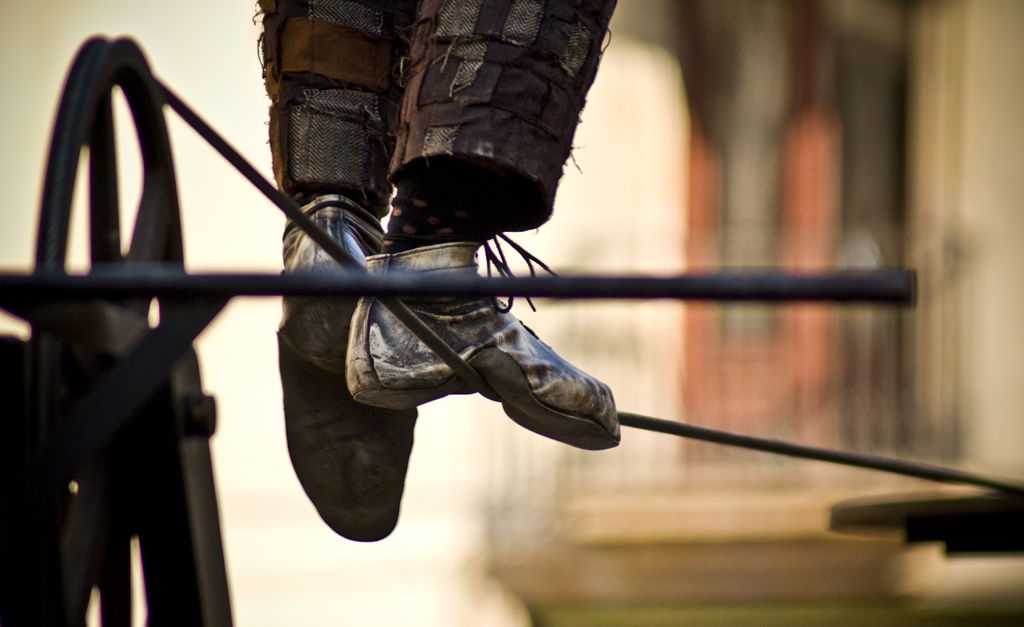
The feet of a tightrope walker

Tightrope walking, also called funambulism, is the skill of walking along a thin wire or rope. It has a long tradition in various countries and is commonly associated with the circus. Other skills similar to tightrope walking include slack rope walking and slacklining.

Types

[edit]
Tightrope walking, Armenian manuscript, 1688

Tightwire is the skill of maintaining balance while walking along a tensioned wire between two points. It can be done either using a balancing tool (umbrella, fan, balance pole, etc.) or "freehand", using only one's body to maintain balance. Typically, tightwire performances either include dance or object manipulation. Object manipulation acts include a variety of props in their acts, such as clubs, rings, hats, or canes. Tightwire performers have even used wheelbarrows with passengers, ladders, and animals in their act. The technique to maintain balance is to keep the performer's centre of mass above their support point—usually their feet.

Man Crossing the River balancing sculpture across the Brda River in Bydgoszcz, Poland

Highwire is a form of tightwire walking but performed at much greater height. Although there is no official height when tightwire becomes highwire, generally a wire over 20 feet (6 m) high are regarded as a highwire act.

Skywalk is a form of highwire which is performed at great heights and length. A skywalk is performed outdoors between tall buildings, gorges, across waterfalls or other natural and man-made structures.

Ropes

[edit]

If the "lay" of the rope (the orientation of the constituent strands, the "twist" of a rope) is in one direction, the rope can twist on itself as it stretches and relaxes. Underfoot, this could be hazardous to disastrous in a tightrope. One solution is for the rope core to be made of steel cable, laid in the opposite direction to the outer layers, so that twisting forces balance each other out.

Biomechanics

[edit]

Acrobats maintain their balance by positioning their centre of mass directly over their base of support, i.e. shifting most of their weight over their legs, arms, or whatever part of their body they are using to hold them up. When they are on the ground with their feet side by side, the base of support is wide in the lateral direction but narrow in the sagittal (back-to-front) direction. In the case of highwire-walkers, their feet are parallel with each other, one foot positioned in front of the other while on the wire. Therefore, a tightwire walker's sway is side to side, their lateral support having been drastically reduced. In both cases, whether side by side or parallel, the ankle is the pivot point.

A wire-walker may use a pole for balance or may stretch out their arms perpendicular to their trunk in the manner of a pole. This technique provides several advantages. It distributes mass away from the pivot point, thereby increasing the moment of inertia. This reduces angular acceleration, so a greater torque is required to rotate the performer over the wire. The result is less tipping. In addition, the performer can also correct sway by rotating the pole. This will create an equal and opposite torque on the body.

Tightwire-walkers typically perform in very thin and flexible, leather-soled slippers with a full-length suede or leather sole to protect the feet from abrasions and bruises, while still allowing the foot to curve around the wire. Though very infrequent in performance, amateur, hobbyist, or inexperienced funambulists will often walk barefoot so that the wire can be grasped between the big and second toe. This is more often done when using a rope, as the softer and silkier fibres are less taxing on the bare foot than the harder and more abrasive braided wire.

Famous tightrope artists

[edit]
Maria Spelterini crossing Niagara Falls on July 4, 1876
Jultagi, the Korean tradition of tightrope walking
  • Charles Blondin, a.k.a. Jean-François Gravelet, crossed the Niagara Falls many times
  • Robert Cadman, early 18th-century British highwire walker and ropeslider
  • Jay Cochrane, Canadian, set multiple records for skywalking, including The Great China Skywalk[1] in Qutang Gorge, China, 639-metre-long (2,098 ft), 410-metre-high (1,340 ft) from one cliff wall to the opposite side above the Yangtze River; the longest blindfolded skywalk, 800-foot-long (240 m), 300-foot-high (91 m) in 1998, between the towers of the Flamingo Hilton in Las Vegas, Nevada, and broadcast on FOX Network's Guinness World Records Primetime on Tuesday, February 23, 1999; In 2001, he became the first person to perform a skywalk in Niagara Falls, Canada, in more than a hundred years. His final performances took place during Skywalk 2012[2] with a world record submission[3] of 11.81 miles (19.01 km) in cumulative distance skywalking from the Skylon Tower at a height of 520 feet (160 m) traversing the 1,300 feet (400 m) highwire to the pinnacle of the Hilton Fallsview Hotel at 581 feet (177 m).
  • Con Colleano, Australian, "the Wizard of the Wire"
  • David Dimitri, Swiss highwire walker
  • Pablo Fanque, 19th-century British tightrope walker and "rope dancer", among other talents, although best known as the first black circus owner in Britain, and for his mention in the Beatles song, "Being for the Benefit of Mr. Kite!"
  • The Great Farini, a.k.a. Willie Hunt, crossed the Niagara Falls many times
  • Farrell Hettig, American highwire walker, started as a Wallenda team member, once held record for steepest incline for a wire walk he completed in 1981[4]
  • Henry Johnson (1806–1910), British tightrope walker with Sanger's and Hughes' circuses (also equestrian gymnast and acrobat)
  • Denis Josselin, a French tightrope walker, completed on 6 April 2014 a walk over the river Seine in Paris. It took him 30 minutes to walk over 150 m (490 feet) of rope, 25 m (82 feet) meters above the river. He covered his eyes halfway through without harness or safety net but police boats were on hand in case he fell.[5][6]
  • Jade Kindar-Martin and Didier Pasquette, an American-French highwire duo, most notable for their world-record setting skywalk over the River Thames in London
  • Henri L'Estrange, 19th-century Australian; first person to tightrope walk across Sydney harbour and early balloonist
  • Elvira Madigan, Danish 19th-century tightwire walker
  • Bird Millman, American star of Ringling Brothers & Barnum and Bailey Circus
  • Fyodor Molodtsov (1855–1919), a Russian rope walker. Was known to perform numerous tricks such as rope walking while shooting, carrying another person, wearing stilts, dancing, and even being unbalanced by pyrotechnical explosions. Known to have defeated Blondin during a tightrope crossing of the Neva river, by braving it at a wider place.
  • Jorge Ojeda-Guzman, Ecuadorian highwire walker, set The Guinness Book of World Records, Tightrope Endurance Record, for living 205 days on the wire, from January 1 to July 25, 1993 in Orlando, Florida.[7]
  • Rudy Omankowski Jr., French-Czech highwire walker, holds record for skywalk distance
  • Stephen Peer, after several previous successful crossings, fell to his death at the Niagara Falls in 1887
  • Susanna Bokoyni, Hungarian centenarian and circus performer who was listed in Guinness World Records as the longest-lived dwarf on record.
  • Philippe Petit, French highwire-walker, famous for his walk between the towers of the World Trade Center in New York City in 1974
  • Eskil Rønningsbakken, Norwegian balancing artist whose feats include tightrope walking between hot air balloons in flight
  • Maria Spelterini, Italian highwire walker, first woman to cross the Niagara Falls
  • Falko Traber, German tightwire walker, walked to the Sugarloaf Mountain in Rio de Janeiro
  • Vertelli, British-Australian tightrope walker, nicknamed "the Australian Blondin"
  • The Flying Wallendas, famous for their seven- and eight-person pyramid wire-walks
  • Karl Wallenda, founder of the Flying Wallendas, died after falling from a wire on March 22, 1978, at age 73, while attempting to cross between the two towers of the Condado Plaza Hotel in San Juan, Puerto Rico.
  • Nik Wallenda, great-grandson of Karl, second person to walk from the United States to Canada over the Horseshoe Falls at the Niagara Falls on June 15, 2012; with his mother Delilah (Karl's granddaughter), completed his great-grandfather's final attempt between the two towers of the Condado Plaza Hotelon June 4, 2011. On June 23, 2013, he successfully walked over a gorge in the area of the Grand Canyon. On November 2, 2014, he crossed over the Chicago River from the west tower of Marina City to the Leo Burnett building, following it with a blindfolded trip from the west tower to the east tower of Marina City.[8][9] performed a record-breaking skywalk of 2,000 feet (610 m) at Kings Island on July 4, 2008, breaking Karl Wallenda's record walk[10][11]
  • Adili Wuxor, Chinese (Uyghur), from Xinjiang, performer of the Uyghur tradition of highwire-walking called dawaz; record-holder for highest wire-walk,[citation needed] in 2010 he lived on wire for 60 days, at Beijing's Bird Nest Stadium.[12]
  • Maurizio Zavatta, Holder of highest tightrope walk while blindfolded. Set on 16 November 2016 in Wulong, Chongqing (China).[13]

Metaphorical use

[edit]

The word funambulism, the phrase walking a tightrope, and associated variants also occur in metaphorical contexts not referring to any actual acrobatic acts. For instance, politicians are said to "walk a tightrope" when trying to balance two opposing views with little room for compromise. The idea can also appear in satirical or acidic contexts. Nicholas Taleb uses the concept in his book The Black Swan: "You get respect for doing funambulism or spectator sports [...]."[14] Taleb is criticising scientists who prefer popularism[citation needed] to vigorous research and those who walk a fixed and narrow path rather than explore a large field of empirical study.

See also

[edit]

References

[edit]
Revisions and contributorsEdit on WikipediaRead on Wikipedia
from Grokipedia
Tightrope walking, also known as funambulism, is the skilled art of balancing and traversing a slender or wire suspended tautly between two elevated points, often at significant heights above the ground or obstacles, requiring precise coordination, core strength, and intense mental concentration to perform walks, dances, or without falling. This daring discipline traces its origins to ancient civilizations, including and , where performers known as entertained audiences with high-wire acts, sometimes stretching ropes between ships or buildings, and donning white garments to invoke divine protection. By the , tightrope walking persisted across and the , with documented feats such as a 1426 performance in where a walker traversed 150 feet between minarets while a merchant shot arrows from the rope. In the , it became a hallmark of modern circuses, as innovators adopted rigid steel wires to enable more elaborate routines, including somersaults and crossings, epitomized by French acrobat , who first crossed the on a tightrope in 1859 and repeated the feat under varied conditions like blindfolded or pushing a . Key techniques emphasize stability and control: performers typically grip a long balancing pole, for example weighing up to 55 pounds (25 kg), as in Philippe Petit's 1974 walk, which lowers the body's center of gravity and increases rotational inertia to slow angular momentum and provide precious seconds for corrections during wobbles. Small, deliberate steps with hips aligned over the wire, combined with arm extensions or pole tilts, help maintain equilibrium against wind, vibrations, or uneven tension. Iconic 20th-century examples include Philippe Petit's 1974 illicit walk between New York City's World Trade Center towers, covering 140 feet (43 m) at a height of 1,350 feet (410 m) over 45 minutes, and contemporary highliners like Nik Wallenda, who crossed Niagara Falls in 2012—the first directly over the falls in over a century—while wearing a safety harness for broadcast. As of 2024, performers continue daring feats, such as Philippe Petit's high-wire walk at the Cathedral of St. John the Divine. Beyond entertainment, tightrope traditions endure in regions like Dagestan, Russia, where the skill evolved from practical gorge-crossing in mountainous terrain to a cultural rite taught from childhood.

History

Ancient and Early Practices

Tightrope walking, known historically as funambulism, has roots in several ancient civilizations, with evidence of the practice dating back to around 400–100 BCE. In ancient , the traditional form called dawaz—meaning "aerial tightrope walking" in the —emerged among ethnic groups in the region, where performers balanced on ropes suspended between trees or poles, often incorporating acrobatic elements tied to religious rituals. This art form, with a documented history exceeding 2,000 years, was introduced to the Central Plains during the (206 BCE–220 CE), serving as both and a display of skill in community gatherings. In , tightrope walking was referred to by terms such as neurobatēs for high-rope performers and oreibatēs for those navigating ropes at height, depicted in vase paintings and literary accounts from the period. Performers, dressed in white to invoke divine protection from gods like Hermes, executed feats including jumps and balances, earning the prize of a thaumatron (wonder) for exceptional displays, though the activity was classified as artistic rather than athletic and thus excluded from the . These acts symbolized human daring and were integrated into festivals and theatrical events. By the Roman period, tightrope walking evolved into professional entertainment under the term funambuli, with performers appearing in circuses, festivals, and public spectacles at venues like the . references such acts in his , noting their daring nature alongside other equilibrists who traversed ropes while carrying loads or performing tricks, often amid cheers from crowds during (public games). Safety measures, such as placing mattresses below ropes, were mandated by Emperor following fatal accidents, highlighting the inherent risks. During the medieval period in (12th–15th centuries), tightrope walking persisted as a popular , featured at fairs, markets, and religious pageants where s of performers organized acts to draw crowds and earn . Records from guild ledgers and chronicles describe equilibrists balancing on ropes strung between buildings or poles in town squares, incorporating dances and flips to entertain during festivals like those honoring saints or seasonal celebrations. These rudimentary setups often relied on guyed ropes—auxiliary lines anchored to the ground or structures—for stability in non-tensioned configurations, allowing safer traversal over uneven or slack lines without modern wire tensioning. Such performances bridged ancient traditions with emerging public spectacles, though they occasionally faced clerical criticism for their perceived frivolity.

Modern Evolution and Milestones

In the , tightrope walking evolved from localized street performances into a staple of professional circuses, particularly through the innovations of Philip Astley, who by 1780 had incorporated tightrope walkers alongside equestrian acts, jugglers, and clowns in his amphitheater to create a more structured spectacle. This integration continued under successors like Andrew Ducrow, who managed Astley's Amphitheatre from 1824 and performed as a ropedancer himself, blending tightrope feats with tumbling and riding to captivate Victorian audiences across and . Concurrently, the facilitated a technological shift around 1800, when reliable steel cable production allowed performers to transition from flexible ropes to tensioned wires, enabling higher elevations, greater stability, and more daring routines in circus settings. A pivotal milestone came in 1859 with French acrobat Charles Blondin's crossing of on June 30, where he traversed a 1,100-foot, two-inch-diameter suspended 160 feet above the water using a 30-foot balancing pole, drawing an estimated 100,000 spectators and elevating tightrope walking to international fame. Over the following year, Blondin repeated the feat five more times with theatrical variations, including blindfolded walks, performances on , carrying his manager on his back, and pausing midway to cook an omelet on a , which captivated crowds and inspired similar high-profile stunts worldwide. The 20th century saw further professionalization through major circuses like Ringling Bros. and Barnum & Bailey, which in 1928 contracted the Flying Wallendas—a German high-wire troupe led by Karl Wallenda—for their debut at Madison Square Garden, introducing intricate pyramid formations and no-safety-net acts that became hallmarks of American circus entertainment. Another landmark was Philippe Petit's unauthorized high-wire walk on August 7, 1974, between the World Trade Center's Twin Towers in New York City, where he balanced on a 140-foot steel cable at 1,350 feet above ground for 45 minutes, performing dances and knee-drops without a harness, an event that symbolized urban daring and drew global media attention. Technological advancements solidified steel cables as the standard by the early 1900s, supporting longer spans and higher tensions for circus and outdoor spectacles. The 1970s and 1980s marked the rise of televised events, amplifying reach; for instance, Karl Wallenda's 1970 crossing of Tallulah Gorge—1,000 feet across at 750 feet high—was covered in news broadcasts watched by thousands, while his 1978 fatal attempt between the Condado Plaza Hotel towers in Puerto Rico was documented live on television, heightening public fascination with the art's risks. Subsequent decades brought renewed global attention, with Nik Wallenda achieving the first tightrope crossing of in 150 years on June 15, 2012, wearing a as required for the televised event. In 2020, Wallenda completed his longest walk to date, 1,800 feet over Nicaragua's on March 4. As of November 2025, the Wallendas set a world record for the highest and longest criss-cross high-wire walk in , on November 9, further advancing the discipline's technical boundaries.

Equipment

Ropes, Wires, and Supports

In the early history of tightrope walking, performers relied on natural fiber ropes made from manila hemp, derived from the abaca plant native to the , which provided flexibility and moderate strength for spans at low tension levels. These ropes typically measured 1 to 2 inches in diameter, allowing for some elasticity that accommodated the performer's movements without snapping under body weight. By the , however, practitioners shifted to wires for greater rigidity and , marking a transition from organic materials to engineered metals. Modern tightrope setups predominantly use galvanized cables, coated to resist , with diameters ranging from 0.5 to 1 inch, enabling high tension levels, often several thousand pounds, for minimal flex during walks. The construction of these cables often follows a 7x19 strand configuration—seven strands each containing 19 wires—for optimal balance between flexibility and load-bearing capacity, as seen in professional setups like those rigged by aerialist . Tension is achieved through robust mechanisms including guy wires for lateral stability, heavy-duty anchors embedded in or rock, and turnbuckles or winches to adjust tautness, ensuring the cable forms a controlled catenary curve rather than a straight line, with tensions typically ranging from 2,000 to 5,000 pounds for standard setups. This curve arises from the cable's weight under gravity, with sag controlled by the equation sag=wL28T\text{sag} = \frac{w L^2}{8 T}, where ww is the weight per unit length, LL is the span length, and TT is the horizontal tension; this approximation holds for small sags typical in high-wire acts. Spans in high-wire tightrope walking vary from 10 to 25 meters for standard circus or performance setups, though record attempts extend to over 500 meters, such as Nik Wallenda's 550-meter crossing at in 2012. Supports include engineered towers of or aluminum for indoor arenas, or natural features like canyon rims for outdoor spectacles, with the cable secured at heights from ground level to hundreds of meters above voids. Balance poles are sometimes employed in tandem with these setups to aid stability on the taut surface. Maintenance is critical to prevent failures, with galvanized coatings on cables providing resistance against and oxidation, though prolonged exposure can lead to gradual degradation if not inspected. UV poses less risk to metal than to synthetic alternatives but can accelerate in uncoated sections, necessitating regular checks for pitting or weakening. Pre-walk protocols involve tension testing using dynamometers to verify loads exceed safe margins—often 5:1 safety factors—and visual inspections for frays, kinks, or environmental damage before each use.

Balance Aids and Safety Gear

Balance poles are essential accessories for tightrope walkers, providing crucial support for maintaining equilibrium during performances. These poles are typically constructed from lightweight yet durable materials such as seamless tubing to withstand the stresses of high-altitude walks. Modern examples, like those used by performer , measure between 23 and 30 feet in length and weigh 40 to 45 pounds, allowing for easy portability in sections while offering substantial leverage for stability. Footwear plays a key role in ensuring grip and sensory feedback on the wire. Tightrope walkers often opt for custom-made soft-soled shoes, such as elkskin moccasins, which provide flexibility and without rigid support that could hinder balance. In some low-wire or slackline variations, performers go to maximize tactile sensation and control. Applications of or to the soles or hands can enhance grip, particularly on slick surfaces, drawing from techniques in related disciplines like . Safety harnesses and nets represent critical advancements in mitigating risks, especially for high-profile or elevated acts. While traditional performances, such as those by , eschewed nets to emphasize daring, modern regulations for televised events often mandate tether systems. For instance, during Nik Wallenda's 2012 Niagara Falls crossing, a safety harness tethered him directly to the wire, a requirement imposed by broadcaster ABC to prevent a fatal fall from 200 feet. Circus troupes may employ padded nets below the wire for ensemble high-wire routines, providing a buffer against falls. Other aids enable creative variations and trick performances by altering weight distribution and center of gravity. Stilts extend the performer's height, challenging balance on uneven wires, as demonstrated by 19th-century funambulist Charles Blondin during his Niagara crossings. Bicycles allow for dynamic traversal, distributing weight across wheels for smoother motion over long spans, a technique also used by Blondin. Balancing chairs or similar props tests equilibrium by shifting mass, seen in contemporary Cirque du Soleil acts where walkers perch or ride across multi-rope setups. These tools demand precise adjustments to maintain stability, often customized to the wire's tension for optimal control.

Techniques and Training

Fundamental Skills

Tightrope walking begins with mastering basic posture to maintain equilibrium on the narrow support. Practitioners adopt a centered body position with a straight back and slightly bent knees to distribute weight evenly, while extending the arms horizontally outward to serve as counterbalances against lateral sway. This arm extension, parallel to the ground, allows subtle adjustments to redirect without disrupting forward progress. Additionally, fixing the on a distant point on the horizon provides visual stabilization, preventing disorientation from focusing on the feet or the wire below. Effective step mechanics are essential to minimize wire and sustain . Beginners employ a heel-to-toe rolling , placing the heel of one foot directly in front of the toes of the other to create a continuous, linear path that reduces twisting forces. Small, deliberate steps transfer weight gradually from one foot to the next, ensuring the body remains aligned over the wire's centerline. Initial practice occurs on low lines, typically 1-2 feet above the ground, to allow safe recovery from falls and build foundational coordination without height-induced fear. Mental preparation underpins physical execution, fostering the focus required to navigate . Techniques such as deep breathing and concentration exercises help reduce tension and shaking, promoting a relaxed state that enhances and . Meditation practices quiet the mind, sharpening present-moment awareness to counteract distractions like wind or audience noise. Confidence develops through progressive height increases, starting from ground-level simulations—such as walking a heel-to-toe—and advancing only after consistent success at lower levels. Entry-level training regimens emphasize consistency and safety to ingrain these skills. Aspiring walkers typically dedicate several hours per week, often 2-3 sessions, to on dedicated wires or slacklines, beginning with assisted walks where spotters provide hand support or a nearby line. These sessions incorporate preparatory drills like standing on one foot or ground-based tandem walking to isolate components before integrating them on the wire. Over time, this structured progression—combined with supplementary exercises such as for core stability—prepares performers for unassisted traverses. Advanced tricks, like turns or bounces, build directly upon these foundational elements.

Advanced Methods and Practice

Advanced tightrope walking incorporates complex trick integration, such as backward walking, somersaults, and object handling, where performers sequence movements to preserve rhythmic flow and prevent disruptions in balance. These techniques demand precise coordination to transition seamlessly between maneuvers, often using a balance pole or other aids to stabilize the body during dynamic shifts. Environmental adaptations are essential for outdoor , with walkers employing micro-adjustments like subtle body leans and proprioceptive feedback to counteract wind gusts and maintain stability. These responses allow performers to adapt to varying conditions without losing momentum, relying on instantaneous muscle and joint corrections. Professional training occurs in dedicated , such as the École nationale de cirque in , which provides multi-year programs focused on developing elite skills in disciplines like tightrope walking through intensive, progressive instruction. Achieving mastery typically spans several years of year-round practice, building from foundational to advanced endurance for sustained acts. Injury prevention is a core component of these programs, incorporating structured warm-ups to activate muscles and synchronize sequences, alongside to monitor physical demands and reduce overuse risks from high workloads. Psychological support, including relaxation techniques, complements physical routines to enhance resilience during rigorous training. Performance psychology plays a vital role in elite practice, with visualization methods used to mentally rehearse sequences and anticipate challenges, fostering sustained focus for extended routines. Techniques like blocking distractions and engaging with audience energy further aid concentration, enabling performers to maintain composure over prolonged engagements.

Types and Variations

High Wire Walking

High wire walking is a specialized variant of tightrope walking performed on a tensioned steel cable elevated typically more than 10 meters above the ground, often without safety nets or harnesses, and frequently spanning significant gaps in urban environments or natural landscapes such as canyons or rivers. This form emphasizes spectacle and peril, with performers relying on balance poles and precise footwork to traverse the wire while exposed to wind, vibration, and the psychological strain of height. The apparatus consists of a thin, high-tensile cable—usually 1 to 2 inches in diameter—anchored securely to prevent excessive movement, distinguishing it from lower or slackline variants through its rigid, elevated setup. Key characteristics include a minimal sag in the wire, generally under 5% of the total span length, achieved through precise tensioning to ensure stability during extended crossings that range from 50 to 500 meters. For instance, in Wallenda's 2013 crossing of the gorge near the Grand Canyon, a 426-meter-long, 2-inch-thick cable was tensioned to approximately 28 metric tons, producing a sag of about 7 meters to maintain a near-horizontal path despite the walker's weight and environmental factors. Such precision is essential, as even slight variations in tension can amplify oscillations, demanding constant micro-adjustments from the performer to counteract the wire's natural tendency to form a curve under load. High wire walking dominated circus performances throughout the 19th and 20th centuries, evolving from solo feats to ensemble acts that thrilled audiences in traveling shows and permanent venues. Pioneers like captivated the public in the mid-1800s with crossings over , performing without nets at heights exceeding 50 meters and incorporating daring variations like cooking an omelet midway. By the 20th century, family troupes such as elevated the art in American circuses like Ringling Bros. and Barnum & Bailey, executing pyramid formations and bicycle routines on wires 15 to 30 meters high, often without safety equipment to heighten the drama. Modern spectacles, exemplified by Wallenda's 2013 Grand Canyon walk at 460 meters above the gorge floor, continue this legacy, attracting global attention for their blend of historical tradition and contemporary engineering. More recently, in 2025, and Lijana Wallenda completed a world-record criss-cross high-wire walk in , spanning two cables at about 80 feet (24 meters) high. The risks inherent to high wire walking are profoundly amplified by elevation, with vertigo posing a primary psychological that performers manage through focused mental conditioning and gradual exposure to heights. Unlike lower-altitude practices, the vast visual expanse below can trigger disorienting spatial illusions, requiring artists to train their gaze on the wire and suppress instinctive fear responses to maintain equilibrium. Fall dynamics further escalate danger, as a loss of balance from such heights—often 10 to 500 meters—results in uncontrolled descent with terminal velocities exceeding 50 meters per second, rendering survival improbable without nets due to the absence of immediate deceleration or . These factors underscore the high wire's unforgiving nature, where precision errors lead to catastrophic outcomes far beyond those of ground-level tightrope forms.

Low Wire and Slack Forms

Low wire walking refers to tightrope variations set up at heights of 1 to 5 feet above the ground, primarily employed for beginner training and indoor performances where safety is paramount. These setups commonly utilize ropes, which introduce a subtle bounce to facilitate easier balance and reduce intimidation for novices. Slack rope walking, a traditional circus discipline, employs untensioned or minimally tensioned lines that permit dynamic movements such as swings, drops, and acrobatic twists, distinguishing it from rigid wire acts. Performers rig these ropes from floor level or low anchors, often spanning 7 meters or more in a dedicated performance area, to enable fluid integration of balance, , and aerial elements. Modern offshoots of these low forms include urban , which adapts the practice to city settings using 1- to 2-inch-wide synthetic tensioned minimally over spans of 15 to 50 feet between fixed points like trees or urban structures. Other slacklining variations include highlining (performed at heights, often with leashes for safety), tricklining (focusing on flips and mounts), and longlining (extended spans over 50 meters for endurance). This variation emphasizes accessibility in public spaces, combining walking, tricks, and freestyle elements on bouncy lines. Water walking variants extend slacklining over bodies of water, where the line's instability is amplified by surface reflections and waves, though the soft landing medium enhances safety for experimentation with tricks and longlines. These low and slack forms have gained popularity in fitness and therapeutic contexts due to their proximity to the ground, which results in relatively low overall injury incidence in , with approximately 93% of reported incidents (as of 2015) resulting in minor injuries such as bruises and sprains, compared to elevated disciplines. activates core muscles, improves postural control, and enhances recruitment at low exertion levels, making it valuable for rehabilitation of lower limb injuries and balance training in clinical settings.

Physics and Biomechanics

Principles of Balance and Stability

Tightrope walking relies on maintaining the performer's directly above the wire to achieve static equilibrium, as any horizontal displacement would generate a restoring due to that could lead to . To manage perturbations, performers swing their arms or use a balance pole to dynamically adjust the , effectively creating oscillatory corrections modeled as an system. The period of these arm swings approximates , given by T=2πImgdT = 2\pi \sqrt{\frac{I}{mgd}}
Add your contribution
Related Hubs
User Avatar
No comments yet.