Hubbry Logo
Peter TomichPeter TomichMain
Open search
Peter Tomich
Community hub
Peter Tomich
logo
8 pages, 0 posts
0 subscribers
Be the first to start a discussion here.
Peter Tomich
Peter Tomich
from Wikipedia

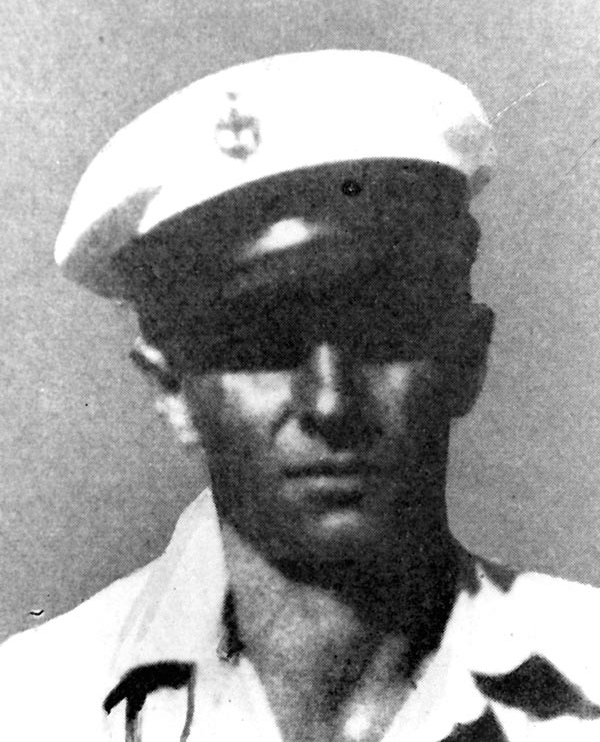
Petar Herceg 'Tonić' (later anglicized as Peter Tomich; June 3, 1893 – December 7, 1941) was a United States Navy sailor of Herzegovinian Croat descent who received the United States military's highest award, the Medal of Honor, for his actions in World War II.[1]

Key Information

Biography

[edit]

Tomich was an ethnic Croat from Herzegovina born as Petar Herceg (family nickname 'Tonić') in Prolog near Ljubuški, under Austro-Hungarian rule in Bosnia and Herzegovina. He immigrated to the United States in 1913 and joined the US Army in 1917.[2]

World War I

[edit]

Tomich served in the US Army during World War I and enlisted in the US Navy in 1919, where he initially served on the destroyer USS Litchfield (DD-336).[1]

World War II

[edit]
Petar Tomich's Medal of Honor, awarded by US President Franklin D. Roosevelt.

By 1941, he had become a chief watertender on board the training and target ship USS Utah.[1] On December 7, 1941, while the ship lay in Pearl Harbor, moored off Ford Island, she was torpedoed during Japan's raid on Pearl Harbor.[1] Tomich was on duty in a boiler room. As Utah began to capsize, he remained below, securing the boilers and making certain that other men escaped, and so lost his life.[1] For his "distinguished conduct and extraordinary courage" at that time, he posthumously received the Medal of Honor.[1] His Medal of Honor was on display at the Navy's Senior Enlisted Academy (Tomich Hall).[1] Later, the decoration was presented to Tomich's family on the aircraft carrier USS Enterprise in the southern Adriatic city of Split in Croatia, on 18 May 2006, sixty-four years after US President Franklin D. Roosevelt awarded it to him.[3]

Awards and honors

[edit]
A light blue ribbon with five white five pointed stars
Bronze star
Bronze star
Medal of Honor
Purple Heart Navy Good Conduct Medal World War I Victory Medal
American Defense Service Medal
with Fleet clasp
Asiatic-Pacific Campaign Medal
with Campaign star
World War II Victory Medal

Medal of Honor citation

[edit]

For distinguished conduct in the line of his profession and extraordinary courage and disregard of his own safety during the attack on the Fleet in Pearl Harbor by the Japanese forces on 7 December 1941. Despite realizing that the ship was capsizing as a result of enemy bombing and torpedoing, Tomich remained at his post in the engineering plant of the U.S.S. Utah until he saw that all boilers were secured and all fireroom personnel had left their stations, and by so doing, lost his own life."[4]

Legacy

[edit]
  • The destroyer escort USS Tomich (DE-242), 1943–1974, was named in honor of Chief Watertender Tomich.[5]
  • The United States Navy Senior Enlisted Academy in Newport, RI is named Tomich Hall in honor of Chief Watertender Tomich.[6]
  • The Steam Propulsion Training Facility at Service School Command Great Lakes is named in honor of Chief Watertender Tomich.[7]
  • The U.S. Citizenship and Immigration Services Headquarters Conference Room in Washington, D.C., is named the Peter Tomich Conference Center.[6]

See also

[edit]

References

[edit]

Further reading

[edit]

Bibliography

[edit]
Revisions and contributorsEdit on WikipediaRead on Wikipedia
from Grokipedia
Peter Tomich (June 3, 1893 – December 7, 1941) was a Chief Watertender in the United States Navy of Herzegovinian Croat descent who posthumously received the Medal of Honor for extraordinary courage during the Japanese attack on Pearl Harbor. Aboard the training ship USS Utah (AG-16), Tomich remained at his post in the engineering plant amid the chaos of the assault, securing the boilers as the vessel capsized from torpedo and bomb strikes, thereby preventing a potential explosion that could have endangered escaping crew members and enabling many crew members to flee the sinking ship. His self-sacrifice exemplified the Navy's core values of honor, courage, and commitment, making him one of only 16 service members awarded the Medal of Honor for actions on that fateful day. Born Petar Herceg-Tomić in , (now ), Tomich immigrated to the in 1913 seeking better opportunities and became a naturalized citizen in 1918. He enlisted in the U.S. Army on June 6, 1917, at , New York, during , serving honorably and earning U.S. citizenship through his service, though he did not see combat. Discharged in early 1919, he joined the just days later on January 24, 1919, beginning a 22-year career that saw him serve on vessels including the destroyer USS Litchfield (DD-336) and rise steadily through the enlisted ranks to Chief Watertender by 1941. Tomich's Medal of Honor citation specifically commended his "distinguished conduct in the line of his profession, and extraordinary courage and disregard of his own safety" during the attack, where he lost his life at age 48; his remains were never recovered and are commemorated on the Wall of the Missing at the National Memorial Cemetery of the Pacific in . The medal was first presented to the USS Tomich (DE-242) upon its commissioning in 1943 and later transferred to the state of in 1947, where he was named an honorary citizen; it is now displayed at Tomich Hall in the U.S. Navy Senior Enlisted Academy in . His legacy endures as a symbol of immigrant contributions to American military valor, honored through naval facilities and commemorations that highlight his pivotal role in safeguarding lives amid one of the deadliest surprise attacks in U.S. history.

Early Life

Birth and Ancestry

Peter Tomich was born Petar Herceg-Tonić on June 3, 1893, in the small rural village of near in , then part of the . He was of ethnic Croat descent from the region, where his family bore the Herceg-Tonić, with "Tonić" serving as a derived from local naming . Details on his remain limited and somewhat inconsistent across records. Possible parental names include John Tomich (or the Croatian equivalent Ante or ) and Anna Drazich, reflecting the family's modest agrarian roots in a area prone to the ethnic tensions and political upheavals of the late Austro-Hungarian era in the before . Genealogical sources indicate at least one , a brother named Herceg, though comprehensive information is scarce. Life in involved typical rural subsistence in a multi-ethnic zone, amid growing regional instability from imperial decline and rising nationalist movements. Upon immigrating to the in , Tomich anglicized his name to Peter Tomich, a change emblematic of early 20th-century cultural adaptation among Balkan immigrants seeking integration.

Immigration to the

In , at the age of 19, Peter Tomich immigrated to the from in (now part of ), driven by a desire for better economic opportunities amid the escalating political tensions in the following the of 1912–1913. Upon arrival, Tomich settled in , , joining his cousin John Tomich, whom he designated as his next-of-kin in official records. He adopted "Peter Tomich" as his legal name, anglicizing his original name of Petar Herceg-Tonić to better integrate into American society. Over the following four years, Tomich resided in Los Angeles and supported himself through various labor-intensive jobs, establishing the necessary residency for eventual U.S. citizenship without pursuing formal education. This period of adjustment allowed him to build a foundation in his new country before the entered . Tomich's path to naturalization culminated in 1918, facilitated by his established residency and eligibility through wartime service provisions that expedited for immigrants. He was officially naturalized on October 19, 1918, in , marking his full legal integration as a U.S. citizen.

World War I Service

Enlistment in the U.S. Army

Following his in 1913, Peter Tomich enlisted in the U.S. Army as a private on June 6, 1917, at in , shortly after the nation's entry into . As a recent immigrant from , Tomich's decision was driven by a desire to demonstrate loyalty to his adopted country and to accelerate his path to U.S. citizenship, a common route for foreign-born recruits at the time. Upon enlistment, Tomich was assigned to the 12th Company, 3rd Training Battalion, 154th Depot Brigade, a training unit based at Camp Greene, , where he underwent basic military instruction as part of the wartime mobilization effort. He later served with Company L, 47th Infantry, also at Camp Greene. This initial training focused on equipping recruits with essential skills, , and in preparation for potential overseas deployment. Tomich's military service expedited his naturalization process, and he became a U.S. citizen on October 19, 1918, in . In the lead-up to the war's end, Tomich participated in unit preparations, including advanced drills and logistical readiness, as his group readied for transatlantic transport in late 1918; however, the signing on prevented engagement in active combat operations.

Combat in France

Tomich's U.S. Army service took place during the height of American involvement in on the Western Front in , though records indicate he did not deploy overseas or participate in operations. Enlisting on , 1917, he served for 18 months in stateside training roles, avoiding the major offensives such as the Meuse-Argonne Offensive from September to November 1918, and the heavy casualties that afflicted frontline units. The period encompassed intense , artillery barrages, and infantry advances against German positions in the Argonne Forest and along the Meuse River, but Tomich remained in the United States. He was honorably discharged on January 13, 1919, concluding his Army tenure with a clean service record and U.S. citizenship granted during his enlistment.

Enlistment and Early Service

Following his honorable discharge from the U.S. Army in January 1919, Peter Tomich enlisted in the U.S. Navy on January 23, 1919, in , having recently become a naturalized U.S. citizen. He joined as an engineering specialist, undertaking initial training before assignment to duties centered on operating and maintaining boilers and steam propulsion systems aboard ships. Tomich's first sea duty came aboard the Clemson-class destroyer USS Litchfield (DD-336), commissioned in May 1920 and based in the Pacific Fleet out of , . Serving in her engineering department from 1919 onward, he participated in routine fleet operations, including patrols along the West Coast and exercises in Pacific waters that honed the destroyer's antisubmarine and escort capabilities. His aptitude in handling complex systems led to steady advancement in the watertender rating during the early 1920s; by 1920, he had reached Fireman Second Class, progressing to Watertender Second Class and by the mid-decade, positions that underscored his growing expertise in management and reliability.

Interwar Assignments

Following his early service aboard the USS Litchfield (DD-336) after enlisting in the U.S. Navy in January 1919, Peter Tomich continued his duties on the Clemson-class destroyer through the 1920s, contributing to engineering operations during peacetime activities. The ship participated in fleet maneuvers and tactical exercises with the in October 1924, where Litchfield earned prize money for excellence in short-range firing, highlighting the routine gunnery drills and competitive that characterized interwar Navy operations. In 1925, Tomich supported a transpacific cruise to and , involving maintenance of the ship's engineering systems, including oversight to ensure propulsion and power during extended voyages. A 1920 census record also places him temporarily aboard the USS Rochester (ACR-2) as a Fireman Second Class, reflecting possible short rotations amid his primary Litchfield assignment. By June 4, 1930, Tomich had advanced to Chief Watertender, the highest enlisted rate in the engineering branch, a position that entailed supervising boiler room operations, monitoring steam pressure and water levels, and training junior crew in fire room procedures to maintain vessel readiness. His service records indicate continued assignment to Litchfield until at least 1932, involving standard interwar duties such as engineering maintenance during port overhauls and participation in squadron exercises along the West Coast. Service records for the mid-1930s are incomplete. By April 1937, he transferred to the USS Utah (BB-31/AG-16) as a Chief Watertender, continuing his engineering supervision on the aging battleship repurposed for training, in line with the Navy's emphasis on experienced non-commissioned officers for operational stability. Tomich's interwar career demonstrated a steadfast commitment to the Navy, with no documented family ties or personal pursuits interrupting his professional progression through the and 1930s.

World War II Assignment

In the lead-up to , Chief Watertender Peter Tomich continued his naval service aboard the USS Utah (AG-16), a that had been converted into a training and following the 1930 , with its main battery removed to comply with arms limitations. Tomich had joined the ship in April 1937 and reenlisted for a four-year term in October 1939 while aboard at San Pedro, California, making this his final posting as the prepared for potential conflict. The USS Utah supported fleet readiness by serving as a mobile target for anti-aircraft gunnery practice and carrier aviation training, with Tomich's prior advancement to chief watertender during the interwar years positioning him to oversee critical engineering functions. By late 1940, the USS Utah arrived at on August 1 for advanced antiaircraft exercises in Hawaiian waters, departing for the West Coast in December before returning in April 1941 to embark gunners for further . After an overhaul at Bremerton Yard, the ship sailed westward and reached in early December 1941, mooring at berth F-11 to continue routine preparations amid escalating U.S.-Japan tensions, including oil embargoes and diplomatic breakdowns over Japan's expansion in . Tomich's responsibilities as Chief Watertender centered on managing operations in the plant, ensuring generation for propulsion, power, and auxiliary systems during gunnery drills and target tows, often under simulated conditions to hone Pacific Fleet skills. The ship's numbered approximately 520 personnel, a reduced complement suited to its non-combat role compared to its original battleship configuration of over 1,000. Moored on the west side of —a location typically reserved for aircraft carriers—the USS Utah carried only anti-aircraft armament for purposes, lacking the heavy guns and armor plating of active warships, which underscored its vulnerability in the event of hostilities. This setup reflected the Navy's emphasis on its utility for peacetime exercises rather than frontline defense, as the vessel operated with a skeleton crew focused on maintenance and instruction rather than full operational readiness.

Actions at Pearl Harbor

The Attack on USS Utah

The Japanese attack on Pearl Harbor commenced at 7:48 a.m. Hawaiian time on December 7, 1941, with 183 aircraft from six carriers striking U.S. naval forces in a surprise assault. The USS Utah, a non-commissioned moored outboard of the light cruiser USS Raleigh northwest of , was among the initial targets despite its demilitarized status and lack of armament. At approximately 8:01 a.m., the first torpedo struck the port side amidships, followed by a second hit moments later, causing severe flooding and an immediate 15-degree list to port. Peter Tomich was assigned to the USS Utah's engineering section at the time. General quarters alarms sounded across the ship shortly after the first explosion, but the rapid sequence of events led to widespread confusion among the crew as they rushed to battle stations amid buckling bulkheads and rising water. Orders were given to abandon ship by 8:05 a.m., with personnel directed to the starboard side to counter the list; however, fires erupted in the well deck from , and flooding accelerated in the engine and boiler rooms, forcing evacuations through narrowing passageways. The rolled completely over onto her port side by 8:12 a.m., sinking in just 11 minutes and trapping dozens below deck in inverted compartments filled with oil and water. Survivor accounts describe initial disorientation in the engineering spaces, where crew members mistook the torpedo impacts for a collision or drill, only to face sudden power failures, battery acid spills, and steam releases as boilers were shut down. The assault on the Utah occurred amid broader chaos in Pearl Harbor, where simultaneous torpedo and dive-bombing runs targeted battleships along Battleship Row, including the USS Arizona, which suffered catastrophic damage from armor-piercing bombs at around 8:06 a.m., resulting in over 1,100 deaths. The Utah's position on the less defended west side of Ford Island spared it from the heaviest bombing but exposed it to torpedo planes, leading to its quick incapacitation with 58 fatalities among its 525-man crew—fewer than on the adjacent battleships due to the ship's rapid capsize allowing many to escape topside. Japanese aircraft strafed survivors in the water as they swam through burning oil slicks toward Ford Island, exacerbating the pandemonium of exploding ammunition and sinking vessels across the harbor. In the boiler and fireroom areas, a large number of crew members escaped through portholes in the captain's cabin, including three—Lieutenant (jg) P. F. Hauck, Machinist S. A. Szymanski, and Fireman 1c E. A. Brogan—who squeezed through one such porthole after the ship had inverted, highlighting the desperate improvisation amid the flooding.

Heroic Sacrifice

During the Japanese attack on on December 7, 1941, as the USS Utah was struck by torpedoes and began to capsize rapidly, Chief Watertender remained at his post in the ship's boiler room. Recognizing that rising floodwater could trigger catastrophic steam explosions from the hot boilers—potentially killing trapped sailors—Tomich ordered his crew to evacuate immediately while he stayed behind to secure the valves and pumps. Tomich's actions exemplified selfless professionalism; he was last observed calmly working to shut down the boilers as water levels rose, ensuring the equipment was stabilized before the ship fully overturned. Although he assisted in facilitating escapes by directing personnel to safety, Tomich himself was unable to exit and drowned when the settled on its side, trapping him inside. His efforts helped avert explosions that could have claimed additional lives among the trapped crew, enabling more to escape, though his body was never recovered, and he was officially listed as . Survivors' eyewitness testimonies underscored Tomich's composure and dedication under extreme duress. Shipmate Leonard Purifoy later recalled Tomich as a leader who always prioritized his crew's welfare, while Lee Soucy described him checking on both personnel and equipment rather than fleeing for his own safety. Gilbert Meyer similarly praised Tomich's quiet resolve in maintaining order amid chaos, crediting his calm actions with saving lives during the sinking.

Medal of Honor

Award and Citation

The for Peter Tomich was authorized by an in 1942 as part of the awards to 16 recipients for valor during the Japanese , with 11 of those honors, including Tomich's, awarded posthumously following a review of survivor accounts and after-action reports. The official citation reads: "For distinguished conduct in the line of his profession, and extraordinary courage and disregard of his own safety, during the by the Japanese forces on 7 December 1941. Although realizing that the ship was capsizing as a result of enemy bombing and torpedoing, Tomich remained at his post in the engineering plant of the U.S.S. until he saw that all boilers were secured and all fireroom personnel had left their stations, and by so doing lost his own life." This award underscored the recognition of engineering and technical valor in a crisis, rather than direct combat engagement, a distinction rare among Medal of Honor recipients in non-combatant roles like chief watertender, where Tomich had no prior major decorations but demonstrated exceptional duty adherence. The medal was initially presented on January 4, 1944, to representatives of the U.S. Navy aboard the USS Peter Tomich (DE-242), named in his honor. After the ship was decommissioned in 1946, the medal was transferred to the State of Utah on May 25, 1947, and later to the U.S. Navy Senior Enlisted in 1989, where it remains on display in Tomich Hall.

Presentation to Family

Following the posthumous award of the to Peter Tomich in 1942, the decoration remained in U.S. custody due to the inability to locate at the time, and it was subsequently displayed at the Navy's Senior Enlisted Academy in Tomich Hall, named in his honor. On May 18, 2006, a replica of the was presented to Tomich's Croatian relatives during a U.S. aboard the USS Enterprise, anchored off the coast of . The recipient was Srecko Herceg-Tonic, Tomich's grand-nephew and a retired lieutenant colonel, representing the family; the presentation was conducted by Harry B. Ulrich III, Commander of U.S. Naval Forces Europe, in the presence of over 60 U.S. chief petty officers and other officials. This event marked the first receipt of the award by Tomich's family, 64 years after its authorization, emphasizing the narrative of an immigrant hero from who exemplified selfless service in the U.S. Navy. The ceremony highlighted the emotional weight of the long-delayed recognition, with Herceg-Tonic expressing profound pride in his relative's legacy and connecting it to the enduring Croatian spirit of resilience. Accompanying honors included speeches underscoring Tomich's ultimate sacrifice at and its role in strengthening ties between the and ; Admiral Ulrich praised Tomich's courage as a model for naval leadership and readiness.

Legacy and Honors

Military Naming

The USS Tomich (DE-242), an Edsall-class , was named in honor of Chief Watertender Peter Tomich to commemorate his heroism during the Japanese attack on . Laid down on 15 September 1942 and launched on 28 December 1942, the vessel was commissioned on 27 July 1943 under the command of H. A. Hull. During World War II, Tomich conducted antisubmarine patrols and escorted convoys across the Atlantic Ocean, including operations to Casablanca and through the Mediterranean and Caribbean seas, before transitioning to Pacific duties in late 1945. The ship earned one battle star for her wartime service but saw no direct combat engagements. Decommissioned on 20 September 1946 and placed in reserve at Green Cove Springs, Florida, she was stricken from the Naval Vessel Register on 1 November 1972 and sold for scrapping on 7 March 1974. Though her operational role was supportive rather than frontline, the naming of USS Tomich endures as a naval tribute to Tomich's engineering expertise and self-sacrifice in securing the boilers aboard USS Utah amid the chaos of the attack. Additional U.S. military facilities bear Tomich's name, reflecting his legacy in enlisted leadership and immigrant service. In 1989, the U.S. Navy dedicated Tomich Hall as the home of the Senior Enlisted Academy in , where his original remains on display on the as of 2025. This facility trains senior enlisted personnel, honoring Tomich's 22 years of naval service that culminated in his . Tomich's name is also inscribed on the USS Utah Memorial at , , dedicated on 7 December 1972 to commemorate the 58 sailors entombed in the capsized ship, including Tomich. The memorial, located adjacent to the sunken Utah, serves as a focal point for naval remembrance of the events. In recognition of Tomich's status as a naturalized Croatian immigrant, the U.S. Citizenship and Immigration Services (USCIS) dedicated the Peter Tomich Conference Center at its headquarters in , on 4 February 2008. This space highlights the contributions of immigrant recipients and supports USCIS operations in processing naturalizations.

International Recognition

In his native Bosnia-Herzegovina, Peter Tomich is commemorated as a local hero from the village of Prolog near Ljubuški, with tributes emphasizing his Herzegovinian Croat roots and sacrifice during World War II. A monument dedicated to Petar Herceg Tonić (Tomich's original name) was unveiled on December 7, 2023, in the Park of Croatian Bans in Ljubuški, Bosnia and Herzegovina, drawing attendees from local communities and highlighting his role as a U.S. Navy Medal of Honor recipient. This installation serves as a cultural landmark, reinforcing his legacy amid regional efforts to honor Croatian diaspora figures. Croatian tributes further underscore Tomich's international stature, positioning him as an exemplar of Herzegovinian Croat valor in media, educational materials, and official ceremonies. On May 18, 2006, the U.S. Navy conducted a formal presentation aboard the USS Enterprise off the coast of , where Harry B. Ulrich Jr. awarded a replica of Tomich's to his great-nephew, retired Srecko Herceg Tonic, in recognition of familial and national ties. Croatian media outlets, such as HINA , have since portrayed him as a symbol of immigrant success and heroism, integrating his story into narratives of Croatian contributions to global conflicts. Tomich's broader global impact is evident in scholarly and narrative accounts portraying him as an archetypal immigrant hero, exemplified by a feature in U.S. Naval Institute Proceedings that traced his origins and unclaimed , sparking renewed interest in his story. No direct living descendants were identified during these international efforts, with honors instead extending to extended family in and Bosnia-Herzegovina.

References

Add your contribution
Related Hubs
User Avatar
No comments yet.