



Community hub
Recent from talks
Knowledge base stats:
Talk channels stats:
Members stats:
Phosphorus cycle
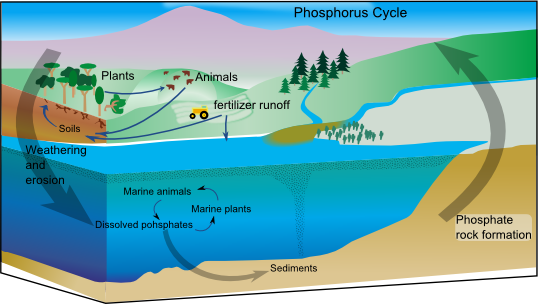
The phosphorus cycle is the biogeochemical cycle that involves the movement of phosphorus through the lithosphere, hydrosphere, and biosphere. Unlike many other biogeochemical cycles, the atmosphere does not play a significant role in the movement of phosphorus, because phosphorus and phosphorus-based materials do not enter the gaseous phase readily, as the main source of gaseous phosphorus, phosphine, is only produced in isolated and specific conditions. Therefore, the phosphorus cycle is primarily examined studying the movement of orthophosphate (PO3−4), the form of phosphorus that is most commonly seen in the environment, through terrestrial and aquatic ecosystems.
Living organisms require phosphorus, a vital component of DNA, RNA, ATP, etc., for their proper functioning. Phosphorus also enters in the composition of phospholipids present in cell membranes. Plants assimilate phosphorus as phosphate and incorporate it into organic compounds. In animals, inorganic phosphorus in the form of apatite (Ca5(PO4)3(OH,F)) is also a key component of bones, teeth (tooth enamel), etc. On the land, phosphorus gradually becomes less available to plants over thousands of years, since it is slowly lost in runoff. Low concentration of phosphorus in soils reduces plant growth and slows soil microbial growth, as shown in studies of soil microbial biomass. Soil microorganisms act as both sinks and sources of available phosphorus in the biogeochemical cycle. Short-term transformation of phosphorus is chemical, biological, or microbiological. In the long-term global cycle, however, the major transfer is driven by tectonic movement over geologic time and weathering of phosphate containing rock such as apatite. Furthermore, phosphorus tends to be a limiting nutrient in aquatic ecosystems. However, as phosphorus enters aquatic ecosystems, it has the possibility to lead to over-production in the form of eutrophication, which can happen in both freshwater and saltwater environments.
Human activities have caused major changes to the global phosphorus cycle primarily through the mining and subsequent transformation of phosphorus minerals for use in fertilizer and industrial products. Some phosphorus is also lost as effluent through the mining and industrial processes as well.
Phosphorus is an essential nutrient for plants and animals. Phosphorus is a limiting nutrient for aquatic organisms. Phosphorus forms parts of important life-sustaining molecules that are very common in the biosphere. Phosphorus does enter the atmosphere in very small amounts when dust containing phosphorus is dissolved in rainwater and sea spray, but the element mainly remains on land and in rock and soil minerals. Phosphates which are found in fertilizers, sewage and detergents, can cause pollution in lakes and streams. Over-enrichment of phosphate in both fresh and inshore marine waters can lead to massive algae blooms. In fresh water, the death and decay of these blooms leads to eutrophication. An example of this is the Canadian Experimental Lakes Area.
Freshwater algal blooms are generally caused by excess phosphorus, while those that take place in saltwater tend to occur when excess nitrogen is added. However, it is possible for eutrophication to be due to a spike in phosphorus content in both freshwater and saltwater environments.
Phosphorus occurs most abundantly in nature as part of the orthophosphate ion (PO4)3−, consisting of a P atom and 4 oxygen atoms. On land most phosphorus is found in rocks and minerals. Phosphorus-rich deposits have generally formed in the ocean or from guano, and over time, geologic processes bring ocean sediments to land. Weathering of rocks and minerals release phosphorus in a soluble form where it is taken up by plants, and it is transformed into organic compounds. The plants may then be consumed by herbivores and the phosphorus is either incorporated into their tissues or excreted. After death, the animal or plant decays, and phosphorus is returned to the soil where a large part of the phosphorus is transformed into insoluble compounds. Runoff may carry a small part of the phosphorus back to the ocean. Generally with time (thousands of years) soils become deficient in phosphorus leading to ecosystem retrogression.
There are four major pools of phosphorus in freshwater ecosystems: dissolved inorganic phosphorus (DIP), dissolved organic phosphorus (DOP), particulate inorganic phosphorus (PIP) and particulate organic phosphorus (POP). Dissolved material is defined as substances that pass through a 0.45 μm filter. DIP consists mainly of orthophosphate (PO3−4) and polyphosphate, while DOP consists of DNA and phosphoproteins. Particulate matter are the substances that get caught on a 0.45 μm filter and do not pass through. POP consists of both living and dead organisms, while PIP mainly consists of hydroxyapatite, Ca5(PO4)3OH . Inorganic phosphorus comes in the form of readily soluble orthophosphate. Particulate organic phosphorus occurs in suspension in living and dead protoplasm and is insoluble. Dissolved organic phosphorus is derived from the particulate organic phosphorus by excretion and decomposition and is soluble.
The primary biological importance of phosphates is as a component of nucleotides, which serve as energy storage within cells (ATP) or when linked together, form the nucleic acids DNA and RNA. The double helix of our DNA is only possible because of the phosphate ester bridge that binds the helix. Besides making biomolecules, phosphorus is also found in bone and the enamel of mammalian teeth, whose strength is derived from calcium phosphate in the form of hydroxyapatite. It is also found in the exoskeleton of insects, and phospholipids (found in all biological membranes). It also functions as a buffering agent in maintaining acid base homeostasis in the human body.
Hub AI
Phosphorus cycle AI simulator
(@Phosphorus cycle_simulator)
Phosphorus cycle
The phosphorus cycle is the biogeochemical cycle that involves the movement of phosphorus through the lithosphere, hydrosphere, and biosphere. Unlike many other biogeochemical cycles, the atmosphere does not play a significant role in the movement of phosphorus, because phosphorus and phosphorus-based materials do not enter the gaseous phase readily, as the main source of gaseous phosphorus, phosphine, is only produced in isolated and specific conditions. Therefore, the phosphorus cycle is primarily examined studying the movement of orthophosphate (PO3−4), the form of phosphorus that is most commonly seen in the environment, through terrestrial and aquatic ecosystems.
Living organisms require phosphorus, a vital component of DNA, RNA, ATP, etc., for their proper functioning. Phosphorus also enters in the composition of phospholipids present in cell membranes. Plants assimilate phosphorus as phosphate and incorporate it into organic compounds. In animals, inorganic phosphorus in the form of apatite (Ca5(PO4)3(OH,F)) is also a key component of bones, teeth (tooth enamel), etc. On the land, phosphorus gradually becomes less available to plants over thousands of years, since it is slowly lost in runoff. Low concentration of phosphorus in soils reduces plant growth and slows soil microbial growth, as shown in studies of soil microbial biomass. Soil microorganisms act as both sinks and sources of available phosphorus in the biogeochemical cycle. Short-term transformation of phosphorus is chemical, biological, or microbiological. In the long-term global cycle, however, the major transfer is driven by tectonic movement over geologic time and weathering of phosphate containing rock such as apatite. Furthermore, phosphorus tends to be a limiting nutrient in aquatic ecosystems. However, as phosphorus enters aquatic ecosystems, it has the possibility to lead to over-production in the form of eutrophication, which can happen in both freshwater and saltwater environments.
Human activities have caused major changes to the global phosphorus cycle primarily through the mining and subsequent transformation of phosphorus minerals for use in fertilizer and industrial products. Some phosphorus is also lost as effluent through the mining and industrial processes as well.
Phosphorus is an essential nutrient for plants and animals. Phosphorus is a limiting nutrient for aquatic organisms. Phosphorus forms parts of important life-sustaining molecules that are very common in the biosphere. Phosphorus does enter the atmosphere in very small amounts when dust containing phosphorus is dissolved in rainwater and sea spray, but the element mainly remains on land and in rock and soil minerals. Phosphates which are found in fertilizers, sewage and detergents, can cause pollution in lakes and streams. Over-enrichment of phosphate in both fresh and inshore marine waters can lead to massive algae blooms. In fresh water, the death and decay of these blooms leads to eutrophication. An example of this is the Canadian Experimental Lakes Area.
Freshwater algal blooms are generally caused by excess phosphorus, while those that take place in saltwater tend to occur when excess nitrogen is added. However, it is possible for eutrophication to be due to a spike in phosphorus content in both freshwater and saltwater environments.
Phosphorus occurs most abundantly in nature as part of the orthophosphate ion (PO4)3−, consisting of a P atom and 4 oxygen atoms. On land most phosphorus is found in rocks and minerals. Phosphorus-rich deposits have generally formed in the ocean or from guano, and over time, geologic processes bring ocean sediments to land. Weathering of rocks and minerals release phosphorus in a soluble form where it is taken up by plants, and it is transformed into organic compounds. The plants may then be consumed by herbivores and the phosphorus is either incorporated into their tissues or excreted. After death, the animal or plant decays, and phosphorus is returned to the soil where a large part of the phosphorus is transformed into insoluble compounds. Runoff may carry a small part of the phosphorus back to the ocean. Generally with time (thousands of years) soils become deficient in phosphorus leading to ecosystem retrogression.
There are four major pools of phosphorus in freshwater ecosystems: dissolved inorganic phosphorus (DIP), dissolved organic phosphorus (DOP), particulate inorganic phosphorus (PIP) and particulate organic phosphorus (POP). Dissolved material is defined as substances that pass through a 0.45 μm filter. DIP consists mainly of orthophosphate (PO3−4) and polyphosphate, while DOP consists of DNA and phosphoproteins. Particulate matter are the substances that get caught on a 0.45 μm filter and do not pass through. POP consists of both living and dead organisms, while PIP mainly consists of hydroxyapatite, Ca5(PO4)3OH . Inorganic phosphorus comes in the form of readily soluble orthophosphate. Particulate organic phosphorus occurs in suspension in living and dead protoplasm and is insoluble. Dissolved organic phosphorus is derived from the particulate organic phosphorus by excretion and decomposition and is soluble.
The primary biological importance of phosphates is as a component of nucleotides, which serve as energy storage within cells (ATP) or when linked together, form the nucleic acids DNA and RNA. The double helix of our DNA is only possible because of the phosphate ester bridge that binds the helix. Besides making biomolecules, phosphorus is also found in bone and the enamel of mammalian teeth, whose strength is derived from calcium phosphate in the form of hydroxyapatite. It is also found in the exoskeleton of insects, and phospholipids (found in all biological membranes). It also functions as a buffering agent in maintaining acid base homeostasis in the human body.