Hubbry Logo
Photo boothPhoto boothMain
Open search
Photo booth
Community hub
Photo booth
logo
8 pages, 0 posts
0 subscribers
Be the first to start a discussion here.
Photo booth
Photo booth
from Wikipedia

A Snap Digital Imaging booth in the UK.

A photo booth is a vending machine or modern kiosk that contains an automated, usually coin-operated, camera and film processor. Today, the vast majority of photo booths are digital.

History

[edit]
Anatol Josepho inside his photo booth.

The patent for the first automated photography machine was filed in 1888 by William Pope and Edward Poole of Baltimore. The first known really working photographic machine was a product of the French inventor T. E. Enjalbert (March 1889). It was shown at the 1889 World's Fair in Paris. The German-born photographer Mathew Steffens from Chicago filed a patent for such a machine in May 1889. These early machines were not reliable enough to be self-sufficient. The first commercially successful automatic photographic apparatus was the "Bosco" from inventor Conrad Bernitt of Hamburg (patented July 16, 1890). All of these early machines produced ferrotypes. The first automatic photographic apparatus with negative and positive process was invented by Carl Sasse (1896) of Germany.[1]

The modern concept of photo booth with (later) a curtain originated with Anatol Josepho (previously Josephewitz), who had arrived in the U.S. from Russia in 1923.[2] In 1925, the first photo booth appeared on Broadway in New York City. For 25 cents, the booth took, developed, and printed 8 photos, a process taking roughly 10 minutes. In the first six months after the booth was erected, it was used by 280,000 people. The Photomaton Company was created to place booths nationwide. On March 27, 1927, Josepho was paid $1 million and guaranteed future royalties for his invention.[3]

In the United Kingdom, entrepreneur Clarence Hatry established the Photomaton Parent Corporation, Ltd., in 1928.

Operation

[edit]

After money has been inserted in the machine, multiple customers can enter the booth and pose for a set number of exposures. Some common options include the ability to alter lighting and backdrops while the newest versions offer features such as cameras from a variety of angles, fans, seats, and blue screen effects. Some establishments even offer costumes and wigs for customers to borrow.

Once the pictures have been taken, the customers select the pictures that they wish to keep and customize them using a touch screen or pen-sensitive screen. The touch screen then displays a vast array of options such as virtual stamps, pictures, clip art, colorful backdrops, borders, and pens that can be superimposed on the photographs.

Features that can be found in some sticker machines are customizing the beauty of the customers such as brightening the pictures, making the eyes sparkle more, changing the hair, bringing a more reddish color to the lips, and fixing any blemishes by having them blurred. Other features include cutting out the original background and replacing it with a different background. Certain backgrounds may be chosen so when the machine prints out the picture, the final sticker will be shiny with sparkles.[citation needed]

Old Friend Photo Booth, New York, 2025

Finally, the number and size of the pictures to be printed are chosen, and the pictures print out on a glossy full-color 10 × 15 cm sheet to be cut up and divided among the group of customers. Some photo booths also allow the pictures to be sent to customers' mobile phones. Other photo places have a scanner and laptop at the cashier's desk for customers to scan and copy their original picture before they cut and divide the pictures amongst their group.[citation needed]

Types of photo booths

[edit]

Passport photo booths

[edit]
passport photo taken with photo booth

Most of the photo booths are used for passport photos. They are coin-operated automated machines that are designed to print a photo in a specific format that meets the passport photo requirements. Multiple copies can be printed so users can save some for future uses.

Traditionally, photo booths contain a seat or bench designed to seat the one or two patrons being photographed. The seat is typically surrounded by a curtain of some sort to allow for some privacy and help avoid outside interference during the photo session. Once the payment is made, the photo booth will take a series of photographs, although most modern booths may only take a single photograph and print out a series of identical pictures.[citation needed] Before each photograph, there will be an indication, such as a light or a buzzer, that will signal the patron to prepare their pose. Most booths will use artificial lighting, which may be flash or continuous lighting. After the last photograph in the series (typically between 3 and 8) has been taken, the photo booth begins developing the film — a process that used to take several minutes in the old "wet chemistry" booths, but is now typically accomplished in about 30 seconds with digital technology. The prints are then delivered to the customer. Typical dimensions of these prints vary. The classic and most familiar arrangement from the old style photo booths is four pictures on a strip about 40 mm wide by 205 mm long; digital prints tend to have a square arrangement of two images above two images.

Both black and white and colour photo booths are common in the US, however in Europe the colour photo booth has almost entirely replaced black and white booths. However, newer digital booths now offer the customer the option of whether to print in colour or in black and white. Most modern photo booths use video or digital cameras instead of film cameras, and are under computer control. Some booths can also produce stickers, postcards, or other items with the photographs on them, rather or as well as simply a strip of pictures. These often include an option of novelty decorative borders around the photos.

Korean-style photo booths

[edit]

South Korea’s photo-booth renaissance gathered pace in the late 2010s, led by chains such as Life Four Cut (인생네컷), Photoism, Photomatic, and Haru Film.[4][5][6]

These booths emphasise a studio-style portrait look—typically using DSLR or mirrorless cameras with a slightly high-angle lens position, soft continuous lighting, slim vertical “four-cut’’ or receipt-style strips, seasonal decorative frames, and muted film-look filters.[7]

By the early-2020s they had become ubiquitous along shopping streets, cafés, subway stations, festivals and K-pop fan-event venues, often operating 24 hours and offering QR-code downloads and cashless payment.[5]

The K-style booth format has since expanded beyond Korea, with permanent outlets or pop-ups reported in Hong Kong, Singapore, the United States and the United Kingdom.[8][9][10][11]

Alongside the major chains, Korean developers and manufacturers — such as Chalkak Studio — provide studio-look booths, vertical-strip layouts and event-driven software to domestic and overseas venues, helping the Korean style become one of the most influential modern photo-booth formats.[12]

Photo sticker booths

[edit]
Photo sticker shop in Seoul, South Korea

Photo sticker booths or photo sticker machines originated from Japan (see Purikura below). They are a special type of photo booth that produce photo stickers. Still maintaining huge popularity in Japan, they have spread throughout Asia to Taiwan, South Korea, Hong Kong, Singapore, Malaysia, Philippines, China, Vietnam, and Thailand. They have also been imported to Australia. Some have also begun appearing in the United States and Canada although they failed to make any impression in Europe when introduced in the mid-1990s.[citation needed]

Purikura

[edit]
Photo sticker that various effects designed with Purikura
A pen-sensitive touchscreen for decorating photos inside a purikura photo booth in Fukushima City, Japan

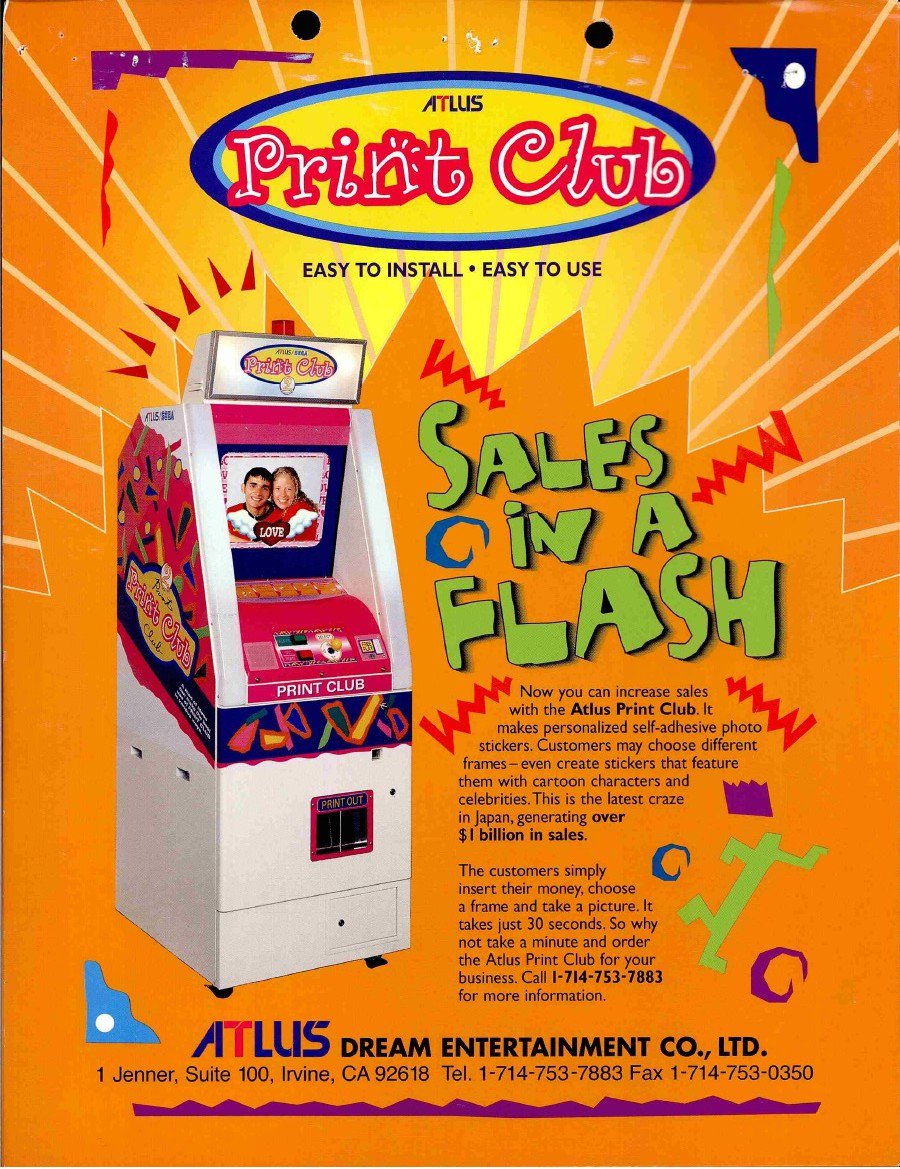
In Japan, purikura (プリクラ) refers to a photo sticker booth or the product of such a photo booth. The name is a shortened form of the registered Atlus/Sega trademark Print Club (プリント倶楽部, Purinto Kurabu), the first purikura machine, introduced to arcades in 1995.

Purikura produce what are today called selfies.[13][14] Purikura is essentially a cross between a traditional license/passport photo booth and an arcade video game, with a computer which allows the manipulation of digital images.[15] It involves users posing in front of a camera within the compact booth, having their images taken, and then printing the photos with various effects designed to look kawaii.[13] It presents a series of choices, such as desired backdrops, borders, insertable decorations, icons, text writing options, hair extensions, twinkling diamond tiaras,[14] tenderized light effects, and predesigned decorative margins.[13]

History of purikura

[edit]

Purikura has roots in Japanese kawaii culture, which involves an obsession with beautifying self-representation in photographic forms, particularly among females.[13] Purikura originate from the Japanese video game arcade industry. It was conceived in 1994 by Sasaki Miho, inspired by the popularity of girl photo culture and photo stickers in 1990s Japan. She worked for a Japanese game company, Atlus, where she suggested the idea, but was initially rejected.[16] Atlus eventually decided to pursue Miho's idea,[16] and developed it with the help of a leading Japanese video game company, Sega,[17] which later became the owner of Atlus.[14] Sega and Atlus introduced Print Club, the first purikura,[14] in February 1995, initially at game arcades, before expanding to other popular locations such as fast food shops, train stations, karaoke establishments and bowling alleys.[17] Game Machine magazine listed Printing Club as Japan's most successful arcade game in the non-video game category during early 1996,[18] and it went on to become the overall highest-grossing arcade game of 1996 in Japan.[19] By 1997, about 45,000 Purikura machines had been sold, earning Sega an estimated ¥25 billion (£173 million) or $283,000,000 (equivalent to $568,000,000 in 2025) annually from Purikura sales that year.[20] Print Club went on to generate over $1 billion in sales for Atlus and Sega.[21]

The success of the original Sega-Atlus machine led to other Japanese arcade game companies producing their own purikura, including SNK's Neo Print in 1996 and Konami's Puri Puri Campus (Print Print Campus) in 1997,[14] with Sega controlling about half of the market that year.[20] Purikura became a popular form of entertainment among youths in Japan, then East Asia, in the 1990s.[13] To capitalize on the purikura phenomenon, Japanese mobile phones began including a front-facing camera, which facilitated the creation of selfies, during the late 1990s to early 2000s.[13][22] Photographic features in purikura were later adopted by smartphone apps such as Instagram and Snapchat, including scribbling graffiti or typing text over selfies, adding features that beautify the image, and photo editing options such as cat whiskers or bunny ears.[23][24]

3D selfie photo booths

[edit]

A 3D selfie photo booth such as the Fantasitron located at Madurodam, the miniature park, generates 3D selfie models from 2D pictures of customers. These selfies are often printed by dedicated 3D printing companies such as Shapeways. These models are also known as 3D portraits, 3D figurines or mini-me figurines.

Different types of photo booths

[edit]

Cultural significance of photo booths

[edit]

Purikura

[edit]

Purikura offer rare insight into Japanese popular culture, specifically girl culture. Purikura is a social activity, rarely done alone. It is also now an established form of entertainment, with most Japanese having tried it at least once. The wide lexicon associated with purikura also reveals that it has grown outside kawaii culture; erotic purikura, creepy purikura, and couples purikura are all genres of this popular form of self-photography.[25] Graffiti purikura, an alternative genre of purikura, represents young females' desire to rebel from traditional gender roles.[26] In order to contradict stereotypical images of Japanese women as docile and meek, graffiti purikura photographers may photograph themselves in unflattering fashion or add stickers which defy cuteness, such as the poop emoji.[27] Rather than simple conceited frivolity, purikura photography demonstrates ingenuity and creativity on the part of young Japanese women seeking forms of self-expression.[27]

Flinders Street Station photo booth

[edit]

Located at the Elizabeth Street exit of Melbourne's busiest railway station, Flinders Street Station, lies a culturally significant photo booth. The photo booth has been continuously operating at the station since 1961, with many feeling it has become an iconic and irreplaceable part of the station.[28] It has been maintained for the entirety of its life by owner Alan Adler. During May 2018, Mr Adler (then 86) was given 10 days notice to remove the photo booth by Metro Trains Victoria to make way for station upgrades. Alan informed passerby with a hand written note explaining the news prompting widespread backlash from the public and support for Alan and his photo booth. After a letter writing campaign to Metro Trains, Public Transport Victoria CEO Jeroen Weimar phoned Alan to apologise and assured him a new home would be found.[29] Days later they successfully relocated the photo booth to another location within Flinders Street Station. The photo booth shoots analogue images in black and white and joins 3 images together vertically. The three photo format is unusual and adds to the booth's international attraction and reputation. Most photo booths internationally print a narrower 4 image strip. The three image strip is a legacy of a time when the booths were used for things like identification cards for taxi drivers which required a wider image.

Alan Adler at his internationally famous Flinders Street photo booth on 23 May 2024.

Alan Adler was acknowledged in 2023 as "Melbourne's most photographed man" in an article in The Age, after 50 years of maintaining and adjusting his booths involved innumerable photo strips.[30] Alan died at 92 years of age on 18 Dec 2024, leaving a legacy of millions of images of residents and visitors to Melbourne. For a man who didn't consider himself a photographer, he left a body of work larger than almost anyone alive.[31]

Alan's work has been curated into a book, "Auto-Photo: A Life in Portraits." In June 2025 Alan's life work was celebrated in an exhibition with the same name at RMIT Melbourne,[32] coinciding with 100 years since the first photobooth commenced operation in New York.[31][33]

When Alan announced by way of a note on the Flinders Street booth that he was retiring and the booth would no longer be there after May 23, 2018, it prompted Chris Sutherland and Jess Norman to initially assist in the booth maintenance. The pair had a long term emotional attachment to the Flinders Street photo booth and recognized its place as a Melbourne icon. Several years later the pair set about purchasing Alan's booths and creating Metro Auto Photo to continue his legacy.[31] Assisted by Lance Weeks from Burnt Out Electronics,[34] Sutherland and Norman now continue Adler's life work operating his original photo booths in Melbourne, while also restoring and commissioning booths that have not operated for decades to new Melbourne locations.

Amélie

[edit]

In the 2001 French movie Amélie, the photobooth is an essential element of the story. Amélie (Audrey Tautou) encounters Nino (Mathieu Kassovitz) collected unwanted photos under a photobooth and collects these artefacts in a photo album. Photobooth pictures become a means of communication between the characters as well as characters themselves.[35]

Photo booths for parties

[edit]

Photo booth rental companies allow a person to rent a photo booth for a short period of time (usually in hours) for a fee. Photo booth rentals have become popular in the United States primarily for wedding receptions, sweet sixteen parties, Bar and Bat Mitzvah parties, along with a growing number of other public and private events. In addition to the photo booth and the printing of unlimited photo strips, rental companies usually include a photo booth attendant to service the photo booth and to help guests construct the guest book of photo strips. Online image hosting, compact discs containing the images and related merchandise are readily available. Celebrities are frequent users of photo booths in parties.[36]

A photo printed from a Chanel event in Singapore in 2013

Apart from traditional photo printing, modern photo booths may also include the following new functions:[37]

  • Animated GIF
  • Flip book printing
  • Virtual props, placed intelligently on the person's eyes or shoulders etc.
  • Slow-motion video
  • Green-screen background removal
  • Fun costume virtual dressing
  • Games - mostly Kinect body gesture controlled games, and print a photo of the person and his/her scores
  • Facial gesture recognition

Growth of photo booth rentals

[edit]

As digital cameras, compact photo printers, and flat screen computer monitors became widely available in the early 2000s, people connected these together using a personal computer and software and created their own photo booths. Entrepreneurs began renting machines built along these lines at weddings and parties and the idea spread.[38] From 2005 to 2012, interest in the United States for photo booth rentals grew significantly. By 2016, more people were searching for photo booth rentals than DJ rentals in 15 of North America's largest cities.[39] In Greater Los Angeles alone, there are now more than 600 photo booth rental companies.[40] Photo booth rentals have also become popular in other countries such as Canada, Australia, and the UK.[38] So far in 2016, there is an average of 226,000 monthly searches for a photo booth globally. This has risen by 48.9% since 2015 (in the UK alone this is nearly 20,000 searches a month).[41]

References

[edit]

Further reading

[edit]
[edit]
Revisions and contributorsEdit on WikipediaRead on Wikipedia
from Grokipedia
A photo booth is a compact, enclosed kiosk or vending machine featuring an automated camera and processing system that enables users to capture self-portraits or group photos quickly and affordably, often producing instant strips of four to eight images for a small coin-operated fee. The modern photo booth traces its origins to the 1920s, when Siberian immigrant Anatol Josepho invented the first fully automated model, opening a "Photomaton" studio on Broadway in New York City in 1926 that delivered eight photographs in under five minutes for 25 cents. This innovation democratized portrait photography, shifting it from expensive studio sessions to accessible public entertainment and making it a staple at amusement parks, arcades, and malls by the mid-20th century. Early models relied on chemical film development, capturing candid expressions in a private curtained space that encouraged playful posing. Over time, photo booths evolved from analog chemical processors to digital systems in the 1990s, incorporating video, props, and touchscreen interfaces for enhanced interactivity at events like weddings and parties, while preserving their role in documenting personal milestones and celebrity culture—such as images of John F. Kennedy, Andy Warhol, and John Lennon with Yoko Ono. As of 2024, approximately 200 authentic chemical photo booths operate in the United States, supplemented by tens of thousands of digital variants worldwide.

History

Origins and Early Innovations

The concept of an automated photo booth emerged in the late 19th century with initial patents for mechanical devices aimed at simplifying portrait photography. In 1888, William Pope and Edward Poole of Baltimore filed the first known patent for an automated photography machine, describing a coin-operated apparatus that would expose and develop photographs without manual intervention, though no evidence exists of a functioning prototype being built. This laid a foundational idea for self-service imaging, building on earlier photographic advancements like roll film introduced by George Eastman in the 1880s. The following year, in 1889, French inventor T.E. Enjalbert created the first operational photographic booth, demonstrated at the Paris World's Fair, where users could insert a coin to trigger exposure on sensitized paper within a compact enclosure, followed by manual chemical development nearby. These early efforts highlighted the potential for portable, user-driven portraiture but were limited by unreliable mechanics and processing times. A significant breakthrough occurred in 1925 when Siberian immigrant Anatol Josepho (born Anatol Yozhpe, later shortened from Josephowitz) invented and patented the first fully automated, coin-operated photo booth in New York City, named the Photomaton. Josepho, who had studied photography in Europe and worked as a portraitist in China, designed the device after observing demand for affordable, instant images; he raised $11,000 from investors to build and install the first unit at 1659 Broadway near Times Square. For a quarter, users entered a curtained wooden enclosure about the size of a telephone booth, posed before a fixed camera triggered by a timer, and received a strip of eight black-and-white portraits—each roughly 2x3 inches—developed on-site in under ten minutes using 35mm roll film and an automated chemical process involving developer, fixer, and washer baths integrated into the machine. The Photomaton's mechanics relied on a simple pneumatic timer for eight sequential exposures, advancing the film strip automatically, followed by rapid immersion in processing trays that produced dry prints via heated air circulation, marking a shift from prior manual or semi-automated systems. Josepho's patent (U.S. No. 1,656,522, granted in 1928 but filed in 1925) specifically covered the film strip development apparatus, emphasizing efficiency for high-volume use. The Photomaton quickly gained traction, with the initial booth processing over 7,000 customers per day in its early weeks of operation and reportedly 14 million portraits annually across early installations, prompting Josepho to sell North American rights in 1927 for $1 million to a group of investors led by Henry Morgenthau Sr. This commercialization spurred widespread adoption in the late 1920s and 1930s, particularly in high-traffic public venues where novelty and affordability appealed to the masses. Photo booths appeared in amusement parks like Coney Island, offering quick souvenirs amid rides and games, and in train stations such as New York's Penn Station, catering to travelers seeking mementos or identification photos. These locations capitalized on the booths' compact design and self-contained operation, which required minimal supervision, fostering a cultural phenomenon of spontaneous self-portraiture before the rise of personal cameras.

Mid-20th Century Expansion

The widespread adoption of photo booths accelerated during World War II, as American soldiers frequently used them to produce quick, inexpensive portraits for mailing to family and sweethearts, fostering a surge in installations across the country. By the war's end in 1945, more than 30,000 booths operated in the United States, reflecting their role in providing accessible mementos amid wartime separation. This demand prompted technological refinements for greater portability and user-friendliness, particularly in the 1940s, to suit mobile military populations and urban settings. The Photomatic booth, developed by the International Mutoscope and Reel Company, exemplified this shift with its compact, stylish design that was more portable than predecessors, producing images in just one minute and facilitating easier placement in transient locations like bases and transit hubs. Key manufacturers, including International Mutoscope, standardized the iconic four-photo strip format during this period, establishing a consistent output of sequential poses on a single vertical strip that became the industry norm for analog booths. Photo booths enjoyed widespread popularity through the mid-20th century, peaking in the post-World War II era with tens of thousands active nationwide, and remaining a fixture in the 1970s in emerging shopping malls and amusement arcades, where they offered spontaneous entertainment for families and youth. The introduction of color film in the late 1960s and early 1970s, advanced by firms like International Mutoscope through chemical processing techniques, dramatically boosted their cultural appeal by enabling vibrant, expressive images suited to personal keepsakes and social sharing. This era solidified photo booths as embedded fixtures in American leisure, blending affordability with the era's emphasis on individuality and fun.

Digital Era Transformations

The transition to digital photo booths marked a significant evolution in the late 1990s, with Photo-Me pioneering the introduction of color digital models that utilized digital cameras for image capture and computer-based printers for rapid output. These booths replaced chemical processing with electronic sensors and thermal printing technology, enabling instant color photo strips without the need for darkroom development. This shift improved accessibility and reduced maintenance costs, allowing for deployment in high-traffic locations like malls and airports. In the 2000s, advancements in software and hardware further transformed photo booths, incorporating touchscreen interfaces that simplified user navigation and introduced customizable options such as digital filters and basic editing tools. These interfaces allowed users to select poses or effects directly on-screen, enhancing interactivity beyond mechanical buttons. Additionally, digital storage capabilities enabled sharing of photos via email or USB export, facilitating personal distribution without relying solely on physical prints. This era's innovations made photo booths more versatile for events, blending instant gratification with digital convenience. Following 2010, photo booths integrated seamlessly with social media platforms, including compatibility with Instagram for direct uploads and hashtag campaigns that amplified event visibility. These features leveraged smartphone proliferation to allow users to share booth photos in real-time, turning individual captures into communal experiences. In the early 2020s, particularly around 2023, artificial intelligence enhancements began to emerge, incorporating pose detection algorithms to guide users toward optimal positioning and automatically adjust lighting or framing for better results. Such AI-driven tools, often based on deep learning models for facial and body recognition, improved photo quality and user engagement in automated setups. The COVID-19 pandemic from 2020 to 2022 profoundly influenced photo booth design, accelerating the adoption of contactless operations through QR code access and remote controls to minimize physical interactions. Virtual photo booth applications proliferated during this period, enabling remote participation via web-based interfaces where users could apply filters and share digital strips from personal devices. These adaptations sustained the industry amid event cancellations, with companies pivoting to online formats for virtual gatherings. By 2025, recovery trends have emphasized hybrid models that combine physical booths with virtual extensions, supporting both in-person and remote attendees while incorporating lingering contactless features for broader accessibility. As of 2025, the industry continues to innovate with advanced AI features and sustainable practices, reflecting ongoing recovery and adaptation.

Operation

Mechanical and Technical Components

Photo booths rely on distinct mechanical and technical components that vary between analog and digital models, enabling the capture, processing, and delivery of images within a compact, user-operated enclosure.

Camera Systems

In analog photo booths, the camera system typically employs either a 35mm film loader or direct exposure of photographic paper with a fixed lens to light flashes from an integrated strobe unit, ensuring consistent exposure across multiple shots in a strip. This setup, often featuring a focal plane shutter, captures images on reversal paper that develops into positive prints without negatives. Digital photo booths, by contrast, utilize high-resolution DSLR or mirrorless cameras connected to a computing device, providing superior image quality and low-light performance through sensors that capture up to 20+ megapixels per frame. These cameras are frequently paired with ring lights—circular LED arrays delivering even, shadow-free illumination at intensities up to 5400 lux—to enhance facial details and minimize glare on glasses or skin.

Processing Units

Analog models incorporate mechanical transport systems, such as a "spider" arm assembly, to move exposed paper through a series of chemical tanks containing developer (e.g., Clayton RAD 5 solution), water rinses, bleach (potassium dichromate-based), clearing agents, and toner for image fixation and enhancement. This electromechanical process, driven by gears, solenoids, and relays, completes development in approximately 2 minutes per strip, producing instant black-and-white or sepia prints. Modern digital units feature dedicated computers or tablets running proprietary software (e.g., Face Place) for real-time image capture, basic editing like cropping and filter application, and output preparation. Processing culminates in dye-sublimation or inkjet printers that produce color prints on photo paper using thermal transfer or ink cartridges, enabling rapid 4x6-inch outputs in under 30 seconds while supporting digital sharing via USB or cloud upload.

Enclosure Design

Enclosures in both analog and digital photo booths are engineered for privacy and usability, often featuring a compact cabinet (typically 6-8 feet tall) with a one-sided entry curtain made of heavy fabric to block external light and sightlines. Internal layouts include a adjustable stool or bench for seating 1-4 users, a full-length mirror positioned adjacent to the camera lens for pose alignment, and reinforced walls (wood, aluminum, or fabric-covered frames) to house components securely. Power integration supports coin-operated mechanisms in legacy designs or credit card readers in contemporary ones, with enclosures often portable via wheels for event mobility.

Safety Features

Legacy analog booths require ventilation systems to exhaust chemical fumes from processing tanks, alongside operator guidelines mandating respirators, gloves, and goggles to mitigate exposure to developers and bleaches. Digital variants prioritize data security through encryption protocols for stored images, password-protected access to software interfaces, and secure transmission during sharing to prevent unauthorized viewing or breaches.

User Interaction Process

The user interaction process in a photo booth typically begins with payment and selection. Users insert coins, bills, or use credit cards via a slot or touchscreen interface to initiate the session, often costing a fixed amount for a set number of shots. In modern digital booths, the interface may prompt selection of themes, backgrounds, or basic options before proceeding. Once payment is confirmed, users enter the booth and prepare for posing and capture. A timer countdown, usually 3-5 seconds per shot, signals the start, allowing time to adjust poses; this is synchronized with a camera flash for optimal lighting. The sequence often involves multiple shots—typically three or four poses in rapid succession over about 30 seconds—to create a strip or collage. Hardware components, such as the camera and lighting systems, enable this automated timing and synchronization. In digital photo booths, the process continues with post-capture editing on an on-screen interface. Users preview the images and apply options like cropping to fit the frame, adding digital filters for effects, or overlaying text and graphics for personalization, typically within 20-30 seconds. Analog booths skip this step, proceeding directly to processing. Finally, retrieval provides the output. Traditional booths dispense a physical photo strip from a slot after chemical development, while digital versions offer instant prints or QR codes for downloads and sharing via email or apps. The entire session, from entry to exit, averages 2-5 minutes, accommodating quick turnover in high-traffic settings.

Output and Customization Options

Photo booths typically produce physical prints in standardized formats designed for portability and keepsake value, with the most common being a 2x6 inch vertical strip containing four wallet-sized photos arranged in a sequence captured during a single session. This format allows users to receive a compact, multi-image memento that fits easily into wallets or pockets. Variations include single 4x6 inch prints for individual shots, or collage layouts combining multiple images on a larger sheet, such as 4x6 or 5x7 inches, to accommodate group photos or thematic arrangements. Customization options enhance the creative output of photo booths, enabling users to personalize their results through digital overlays and effects applied post-capture. Background swaps allow replacement of the default booth setting with themed images, such as scenic landscapes or event-specific graphics, while stickers and frames add decorative elements like borders, text, or icons to frame the photos. In modern booths, augmented reality (AR) effects introduce interactive features, such as virtual accessories, animations, or filters that overlay the images for a dynamic, shareable result. Digital extras extend the utility of photo booth outputs beyond physical prints, facilitating easy distribution and event branding. QR codes printed on or accompanying the photos link to online galleries where users can download high-resolution versions for social media sharing, often without requiring email sign-ups. Watermarking integrates event logos or custom messages directly onto the images, ensuring branded visibility in shared content. Additionally, digital files can incorporate prop-inspired overlays, simulating physical accessories like hats or signs through software for cohesive, themed results. Print quality in photo booths adheres to professional standards to ensure sharp, vibrant results, with resolutions commonly reaching up to 300 DPI for crisp detail on standard sizes like 2x6 inches. Digital files are typically exported in JPEG format for compatibility with sharing platforms, though PNG is used for options requiring transparency, such as overlays in custom designs. These specifications balance file size with visual fidelity, supporting both immediate printing and online dissemination.

Types

Passport and Identification Booths

Passport and identification photo booths are self-service kiosks engineered specifically to capture and print photographs that adhere to rigorous biometric standards required for official documents, including passports, visas, national IDs, and driver's licenses. These standards are primarily governed by the International Civil Aviation Organization (ICAO) Doc 9303 guidelines, which specify a photo size of 35 mm wide by 45 mm high, with the subject's face measuring 32-36 mm from chin to crown (70-80% of the image height), a plain light-colored or white background, full frontal view with eyes open and mouth closed, and no shadows or reflections on the face. Similar requirements apply in the United States, where the U.S. Department of State mandates a 2x2 inch (51x51 mm) color photo taken within the last six months against a white or off-white background, ensuring uniformity for machine-readable travel documents. Key features of these booths prioritize precision and consistency to meet regulatory demands. They typically include a fixed-height stool or seating apparatus to position the subject's head at a standardized distance from the camera, preventing variations in scale that could invalidate the photo. Built-in cameras with auto-focus and face-detection technology capture high-resolution images, followed by automated software that crops, resizes, and adjusts brightness or contrast to comply with specifications, such as removing any non-neutral elements from the backdrop. Plain, seamless backdrops—often white or light gray—are standard to eliminate distractions and ensure the image's neutrality, with the entire process designed for quick, unattended operation. These booths are widely deployed in high-traffic public venues worldwide to facilitate easy access for travelers and applicants. They are prevalent in airports for last-minute visa or ID needs, as well as in post offices and government service centers; for instance, in the United Kingdom, Post Office branches have offered digital passport photo booths as part of their Check & Send service, charging a standard fee for compliant prints. Unlike recreational booths, identification models exclude filters, props, or creative effects, emphasizing unadorned accuracy to avoid rejection by issuing authorities, thereby supporting secure biometric verification in global travel and identification systems.

Traditional Coin-Operated Booths

Traditional coin-operated photo booths feature compact enclosures typically constructed from wood or metal, providing a private space for users. These booths include manual curtains that users draw closed for privacy during the session, along with prominent coin slots designed to accept 25 to 50 cents per use, depending on the era and location. The design emphasizes simplicity and self-service, with an automated camera and film processing system activated upon coin insertion, allowing for quick, unattended operation without staff intervention. These booths were commonly installed in high-traffic public venues such as shopping malls, amusement arcades, and seaside boardwalks, where they offered accessible entertainment to passersby. Users would receive output in the form of simple strips containing four to eight images, initially in black-and-white during the mid-20th century and transitioning to color by the 1970s in many models. The strips provided instant, affordable snapshots, capturing candid expressions in a standardized format that emphasized the booth's mechanical efficiency. The nostalgic charm of these booths stems from their retro aesthetics, with iconic models from the 1920s like the Photomaton to 1980s variants such as the Auto-Photo Model 14 still cherished and restored by enthusiasts today. These restorations preserve the original art deco styling and analog functionality, evoking a sense of mid-century Americana and mechanical ingenuity. Maintenance involves periodic film restocking and chemical replenishment to ensure consistent image quality, while later designs incorporated enhanced durability to resist vandalism in public settings.

Sticker and Themed Fun Booths

Sticker and themed fun booths emerged as a vibrant subset of photo booths in the Western world during the 1990s, prioritizing entertainment and creativity over utilitarian photography. These booths featured adhesive-backed prints that allowed users to decorate laptops, notebooks, and personal items with their photos, often enhanced by cartoon overlays and digital effects for whimsical group shots. Costume props, such as hats, glasses, and silly accessories, were commonly provided inside the booth to encourage playful posing and thematic role-playing, transforming the experience into a social activity. The popularity of these booths surged alongside the rise of digital technology and mall culture in the 1990s, where they became fixtures in shopping centers, arcades, and teen-oriented stores like Claire's and Limited Too. This era marked a shift from traditional strip photos to interactive, customizable outputs, with dye-sublimation printers from brands like Mitsubishi enabling the production of glossy, durable stickers that resisted fading and peeling. The integration of coin-operated mechanisms from earlier booth designs facilitated easy access, making them affordable novelties for casual outings. Typical sessions extended up to 10 minutes, incorporating upbeat music to set a festive mood and screens displaying live previews that let groups review and select poses in real time. This extended format fostered collaboration among users, often 2 to 4 friends or family members squeezing into the booth for coordinated antics. Primarily appealing to teens and families, these booths served as creators of shareable mementos that captured spontaneous fun, contributing to their role as social bonding tools in pre-smartphone entertainment landscapes.

Purikura and Regional Variants

Purikura, a portmanteau of "purinto kurabu" meaning "print club," originated in Japan with the launch of the first dedicated photo sticker machines by the Tokyo-based game developer Atlus in July 1995. These early booths, developed in collaboration with Sega, introduced a novel format where users could capture multiple photos in a compact, arcade-style enclosure designed for one or two people, emphasizing fun and shareable outputs. The concept quickly captured the youth market, surging in popularity by 1997 after endorsements from celebrities like the band SMAP on national television, which helped establish purikura as a staple of Japanese teen culture. Central to purikura's appeal are its interactive features, including a variety of themed backdrops, props, and green-screen effects for posing, followed by robust digital editing tools. Users can apply filters to enlarge eyes, slim faces, add hearts, sparkles, cat ears, and decorative text, before selecting layouts for printing on adhesive sheets—typically yielding two copies per session. Booths often feature specialized rooms for couples or groups, with sessions costing around 400 yen (approximately 2-3 USD) and lasting 10-15 minutes, making them an affordable social activity in arcades and malls. The purikura model spread across Asia in the late 1990s and 2000s, inspiring regional adaptations that blended local aesthetics with the core sticker-printing mechanic. In South Korea, equivalents known as "Life 4 Cuts" (인생네컷) or photo sticker booths emerged in the early 2000s, often featuring four sequential shots with customizable frames and props influenced by K-pop idols and vibrant youth trends. By the 2010s, similar booths proliferated in China, incorporating K-pop elements like idol-themed stickers and filters amid the genre's rising popularity among young consumers, alongside localized designs for urban entertainment venues. Purikura reached its zenith in the 2000s, dominating arcade floors across Japan with long queues and themed variants tied to pop culture fads. Popularity waned in the 2010s due to smartphone cameras and social media filters offering similar effects at no cost, leading to fewer installations. However, a revival occurred in the 2020s, driven by nostalgia and post-COVID innovations like touchless interfaces, enhanced hygiene protocols, and hybrid models integrating QR codes for digital downloads alongside prints; apps mimicking purikura editing further extended its reach globally.

Digital and Selfie-Integrated Booths

Digital and selfie-integrated photo booths represent a modern evolution in the photo booth industry, leveraging smartphone technology, mobile applications, and interactive interfaces to facilitate self-captured images and videos without traditional enclosed structures. These booths often utilize open-air setups or mirror-based systems that encourage group participation through touchscreens or app-controlled cameras, allowing users to pose in real-time while guided by on-screen animations and prompts. Unlike earlier analog models, which relied on fixed mechanical cameras, digital variants integrate seamlessly with personal devices for enhanced accessibility and immediacy in capturing and distributing content. Key technological integrations in these booths include compatibility with smartphones via dedicated apps such as Simple Booth, dslrBooth, and LumaBooth, which enable users to control captures remotely or through iPad interfaces for mirror-style experiences. Simple Booth, launched around 2012, was an early contributor to iPad-based photo booth technology for iOS and iPad selfie-stations, featured as a demo app on iPad displays in Apple Stores globally following the 2014 iPad Air 2 release. It emphasized intuitive mobile UX, fast delivery straight to the user’s phone via text, seamless social sharing, user-driven experiences without need for an attendant, and an innovative design turning the light and camera toward the party to draw more users in. Artificial intelligence features, like those in Foto Master's AI-powered booths, automate posing suggestions and apply effects such as face swaps or virtual backgrounds, while green-screen technology allows for customizable virtual environments during sessions. These advancements build on open-air designs, providing portability and ease of setup for diverse venues. Core features emphasize digital sharing and multimedia output, including wireless transmission of photos and videos directly to platforms like TikTok and Instagram via QR codes or email, as seen in Pixster's social media-enabled booths. Boomerang-style looping videos and GIFs add dynamic elements, with instant cloud storage solutions like Photo Booth Cloud ensuring secure, accessible archiving of event media—a capability that gained prominence around 2015 with the rise of app-based booth software. These elements prioritize user-generated content that can be personalized with overlays, filters, and branding for immediate social dissemination. Such booths are commonly deployed at weddings and trade shows, where their compact, portable nature suits high-traffic environments; for instance, Open Air Photobooths offer a lightweight setup that assembles in under 10 minutes, ideal for capturing candid moments at corporate expos or matrimonial celebrations. This flexibility enhances attendee engagement by allowing seamless integration into event flows without requiring dedicated spaces. Looking toward 2025, emerging trends in these booths incorporate virtual reality (VR) enhancements for immersive posing experiences, as projected by industry innovators like DigiX Valley. AI continues to evolve with predictive personalization, such as generating avatars from user inputs, further blurring the lines between physical and virtual interactions in selfie-integrated systems. These developments underscore a shift toward interactive, tech-driven entertainment that extends beyond static photos.

Cultural and Social Impact

Role in Events and Social Gatherings

Photo booths serve as engaging interactive elements at parties, weddings, and social events, typically featuring a selection of props such as hats, signs, and themed accessories to encourage playful participation. Custom backdrops, often tailored to the event's aesthetic, provide a scenic setting that enhances the visual appeal and ties into the occasion's theme. Additionally, many setups include guest books where attendees paste their photo strips alongside handwritten messages, creating a tangible memento that captures the event's spirit and allows guests to contribute personally. The integration of photo booths into corporate events has surged since the early 2000s, coinciding with the digital revolution that introduced computer-operated, full-color models, making them accessible for professional gatherings like conferences, team-building functions, career fairs, and job fairs. This rise reflects their utility in fostering a relaxed atmosphere amid formal settings, with companies and event organizers increasingly incorporating them post-2000 to boost attendee involvement. In 2023, surveys indicated that over 47% of North American weddings featured photo booths, with adoption continuing to grow into the 2020s, underscoring their widespread adoption in social celebrations. In terms of social dynamics, photo booths function as effective icebreakers, particularly in networking scenarios such as career fairs and job fairs, where they draw attendees together for spontaneous interactions and reduce social barriers. Creative photo booth ideas for these professional events emphasize engagement, networking, branding, and fun while aligning with career themes. Common setups include branded photo booths with custom filters, overlays, or backdrops featuring company logos or event themes, encouraging attendees to share their photos on social media using specific event hashtags to generate buzz and visibility; profession-themed props such as signs ("Future CEO," "Hire Me," "Dream Job Loading"), hats, glasses, briefcases, or career tools (e.g., stethoscope, hard hat) to inspire participants and spark conversations; green screen booths allowing users to appear in dream job settings, office environments, or branded scenes for memorable and shareable photos; selfie stations with branded backdrops and props to serve as icebreakers and alleviate awkwardness at networking events; and GIF or animated photo booths producing dynamic, fun content that stands out and promotes sharing. These features help collect leads, boost event or employer visibility, create positive associations, and enhance overall engagement and networking. Group poses prompted by the booth's setup promote camaraderie and shared laughter, helping to forge connections and create enduring memories among participants. Studies suggest that incorporating photo booths at events can enhance positive team dynamics, highlighting their role in enhancing overall engagement. Customization options allow photo booths to align seamlessly with specific occasions, such as holiday themes featuring filters for events like Halloween or Christmas, complete with seasonal props and digital overlays. For branded events, including career fairs and job fairs, companies often incorporate logos, color schemes, and promotional messaging into photo strips and backdrops, turning the booth into a marketing tool that reinforces brand identity without disrupting the fun. This adaptability ensures the booth remains a versatile centerpiece for diverse social gatherings. Photo booths have left a significant mark on cinema, often symbolizing moments of intimacy and serendipity. In the 2001 film Amélie, directed by Jean-Pierre Jeunet, the protagonist Amélie Poulain collects discarded photo booth strips from Paris metro stations, using them to unravel the mystery of a man named Nino Quincampoix, whose habit of reassembling torn photos leads to a romantic connection; this narrative device underscores the booths' role in fostering unexpected human bonds and quiet vulnerability. In the realm of music and visual art, photo booths have inspired creative expressions that blend the mundane with the artistic. Andy Warhol pioneered their use in the 1960s, producing numerous self-portraits and celebrity portraits—such as those of Ethel Scull and himself—from booth strips, which he then silkscreened into larger installations exploring identity, repetition, and celebrity culture; these works, like the 1963 Self-Portrait at the Metropolitan Museum of Art, elevated the booth's instant, unpolished aesthetic to high art. While specific album covers utilizing booth imagery remain niche, the format's raw, sequential framing has influenced promotional photography in rock music, echoing Warhol's democratizing approach to portraiture. Throughout the 2010s, photo booths emerged as potent symbols in indie media, evoking spontaneity and nostalgia amid digital saturation. In independent films and visual storytelling of the era, they represented unfiltered, ephemeral joy—contrasting curated social media personas—and captured the era's yearning for analog authenticity, as seen in their revival in urban settings and artistic projects that romanticized pre-digital whimsy. In the social media era, photo booths have expanded their cultural reach through viral phenomena on platforms like TikTok. By 2025, challenges such as couple pose recreations and 360-degree slow-motion spins have garnered millions of views, transforming booths into interactive content generators that blend vintage charm with modern virality, further embedding them in youth-driven pop culture.

Iconic Installations and Landmarks

One of the most enduring symbols of photo booth history is the installation at Flinders Street Station in Melbourne, Australia, which began operations in 1961 and quickly became a fixture for commuters and visitors alike. Operated for over 50 years by Alan Adler until his passing in 2024, the booth captured countless candid moments in black-and-white strip format, embodying the simplicity of analog photography amid the bustling railway hub, and continues to operate under new management as of 2025. In 2018, during a major station renovation, the booth faced eviction but was preserved through public advocacy and community efforts, transforming it into a cherished tourist attraction that draws nostalgia-seekers to relive mid-20th-century snapshots. In Tokyo's Shibuya district, clusters of Purikura booths have served as vibrant youth landmarks since the mid-1990s, evolving from simple sticker photo machines into immersive cultural hubs within arcades and shopping complexes like Shibuya 109. These installations, often featuring dozens of themed machines with digital enhancements for creative posing and editing, have anchored Shibuya's reputation as a center of Japanese pop culture, where groups of friends and couples flock to produce personalized, embellished prints as social mementos. Sites such as Purikura no Mecca exemplify this semi-permanent presence, maintaining their allure as enduring spots for generational photo rituals in one of the world's busiest pedestrian crossings. Beyond these, other notable examples include vintage photo booths near the Hollywood Walk of Fame in Los Angeles, where analog units like those operated by Booth by Bryant offer film-based strips that complement the area's star-studded glamour and attract tourists seeking retro Hollywood memorabilia. In Europe, relics of early 20th-century photomaton booths persist in train stations and metros, such as the vintage installations in Barcelona's metro system, which provide historical black-and-white portraits reminiscent of the 1920s automated pioneers that once dotted railway platforms across the continent. Similarly, Paris features preserved Fotoautomats near stations like Gare du Nord, continuing the tradition of quick, utilitarian yet culturally resonant photography. Preservation efforts have played a crucial role in safeguarding these installations, with organizations like Photomatica maintaining dedicated museums in San Francisco and Los Angeles that house and operate over a dozen restored vintage booths, allowing visitors to engage with analog technology while archiving strips and machines from global collections. These initiatives not only document the mechanical evolution of photo booths but also highlight their role as cultural artifacts, ensuring that historical units from stations and arcades are maintained for educational and experiential purposes.

Business and Modern Developments

Rental and Service Industry Growth

The photo booth rental industry underwent a significant transformation in the 2000s, shifting from traditional ownership models to portable rental services tailored for events. This evolution was driven by the development of easy-to-transport booths suitable for weddings and parties, with party companies increasingly offering rentals as a convenient alternative to permanent installations. Companies like Simple Booth, an early contributor to photo booth technology for iOS and iPad-based "selfie-stations," further accelerated this change starting in 2012. Launching around the time of Instagram's acquisition by Facebook in 2012 and building on the iPad's initial release in 2010, Simple Booth was featured as a demo app on iPads in Apple stores globally following the 2014 iPad Air 2 release. The company emphasized growing familiarity with mobile interfaces through intuitive user experiences (UX), fast delivery of photos straight to the user’s phone via text, and seamless social sharing. Doubling down on user-driven experiences without the need for an attendant, Simple Booth innovated by directing the light and camera toward the party rather than a traditional backdrop, thereby drawing in even more users. It has served over 30,000 customers globally, introducing iPad-based software for live events that emphasized interactive experiences, social sharing, and features such as virtual backgrounds, making rentals more accessible and modern. By 2025, the global photo booth market, largely propelled by the rental segment, had surpassed USD 818 million in revenue, with projections indicating continued expansion at a compound annual growth rate (CAGR) of 8.8% through 2034, fueled by the booming events industry including weddings, corporate gatherings, and social functions. This growth reflects rising demand for personalized entertainment at events, where rentals provide a cost-effective way to enhance guest engagement without long-term ownership commitments. Rental services typically include professional setup, on-site attendants to assist guests, and unlimited photo prints or digital shares, with pricing ranging from $300 to $1,000 per event depending on duration, booth type, and location. For instance, basic packages often cover 3-4 hours of operation, while premium options add custom backdrops and props. The industry has faced challenges, particularly competition from smartphone apps and DIY solutions that offer similar photo-sharing features at lower or no cost, pressuring traditional rentals to differentiate through professional quality and event integration. During the 2020-2022 pandemic, operators adapted by pivoting to virtual and hybrid booth experiences, such as remote photo uploads and digital galleries, to sustain business amid restrictions on in-person gatherings. In the 2020s, artificial intelligence (AI) and machine learning have driven significant enhancements in photo booth technology, particularly through automated image processing. AI algorithms now perform real-time auto-enhancements for lighting and skin tone, adjusting brightness, contrast, color balance, and even correcting shadows to produce professional-quality outputs without manual intervention. For instance, glam filters analyze facial structure and ambient lighting to even skin tones and enhance details, ensuring consistent results across diverse group photos. These features, powered by machine learning models trained on vast image datasets, have become standard in modern booths since the early 2020s, improving accessibility for non-professional users. Facial recognition technology has further advanced group interactions in photo booths, enabling automated sorting and personalization of collective shots. Systems like GroupIntelligence use AI to detect and group individuals within photos, streamlining the organization of event galleries by identifying faces and associating them with participants. This capability reduces post-event processing time and allows for targeted sharing, such as sending personalized images to specific attendees via integrated apps. Sustainability efforts in photo booth design have gained momentum, focusing on eco-friendly materials and reduced waste generation. Manufacturers are increasingly adopting recyclable props made from bamboo, reclaimed wood, or recycled plastics, minimizing environmental impact while maintaining durability for repeated use. The shift toward digital-only outputs has also accelerated, eliminating the need for physical prints and thereby cutting down on paper and ink consumption; eco-friendly inks, such as soy-based alternatives, are used in remaining print options to lower chemical runoff. These innovations align with broader industry goals, with digital booths reducing waste compared to traditional models. Emerging trends are pushing photo booths into immersive digital realms, including integration with metaverse platforms and experimental holographic outputs. As of 2025, metaverse-ready booths allow users to upload photos into virtual environments via AR/VR interfaces, enabling shared experiences in digital spaces. Holographic displays, tested in event prototypes that year, project 3D images of participants for interactive, lifelike souvenirs, blending physical captures with augmented projections. These developments enhance engagement in hybrid events, where real-time data processing supports seamless virtual participation. Looking ahead, the future outlook for photo booths emphasizes 5G-enabled remote capabilities, projected to enable global virtual participation by 2030. Current virtual booth platforms already support remote access for distributed attendees, but 5G's low-latency networks will facilitate high-quality, real-time interactions, such as synchronized group poses across continents. This evolution builds on 2025 trends in hybrid events, where 5G integration promises immersive, lag-free experiences for worldwide users.

Accessibility and Sustainability Considerations

Photo booths have increasingly incorporated accessibility features to ensure usability for individuals with disabilities, aligning with broader standards like the Americans with Disabilities Act (ADA). Wheelchair-friendly designs, such as those without raised platforms or obstructions and with adjustable camera and touchscreen heights, allow users of varying mobility levels to participate comfortably. These adaptations promote inclusivity at events, enabling seamless access for wheelchair users. Additionally, some modern booths include voice commands and guided interfaces to assist visually impaired individuals, enhancing independent operation through audio feedback. Such features reflect ongoing efforts to meet ADA guidelines, which emphasize equitable access in public accommodations since their 2010 updates. Inclusivity extends to diverse user demographics through targeted design elements. Adjustable lighting systems in contemporary photo booths accommodate various skin tones, providing even illumination that avoids biases in image capture historically embedded in photographic technology. Gender-neutral props, such as those featuring universal themes like speech bubbles or abstract shapes, support participation across gender identities and are commonly used in events like baby showers to foster an welcoming environment. Global models often integrate multilingual options, with interfaces supporting multiple languages to serve international audiences and reduce language barriers. Sustainability practices in the photo booth industry have gained prominence, particularly following increased environmental awareness after 2020. Many operators have shifted toward reusable or digital props made from wood, fabric, or recyclable materials, minimizing the use of single-use plastics and reducing overall waste generation. Digital upgrades, while enabling features like app-based sharing, contribute to electronic waste from outdated hardware; to counter this, some providers participate in general e-waste recycling programs that refurbish or responsibly dispose of components. In 2025, industry trends emphasize carbon-neutral rental options, achieved through energy-efficient LED lighting and offset programs, alongside the promotion of recycled paper prints to lower environmental impact. These initiatives, driven by event sustainability demands, include biodegradable alternatives for physical outputs where feasible.

References

Add your contribution
Related Hubs
User Avatar
No comments yet.