Hubbry Logo
PickfairPickfairMain
Open search
Pickfair
Community hub
Pickfair
logo
8 pages, 0 posts
0 subscribers
Be the first to start a discussion here.
Pickfair
Pickfair
from Wikipedia

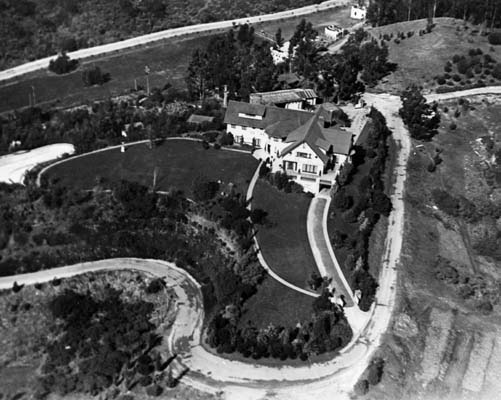
Aerial black-and-white photo showing a grand mansion with a curved driveway and manicured lawn nestled in the hills, surrounded by sparse trees and dirt roads
Aerial view of Pickfair, 1920.

Key Information

Pickfair is a mansion and estate in the city of Beverly Hills, California. The original Pickfair was an 18-acre (7.3 ha) estate[1] designed by architect Horatio Cogswell for attorney Lee Allen Phillips of Berkeley Square as a country home. Phillips sold the property to actor Douglas Fairbanks in 1918.[2] Dubbed "Pickfair" by the press, it became one of the most celebrated houses in the world.[3] Life described Pickfair as "a gathering place only slightly less important than the White House... and much more fun."[4]

History

[edit]

Construction and renovation (1919–1920s)

[edit]

Located at 1143 Summit Drive in San Ysidro Canyon in Beverly Hills, the property was a hunting lodge[5] when purchased by Fairbanks in 1919 for his bride-to-be, Mary Pickford. In the 1920s, the newlyweds extensively renovated the lodge, transforming it into a four-story, 25-room[4] mansion complete with stables, servants quarters, tennis courts, a large guest wing, and garages.

Remodeled by Wallace Neff in a mock Tudor style,[1] it took five years to complete. Ceiling frescos, parquet flooring, wood-paneled halls of fine mahogany and bleached pine, gold leaf, and mirrored decorative niches, all added to the authentic charm of Pickfair. The property was said to have been the first private home in the Los Angeles area to include an in-ground swimming pool, in which Pickford and Fairbanks were famously photographed paddling a canoe.[6]

Pickfair featured a collection of early 18th-century English and French period furniture, decorative arts, and antiques. Notable pieces in the collection included furniture from the Barberini Palace, the Baroness Burdett-Coutts estate in London, and Louis XVI furniture from the Countess Rodezno and Lord Leverhulme collections.[7][8] The highlight of any visit to Pickfair was a large collection of Chinese objets d'art collected by Fairbanks and Pickford on their many visits to the Orient. The Pickfair art collection was wide and varied and included paintings by Philip Mercier, Guillaume Seignac, George Romney, and Paul de Longpré.

The mansion also featured an Old West-style saloon complete with an ornate burnished mahogany bar obtained from a saloon in Auburn, California, and paintings by Frederic Remington. In the 1970 Volume 2, Number 10 issue of Mankind Magazine it states there were twelve Remingtons from 1907 purchased from the Cosmopolitan Publishing Company that "were Mary Pickford's gift to her husband, Charles 'Buddy' Rogers". The interior of Pickfair was decorated and updated throughout the years by Marilyn Johnson Tucker, Elsie De Wolfe, Marjorie Requa,[9][10][11][12] Tony Duquette, and Kathryn Crawford.[13]

Hollywood's social center (1920s–1930s)

[edit]

During the 1920s, the house became a focal point for Hollywood's social activities, and the couple became famous for entertaining there. An invitation to Pickfair was a sign of social acceptance into the closed Hollywood community. In 1928, Will Rogers said "My most important duty as mayor of Beverly Hills is directing people to Mary Pickford's house".[14]

Dinners at Pickfair became legendary; guests included Charlie Chaplin (who lived next door), the Duke of Windsor and Duchess of Windsor, Dorothy and Lillian Gish, Mildred Harris, Greta Garbo, George Bernard Shaw, Albert Einstein, Elinor Glyn, Helen Keller, H.G. Wells, Lord Louis Mountbatten, Fritz Kreisler, Tony Duquette, Amelia Earhart, F. Scott Fitzgerald, Joan Crawford, Noël Coward, President Franklin D. Roosevelt and Eleanor Roosevelt, Pearl S. Buck, Charles Lindbergh, Max Reinhardt, Arthur Conan Doyle, Thomas Edison, Gloria Swanson, the Duke and Duchess of Alba, the King and Queen of Siam, Austen Chamberlain, Vladimir Nemirovich-Danchenko,[15] the spiritual teacher Meher Baba, and Sir Harry Lauder. Lauder's nephew, Matt Lauder Jr., a professional golfer whose family had a property at Eagle Rock, Los Angeles, California, taught Fairbanks to play golf.

Later years (1936–1979)

[edit]

Fairbanks and Pickford divorced in January 1936, but Pickford continued to reside in the mansion with her third husband, actor and musician Charles "Buddy" Rogers,[4] until her death in 1979. Pickford received few visitors in her later years, but continued to open up her grand home for charitable organizations and parties, including an annual Christmas party for blind war veterans, mostly from World War I.[14]

In 1976, Pickford received a second Academy Award for contribution to American film. The Academy Honorary Award was presented to her in the formal living room of Pickfair, and televised on the 48th Academy Awards. Introduced and narrated by Gene Kelly, it gave the public a rare glimpse inside the fabled mansion.[16]

Sale, demolition, and rebuild (1979–present)

[edit]

Empty for several years after Pickford's death in 1979, Pickfair was eventually sold to Los Angeles Lakers owner Jerry Buss, who continued to care for the home, updating and preserving much of its unique charm.[17] In 1988, it was purchased by actress Pia Zadora and her husband Meshulam Riklis.[5] They announced they were planning renovations to the famous estate, but revealed in 1990 that they had in fact demolished Pickfair and a new larger "Venetian style palazzo" was going to be constructed in its place. In 1990, the Los Angeles Times reported that all but the guest wing and part of the living room had been razed.[18]

Faced with harsh criticism from a nostalgic public, including Douglas Fairbanks, Jr., Zadora defended her family's actions, stating that the house was allegedly in a poor state of repair and was infested by termites. In the L.A. Times, Fairbanks was quoted as saying, "I regret it very much. I wonder, if they were going to demolish it, why they bought it in the first place."

In 2012, Zadora claimed on the BIO channel's Celebrity Ghost Stories that the real reason she demolished Pickfair was not due to termite infestation but because it was haunted by the laughing ghost of a woman who allegedly died there while having an affair with the elder Fairbanks. Defending her actions, Zadora explained, "If I had a choice, I never would have torn down this old home. I loved this home, it had a history, it had a very important sense about it and you can deal with termites, and you can deal with plumbing issues, but you can't deal with the supernatural."

Remaining artifacts from the original Pickfair include the gates to the estate, the kidney-shaped pool and pool house, remnants of the living room, and the two-bedroom guest wing that played host to visiting royalty and notable film celebrities for over half a century. The guest wing was once used as a honeymoon suite for Lord Louis and Lady Mountbatten.[19]

Located at 1143 Summit Drive in Beverly Hills, UNICOM Global bought the mansion on April 19, 2005, for $15,000,000. The property included a gym, disco room, and sits on 2.25 acres (0.91 ha).[20] UNICOM Global now uses it for meetings, conferences and events.

[edit]

Zadora's purchase and subsequent demolition of Pickfair is referenced in Deborah Harry and Iggy Pop's version of "Well, Did You Evah!". Pop claims he was invited to Pia Zadora's house but didn't go, later saying "I hear they dismantled Pickfair... wasn't elegant enough", to which Harry replies "probably full of termites".

In The Simpsons, Krusty the Klown's mansion is named "Schtickfair" in an homage.

Lucille Ball stated that she and husband Desi Arnaz were inspired by the combination of names in Pickfair to name their own estate (and later studio) Desilu.

See also

[edit]
  • Casa del Rio, a house in Devon, England, inspired by Pickfair.

References

[edit]
[edit]
Revisions and contributorsEdit on WikipediaRead on Wikipedia
from Grokipedia
Pickfair was a historic mansion in , originally built in 1911 as a six-room hunting lodge by developer Lee A. Phillips and later transformed into a luxurious estate that became synonymous with Hollywood's . Purchased by actor Sr. in 1919 for $35,000 as a wedding gift for his bride-to-be, silent film star , the property was extensively renovated that same year at a cost of $175,000 into a three-story, L-shaped structure blending English Tudor and styles, designed by architect Max Parker. Following their marriage in 1920, the home—dubbed "Pickfair" as a portmanteau of their surnames—evolved into a 42-room colonial revival mansion with additions like the first private residential swimming pool in , stables, tennis courts, and guest quarters, further rebuilt in 1932 by architect Wallace Neff into a Regency-style residence in preparation for the Los Angeles Olympics. As the unofficial "Western White House," Pickfair symbolized the rise of Hollywood royalty and served as a glittering social epicenter during the and , hosting luminaries such as , , , and members of the , including the . The estate's lavish parties and public tours reflected Pickford's appreciation for her fans, cementing its status as America's second-most famous residence after the itself. After Fairbanks and Pickford's divorce in 1936, Pickford retained the property, remarrying bandleader Buddy Rogers in 1937 and residing there until her death in 1979; Rogers sold it in 1980 to Los Angeles Lakers owner for $5.4 million. In 1988, the estate was acquired by actress and her husband, businessman , for $6.675 million, but severe structural issues—including , , and a foundation lacking steel reinforcement—prompted its complete in April 1990. The original living room was salvaged and incorporated into a new $5 million Renaissance-style Venetian on the site, preserving echoes of Pickfair's legacy while marking the end of an era for one of Hollywood's most iconic landmarks.

Early History

Origins and Construction

In 1919, actor purchased a 15-acre site in the then-rural Beverly Hills area from developer and attorney Lee Allen Phillips for $35,000, who had originally acquired the land for a country retreat. The property featured a modest hunting lodge built around 1911 by architect Horatio Cogswell, intended as a weekend escape amid the undeveloped hills. Construction on expanding the lodge began in 1919, possibly under art director Max Parker, transforming it into a mock Tudor mansion inspired by English countryside estates. Further remodeling in the mid-1920s by architect Wallace Neff resulted in an approximately 22-25-room residence characterized by gabled roofs, leaded-glass windows, and rustic stonework accents that evoked a sense of old-world charm. Neff's expansions laid the foundation for the estate's grandeur, incorporating practical amenities suited to Fairbanks's active lifestyle. Among the key original features were stables for , tennis courts for , and one of the first in-ground private pools in the area, a novel luxury at the time that highlighted the estate's innovative design. These elements positioned the property as a pioneering residential compound in early Hollywood. The mansion's development coincided with Fairbanks's marriage to in 1920, after which the estate became known as Pickfair, marking its transition into a shared family home.

Fairbanks-Pickford Ownership

Mary Pickford and Douglas Fairbanks married on March 28, 1920, shortly after Pickford's divorce from her first husband, Owen Moore. Fairbanks had purchased the property in 1919 as a wedding gift for Pickford, and the couple moved into the existing hunting lodge upon their marriage. The press coined the name "Pickfair" as a portmanteau of their surnames, transforming the modest structure into a symbol of their union. Under their ownership, Pickford and Fairbanks extensively renovated and expanded the original lodge into a luxurious approximately 22-25-room mansion, including the installation of one of the first swimming pools in Beverly Hills. Architect Wallace Neff oversaw later transformations in the , enlarging the estate while preserving a mock-Tudor style that blended elegance with seclusion. These enhancements reflected their status as pioneers of Hollywood's emerging during the silent film era. Pickfair epitomized the glamour and privacy of early Hollywood royalty, serving as the residence of the industry's first power couple and setting a standard for star-studded estates that fused opulence with personal retreat. The home's design and location in the exclusive San Ysidro Canyon underscored their influence, attracting media attention and establishing Pickfair as an icon of the film world's aspirational lifestyle. Pickford continued her residency at Pickfair after the couple's separation, with Fairbanks moving out following their 1936 divorce.

Pickford-Rogers Era

In 1937, following her divorce from , Mary married actor and bandleader Charles "Buddy" Rogers, her co-star from the 1927 film My Best Girl, in a private ceremony at Pickfair. The couple, who had known each other for over a decade, settled into a quieter life at the estate, adopting two children, Ronald Charles in 1943 and Roxanne in 1944. Rogers shifted his career focus to music, leading the Cavaliers orchestra with Pickford's financial support, while she managed as vice president after retiring from acting in 1933. Their residency at Pickfair lasted until Pickford's in 1979, spanning 42 years of marriage marked by increasing privacy. As Hollywood's faded, Pickford's social activities at Pickfair diminished significantly, transitioning from the lavish parties of the to a more secluded family existence. By the 1950s, she had withdrawn from public view, rarely leaving the estate and limiting visitors to a close circle, including friends and Mildred Loew, who called annually. Pickford spent her days in her bedroom reading mystery novels, watching television, and listening to records, citing exhaustion from her earlier career demands. In her later years, she occasionally opened Pickfair for fund-raising events, such as tours and parties in 1979 to support charitable causes, but these were exceptions to her reclusive routine. By the 1970s, Pickfair showed signs of structural wear, with the estate's film vaults deteriorating and the property's original 15 acres reduced through prior sales to support maintenance. Reports highlighted challenges like outdated infrastructure, contributing to the mansion's estimated $2 million value amid broader upkeep difficulties. In her final years, Pickford focused on from the estate, channeling resources through the Mary Pickford Foundation, which allocated $260,000 to preserve her films for public access after she relented on earlier plans to destroy them. Upon her death on May 29, 1979, at age 87, Pickford's will bequeathed Pickfair to Rogers, who subsequently sold the property to owner in 1980 for $5.4 million.

Architectural Features

Original Mansion Design

The original Pickfair mansion blended English Tudor and Swiss Chalet styles, characterized by its rambling, multi-story structure with steep gabled roofs, half-timbered facades, and leaded glass windows that evoked European country estates. Designed by architect Max Parker, the estate spanned approximately 13,000 square feet across three stories on an 18-acre hillside site. The ground floor layout centered on entertaining spaces, featuring a grand central hall for receptions, an adjacent paneled in dark for quiet gatherings, and a formal capable of seating large parties. Upper levels provided private quarters, including multiple bedrooms with en-suite on the second floor and additional guest rooms on the third, while dedicated occupied a separate to support the staff. Innovative amenities reflected the era's emerging cinematic culture, including a private projection room installed in the 1920s—the first such facility in a Hollywood residence—for screening films directly from the studios, alongside a billiards room and on the upper floors for recreation. The surrounding landscaping contributed to the estate's picturesque quality, with formal gardens designed by A. E. Hanson featuring structured rose parterres, terraced lawns, and a reflective that integrated seamlessly with the natural hillside contours.

Rebuilt Structure

Following the near-total of the original in 1990 due to extensive damage and , the estate was reconstructed between 1990 and 1994 as a grand Renaissance-style Venetian palazzo, marking a significant stylistic shift from the original English Tudor design to an opulent Italian-inspired aesthetic. The rebuilt spans approximately 26,000 square feet on 2.23 acres, expanding the and room count substantially to accommodate over 50 rooms, including 15 bedrooms and 17 bathrooms across the main house, a three-bedroom , a two-bedroom guesthouse, staff quarters, and offices. Key architectural elements include tile roofs, leaded windows, sweeping balconies, verandas, Italianate arches framing the front entrance with tiered stairs, marble floors throughout principal areas, and a grand ballroom-size living room featuring hand-painted ceilings. To honor the site's legacy, several original elements were salvaged and integrated into the new design, such as remnants of the , a bar from the era where entertained guests, portions of the Wallace Neff-designed structure, and the iconic kidney-shaped swimming pool, which was relocated and preserved as a central outdoor feature alongside a pool house, fountains, and terraced gardens. The reconstruction also incorporated guest wings for privacy and entertainment, with formal dining areas, a family room with intricately carved ceilings, and expansive terraces offering views of the city, ocean, and mountains. Modern adaptations enhanced the palazzo's functionality while blending with its classical grandeur, including state-of-the-art with dedicated guard offices, a subterranean parking garage for 15 vehicles, and a three-car attached garage. Additional contemporary features comprise a glass-domed indoor and , , room, , , and a 35mm projection theater for private screenings. These updates, completed under the direction of owner at a cost exceeding $5 million, transformed the estate into a versatile modern residence while evoking the opulence of its Hollywood heyday.

Later Developments

Sales and Demolition

Buddy Rogers sold the Pickfair estate in 1980 to Los Angeles Lakers owner Jerry Buss for $5.4 million. Buss maintained the property as a private residence during his ownership, which lasted nearly a decade. In 1988, Buss resold Pickfair to actress Pia Zadora and her husband, businessman Meshulam Riklis, for $6.7 million. The couple initially announced plans for extensive renovations to restore and expand the aging mansion while preserving its historic elements. By early 1990, however, Zadora and Riklis determined that the structure was beyond repair, citing severe damage and throughout the timbers, compounded by a foundation lacking steel reinforcement that rendered it unstable for any rebuilding efforts. Their contractor described the as spreading "like cancer," necessitating complete to ensure . Zadora defended the decision by prioritizing structural integrity and family over historical , stating that the home's condition posed significant risks. The announcement and subsequent razing in April 1990 sparked widespread public backlash from preservationists, who decried the loss of a key Hollywood landmark as an irreparable blow to cultural heritage. Protests highlighted Pickfair's status as the original social hub of early film royalty, with figures like Douglas Fairbanks Jr. expressing deep regret over the destruction. The Beverly Hills Historical Society also mourned the erasure of its legacy, though no formal objections had been raised during the permitting process. Demolition proceeded swiftly using heavy machinery, reducing the 42-room mansion to rubble and leaving only select remnants like the original living room intact for incorporation into future plans. This controversial act paved the way for the couple's immediate construction of a new, larger residence on the site.

Modern Ownership and Restoration

In April 2005, , through its subsidiary UNICOM International, Inc., purchased the Pickfair estate for $17.6 million from the ownership of and . The acquisition marked a shift toward stable, long-term corporate stewardship, contrasting earlier turbulent sales, and preserved the 1990s-rebuilt Venetian-style mansion as a key asset. As of 2025, the estate remains under 's ownership. Under UNICOM's ownership, Pickfair has served exclusively as a private corporate retreat and event facility, hosting executive meetings, conferences, and retreats for Fortune 500 and Global 2000 clients, with no public access permitted. The 2.25-acre property, featuring the 25,000-square-foot mansion with amenities like a ballroom, theater, and pool, remains a key corporate event facility for such functions, emphasizing its role in high-level business gatherings. Maintenance efforts have focused on sustaining the estate's structural integrity and operational viability in Beverly Hills' upscale residential landscape, though specific details on upgrades remain private due to the property's non-public status. The estate's value has appreciated significantly since the purchase, reflecting its historical prestige and prime location, though exact 2025 appraisals are not publicly disclosed.

Cultural Legacy

Hollywood Social Center

During the and , Pickfair emerged as Hollywood's premier social venue, transforming the estate into a hub for elite gatherings that blended film industry insiders with global dignitaries and intellectuals. The residencies of and from 1920 to 1936, followed by Pickford's marriage to Buddy Rogers, enabled this vibrant scene by providing a glamorous backdrop for events that underscored the rising prestige of cinema. Invitations to Pickfair were highly coveted, often likened to summons, and the estate hosted dinners and private screenings attended by luminaries including , , , and President . Signature events at Pickfair epitomized the era's opulence, with elaborate festivities that drew hundreds of guests for dancing and into the early hours. Private screenings further highlighted the estate's role in the industry's evolution, allowing attendees to preview upcoming releases in an intimate setting that fostered networking and celebration among stars, directors, and producers. These occasions not only solidified Pickfair's status as a command performance destination but also influenced broader cultural naming conventions, as and drew inspiration from the "Pickfair" portmanteau to name their in 1950. Pickfair's gatherings also symbolized Hollywood's shift from silent films to talkies, with Pickford—once the era's defining silent star—hosting events that bridged the two mediums amid technological and artistic transitions. However, the frequency of such high-profile hosting declined after , as Pickford withdrew from public life following her divorce from Fairbanks and her retirement from acting in 1933, leading to a more reclusive existence at the estate. Pickfair has been referenced in various television parodies, highlighting its status as a symbol of Hollywood excess. In the 1996 episode "" of the animated series , comedian resides in a lavish estate named Schtickfair, a direct satirical nod to Pickfair's name and celebrity allure. The estate features prominently in literary works and film analyses, underscoring its mythic role in early Hollywood. Biographies of and , such as Eileen Whitfield's 1997 Pickford: The Woman Who Made Hollywood, describe Pickfair as the epicenter of their social and professional lives, where they hosted influential gatherings that defined celebrity culture. Similarly, the 1950 film evokes the faded glamour of grand estates like Pickfair, with director and co-writer visiting Pickford at the property in 1948 to pitch the story, though she rejected it for portraying an aging star unfavorably. During the , Pickfair garnered renewed media attention amid coverage of its 1990 , with archival footage appearing in documentaries on Hollywood's to illustrate the era's opulence. This period's interest drew from Pickfair's original prestige as a social hub, inspiring reflections on lost Hollywood landmarks. More recently, in 2024, publications revisited its iconography, including promotions for Jeffrey Hyland's The Legendary Estates of Beverly Hills, which dedicates sections to Pickfair's architectural and cultural legacy.

Hauntings and Legends

Pickfair's reputation as a haunted site dates back to the 1920s during and ' residency, when both reported sightings of a "dark " apparition wandering the grounds, believed to be the of a previous resident who had died tragically on the property. described hearing unexplained footsteps and banging noises emanating from the attic, which she attributed to activity rather than natural causes. , more skeptical, acknowledged the disturbances but suggested a rational explanation, though the experiences contributed to early legends of unrest at the estate. These tales persisted through subsequent ownerships, culminating in singer Pia Zadora's 2012 appearance on the television series Celebrity Ghost Stories, where she revealed that paranormal encounters were the actual impetus for the 1990 demolition, overshadowing the publicly cited termite infestation. Zadora recounted her children being terrified by giggling spirits that seemed to mock them at night, as well as multiple sightings of a tall female figure in white entering their bedrooms, which she linked to a woman who had perished in the house decades earlier. This disclosure tied into the broader demolition controversy, amplifying claims that ghostly presences made the original structure untenable. Following the rebuild in the early 1990s, Zadora reported continued , including sounds of parties in empty hallways, during her ownership. Such accounts, though lacking corroboration, fueled ongoing . These legends have been further popularized in literature, including Tom Ogden's Haunted Hollywood (2009), which connects Pickfair's ghosts to the estate's storied of Hollywood glamour and misfortune, portraying the apparitions as echoes of the site's tragic past.

References

Add your contribution
Related Hubs
User Avatar
No comments yet.