
Recent from talks
Pierre Le Gros the Younger
Knowledge base stats:
Talk channels stats:
Members stats:
Pierre Le Gros the Younger
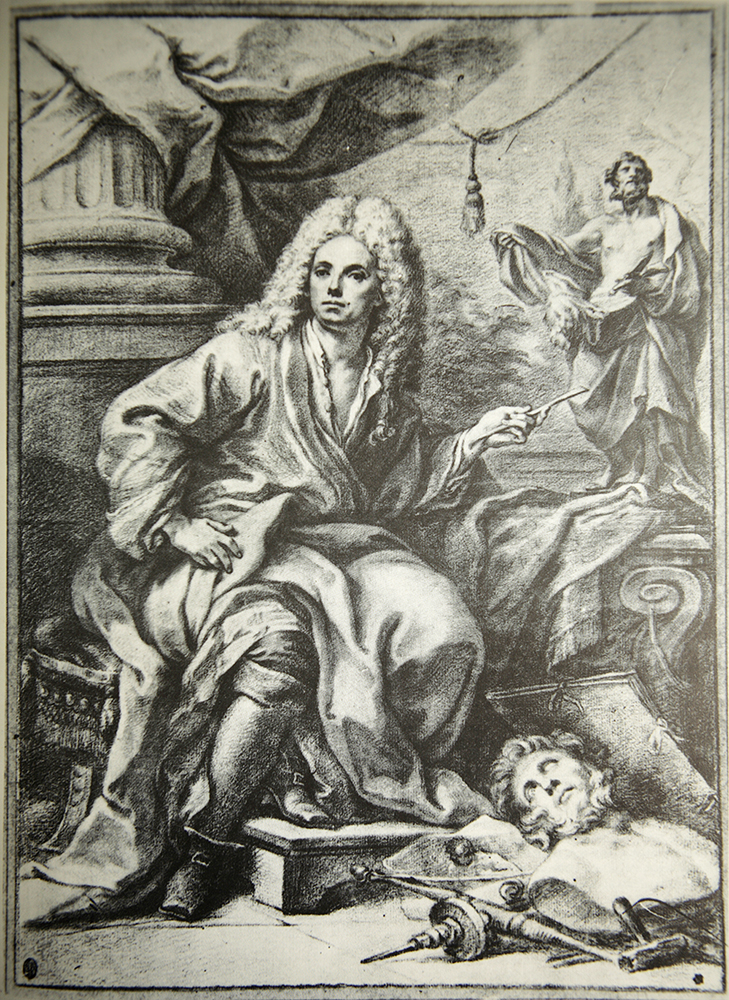
Pierre Le Gros (12 April 1666 Paris – 3 May 1719 Rome) was a French sculptor, active almost exclusively in Baroque Rome where he was the pre-eminent sculptor for nearly two decades.
He created monumental works of sculpture for the Jesuits and the Dominicans and found himself centre stage of the two most prestigious artistic campaigns of his era, the Altar of Saint Ignatius of Loyola in the Gesù and the cycle of the twelve huge Apostle statues in the nave of the Lateran basilica. Le Gros' handling of the marble attracted powerful patrons like the papal treasurer Lorenzo Corsini (much later to become Pope Clement XII) and Cardinal de Bouillon, as Dean of the Sacred College the highest ranking cardinal. He also played a prominent role in more intimate settings like the chapel of the Monte di Pietà and the Cappella Antamori in San Girolamo della Carità, both little treasures of the Roman late baroque not known to many because they are difficult to access.
Le Gros was the most exuberant baroque sculptor of all his contemporaries but eventually lost his long battle for artistic dominance to a prevailing classicist tendency against which he fought in vain.
While he himself always signed as Le Gros and is referred to in this way in all legal documents, it has become common practice in the 19th and 20th centuries to spell the name Legros. Scholars frequently add a suffix like 'the Younger' or 'Pierre II' to distinguish him from his father, Pierre Le Gros the Elder, who was also a sculptor of renown to the French king Louis XIV.
Le Gros was born in Paris into a family with a strong artistic pedigree. Jeanne, his mother, died when he was three, but he stayed in close contact with her brothers, the sculptors Gaspard and Balthazard Marsy, whose workshop he frequented and eventually inherited at the age of fifteen. His initial training as a sculptor lay in the hands of his father while he learned drawing from the engraver Jean Le Pautre, the uncle of his stepmother, Marie Le Pautre. His half brother Jean (1671–1745) was to become a portrait painter.
As a student of the Académie royale de peinture et de sculpture Le Gros was awarded the prestigious Prix de Rome to study at the French Academy in Rome, where he arrived in 1690. There, he renewed his close friendship with his cousin Pierre Lepautre, also a sculptor, and struck a friendship with the academy's other fellow, the architect Gilles-Marie Oppenordt. His time there from 1690 to 1695 was fruitful but not untroubled. The academy was plagued by a constant financial crisis, and the premises at the Palazzo Capranica were also a rather ramshackle affair, far from the grandeur the academy would later enjoy after a move in the 18th century to the Palazzo Mancini under the directorship of Le Gros' friend Nicolas Vleughels, and eventually to the Villa Medici.
Keen to prove himself by carving a marble copy of an antique statue, after much lobbying Le Gros was eventually granted permission to do so by the director of the academy Matthieu de La Teulière and his superior in Paris, Édouard Colbert de Villacerf. His model was the then so-called Vetturie, an ancient sculpture then in the garden of the Villa Medici in Rome (today in the Loggia dei Lanzi in Florence), chosen by La Teulière as a good example for female Roman dress – which Le Gros, nevertheless, improved upon following La Teulière's instructions, by introducing dress details found in engravings after Raphael. Finished in 1695, she was finally shipped to Marly some twenty years later and came to Paris in 1722 where she was placed in the Tuileries Garden.
In the same year 1695, Le Gros took part in a competition for a marble group to be placed on the altar of Saint Ignatius of Loyola which the Jesuit Order was erecting to its founder in their Roman mother church Il Gesù. The enterprise turned out to be the most ambitious and prestigious sculptural project Rome saw in decades. The altar's architecture was designed by Andrea Pozzo who also provided oil paintings of the sculptures and reliefs as guides to their composition while leaving the details to the individual sculptors.
Hub AI
Pierre Le Gros the Younger AI simulator
(@Pierre Le Gros the Younger_simulator)
Pierre Le Gros the Younger
Pierre Le Gros (12 April 1666 Paris – 3 May 1719 Rome) was a French sculptor, active almost exclusively in Baroque Rome where he was the pre-eminent sculptor for nearly two decades.
He created monumental works of sculpture for the Jesuits and the Dominicans and found himself centre stage of the two most prestigious artistic campaigns of his era, the Altar of Saint Ignatius of Loyola in the Gesù and the cycle of the twelve huge Apostle statues in the nave of the Lateran basilica. Le Gros' handling of the marble attracted powerful patrons like the papal treasurer Lorenzo Corsini (much later to become Pope Clement XII) and Cardinal de Bouillon, as Dean of the Sacred College the highest ranking cardinal. He also played a prominent role in more intimate settings like the chapel of the Monte di Pietà and the Cappella Antamori in San Girolamo della Carità, both little treasures of the Roman late baroque not known to many because they are difficult to access.
Le Gros was the most exuberant baroque sculptor of all his contemporaries but eventually lost his long battle for artistic dominance to a prevailing classicist tendency against which he fought in vain.
While he himself always signed as Le Gros and is referred to in this way in all legal documents, it has become common practice in the 19th and 20th centuries to spell the name Legros. Scholars frequently add a suffix like 'the Younger' or 'Pierre II' to distinguish him from his father, Pierre Le Gros the Elder, who was also a sculptor of renown to the French king Louis XIV.
Le Gros was born in Paris into a family with a strong artistic pedigree. Jeanne, his mother, died when he was three, but he stayed in close contact with her brothers, the sculptors Gaspard and Balthazard Marsy, whose workshop he frequented and eventually inherited at the age of fifteen. His initial training as a sculptor lay in the hands of his father while he learned drawing from the engraver Jean Le Pautre, the uncle of his stepmother, Marie Le Pautre. His half brother Jean (1671–1745) was to become a portrait painter.
As a student of the Académie royale de peinture et de sculpture Le Gros was awarded the prestigious Prix de Rome to study at the French Academy in Rome, where he arrived in 1690. There, he renewed his close friendship with his cousin Pierre Lepautre, also a sculptor, and struck a friendship with the academy's other fellow, the architect Gilles-Marie Oppenordt. His time there from 1690 to 1695 was fruitful but not untroubled. The academy was plagued by a constant financial crisis, and the premises at the Palazzo Capranica were also a rather ramshackle affair, far from the grandeur the academy would later enjoy after a move in the 18th century to the Palazzo Mancini under the directorship of Le Gros' friend Nicolas Vleughels, and eventually to the Villa Medici.
Keen to prove himself by carving a marble copy of an antique statue, after much lobbying Le Gros was eventually granted permission to do so by the director of the academy Matthieu de La Teulière and his superior in Paris, Édouard Colbert de Villacerf. His model was the then so-called Vetturie, an ancient sculpture then in the garden of the Villa Medici in Rome (today in the Loggia dei Lanzi in Florence), chosen by La Teulière as a good example for female Roman dress – which Le Gros, nevertheless, improved upon following La Teulière's instructions, by introducing dress details found in engravings after Raphael. Finished in 1695, she was finally shipped to Marly some twenty years later and came to Paris in 1722 where she was placed in the Tuileries Garden.
In the same year 1695, Le Gros took part in a competition for a marble group to be placed on the altar of Saint Ignatius of Loyola which the Jesuit Order was erecting to its founder in their Roman mother church Il Gesù. The enterprise turned out to be the most ambitious and prestigious sculptural project Rome saw in decades. The altar's architecture was designed by Andrea Pozzo who also provided oil paintings of the sculptures and reliefs as guides to their composition while leaving the details to the individual sculptors.
Recent media