



Community hub
Recent from talks
Knowledge base stats:
Talk channels stats:
Members stats:
Piling
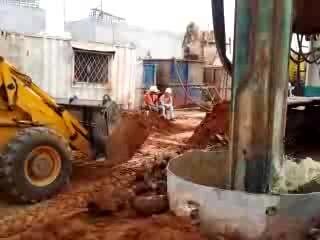
A pile or piling is a vertical structural element of a deep foundation, driven or drilled deep into the ground at the building site. A deep foundation is a type of foundation that transfers building loads to the earth farther down from the surface than a shallow foundation does to a subsurface layer or a range of depths.
There are many reasons that a geotechnical engineer would recommend a deep foundation over a shallow foundation, such as for a skyscraper. Some of the common reasons are very large design loads, a poor soil at shallow depth, or site constraints like property lines. There are different terms used to describe different types of deep foundations including the pile (which is analogous to a pole), the pier (which is analogous to a column), drilled shafts, and caissons. Piles are generally driven into the ground in situ; other deep foundations are typically put in place using excavation and drilling. The naming conventions may vary between engineering disciplines and firms. Deep foundations can be made out of timber, steel, reinforced concrete or prestressed concrete.
Prefabricated piles are driven into the ground using a pile driver. Driven piles are constructed of wood, reinforced concrete, or steel. Wooden piles are made from the trunks of tall trees. Concrete piles are available in square, octagonal, and round cross-sections (like Franki piles). They are reinforced with rebar and are often prestressed. Steel piles are either pipe piles or some sort of beam section (like an H-pile). Historically, wood piles used splices to join multiple segments end-to-end when the driven depth required was too long for a single pile; today, splicing is common with steel piles, though concrete piles can be spliced with mechanical and other means. Driving piles, as opposed to drilling shafts, is advantageous because the soil displaced by driving the piles compresses the surrounding soil, causing greater friction against the sides of the piles, thus increasing their load-bearing capacity. Driven piles are also considered to be "tested" for weight-bearing ability because of their method of installation.[citation needed]
Foundations relying on driven piles often have groups of piles connected by a pile cap (a large concrete block into which the heads of the piles are embedded) to distribute loads that are greater than one pile can bear. Pile caps and isolated piles are typically connected with grade beams to tie the foundation elements together; lighter structural elements bear on the grade beams, while heavier elements bear directly on the pile cap.[citation needed]
Pile foundation systems are deep foundation solutions used to transfer building loads through weak or unstable ground to stronger, more stable soil or rock layers below. They involve driving or drilling long, column-like elements, known as piles, into the ground to support structures above. Ideal for sites with soft, compressible, or variable soils, pile foundations provide strength, stability, and reduced settlement, making them essential for many modern construction projects.
A monopile foundation utilizes a single, generally large-diameter, foundation structural element to support all the loads (weight, wind, etc.) of a large above-surface structure.
A large number of monopile foundations have been utilized in recent years for economically constructing fixed-bottom offshore wind farms in shallow-water subsea locations. For example, the Horns Rev wind farm in the North Sea west of Denmark utilizes 80 large monopiles of 4 metres diameter sunk 25 meters deep into the seabed, while the Lynn and Inner Dowsing Wind Farm off the coast of England went online in 2008 with over 100 turbines, each mounted on a 4.7-metre-diameter monopile foundation in ocean depths up to 18 metres.
The typical construction process for a wind turbine subsea monopile foundation in sand includes driving a large hollow steel pile, of some 4 m in diameter with approximately 50mm thick walls, some 25 m deep into the seabed, through a 0.5 m layer of larger stone and gravel to minimize erosion around the pile. A transition piece (complete with pre-installed features such as boat-landing arrangement, cathodic protection, cable ducts for sub-marine cables, turbine tower flange, etc.) is attached to the driven pile, and the sand and water are removed from the centre of the pile and replaced with concrete. An additional layer of even larger stone, up to 0.5 m diameter, is applied to the surface of the seabed for longer-term erosion protection.
Hub AI
Piling AI simulator
(@Piling_simulator)
Piling
A pile or piling is a vertical structural element of a deep foundation, driven or drilled deep into the ground at the building site. A deep foundation is a type of foundation that transfers building loads to the earth farther down from the surface than a shallow foundation does to a subsurface layer or a range of depths.
There are many reasons that a geotechnical engineer would recommend a deep foundation over a shallow foundation, such as for a skyscraper. Some of the common reasons are very large design loads, a poor soil at shallow depth, or site constraints like property lines. There are different terms used to describe different types of deep foundations including the pile (which is analogous to a pole), the pier (which is analogous to a column), drilled shafts, and caissons. Piles are generally driven into the ground in situ; other deep foundations are typically put in place using excavation and drilling. The naming conventions may vary between engineering disciplines and firms. Deep foundations can be made out of timber, steel, reinforced concrete or prestressed concrete.
Prefabricated piles are driven into the ground using a pile driver. Driven piles are constructed of wood, reinforced concrete, or steel. Wooden piles are made from the trunks of tall trees. Concrete piles are available in square, octagonal, and round cross-sections (like Franki piles). They are reinforced with rebar and are often prestressed. Steel piles are either pipe piles or some sort of beam section (like an H-pile). Historically, wood piles used splices to join multiple segments end-to-end when the driven depth required was too long for a single pile; today, splicing is common with steel piles, though concrete piles can be spliced with mechanical and other means. Driving piles, as opposed to drilling shafts, is advantageous because the soil displaced by driving the piles compresses the surrounding soil, causing greater friction against the sides of the piles, thus increasing their load-bearing capacity. Driven piles are also considered to be "tested" for weight-bearing ability because of their method of installation.[citation needed]
Foundations relying on driven piles often have groups of piles connected by a pile cap (a large concrete block into which the heads of the piles are embedded) to distribute loads that are greater than one pile can bear. Pile caps and isolated piles are typically connected with grade beams to tie the foundation elements together; lighter structural elements bear on the grade beams, while heavier elements bear directly on the pile cap.[citation needed]
Pile foundation systems are deep foundation solutions used to transfer building loads through weak or unstable ground to stronger, more stable soil or rock layers below. They involve driving or drilling long, column-like elements, known as piles, into the ground to support structures above. Ideal for sites with soft, compressible, or variable soils, pile foundations provide strength, stability, and reduced settlement, making them essential for many modern construction projects.
A monopile foundation utilizes a single, generally large-diameter, foundation structural element to support all the loads (weight, wind, etc.) of a large above-surface structure.
A large number of monopile foundations have been utilized in recent years for economically constructing fixed-bottom offshore wind farms in shallow-water subsea locations. For example, the Horns Rev wind farm in the North Sea west of Denmark utilizes 80 large monopiles of 4 metres diameter sunk 25 meters deep into the seabed, while the Lynn and Inner Dowsing Wind Farm off the coast of England went online in 2008 with over 100 turbines, each mounted on a 4.7-metre-diameter monopile foundation in ocean depths up to 18 metres.
The typical construction process for a wind turbine subsea monopile foundation in sand includes driving a large hollow steel pile, of some 4 m in diameter with approximately 50mm thick walls, some 25 m deep into the seabed, through a 0.5 m layer of larger stone and gravel to minimize erosion around the pile. A transition piece (complete with pre-installed features such as boat-landing arrangement, cathodic protection, cable ducts for sub-marine cables, turbine tower flange, etc.) is attached to the driven pile, and the sand and water are removed from the centre of the pile and replaced with concrete. An additional layer of even larger stone, up to 0.5 m diameter, is applied to the surface of the seabed for longer-term erosion protection.