Hubbry Logo
Quercus palustrisQuercus palustrisMain
Open search
Quercus palustris
Community hub
Quercus palustris
logo
8 pages, 0 posts
0 subscribers
Be the first to start a discussion here.
Quercus palustris
Quercus palustris
from Wikipedia

Pin oak
Scientific classification Edit this classification
Kingdom: Plantae
Clade: Tracheophytes
Clade: Angiosperms
Clade: Eudicots
Clade: Rosids
Order: Fagales
Family: Fagaceae
Genus: Quercus
Subgenus: Quercus subg. Quercus
Section: Quercus sect. Lobatae
Species:
Q. palustris
Binomial name
Quercus palustris
Synonyms[3]
  • Quercus palustris var. heterophylla Cockerell
  • Quercus rubra var. dissecta Lam.
  • Quercus rubra var. palustris (Münchh.) Kuntze

Quercus palustris, also called pin oak,[4] swamp oak, or swamp Spanish oak,[5] is a tree in the red oak section (Quercus sect. Lobatae) of the genus Quercus. Pin oak is one of the most commonly used landscaping oaks in its native range due to its ease of transplant, relatively fast growth, and pollution tolerance.[6]

Description

[edit]
Largest known pin oak in New England, located in Northampton, Massachusetts. 2005 measurements: Height 32.9 metres (107.9 ft), circumference 5.3 metres (17.4 ft), average spread 29 metres (96 ft)

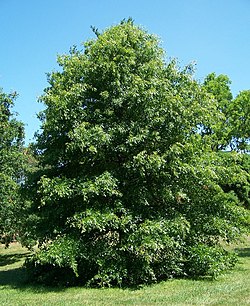
Quercus palustris is a medium-sized deciduous tree growing to 18–22 metres (59–72 feet) tall, with a trunk up to 1 m (3+12 ft) in diameter. It has an 8–14 m (26–46 ft) spread. A 10-year-old tree grown in full sun will be about 8 m (26 ft) tall. Young trees have a straight, columnar trunk with smooth bark and a pyramidal canopy.

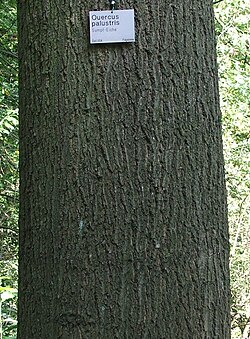
By the time the tree is 40 years old, it develops more rough bark with a loose, spreading canopy. This canopy is considered one of the most distinctive features of the pin oak: the upper branches point upwards, the middle branches are at right angles to the trunk, and the lower branches droop downwards.[6][7]

The leaves are 5–16 centimetres (2–6+14 inches) long and 5–12 cm (2–4+34 in) broad, lobed, with five or seven lobes. Each lobe has five to seven bristle-tipped teeth. The sinuses are typically U-shaped and extremely deep cut. In fact, roughly the same amount of sinus area exists as actual leaf area. The leaf is mostly hairless, except for a very characteristic tuft of pale orange-brown down on the lower surface where each lobe vein joins the central vein. Overall autumn leaf coloration is generally bronze, though individual leaves may be red for a time, and is not considered particularly distinctive.[8]

The acorns, borne in a shallow, thin cap, are hemispherical, 10–16 millimetres (133258 in) long and 9–15 mm (11321932 in) broad, green maturing pale brown about 18 months after pollination.[7] Unless processed using traditional methods, the acorn is unpalatable because the kernel is very bitter.[citation needed]

In its natural environment pin oak is a relatively short-lived, fast-growing pioneer or riparian species with a lifespan of approximately 120 years against many oaks which can live several centuries. Despite this there are many examples of pin oak that exceed this lifespan.[9] It develops a shallow, fibrous root system, unlike many oaks, which have a strong, deep taproot when young.[6]

A characteristic shared by a few other oak species, and also some beeches and hornbeams, is the retention of leaves through the winter on juvenile trees, a natural phenomenon referred to as marcescence. Young trees under 6 m (20 ft) are often covered with leaves year-round, though the leaves die in the fall, remaining attached to the shoots until the new leaves appear in the spring. As with many other oak species, dead pin oak branches stay on the tree for many years.[6][7]

Flowering and fruiting

[edit]

Like all oaks, flowering and leaf-out occur in late spring when all frost danger has passed. The flowers are monoecious catkins which, being self-incompatible, require the presence of another oak for pollination. Any species in the red oak group can serve as a pollinator, but in pin oak's natural range, this will usually be northern red oak or scarlet oak. Interspecies hybridization occurs freely. The acorns require two growing seasons to develop.[7]

Name

[edit]

The Latin specific epithet palustris means "of marshland" or "of swamps", referring to its natural habitat.[7][10]

The common name "pin oak" is possibly due to the many small, slender twigs, but may also be from the historical use of the hard wood for pins in wooden building construction.[11]

Distribution and habitat

[edit]

Q. palustris is mainly distributed in the eastern and central United States from Connecticut in the northeast, west to eastern Oklahoma and Kansas, and south to Georgia.[12] It is also native in the extreme south of Ontario, Canada.[citation needed]

The pin oak is also well adapted to life in England and Australia (where it has been introduced), and is quite widespread across the Australian continent, especially in the cooler southern States such as Victoria and New South Wales. It is also well adapted to life in South Africa and Argentina, especially in the Río de la Plata region.[citation needed]

It is naturally a wetland tree,[6] confined to acidic soils, and does not tolerate limestone or sandy Florida soil, and grows at low altitudes from sea level up to 350 m (1,148 ft).[7][10]

It grows primarily on level or nearly level, poorly drained, alluvial floodplain and river-bottom soils with high clay content. They are usually found on sites that flood intermittently during the dormant season, but do not ordinarily flood during the growing season. They do not grow on the lowest, most poorly drained sites that may be covered with standing water through much of the growing season. However, they do grow extensively on poorly drained upland "pin oak flats" on the glacial till plains of southwestern Ohio, southern Illinois and Indiana, and northern Missouri. The level topography and presence of a claypan in the soil of these areas cause these sites to be excessively wet in winter and spring.[6]

Ecology

[edit]

Associated forest cover

[edit]

Pin oak is a major species in only one forest cover type, pin oak–sweetgum, which is found on bottom lands and some upland sites throughout the central portion of the pin oak range. Pin oak and sweetgum (Liquidambar styraciflua) vary in their relative proportions in this cover type. Large areas of almost pure pin oak occur on the "pin oak flats" of the upland glacial till plains or in the bottom lands of the lower Ohio and central Mississippi River valleys.[6] Associated species in this forest type include red maple (Acer rubrum), American elm (Ulmus americana), black tupelo (Nyssa sylvatica), swamp white oak (Quercus bicolor), willow oak (Quercus phellos), overcup oak (Quercus lyrata), bur oak (Quercus macrocarpa), green ash (Fraxinus pennsylvanica), Nuttall's oak (Quercus texana), swamp chestnut oak (Quercus michauxii), and shellbark (Carya laciniosa) and shagbark (Carya ovata) hickories.[6]

Pin oak is an associated species in silver maple–American elm forests in the bottom lands along the Ohio, Wabash, Mississippi, and Missouri Rivers. A variant of this type, silver maple–American elm–pin oak–sweetgum, is found along major streams in southern Illinois and Indiana.[6]

Pin oak also occurs in black ash–American elm–red maple forests in poorly drained bottom lands in northern Ohio and Indiana along with silver maple (Acer saccharinum), swamp white oak, sycamore (Platanus occidentalis), black tupelo, and eastern cottonwood (Populus deltoides).[6]

Reaction to competition

[edit]

Pin oak is classed as intolerant of shade. It is less tolerant than elm, boxelder (Acer negundo), sweetgum, hackberry (Celtis occidentalis), and ash, but is more tolerant than eastern cottonwood and black willow. Pin oak usually grows in even-aged stands of dominant and co-dominant trees. Intermediate and suppressed trees in such stands usually die within a few years of being overtopped. Single pin oaks in mixed stands usually are dominants. Pin oak is considered a subclimax species. It persists on heavy, wet soils because it produces an abundance of acorns which, if released, grow faster on these sites than most of its competitors.[6]

Damaging agents

[edit]

Although pin oak is very tolerant of dormant-season flooding, it is much less tolerant of growing-season flooding. Trees may be injured or killed by intermittent growing-season flooding over several successive years. The trees can usually survive one growing season of continuous flooding, but will be killed by continuous flooding over 2 or 3 consecutive years. Pin oak is rated as "intermediately tolerant" to growing-season flooding. Also, since the bark of pin oak is relatively thin, the species is especially susceptible to damage by fire and decay associated with fire wounds.[6]

Associated species

[edit]

Due to similarity in leaf shape, the pin oak is often confused with scarlet oak and black oak, and occasionally, red oak. However, it can be distinguished by its distinctive dead branches on the lower trunk ("pins"), and its uniquely shaped crown. The sinuses on pin oak leaves are also deeply cut, often covering just as much area as the leaf itself.[citation needed]

The pin oak is the only known food plant of Bucculatrix domicola caterpillars.[citation needed]

Uses

[edit]

In its native range, pin oak is the most commonly used landscaping oak along with northern red oak due to its ease of transplant, relatively fast growth, and pollution tolerance. However, as it is naturally adapted to moist, acidic soils, it may develop a condition known as iron chlorosis on less suitable locations, causing the tree to shed leaves during the growing season and rot from the top down. Mature pin oaks are often too big to treat and this nutrient deficiency on alkaline soil may eventually kill them. The drooping lower branches can also be a problem, interfering with access for traffic and pedestrians.[citation needed]

It is also cultivated in parks and large gardens in the United Kingdom, and has gained the Royal Horticultural Society's Award of Garden Merit.[13][14]

The wood is generally marketed as red oak, but is of significantly inferior quality, being somewhat weaker, often with many small knots.[6] The wood is hard and heavy and is used in general construction and for firewood. The bark was used by some Native American tribes to make a drink for treatment of intestinal pain.[citation needed]

References

[edit]
[edit]
Revisions and contributorsEdit on WikipediaRead on Wikipedia
from Grokipedia
Quercus palustris, commonly known as pin oak or swamp oak, is a medium-sized tree in the family () native to the eastern and . It typically reaches heights of 50 to 70 feet (15 to 21 meters) with a trunk diameter up to 3 feet (1 meter), featuring a distinctive pyramidal crown when young that rounds with age, characterized by lower branches drooping downward, middle branches growing horizontally, and upper branches ascending. The leaves are alternate, simple, and deeply lobed with 5 to 7 bristle-tipped lobes, measuring 3 to 6 inches long, glossy green above with tan tufts of hair in vein axils below, turning vibrant orange, red, or bronze in fall. The bark is smooth and grayish-brown on young trees, becoming fissured and scaly with age, while twigs are slender and reddish-brown. Acorns are small, rounded, and tan-colored, about 0.5 inches in diameter, with a cap covering one-quarter to one-third of the nut, maturing in the second year and serving as an important food source for wildlife such as birds, squirrels, and deer. Native to regions from southwestern and southward to northern , northeastern , and east to the , pin oak thrives in moist to wet, acidic, loamy soils of bottomlands, , and poorly drained uplands, particularly in the Ohio Valley, though it adapts to drier urban conditions. It exhibits rapid growth, reaching maturity in 80 to 100 years, and is shade-intolerant, preferring full sun and even-aged stands for optimal development. Ecologically, it plays a key role in and forests, such as the pin oak-sweetgum type, providing habitat and food for pollinators, like the banded hairstreak, imperial moths, and various songbirds and mammals, while demonstrating intermediate tolerance to flooding. Widely valued for its ornamental qualities, including its symmetrical form, attractive foliage, and striking autumn color, Quercus palustris is commonly planted as a street, park, and , transplanting easily due to its shallow . Its wood, hard and heavy like other , is used for , , and , though it is not extensively harvested commercially. Acorns are edible for humans after leaching but can be toxic to , causing stomach upset. Despite its popularity, the tree is susceptible to issues like iron in alkaline soils, various insect pests, and diseases common to oaks.

Taxonomy

Classification

Quercus palustris is a within the , which encompasses beeches, chestnuts, and oaks, and is placed in the subfamily Quercoideae. Within the Quercus, it belongs to section Lobatae, commonly known as the red oak group, historically referred to as subgenus Erythrobalanus. In modern cladistic , it is placed in the following clades: Tracheophytes, Angiosperms, , . The traditional taxonomic hierarchy includes kingdom Plantae, Magnoliophyta, class Magnoliopsida, order Fagales, Fagaceae, Quercus, and Q. palustris Muenchh. Key morphological traits that distinguish Q. palustris and other in section Lobatae from the white oak section (Quercus sect. Quercus, formerly Leucobalanus) include leaves with bristle-tipped lobes and acorns that require two growing seasons to mature. In contrast, white oaks feature leaves with rounded, bristle-free lobes and acorns that mature in a single season. These characteristics reflect adaptations in fruit development and foliage structure that define the sectional boundaries within the genus. As a New World species in the red oak section, Q. palustris shares evolutionary ties with other North American red oaks, exhibiting a pattern of interspecific hybridization common across section Lobatae. Genetic studies indicate hybridization potential with congeners such as Quercus rubra, though introgression may be limited by selection pressures.

Etymology and nomenclature

The scientific name Quercus palustris derives from Latin roots, with Quercus being the classical Latin term for "oak," referring to the genus encompassing all oak species. The specific epithet palustris means "marshy" or "of swamps," alluding to the tree's preference for wet environments. Common names for Quercus palustris include pin oak, which originates from the numerous short, slender, pin-like branchlets that persist after leaves drop, giving the tree a distinctive appearance. Other names such as swamp oak, water oak, and swamp Spanish oak reflect its association with moist sites, with "Spanish oak" used regionally in parts of the . Quercus palustris was first described in 1770 by German botanist Otto von Münchhausen in the publication Der Hausvater, volume 5, page 253. As a member of the red oak group (section Lobatae), its nomenclature aligns with other species in this subsection characterized by similar traits. Accepted synonyms include Quercus rubra var. palustris (Münchh.) Kuntze (1891) and Quercus rubra var. dissecta Lam. (1785), reflecting historical classifications that sometimes grouped it under the northern red oak (Q. rubra).

Description

Morphology

Quercus palustris is a medium-sized deciduous tree that typically reaches a height of 15 to 24 meters (50 to 80 feet) with a trunk diameter up to 1 meter (3 feet) and a spread of 12 to 18 meters (40 to 60 feet). It exhibits a distinctive pyramidal to conical form in its youth, characterized by ascending upper branches, horizontal middle branches, and pendulous lower branches that often persist, giving the tree a narrow, oval silhouette; with age, the crown becomes more rounded and open. The tree develops a shallow, fibrous root system, which facilitates adaptation to various soil conditions but can lead to surface rooting in landscapes. The leaves are alternate, simple, and elliptical to obovate, measuring 8 to 15 centimeters (3 to 6 inches) in length and 5 to 10 centimeters (2 to 4 inches) wide, with 5 to 7 deep, triangular lobes that end in bristle-like tips and are separated by wide, U-shaped sinuses. The upper surface is glossy dark green, while the lower is paler with axillary tufts of in the vein angles; in autumn, the foliage turns vibrant shades of red to russet, providing notable ornamental value. The bark on young trees is smooth and gray, featuring prominent horizontal lenticels, but it becomes gray-brown and develops shallow furrows and ridges with age, though it remains relatively thin and less scaly compared to other oaks. Twigs are slender, reddish-brown, and pubescent with stellate hairs initially, supporting the alternate . Buds are ovoid, reddish-brown, shiny, sharply pointed, and measure 2 to 4 millimeters (about 1/8 inch) long, often clustered at twig tips. As one of the faster-growing oaks, Q. palustris exhibits a medium to rapid growth rate, potentially adding up to 60 centimeters (2 feet) or more annually under optimal conditions, and reaches reproductive maturity in approximately 15 to 25 years.

Reproduction

Quercus palustris is monoecious, bearing separate flowers on the same individual. Male flowers form pendulous catkins measuring 5–10 cm in length, emerging in spring from to May alongside new leaves. Female flowers are small and clustered in axillary . Pollination occurs via wind, with male catkins releasing pollen as leaves expand; female flowers typically open after male pollen dispersal on the same tree to favor cross-pollination. The fruit is an ovoid acorn, 1–1.5 cm long, that matures in the second autumn after flowering, requiring 16–18 months from pollination to ripeness. The saucer-shaped cupule encloses one-third to one-half of the nut, and acorns possess high tannin content that deters predation by certain wildlife species. Acorns disperse primarily by gravity, with secondary roles played by animals like squirrels and birds that cache seeds, and by water in periodically flooded habitats. Successful germination demands cold stratification for 30–45 days at 0–5°C to overcome , after which emergence follows in spring under moist conditions. Acorn viability remains high for fresh seeds but declines markedly after one year in storage. Reproductive phenology shows interannual variability driven by weather factors such as temperature and precipitation, leading to irregular acorn crops; mast seeding events, characterized by synchronized high-yield production across populations, occur periodically to enhance predator satiation and dispersal efficacy.

Biogeography

Distribution

Quercus palustris, commonly known as pin oak, is native to eastern and central , with its range extending from southwestern west to extreme and New York, southward to central , and westward to eastern and northeastern . The species is most abundant in bottomlands along major river systems such as the and , as well as on glacial till plains in the north-central and . Historically, the distribution of Q. palustris reflects post-glacial expansion from southern refugia following the last Ice Age, allowing colonization of suitable lowland habitats across its current range. No significant range contraction has been documented, with the species maintaining presence in its preferred riparian and environments since European settlement, despite some historical clearing for . Beyond its native range, Q. palustris has been widely introduced and planted as an ornamental tree in urban areas worldwide, including since the late seventeenth century, where it has naturalized in wetlands from and eastward to . It is also cultivated in parts of , such as , , and provinces in , and in various global urban settings for its adaptability. Native populations of Q. palustris remain stable with no federal , thriving in USDA hardiness zones 4 through 8.

Habitat preferences

Quercus palustris thrives in acidic soils with a range of 5.0 to 6.5, favoring loamy or clayey textures that are often poorly drained. It performs best on level alluvial soils classified as or on upland "pin oak flats" that are Alfisols with a claypan subsoil, tolerating periodic flooding during the dormant season but avoiding prolonged submersion that could lead to root damage. The species requires full sun to partial shade for optimal growth and prefers medium to wet moisture regimes, commonly occurring in bottomlands and floodplains where soil saturation supports its development. It exhibits intermediate tolerance to shallow flooding during the growing season, surviving up to 84 days of such conditions, though complete inundation limits survival to 10-20 days. Adapted to temperate climates in humid to moist subhumid regions, Q. palustris endures mean annual temperatures from 10°C to 16°C and growing seasons of 120 to over 210 days, with cold hardiness extending to USDA Zone 4 (approximately -30°C). Annual precipitation in its preferred habitats ranges from 810 mm to over 1270 mm, supporting consistent moisture availability. Site limitations include intolerance to alkaline soils, where iron chlorosis manifests as yellowing foliage, often requiring for mitigation. Once established, its shallow, renders it vulnerable to stress, despite initial tolerance to wet conditions. Flood tolerance is facilitated by adaptations such as a shallow and the capacity to develop adventitious roots under waterlogged conditions, enabling persistence in intermittently flooded sites like alluvial terraces and glacial till plains.

Ecology

Community associations

Quercus palustris is a key component of bottomland forests, particularly in oak-swamp and bottomland communities across its native range in the central and . It often dominates or co-dominates in environments, forming mixed stands with species such as swamp white oak (), sweetgum (), and blackgum (), which thrive in periodically flooded depressions and poorly drained soils. These associations contribute to the structural diversity of forests, where Q. palustris provides canopy cover alongside elements like American hornbeam () and sedges ( spp.). The species plays a significant role in supporting wildlife through its acorn production and foliage. Acorns serve as a vital mast crop for white-tailed deer (Odocoileus virginianus), eastern gray squirrels (Sciurus carolinensis), wild turkeys (Meleagris gallopavo), and various birds including woodpeckers, blue jays (Cyanocitta cristata), and waterfowl such as wood ducks (Aix sponsa) and mallards (Anas platyrhynchos). Additionally, Q. palustris foliage serves as a host plant for over 200 species of caterpillars from moths and butterflies in the Lepidoptera order, with oaks collectively supporting more than 500 such species and thereby enhancing biodiversity in forest ecosystems. In ecological succession, Q. palustris functions as an early- to mid-seral species, favoring open or disturbed sites due to its shade intolerance. It establishes rapidly following disturbances like flooding or drought that reduce competition from pioneers such as black willow (Salix nigra) or cottonwood (Populus deltoides), but it is typically succeeded in climax communities by more shade-tolerant oaks like white oak () or cherrybark oak (), as well as red maple (). This dynamic positions it as a transitional dominant in regenerating floodplains. Q. palustris forms symbiotic ectomycorrhizal associations with soil fungi, which enhance nutrient uptake, particularly and , in the nutrient-poor, wet soils of its habitats. These mutualistic relationships, common among Quercus species, involve fungal hyphae extending the system's reach and improving tolerance to anaerobic conditions during ing. Competitively, Q. palustris excels in flood-prone areas by outcompeting mesophytic species through prolific regeneration and flood tolerance, often forming nearly pure stands in low-lying bottomlands. However, in upland or less disturbed sites, it is suppressed by more competitive shade-tolerant s such as American beech () or sugar maple (), limiting its persistence beyond mid-succession stages.

Pests and diseases

Quercus palustris is susceptible to several insect pests that can cause significant defoliation and structural damage. The gypsy moth (Lymantria dispar) is a major defoliator, feeding on leaves and potentially leading to complete canopy loss in heavy infestations, though mature trees often recover if not repeatedly attacked. Sawflies, including the pin oak sawfly (Arge pullata) and scarlet oak sawfly (Arge occulta), skeletonize leaves, causing aesthetic damage and reduced photosynthesis during larval stages in spring. Gall-inducing wasps, such as the horned oak gall wasp (Callirhytis cornigera) and gouty oak gall wasp (Callirhytis quercusclaviger), form woody galls on twigs and branches, which can girdle tissues and result in dieback, particularly in severe outbreaks on younger trees. Fungal pathogens pose additional threats, with oak wilt caused by Bretziella fagacearum being particularly virulent in the red oak group, including Q. palustris, where infection leads to rapid wilting, vein browning, and tree death within 4-6 weeks via vascular blockage. Anthracnose, incited by Discula quercina, manifests in wet springs as irregular necrotic lesions on leaves and twigs, potentially causing premature defoliation and minor branch dieback, though it rarely kills established trees. Oak leaf blister, caused by Taphrina caerulescens, produces raised, cushion-like distortions on leaves during cool, moist conditions, leading to yellowing and early drop but typically not threatening tree health. Root and canker diseases exacerbate vulnerability in suboptimal sites. Shoestring root rot (Armillaria mellea) infects roots in poorly drained soils, disrupting water uptake and causing progressive decline with yellowed foliage and dieback, often fatal in waterlogged conditions. Dothiorella canker affects stressed branches, forming sunken lesions that lead to wilting and dieback. Boring insects, such as those in the family Buprestidae, and the oak twig girdler (Acrocercops hospes) target weakened trees, creating galleries or girdling twigs that contribute to localized dieback. Vertebrate damage includes browsing by (Odocoileus virginianus), which can strip bark and buds on young Q. palustris, though the species shows mild resistance compared to other hardwoods. Urban stress and the tree's shallow heighten susceptibility to these agents by limiting vigor and recovery. Iron chlorosis in alkaline soils can mimic symptoms like leaf yellowing, complicating diagnosis. Management emphasizes cultural practices to bolster resilience, such as mulching to retain moisture and improve soil conditions, alongside proper to avoid compaction and poor drainage. For severe insect outbreaks, like gypsy moth or defoliation, targeted insecticides such as can be applied during larval stages; gall wasps are often tolerated unless dieback is extensive, in which case affected twigs in late winter disrupts the life cycle. Oak wilt prevention involves avoiding wounds during active seasons and trenching to sever root grafts in infected areas, as no cure exists once established. Fungicides may control anthracnose or leaf blister in high-value landscapes during wet periods, but maintaining overall tree health through fertilization and irrigation is prioritized over chemical interventions.

Cultivation and uses

Horticultural applications

Quercus palustris is primarily propagated by , which requires moist stratification for 30 to 45 days at temperatures between 32°F and 41°F to overcome and promote . For cultivars, via onto rootstocks is common, though challenges such as incompatibility and graft failure can reduce success rates. The tree transplants readily while young and is best moved as balled-and-burlapped in spring or fall to minimize root disturbance. This species performs well in USDA hardiness zones 4 to 8, preferring full sun exposure for optimal growth and form development. It requires spacing of 10 to 15 meters (30 to 50 feet) between to accommodate its mature dimensions of 15 to 21 meters (50 to 70 feet) in height and 12 to 18 meters (40 to 60 feet) in spread. during the tree's early years is recommended to establish a strong central leader and pyramidal shape, including the removal of competing leaders and selective thinning of lower branches to prevent drooping while maintaining natural structure. Several cultivars have been developed to enhance ornamental qualities, such as 'Green Pillar', which features a narrow, columnar ideal for confined urban sites and retains glossy green leaves that turn vibrant red in fall. Another is '', prized for its symmetrical growth and vigorous performance, though its propagation is limited by incompatibilities. These selections emphasize improved branch architecture, reliable fall coloration, and reduced maintenance needs compared to the species. In horticultural settings, Quercus palustris serves as an effective street tree, park specimen, or large-scale shade provider in lawns and meadows, valued for its tolerance to urban stressors including , , and occasional flooding. Its native affinity for wet conditions also suits it to rain gardens and low-lying areas in managed landscapes. However, it should not be sited in alkaline environments, as high pH soils (above 6.5) induce , manifesting as yellowing leaves with green veins; mitigation involves using or applications, often via soil injection or drenching for established trees.

Ecological and other uses

Quercus palustris plays a significant role in , particularly in urban forests and s, where it contributes to long-term carbon storage due to its large canopy and . Studies have shown that Q. palustris-dominated forested s can achieve high sequestration rates, up to 473 g C m⁻² yr⁻¹, outperforming other communities in temperate regions. In urban settings, mature pin oaks provide substantial carbon storage and annual sequestration benefits, enhancing overall services in street populations. The species enhances wildlife habitat by providing acorns as a key food source for numerous animals, including , squirrels, wild turkeys, woodpeckers, and waterfowl such as wood ducks. This mast production supports in forested areas, with acorns serving as a critical nutritional resource during fall and winter. In riparian zones, Q. palustris aids by developing extensive root systems that bind sediments and reduce along streambanks, contributing to the maintenance of integrity. Timber from Q. palustris is occasionally harvested for uses such as furniture, fuelwood, and railroad ties, though its commercial value remains low due to the wood's tendency to warp and the presence of knots from branching. The wood shares properties with other , offering moderate strength and hardness suitable for general and pulp. Historically, Native Americans leached acorns from Q. palustris to remove , using them to produce for , soups, and as a , while the bark was boiled for beverages to treat intestinal ailments. In , the tree's tolerance for wet soils positions it for flood control applications, where it helps mitigate runoff and stabilize landscapes prone to inundation. In conservation efforts, is employed in the restoration of bottomland forests, where it is planted to reestablish native in degraded floodplains and support recovery. It also bolsters biodiversity in by providing structure and resources that sustain diverse species. Economically, while Q. palustris has limited commercial timber value, it delivers high services, including through canopy interception and infiltration, which can reduce volumes significantly in planted areas. Valuations of these services often exceed direct wood product benefits, emphasizing the tree's role in sustainable land .

References

Add your contribution
Related Hubs
User Avatar
No comments yet.