Hubbry Logo
Quercus phellosQuercus phellosMain
Open search
Quercus phellos
Community hub
Quercus phellos
logo
8 pages, 0 posts
0 subscribers
Be the first to start a discussion here.
Quercus phellos
Quercus phellos
from Wikipedia

Willow oak
Quercus phellos in Mississippi, United States
Scientific classification Edit this classification
Kingdom: Plantae
Clade: Tracheophytes
Clade: Angiosperms
Clade: Eudicots
Clade: Rosids
Order: Fagales
Family: Fagaceae
Genus: Quercus
Subgenus: Quercus subg. Quercus
Section: Quercus sect. Lobatae
Species:
Q. phellos
Binomial name
Quercus phellos
Branch with acorns and leaves

Quercus phellos, the willow oak, is a North American species of a deciduous tree in the red oak group of oaks. It is native to the south-central and eastern United States.

Description

[edit]

It is a medium-sized tree growing to 20–30 meters (65–100 feet) tall (exceptionally to 39 m, 128 ft), with a trunk up to 1–1.5 m (3+12–5 ft) in diameter (exceptionally 2 m or 6+12 ft). It is distinguished from most other oaks by its leaves, which are shaped like willow leaves, 5–12 centimeters (2–4+34 inches) long and 1–2.5 cm (38–1 in) broad with an entire (untoothed and unlobed) margin; they are bright green above, paler beneath, usually hairless but sometimes downy beneath. The fruit is an acorn, 8–12 millimeters (5161532 in) long, and almost as wide as long, with a shallow cup; it is one of the most prolific producers of acorns.[2] The tree starts acorn production around 15 years of age, earlier than many oak species.[3]

Autumn foliage

Willow oaks can grow moderately fast (height growth up to 60 cm or 2 ft a year), and tend to be conic to oblong when young, rounding out and gaining girth at maturity (i.e. more than 50 years).[citation needed]

Distribution and habitat

[edit]

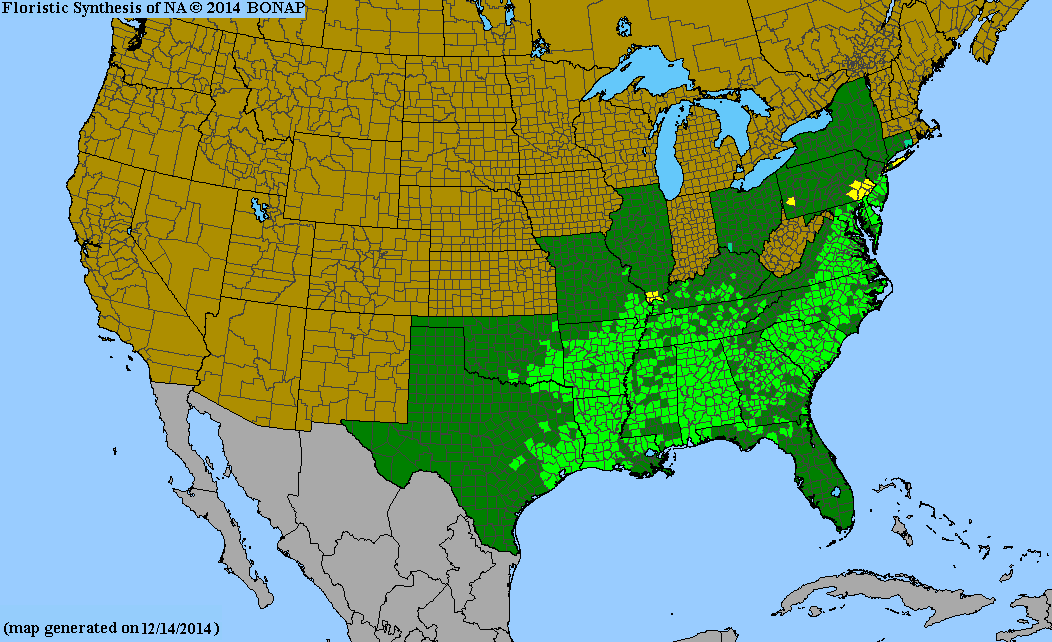
The species is most common in the American south and eastern states.[4] It can be found from Long Island Sound south to northern Florida, and west to southernmost Illinois, Missouri, Oklahoma, and eastern Texas.[5] Its natural range extends into southeastern Pennsylvania and southern New Jersey. It has also historically been recorded as occurring in Lancaster, Bucks, Chester, Delaware, and Philadelphia counties, chiefly on wet sites, occasionally in drier, upland ones.[6] Much of that area has been built over and developed since World War II, and the tree is now classified as endangered in the state.

It is most commonly found growing on lowland floodplains, often along streams, but rarely also in uplands with poor drainage, up to 400 m (1,300 ft) in altitude.

Ecology

[edit]

The acorns are eaten by squirrels and other wildlife.[2]

Uses

[edit]

Economic uses are primarily as an ornamental tree and the wood for pulp and paper production, but also for lumber; it is often marketed as "red oak" wood.[citation needed]

The willow oak is one of the most popular trees for horticultural planting, due to its rapid growth, hardiness, balance between axial and radial dominance, ability to withstand both sun and shade, light green leaf color and full crown. Despite being heavily used in landscaping in the Southern US (in cities such as Washington, D.C., Raleigh, Charlotte, and Atlanta) around malls, along roads, etc., the trees tend to grow larger than planners expect, which often leads to cracked sidewalks.[citation needed]

References

[edit]
[edit]
Revisions and contributorsEdit on WikipediaRead on Wikipedia
from Grokipedia
Quercus phellos, commonly known as willow oak, is a medium to large in the red oak group (section Lobatae) of the family (), characterized by its narrow, willow-like leaves and ability to thrive in moist, lowland environments. It typically reaches heights of 40 to 75 feet (up to 100 feet or more), with a trunk diameter of 3 to 6 feet and an oval to rounded crown featuring fine-textured foliage. The leaves are simple, alternate, lanceolate, 3 to 6 inches long and about 1 inch wide, with smooth margins and bristle tips, turning yellow to red in fall; acorns are small, rounded, and brownish, maturing in to . The bark is initially smooth and light reddish-brown, becoming gray to dark brown and furrowed with age. Native to the eastern, southeastern, and south-central , Q. phellos ranges from southern and southeastern southward to northern and Georgia, extending westward to eastern and northward to , , , and southeastern Oklahoma, primarily along the Atlantic and Gulf Coastal Plains. It is absent from peninsular and southeastern Georgia but occurs in all physiographic provinces of states like . This species favors moist, acidic alluvial s (pH 4.5–5.5) in bottomlands, floodplains, and along streams, swamps, and rivers, where the is typically 2 to 6 feet deep, though it tolerates a variety of textures including clay, , and sand. Ecologically, it is shade-intolerant and occupies mid- to late-successional roles in wetland forests, often associating with like red maple (Acer rubrum), eastern cottonwood (Populus deltoides), and swamp privet (Forestiera acuminata). It reproduces via wind-pollinated monoecious flowers and acorns, which germinate in spring after fall maturation, and it can sprout vigorously from stumps, contributing to its resilience in disturbed habitats. Quercus phellos holds significant value for both ecological and human uses, serving as a fast-growing, long-lived shade and tolerant of urban , wet soils, and salt, while its is utilized for , crossties, , and pulp production. The acorns provide nutritious food (5.9% protein, 19.6% fat) for including ducks, deer, squirrels, , and birds like blue jays and woodpeckers, and the hosts such as the imperial moth () and various butterflies. It is also employed in along reservoir margins and streambanks, though it is fire-intolerant with thin bark that makes it vulnerable to top-kill from low-severity fires, and its acorns and foliage can be toxic to . Known by alternative common names such as peach oak or swamp chestnut oak, Q. phellos can hybridize with related species like Quercus velutina and Quercus nigra, adding to its botanical interest.

Taxonomy

Classification

Quercus phellos is classified within the kingdom Plantae, phylum Tracheophyta, class Magnoliopsida, order Fagales, family Fagaceae, genus Quercus, and species phellos L. This species belongs to the red oak group, specifically section Lobatae of subgenus Quercus, distinguished from the white oak section Quercus by traits such as acorn maturation requiring two years rather than one. Accepted synonyms include Quercus phellos var. sylvatica Michx. and Quercus phellos f. intonsa Fernald, reflecting minor historical varietal distinctions. Phylogenetically, Q. phellos relates closely to other North American in section Lobatae, with molecular studies using (ITS) regions and chloroplast DNA (cpDNA).

Etymology

The scientific name Quercus phellos was first validly published by in the second edition of his in 1753, where he described it based on specimens from . The genus name Quercus originates from the term for "," a word employed by ancient Romans to refer to trees in this group. The specific epithet phellos derives from the word phellós (φελλός), meaning "cork," which Linnaeus applied to this species despite its initial misapplication—the term traditionally denoted the cork oak (), whose bark is notably thick and corky, whereas Q. phellos has bark with somewhat corky ridges on branches but lacks the extensive cork layer of the true cork oak; the name has been retained in modern taxonomy. The common name "willow oak" arises from the tree's narrow, linear leaves, which closely resemble those of willow trees (Salix spp.) in shape and arrangement. In some regions, it is also known regionally as "peach oak," "swamp willow oak," or even "pin oak," though the latter term more accurately applies to the distinct species , which has similarly slender leaves but differs in acorn morphology and branching habits.

Description

Morphology

Quercus phellos is a in the red oak group, typically reaching heights of 12 to 24 meters (40 to 80 feet), with exceptional specimens up to 37 meters (120 feet) tall and trunk diameters up to 1.8 meters (6 feet). The crown is pyramidal when young, becoming broadly rounded to oval with age, often spanning 7.5 to 15 meters in width, and the overall form features a straight, slender trunk supporting dense, fine-textured foliage. The bark on young trees is smooth and reddish-brown, transitioning to gray or dark gray-brown on mature specimens, where it develops shallow furrows, irregular ridges, and scaly plates, but lacks the thick corky texture seen in related species like . Twigs are slender, reddish-brown, and slightly pubescent when young, becoming gray and glabrous with age. Leaves are simple, alternate, and lanceolate to linear-lanceolate, measuring 5 to 12 centimeters in and 0.6 to 2.5 centimeters in width, with entire margins and a fine tip at the apex. They are lustrous dark green above and paler beneath with prominent venation, resembling foliage, and turn shades of yellow, orange-brown, or red in autumn. The tree is monoecious, producing inconspicuous yellowish-green flowers in spring from to May; male flowers form pendulous catkins 5 to 10 centimeters long, while flowers appear as small axillary spikes. Acorns are small and ovoid to rounded, 8 to 12 millimeters long and nearly as broad, maturing in the second year from August to ; the scaly cup covers one-third to one-half of the nut, and production typically begins when the tree is 15 to 20 years old. The root system features a prominent in seedlings to accommodate initial deep penetration, developing into a fibrous, relatively shallow network in mature that aids in transplanting and adaptation to moist bottomland conditions.

Quercus phellos is monoecious, bearing separate male and female flowers on the same , with flowering occurring from to May, typically a week before bud expansion. The inconspicuous flowers are wind-pollinated, with male catkins pendulous and female flowers in small axillary clusters. Acorn development follows a two-year cycle characteristic of the red oak group, with pollination in spring leading to maturation in August to October of the second year, distinguishing it from white oaks that complete development in one year. Unlike many red oaks with irregular masting, Q. phellos produces good acorn crops nearly every year, though heavier yields may occur in even-numbered years in some populations. Acorns are small, ovoid, and typically solitary or in pairs, contributing to consistent regeneration potential. Acorns primarily disperse via gravity from September to October, supplemented by animal agents such as scatter-hoarding and birds like blue jays, which can transport them several kilometers; water dispersal also aids spread in habitats. Viability is maintained for up to 2 years in moist, cool storage, though rapid loss occurs without proper conditions. is hypogeal, occurring in spring following dispersal after natural cold stratification, with high success in moist, well-aerated soils. Trees attain between 15 and 20 years, initiating production that supports over a lifespan of up to 150 years.

Distribution and habitat

Native range

Quercus phellos, commonly known as willow oak, is native to the , with its range extending from in New York southward to northern and the and westward to eastern and . It is absent from peninsular and southeastern Georgia. The species occurs primarily east of the , encompassing states such as , , , the District of Columbia, , Georgia, Illinois, Kentucky, Louisiana, Maryland, , Missouri, New Jersey, New York, , , , , , and . Within its native range, Q. phellos is found from to elevations of 400 meters, but it is generally absent from the higher elevations of the . The distribution has remained relatively stable overall, though local extirpations have occurred at the northern limits, such as in , where the species is now rare and listed as endangered, with only a few small native populations persisting on and . It is widely planted as an ornamental species in and . The native range aligns with USDA hardiness zones 6 through 9, corresponding to a characterized by hot, humid summers and mild winters.

Habitat preferences

Quercus phellos thrives in moist, acidic loam soils with a pH range of 4.5 to 5.5, where medium-textured, silty, or loamy substrates enriched with at least 2% support optimal growth. It tolerates a variety of soil textures, including clay and , provided they are well-drained and deep (greater than 1.2 meters), but performs poorly on shallow, compacted, or clayey soils with restrictive pans. The species favors moisture regimes in bottomlands, floodplains, and stream banks, where a at 0.6 to 1.8 meters depth ensures readily available . It exhibits high tolerance to occasional flooding during but is sensitive to prolonged waterlogging or submergence exceeding 5–7 days in the (February–July), and it avoids sites with extended saturation beyond 60 days. Once established, Q. phellos demonstrates moderate , attributed to its deep that accesses subsurface water in varied conditions. In terms of light and competition, Quercus phellos prefers full sun to partial shade and is shade-intolerant as a subclimax species, with seedlings persisting under canopy for up to 30 years but achieving best growth in canopy openings or disturbed sites. It often occurs in mixed hardwood forests alongside species such as sweetgum () and red maple (), competing moderately but favoring early successional roles. This is characteristically associated with riparian zones and ecosystems, including bottomland forests along watercourses, where it contributes to dynamics as a pioneer in moist, disturbed habitats.

Ecology

Wildlife interactions

Quercus phellos s provide a vital food source for numerous species, serving as a primary dietary component for gray squirrels, , wild turkeys, and black bears during fall and winter. These consistent and abundant crops support population stability among seed predators, with ducks, blue jays, and small mammals also relying on them for . Predation by these animals results in substantial annual losses of the crop before germination, though rates vary by year, location, and species. The tree hosts several insect species that contribute to herbivory, including leafminers such as those in the genus Cameraria, which create mines in foliage and can lead to moderate defoliation. Oakworm larvae (Anisota spp.), particularly those associated with willow oak, feed gregariously on leaves, causing and potential growth reductions in affected trees, especially during outbreak periods. Such defoliation events impair and radial growth, with late-season feeding linked to decreased reserves and overall vigor in Quercus phellos. Quercus phellos forms ectomycorrhizal associations with various fungi, which enhance and uptake, improving survival and accumulation in nutrient-poor soils. These associations extend the system's absorptive capacity, aiding tolerance to environmental stresses and supporting long-term . Mast years, characterized by synchronized heavy production, buffer against by overwhelming predators and ensuring surplus for caching and dispersal. Conversely, outbreaks of the gypsy moth () pose predation pressure through defoliation, though Quercus phellos exhibits lower host suitability compared to other oaks, experiencing lighter impacts during epidemics.

Ecosystem services

Quercus phellos, commonly known as willow oak, plays a significant role in within riparian and environments. Its extensive, anchors along riverbanks and floodplains, effectively preventing during periods of high water flow and heavy rainfall. These are primarily concentrated in the aerated upper layers, contributing to the overall of floodplains by enhancing soil cohesion and reducing into waterways. The species supports biodiversity in bottomland hardwood forests by providing essential habitat structures and resources. Mature trees offer nesting sites for birds, including cavity-nesters like woodpeckers, while their canopy creates shaded conditions that foster diverse understory plant communities. Acorns produced as mast serve as a critical food source, integrating into broader food webs that sustain wildlife populations. In terms of , Quercus phellos contributes notably to atmospheric carbon capture, particularly in bottomland ecosystems. A mature willow oak can sequester approximately 20-25 kg of carbon annually through growth, with lifetime storage reaching up to approximately 6,700 kg of carbon per over 80 years in suitable conditions. This role underscores its importance in mitigating within native forest types. Quercus phellos enhances in natural and urban settings through its leaf litter and tolerance. Decomposed leaves increase , promoting infiltration rates and reducing , which in turn minimizes pollutant delivery to adjacent bodies. The tree's resilience to urban pollutants, including air and contaminants, allows it to maintain functions in disturbed landscapes.

Cultivation

Propagation methods

Quercus phellos is primarily propagated from in cultivation, with acorns collected in the fall shortly after they mature to ensure viability. These acorns exhibit that is typically broken through cold moist stratification for 60 to 90 days at approximately 4°C, after which they are sown in spring in well-drained media such as a mix of and . rates under these conditions generally range from 70% to 90% when sown in controlled nursery environments, with emergence occurring within 2 to 4 weeks post-stratification at temperatures around 20–30°C. Vegetative propagation of Quercus phellos is less common due to the challenges associated with rooting mature tissues, but it can be achieved through softwood cuttings taken in summer from juvenile stock plants. These cuttings, typically 10–15 cm long, are treated with (IBA) at concentrations of 3,000–8,000 ppm to promote root development, yielding success rates of 50–80% under mist systems with bottom heat. is another viable method used for clonal propagation of selected cultivars such as 'Hightower' and 'Ascendor'. Seedlings require careful management during early growth, with transplanting recommended when young to minimize root disturbance and accommodate the developing . Planting depth should ensure the root collar is at or slightly above level to prevent constriction. A key challenge in nursery propagation of Quercus phellos is susceptibility to damping-off diseases caused by soil-borne fungi such as and Rhizoctonia, which can lead to high mortality in overly moist or poorly aerated conditions during the first 4–6 weeks after . Preventive measures include sterilizing growing media and ensuring proper drainage to mitigate these risks.

Growing requirements

Quercus phellos thrives in full sun, receiving at least six hours of direct daily, though it can tolerate . It prefers moist, well-drained soils that are acidic to slightly acidic, with an optimal range of 5.0 to 6.5, but it adapts to a broader up to neutral (6.0-8.0) and various textures including clay, , and . The species is well-suited for urban landscapes, tolerating compacted soils, , and poor drainage, and it exhibits moderate to high tolerance for salt spray in coastal areas. During the establishment phase, typically the first two to three years after planting, provide moderate watering equivalent to about 2.5 cm (1 inch) per week, applied deeply to encourage development, especially during dry periods. Once established, Quercus phellos becomes drought-resistant and requires supplemental water only during prolonged dry spells, thriving in medium to wet conditions without frequent . Fertilization needs are low, as excessive nutrients can lead to weak wood growth; apply a balanced NPK sparingly in early spring only if growth appears slow or foliage is pale. Avoid high-nitrogen formulas to prevent promoting overly vigorous but structurally weak shoots. should be minimal to maintain natural form, focusing on removing dead, diseased, or crossing branches during the dormant winter period; for young trees, structural to eliminate double leaders and space branches helps develop a strong framework. Quercus phellos is hardy in USDA zones 5 to 9, with optimal performance in zones 6 to 9; in northern parts of zone 5, provide protection from frosts to avoid damage to new growth.

Uses

Ornamental applications

Quercus phellos, commonly known as willow oak, serves as a versatile ornamental in due to its graceful, willow-like foliage and balanced growth habit. It is frequently employed as a street , park specimen, or privacy screen, benefiting from its pyramidal form when young that matures into a rounded crown with fine-textured leaves providing dappled shade. The narrow, lance-shaped leaves contribute to an airy aesthetic, while the tree's fall color, ranging from yellow to orange-brown or russet red, adds seasonal interest to landscapes. This species exhibits strong urban tolerance, making it suitable for suburban and city environments in the , where it withstands , , and restricted root spaces better than many other oaks. Its facilitates transplantation and adaptation to challenging sites, such as along streets or in parks with heavy foot traffic. In these settings, willow oak enhances visual appeal without excessive maintenance, supporting its popularity in regions like the southeastern U.S. for both aesthetic and functional roles. Select cultivars improve ornamental value; for instance, 'High Tower' offers a more columnar habit for narrower spaces, providing denser foliage coverage. Other selections emphasize disease resistance, reducing susceptibility to common oak issues like leaf scorch or borers, which enhances reliability in horticultural designs. In , Quercus phellos at spacings of 10–15 meters to allow for its mature spread of 8–15 meters, ensuring room for the rounded canopy. It integrates well in mixed borders alongside evergreens, where its fine texture contrasts with broader-leaved companions, creating layered visual depth in parks or large estates.

Timber and wood products

The wood of Quercus phellos, commonly known as willow oak, is characterized by its light to medium reddish-brown heartwood and coarse grain with medium-to-large pores, making it similar in appearance and working properties to other species in the red oak group. It is a hard and heavy timber, with an average dried of 770 kg/m³ (48 lbs/ft³) and a Janka rating of 1,460 lbf, which contributes to its durability in structural applications. The straight-grained nature of the wood allows for effective , though it requires pre-drilling for nails and screws due to its . Although not a primary timber species in most commercial operations, Q. phellos is frequently harvested from bottomland hardwood forests in the southeastern United States, often as part of mixed-species clear-cuts or thinnings in managed stands. Trees can be harvested at a relatively young age—around 17 years in stream bottom plantations—for pulp production, yielding consistent fiber volumes comparable to older trees without significant loss in quality. Sustainable yields are achieved through plantation management and selective harvesting in bottomlands, where the species grows moderately rapidly on alluvial soils, reaching merchantable sizes in 10–20 years under favorable conditions. Commercially, the is marketed within the red oak group and used for furniture, , interior trim, , and veneer due to its strength and attractive grain. It also serves as a key source for pulp in , with good fiber characteristics that support efficient processing, and as fuelwood or in energy applications. However, defects such as epicormic branches can downgrade quality, reducing the value by up to 13% in affected logs from southeastern stands. The economic value of Q. phellos timber is moderate; as of 2001, it typically ranged from $300 to $500 per thousand board feet in the Southeast U.S., reflecting its role as a secondary in regional markets. This pricing accounts for grading losses from natural defects, with actual yields averaging around $461 per thousand board feet in processed from bottomlands.

Conservation

Status assessments

Quercus phellos is evaluated as Least Concern on the , with the assessment completed in 2015 and remaining unchanged as of 2025, reflecting its widespread distribution and lack of significant threats across its core range. NatureServe assigns it a global rank of G5, indicating the species is secure at a global scale due to its abundance in suitable habitats. Regionally, conservation status varies, particularly at the northern periphery of its range. In , Quercus phellos is classified as Endangered, with relatively few documented populations confined to a limited area in the southeastern part of the state. NatureServe ranks it S2S3 (imperiled) in . In New York, the 2025 draft Species Status Assessment ranks it S1 (critically imperiled), based on only seven existing native populations totaling around 70 known individuals, many of which are small and isolated. In contrast, it holds secure status (typically S5) in core southern states such as , Georgia, and , where populations are abundant. Overall, the global G5 rank indicates security, though regional assessments document declines in northern peripheral areas due to habitat development.

Threats and management

Quercus phellos faces several anthropogenic and environmental threats that impact its populations, particularly in its native southeastern range. due to and has reduced available and bottomland sites, where the species is most abundant, leading to isolated stands and decreased genetic connectivity. changes, including residential and commercial development, exacerbate this fragmentation, affecting 79% (22 of 28) of U.S. oak species of conservation concern, including regionally vulnerable populations of Q. phellos. Climate change poses additional risks through increased drought frequency and severity, potentially stressing Q. phellos in its current southern strongholds despite projections of overall expansion. Modeling under high-emission scenarios (RCP 8.5) indicates a northward range shift, with the mean center moving over 100 km northeast by 2100. Pests such as , caused by the Bretziella fagacearum, threaten Q. phellos by clogging vascular tissues and causing rapid wilting and mortality, particularly in red oak group members like this . In disturbed s, competition from like tree-of-heaven () further challenges establishment, as the rapid-growing non-native outcompetes natives in urban and agricultural edges. Management efforts focus on mitigating these threats through restoration and protection. programs, such as those under the Conservation Reserve Enhancement Program, promote Q. phellos planting in floodplains to restore connectivity and combat fragmentation, emphasizing bottomland hardwood ecosystems. Protected areas, including national forests like those in the Atlantic and Gulf coastal plains (e.g., ), safeguard about 10% of the species' inferred range, providing refugia from development. Genetic conservation relies on ex situ collections in 22 institutions holding over 700 (as of 2021), primarily of wild origin, to preserve diversity amid challenges that limit traditional seed banking. For climate adaptation, model-based strategies include assisted migration trials for oaks, testing Q. phellos in northern states to track northward shifts and build resilience to . These efforts, informed by projections of up to 165% gain by 2100 under moderate emissions, prioritize infill planting in suitable northern sites to facilitate natural dispersal.

References

Add your contribution
Related Hubs
User Avatar
No comments yet.