Hubbry Logo
SawflySawflyMain
Open search
Sawfly
Community hub
Sawfly
logo
8 pages, 0 posts
0 subscribers
Be the first to start a discussion here.
Sawfly
Sawfly
from Wikipedia

Sawfly
Temporal range: Triassic–Present
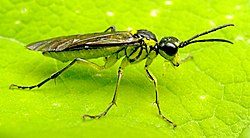
Tenthredo mesomela
Tenthredo mesomela
Scientific classificationEdit this classification
Kingdom: Animalia
Phylum: Arthropoda
Class: Insecta
Order: Hymenoptera
Suborder: Symphyta
Gerstaecker, 1867[1]
Groups included
Cladistically included but traditionally excluded taxa
Larvae of Nematus septentrionalis

Sawflies are wasp-like insects that belong to the suborder Symphyta within the order Hymenoptera. Their common name comes from the saw-shaped ovipositor of the female, which she uses to cut into plant tissue when laying eggs. The largest and most diverse group of sawflies is the Tenthredinoidea, a superfamily that includes most of the approximately 8,000 described species in more than 800 genera worldwide.[3]

Although Symphyta is traditionally ranked as a suborder, it is a paraphyletic grouping that represents several early lineages of Hymenoptera. The insects commonly called sawflies form a natural clade, however, this also includes the ancestors of the Apocrita—the ants, bees, and wasps.[4] Adult sawflies are distinguished from the Apocrita by the absence of a narrow "wasp waist" or petiole between the thorax and abdomen. In sawflies, these segments are broadly joined, which gives the body a smooth profile.[5]

Sawflies first appeared during the Triassic period, about 250 million years ago. The oldest known lineage, the Xyeloidea, is still represented by living species.[6] Around 200 million years ago, some sawfly lineages evolved a parasitoid lifestyle, with larvae that prey on other insects’ eggs or young.[7] Today, sawflies occur worldwide but they are most diverse in the temperate regions of the Northern Hemisphere.[4]

Many sawflies are mimics of bees or wasps, and the female’s ovipositor is sometimes mistaken for a sting, though sawflies cannot sting.[7] Adults range in size from about 2.5 to 20 millimetres (332 to 2532 in), with the largest species reaching about 55 millimetres (2+14 in) in length. Most species are herbivorous, feeding on foliage or other plant parts, while members of the Orussoidea are parasitoids.[3] Sawflies are preyed upon by birds, small mammals such as shrews, and predatory or parasitic insects including flies and other hymenopterans. The larvae of some species defend themselves by regurgitating irritating fluids or by clustering together for protection.[8]

The larvae resemble caterpillars but can be distinguished by their greater number of prolegs and the absence of crochets on the feet. Sawflies undergo complete metamorphosis with four distinct stages, from egg, larva, pupa to adult. Adult sawflies live only about a week, but the larval stage may last from months to more than a year depending on species and environment.[7] Many species reproduce through parthenogenesis, in which females produce fertile eggs without mating, though others reproduce sexually. Adults feed on pollen, nectar, sap, honeydew and sometimes on the hemolymph of other insects, using mouthparts adapted for these varied diets.[9]

Females use their ovipositors to cut into plant tissue—or into the bodies of host insects in parasitoid species—and deposit eggs in clusters called rafts or pods. As the larvae mature, they seek protected sites such as soil or under bark to pupate.[6]

Several species are significant pests. The pine sawfly can cause serious defoliation in forestry, while sawflies such as the iris sawfly damage ornamental plants. Outbreaks of larvae may lead to dieback or tree death. Control methods include the use of insecticides, natural predators and parasitoids, and manual removal of larvae.[8]

Recent phylogenomic research has refined the evolutionary relationships among sawfly lineages, placing Xyeloidea as sister to all other Hymenoptera and revealing complex gene-tree discordance and introgression events.[6][3] These studies highlight key evolutionary innovations such as the transition to parasitoidism and the development of the wasp waist, which underlie the diversification of the order.[4][5]

Etymology

[edit]
Sawfly laying eggs in a plant, using the serrated saw-like ovipositor for which the group is named

The suborder name "Symphyta" derives from the Greek word symphyton, meaning 'grown together', referring to the group's distinctive lack of a wasp waist between prostomium and peristomium.[10] Its common name, "sawfly", derives from the saw-like ovipositor that is used for egg-laying, in which a female makes a slit in either a stem or plant leaf to deposit the eggs.[11] The first known use of this name was in 1773.[12] Sawflies are also known as "wood-wasps".[13]

Phylogeny

[edit]
Carl Gerstaecker established the suborder Symphyta.

In his original description of Hymenoptera in 1863, German zoologist Carl Gerstaecker divided them into three groups, Hymenoptera aculeata, Hymenoptera apocrita and Hymenoptera phytophaga.[14] However, four years later in 1867, he described just two groups, H. apocrita syn. genuina and H. symphyta syn. phytophaga.[1] Consequently, the name Symphyta is given to Gerstaecker as the zoological authority. In his description, Gerstaecker distinguished the two groups by the transfer of the first abdominal segment to the thorax in the Apocrita, compared to the Symphyta. Consequently, there are only eight dorsal half segments in the Apocrita, against nine in the Symphyta. The larvae are distinguished in a similar way.[15]

The Symphyta have therefore traditionally been considered, alongside the Apocrita, to form one of two suborders of Hymenoptera.[16][17] Symphyta are the more primitive group, with comparatively complete venation, larvae that are largely phytophagous, and without a "wasp-waist", a symplesiomorphic feature. Together, the Symphyta make up less than 10% of hymenopteran species.[18] While the terms sawfly and Symphyta have been used synonymously, the Symphyta have also been divided into three groups, true sawflies (phyllophaga), woodwasps or xylophaga (Siricidae), and Orussidae. The three groupings have been distinguished by the true sawflies' ventral serrated or saw-like ovipositor for sawing holes in vegetation to deposit eggs, while the woodwasp ovipositor penetrates wood and the Orussidae behave as external parasitoids of wood-boring beetles. The woodwasps themselves are a paraphyletic ancestral grade. Despite these limitations, the terms have utility and are common in the literature.[17]

While most hymenopteran superfamilies are monophyletic, as is Hymenoptera, the Symphyta has long been seen to be paraphyletic.[19][20] Cladistic methods and molecular phylogenetics are improving the understanding of relationships between the superfamilies, resulting in revisions at the level of superfamily and family.[21] The Symphyta are the most primitive (basal) taxa within the Hymenoptera (some going back 250 million years), and one of the taxa within the Symphyta gave rise to the monophyletic suborder Apocrita (wasps, bees, and ants).[18][20] In cladistic analyses the Orussoidea are consistently the sister group to the Apocrita.[17][18]

The oldest unambiguous sawfly fossils date back to the Middle or Late Triassic. These fossils, from the family Xyelidae, are the oldest of all Hymenoptera.[22] One fossil, Archexyela ipswichensis from Queensland is between 205.6 and 221.5 million years of age, making it among the oldest of all sawfly fossils.[23] More Xyelid fossils have been discovered from the Middle Jurassic and the Cretaceous, but the family was less diverse then than during the Mesozoic and Tertiary. The subfamily Xyelinae were plentiful during these time periods, in which Tertiary faunas were dominated by the tribe Xyelini; these are indicative of a humid and warm climate.[24][25][26]

The cladogram is based on Schulmeister 2003.[27][28]

Symphyta within Hymenoptera
Hymenoptera

Xyeloidea (Triassic–present)

Tenthredinoidea

Pamphilioidea

Cephoidea (stem sawflies)

Siricoidea (horntails or wood wasps)

Xiphydrioidea (wood wasps)

parasitism

Orussoidea (parasitic wood wasps)

wasp waist

Apocrita (ants, bees, wasps)

200mya
250mya
Symphyta
Symphyta (red bar) are paraphyletic as Apocrita are excluded.

Taxonomy

[edit]
Anaxyeloidea: Syntexis libocedrii

There are approximately 8,000 species of sawfly in more than 800 genera, although new species continue to be discovered.[29][30][31] However, earlier studies indicated that 10,000 species grouped into about 1,000 genera were known.[32] Early phylogenies such as that of Alexandr Rasnitsyn, based on morphology and behaviour, identified nine clades which did not reflect the historical superfamilies.[33] Such classifications were replaced by those using molecular methods, starting with Dowton and Austin (1994).[34] As of 2013, the Symphyta are treated as nine superfamilies (one extinct) and 25 families. Most sawflies belong to the Tenthredinoidea superfamily, with about 7,000 species worldwide. Tenthredinoidea has six families, of which Tenthredinidae is by far the largest with some 5,500 species.[2][35]

Extinct taxa are indicated by a dagger ().

Superfamilies and families

[edit]
  • Superfamily Anaxyeloidea (Martynov, 1925)
    • Family Anaxyelidae (Martynov, 1925) (1 species) and 12 genera
  • Superfamily Cephoidea (Newman, 1834) (1 and 1 family)
    • Family Cephidae (Newman, 1834) (21 genera, 160 spp. and 3 genera
  • Superfamily Karatavitoidea (Rasnitsyn, 1963) (1 family)
  • Superfamily Orussoidea (Newman, 1834) (1 and 1 family)
    • Family Orussidae (Newman, 1834) (16 genera, 82 spp.) and 3 genera
  • Superfamily Pamphilioidea (Cameron, 1890) (2 and 1 families) (syn. Megalodontoidea)
    • Family Megalodontesidae (Konow, 1897) (1 genera, 42 spp.) and 1 genus
    • Family Pamphiliidae (Cameron, 1890) (10 genera, 291 spp.) and 3 genera
  • Superfamily Siricoidea (Billberg, 1820) (2 and 5 families)
    • Family Siricidae (Billberg, 1820) (11 genera, 111 spp.) and 9 genera
  • Superfamily Tenthredinoidea (Latreille, 1803) (6 and 2 families)
    • Family Argidae (Konow, 1890) (58 genera, 897 spp.) and 1 genus
    • Family Blasticotomidae (Thomson, 1871) (2 genera, 12 spp.) and 1 genus
    • Family Cimbicidae (W. Kirby, 1837) (16 genera, 182 spp.) and 6 genera
    • Family Diprionidae (Rohwer, 1910) (11 genera, 136 spp.) and 2 genera
    • Family Pergidae (Rohwer, 1911) (60 genera, 442 spp.)
    • Family Tenthredinidae (Latreille, 1803) (400 genera, 5,500 spp.) and 14 genera
  • Superfamily Xiphydrioidea (Leach, 1819)
  • Superfamily Xyeloidea (Newman, 1834)
    • Family Xyelidae (Newman, 1834) (5 genera, 63 spp.) and 47 genera

Description

[edit]
Giant horntail, Urocerus gigas, a Batesian mimic of a hornet, ovipositing. It does not sting.
The European hornet is a wasp-waisted Apocritan with a sting, not a Symphytan.

Many species of sawfly have retained their ancestral attributes throughout time, specifically their plant-eating habits, wing veins and the unmodified abdomen, where the first two segments appear like the succeeding segments.[36] The absence of the narrow wasp waist distinguishes sawflies from other members of hymenoptera, although some are Batesian mimics with coloration similar to wasps and bees, and the ovipositor can be mistaken for a stinger.[37] Most sawflies are stubby and soft-bodied, and fly weakly.[38] Sawflies vary in length: Urocerus gigas, which can be mistaken as a wasp due to its black-and-yellow striped body, can grow up to 20 mm (34 in) in length, but among the largest sawflies ever discovered was Hoplitolyda duolunica from the Mesozoic, with a body length of 55 mm (2+14 in) and a wingspan of 92 mm (3+12 in).[37][39] The smaller species only reach lengths of 2.5 mm (332 in).[40]

Heads of sawflies vary in size, shape and sturdiness, as well as the positions of the eyes and antennae. They are characterised in four head types: open head, maxapontal head, closed head and genapontal head. The open head is simplistic, whereas all the other heads are derived.[41] The head is also hypognathous, meaning that the lower mouthparts are directed downwards. When in use, the mouthparts may be directed forwards, but this is only caused when the sawfly swings its entire head forward in a pendulum motion.[42] Unlike most primitive insects, the sutures (rigid joints between two or more hard elements on an organism) and sclerites (hardened body parts) are obsolescent or absent. The clypeus (a sclerite that makes up an insects "face") is not divided into a pre- and postclypeus, but rather separated from the front.[43] The antennal sclerites are fused with the surrounding head capsule, but these are sometimes separated by a suture. The number of segments in the antennae vary from six in the Accorduleceridae to 30 or more in the Pamphiliidae.[44] The compound eyes are large with a number of facets, and there are three ocelli between the dorsal portions of the compound eyes.[43] The tentorium comprises the whole inner skeleton of the head.[45]

Three segments make up the thorax: the mesothorax, metathorax and prothorax, as well as the exoskeletal plates that connect with these segments.[46] The legs have spurs on their fourth segments, the tibiae.[47] Sawflies have two pairs of translucent wings. The fore and hind wings are locked together with hooks.[48] Parallel development in sawfly wings is most frequent in the anal veins. In all sawflies, 2A and 3A tend to fuse with the first anal vein. This occurs in several families including Argidae, Diprionidae and Cimbicidae.[49]

Aposematically coloured caterpillar-like larva of Abia sericea

The larvae of sawflies are easily mistaken for lepidopteran larvae (caterpillars). However, several morphological differences can distinguish the two: while both larvae share three pairs of thoracic legs and an apical pair of abdominal prolegs, lepidopteran caterpillars have four pairs of prolegs on abdominal segments 3–6 while sawfly larvae have five pairs of prolegs located on abdominal segments 2–6; crochets are present on lepidopteran larvae, whereas on sawfly larvae they are not; the prolegs of both larvae gradually disappear by the time they burrow into the ground, therefore making it difficult to distinguish the two; and sawfly larvae only have a single pair of minute eyes, whereas lepidopteran larvae have four to six eyes on each side of the head.[16][37] Sawfly larvae behave like lepidopteran larvae, walking about and eating foliage. Some groups have larvae that are eyeless and almost legless; these larvae make tunnels in plant tissues including wood.[38] Many species of sawfly larvae are strikingly coloured, exhibiting colour combinations such as black and white while others are black and yellow. This is a warning colouration because some larvae can secrete irritating fluids from glands located on their undersides.[37]

Distribution

[edit]

Sawflies are widely distributed throughout the world.[50] The largest family, the Tenthredinidae, with some 5,000 species, are found on all continents except Antarctica, though they are most abundant and diverse in the temperate regions of the northern hemisphere; they are absent from New Zealand and there are few of them in Australia. The next largest family, the Argidae, with some 800 species, is also worldwide, but is most common in the tropics, especially in Africa, where they feed on woody and herbaceous angiosperms. Of the other families, the Blasticotomidae and Megalodontesidae are Palearctic; the Xyelidae, Pamphilidae, Diprionidae, Cimbicidae, and Cephidae are Holarctic, while the Siricidae are mainly Holarctic with some tropical species. The parasitic Orussidae are found worldwide, mostly in tropical and subtropical regions. The wood-boring Xiphydriidae are worldwide, but most species live in the subtropical parts of Asia.[29]

Behaviour and ecology

[edit]
Rose stem sawfly (Hartigia trimaculata) larva in a rose stem

Sawflies are mostly herbivores, feeding on plants that have a high concentration of chemical defences. These insects are either resistant to the chemical substances, or they avoid areas of the plant that have high concentrations of chemicals.[51] The larvae primarily feed in groups; they are folivores, eating plants and fruits on native trees and shrubs, though some are parasitic.[11][52][53] However, this is not always the case; Monterey pine sawfly (Itycorsia) larvae are solitary web-spinners that feed on Monterey pine trees inside a silken web.[54] The adults feed on pollen and nectar.[52]

Anti-predator adaptation: spitfire sawfly larvae grouped together for safety in numbers

Sawflies are eaten by a wide variety of predators. While many birds find the larvae distasteful, some such as the currawong (Strepera) and stonechats (Saxicola) eat both adults and larvae.[55][56] The larvae are an important food source for the chicks of several birds, including partridges.[57] Sawfly and moth larvae form one third of the diet of nestling corn buntings (Emberiza calandra), with sawfly larvae being eaten more frequently on cool days.[58] Black grouse (Tetrao tetrix) chicks show a strong preference for sawfly larvae.[59][60] Sawfly larvae formed 43% of the diet of chestnut-backed chickadees (Poecile rufescens).[54] Small carnivorous mammals such as the masked shrew (Sorex cinereus), the northern short-tailed shrew (Blarina brevicauda) and the deer mouse (Peromyscus maniculatus) predate heavily on sawfly cocoons.[61] Insects such as ants and certain species of predatory wasps (Vespula vulgaris) eat adult sawflies and the larvae, as do lizards and frogs.[62][63] Pardalotes, honeyeaters and fantails (Rhipidura) occasionally consume laid eggs, and several species of beetle larvae prey on the pupae.[56]

The larvae have several anti-predator adaptations. While adults are unable to sting, the larvae of species such as the spitfire sawfly regurgitate a distasteful irritating liquid, which makes predators such as ants avoid the larvae.[11][64] In some species, the larvae cluster together, reducing their chances of being killed, and in some cases form together with their heads pointing outwards or tap their abdomens up and down.[56][65] Some adults bear black and yellow markings that mimic wasps.[37]

Parasites

[edit]

Sawflies are hosts to many parasitoids, most of which are parasitic Hymenoptera; more than 40 species are known to attack them. However, information regarding these species is minimal, and fewer than 10 of these species actually cause a significant impact on sawfly populations.[66] Many of these species attack their hosts in the grass or in other parasitoids.[clarification needed] Well known and important parasitoids include Braconidae, Eulophidae and Ichneumonidae. Braconid wasps attack sawflies in many regions throughout the world, in which they are ectoparasitoids, meaning that the larvae live and feed outside of the hosts body; braconids have more of an impact on sawfly populations in the New World than they do in the Old World, possibly because there are no ichneumonid parasitoids in North America. Some braconid wasps that attack sawflies include Bracon cephi, B. lisogaster, B. terabeila and Heteropilus cephi.[66][67][68] Female braconids locate sawfly larvae through the vibrations they produce when feeding, followed by inserting the ovipositor and paralysing the larva before laying eggs inside the host. These eggs hatch inside the larva within a few days, where they feed on the host. The entire host's body may be consumed by the braconid larvae, except for the head capsule and epidermis. The larvae complete their development within two or three weeks.[66]

Ten species of wasps in the family Ichneumonidae attack sawfly populations, although these species are usually rare. The most important parasitoids in this family are species in the genus Collyria. Unlike braconids, the larvae are endoparasitoids, meaning that the larvae live and feed inside the hosts body.[66] One well known ichneumonid is Collyria coxator, which is a dominant parasitoid of C. pygmaeus. Recorded parasitism rates in Europe are between 20–76%, and as many as eight eggs can be found in a single larva, but only one Collyria individual will emerge from its host. The larva may remain inside of their host until spring, where it emerges and pupates.[66]

Several species in the family Eulophidae attack sawflies, although their impact is low. Two species in the genus Pediobius have been studied; the two species are internal larval parasitoids and have only been found in the northern hemisphere. Parasitism of sawflies by eulophids in grass exceeds 50%, but only 5% in wheat. It is unknown as to why the attack rate in wheat is low.[69] Furthermore, some fungal and bacterial diseases are known to infect eggs and pupa in warm wet weather.[56]

Outbreaks of certain sawfly species, such as Diprion polytomum, have led scientists to investigate and possibly collect their natural enemies to control them. Parasites of D. polytomum have been extensively investigated, showing that 31 species of hymenopterous and dipterous parasites attack it. These parasites have been used in successful biological control against pest sawflies, including Cephus cinctus throughout the 1930s and 1950s and C. pygmaeus in the 1930s and 1940s.[70][71]

Life cycle and reproduction

[edit]
Adult male newly emerged from its cocoon

Like all other hymenopteran insects, sawflies go through a complete metamorphosis with four distinct life stages – egg, larva, pupa and adult.[72] Many species are parthenogenetic, meaning that females do not need fertilization to create viable eggs. Unfertilized eggs develop as male, while fertilized eggs develop into females (arrhenotoky). The lifespan of an individual sawfly is two months to two years, though the adult life stage is often very short (approximately 7 – 9 days), only long enough for the females to lay their eggs.[37][56][73] The female uses its ovipositor to drill into plant material to lay her eggs (though the family Orussoidea lay their eggs in other insects). Plant-eating sawflies most commonly are associated with leafy material but some specialize on wood, and the ovipositors of these species (such as the family Siricidae) are specially adapted for the task of drilling through bark. Once the incision has been made, the female will lay as many as 30 to 90 eggs. Females avoid the shade when laying their eggs because the larvae develop much slower and may not even survive, and they may not also survive if they are laid on immature and glaucous leaves. Hence, female sawflies search for young adult leaves to lay their eggs on.[37][56]

These eggs hatch in two to eight weeks, but such duration varies by species and also by temperature. Until the eggs have hatched, some species such as the small brown sawfly will remain with them and protects the eggs by buzzing loudly and beating her wings to deter predators. There are six larval stages that sawflies go through, lasting 2 – 4 months, but this also depends on the species. When fully grown, the larvae emerge from the trees en masse and burrow themselves into the soil to pupate. During their time outside, the larvae may link up to form a large colony if many other individuals are present. They gather in large groups during the day which gives them protection from potential enemies, and during the night they disperse to feed. The emergence of adults takes awhile, with some emerging anywhere between a couple months to 2 years. Some will reach the ground to form pupal chambers, but others may spin a cocoon attached to a leaf. Larvae that feed on wood will pupate in the tunnels they have constructed. In one species, the jumping-disc sawfly (Phyllotoma aceris) forms a cocoon which can act like a parachute. The larvae live in sycamore trees and do not damage the upper or lower cuticles of leaves that they feed on. When fully developed, they cut small perforations in the upper cuticle to form a circle. After this, they weave a silk hammocks within the circle; this silk hammock never touches the lower cuticle. Once inside, the upper-cuticle's disc separates and descends towards the surface with the larvae attaching themselves to the hammock. Once they reach the round, the larvae work their way into a sheltered area by jerking their discs along.[37][56]

The majority of sawfly species produce a single generation per year, but others may only have one generation every two years. Most sawflies are female, making males rare.[56]

Relationship with humans

[edit]
The pine sawfly Diprion pini is a serious pest of forestry.
Caterpillar-like larvae of Iris sawfly on yellow flag, showing damage to host plant

Sawflies are major economic pests of forestry. Species in the Diprionidae, such as the pine sawflies, Diprion pini and Neodiprion sertifer, cause serious damage to pines in regions such as Scandinavia. D. pini larvae defoliated 500,000 hectares (1,200,000 acres) in the largest outbreak in Finland, between 1998 and 2001. Up to 75% of the trees may die after such outbreaks, as D. pini can remove all the leaves late in the growing season, leaving the trees too weak to survive the winter.[74] Little damage to trees only occurs when the tree is large or when there is minimal presence of larvae. Eucalyptus trees can regenerate quickly from damage inflicted by the larvae; however, they can be substantially damaged from outbreaks, especially if they are young. The trees can be defoliated completely and may cause "dieback", stunting or even death.[56]

Sawflies are serious pests in horticulture. Different species prefer different host plants, often being specific to a family or genus of hosts. For example, Iris sawfly larvae, emerging in summer, can quickly defoliate species of Iris including the yellow flag and other freshwater species.[75] Similarly the rose sawflies, Arge pagana and A. ochropus, defoliate rose bushes.[76]

The giant woodwasp or horntail, Urocerus gigas, has a long ovipositor, which with its black and yellow colouration make it a good mimic of a hornet. Despite the alarming appearance, the insect cannot sting.[77] The eggs are laid in the wood of conifers such as Douglas fir, pine, spruce, and larch. The larvae eat tunnels in the wood, causing economic damage.[78]

Alternative measures to control sawflies can be taken. Small-scale, mechanical methods include visually confirming larval presence on a plant and subsequently removing them, either by pruning damaged leaves or removing the larvae from the leaves they are on. Larvae typically try to remain hidden on the underside of foliage. Upon removing larvae and/or the affected leaves from plants, they may be dispatched by squishing, or, alternatively, the cut leaves with larvae still attached may be fed to birds; if larger animals do not prey upon them, other insects will. However, this is not practical or useful for some, thus the larvae can be quickly dispatched by simply dropping foliage into a vessel of plain or saltwater, diluted hydrogen peroxide or isopropyl alcohol, insecticidal soap, or other garden chemical. In large-scale, industrial settings, where beneficial insect predators can also be used to eliminate larvae, as well as parasites, which have both been previously used in control programs.[56][70] Small trees can be sprayed with a number of chemicals, including maldison, dimethoate, carbaryl, imidacloprid, etc., if removing larvae from trees is not effective enough.[56]

References

[edit]

Further reading

[edit]
[edit]
Revisions and contributorsEdit on WikipediaRead on Wikipedia
from Grokipedia
Sawflies are the common name for several thousand species of insects belonging to the suborder Symphyta within the order Hymenoptera, the same group that includes bees, wasps, and ants. Unlike the more derived Apocrita suborder (which encompasses stinging Hymenoptera), sawflies lack a narrow "wasp waist" and possess a broad connection between the thorax and abdomen, with females featuring a distinctive saw-like ovipositor used to slice slits in plant tissues for egg deposition. There are approximately 8,000 described species worldwide, distributed across 16 families and 8 superfamilies, with the vast majority—over 7,500 species—falling into the diverse family Tenthredinidae. Adults are typically small to medium-sized, ranging from a few millimeters to about 4 cm in wingspan, with bodies that may appear stout and hairy or slender and wasp-like; they are generally dark-colored but can exhibit metallic blue, orange, or other hues in certain . Sawflies undergo complete (holometabolous) , featuring four life stages: , , , and . Eggs are laid singly or in clusters within slits and hatch in 2–8 weeks, giving rise to caterpillar-like larvae that possess three pairs of true thoracic legs plus at least six pairs of fleshy abdominal prolegs—distinguishing them from true caterpillars (), which have fewer prolegs. Larvae feed voraciously on foliage, needles, buds, or even wood, often in groups, and undergo 5–9 instars over 2–4 months before pupating in soil, cocoons, or galls; most complete one generation per year, though some produce two. Sawflies are primarily phytophagous, with larvae serving as herbivores on a wide range of plants including , trees, shrubs, and ornamentals, while adults subsist on , , or honeydew; a few specialized groups, such as the family Orussidae, are parasitic on wood-boring beetles. They inhabit diverse ecosystems worldwide, from forests and gardens to coastal marshes, but are absent from polar regions, and many act as occasional pests by defoliating crops, forestry plantations, and landscape plants, particularly young or stressed trees. Some reproduce parthenogenetically, with unfertilized eggs developing into females, contributing to rapid population growth in favorable conditions.

Taxonomy and Evolution

Phylogeny

Sawflies belong to the suborder Symphyta, which represents a paraphyletic basal grade within the order , ancestral to the more derived suborder that includes bees, wasps, and . This positioning is supported by both morphological and molecular evidence, placing Symphyta as the earliest diverging lineages in hymenopteran evolution. Fossil records indicate that symphytans originated during the period, with the oldest known sawfly fossil, Archexyela ipswichensis, discovered in the Mount Crosby Formation of , , and dated to between 205.6 and 221.5 million years ago. This specimen, belonging to the family Xyelidae, underscores the ancient origins of sawflies and their early diversification alongside the emergence of angiosperms and gymnosperms. Key evolutionary traits distinguish Symphyta from , reflecting their primitive status. Unlike the , which exhibit a narrow "" formed by a constricted petiole between the and , symphytans have a broad connection without such constriction, allowing for a more generalized . Additionally, the in sawflies is a saw-like adapted for inserting eggs into tissues, rather than the modified stinging apparatus seen in many apocritans for or defense. These traits highlight the phytophagous lifestyle of symphytans, with larvae typically feeding on , in contrast to the or predatory habits that evolved in . Phylogenetic analyses reveal the relationships among sawfly families within Symphyta as a successive grade leading to the . Basal-most is the family Xyelidae, followed by Pamphilioidea (including Pamphiliidae and Megalodontesidae), then a comprising Siricoidea (e.g., Xiphydriidae, Siricidae) and Tenthredinoidea (encompassing most sawfly families like and Pergidae). This arrangement is depicted in recent phylogenomic trees derived from ultraconserved elements (UCEs), showing divergence from around 240–250 million years ago during the early . The transition to involved key innovations like the lifestyle, marking a major evolutionary shift from herbivory. Recent molecular studies since 2020 have reinforced the of Symphyta while resolving debates on interfamilial relationships and the position of Orussidae. For instance, phylogenomic analyses using hundreds of UCE loci confirm that Symphyta does not form a monophyletic , with arising from within this grade. Orussidae, a small of parasitic woodwasps often included in the symphytan grade, is consistently placed as the to , forming the Orussida; this relationship is supported by both mitochondrial genomes and nuclear data, though earlier morphological studies debated its exact placement relative to siricoid sawflies. These findings, from datasets exceeding 300 loci, provide robust evidence for the evolutionary timeline and basal diversification of .

Classification

Sawflies belong to the order within the class Insecta, and they are classified under the suborder Symphyta, which encompasses the non-apocritan lineages of this order. The suborder Symphyta is traditionally divided into 11 superfamilies, reflecting a paraphyletic grouping based on shared primitive traits such as the lack of a and the presence of plant-feeding larvae. These superfamilies include Xyeloidea, Pamphilioidea, Megalodontoidea, Cephaloidea, Siricoidea, Anaxyeloidea, Xiphydrioidea, Orussoidea, Tenthredinoidea, and others, with Tenthredinoidea being the most diverse, containing the majority of sawfly across multiple families such as , Argidae, and Diprionidae. The taxonomic nomenclature of sawflies traces back to , who in the 18th century included early descriptions of hymenopterans, including sawfly-like , under the order in his , establishing foundational binomial names for several species. Significant 19th-century revisions advanced the classification, with William Kirby providing early systematic arrangements of British in works like his 1798 monograph, emphasizing morphological distinctions, and Edward Newman further refining sawfly taxonomy through descriptions of 24 new species and six genera in publications such as his 1834 Entomological Magazine contributions, which incorporated detailed illustrations and keys based on observed variations. Classification criteria for sawflies rely primarily on morphological features, particularly wing venation patterns, which provide diagnostic characters for distinguishing superfamilies and families; for instance, the presence of specific crossveins like the 2r-m in Tenthredinoidea helps delineate boundaries. In recent decades, genetic markers such as mitochondrial and nuclear DNA sequences have supplemented morphology, enabling phylogenomic analyses that refine relationships within Symphyta. Ongoing debates center on superfamily boundaries, informed by cladistic analyses; for example, phylogenomic studies have highlighted close affinities between Xyeloidea and Pamphilioidea, leading some researchers to propose merging them into a single superfamily based on shared synapomorphies in larval structure and molecular data, though this remains contentious due to conflicting morphological evidence from wing and antenna traits.

Diversity

Sawflies represent a diverse group within the suborder Symphyta, with approximately 8,000 described extant distributed across more than 800 genera and 14 families worldwide. Including species, the total rises to 8,618 according to comprehensive catalogs. While exact estimates for undescribed species remain uncertain, the group's is considered underestimated, with potential for thousands more based on ongoing surveys of understudied regions. The family dominates in , encompassing over 5,500 species and representing about 66% of all known sawflies. Key families highlight the varied ecological roles of sawflies. The , often called common sawflies, are the most speciose and widespread, feeding primarily on foliage across diverse plant hosts. The Siricidae, known as woodwasps or horntails, include around 124 species specialized in boring into wood, often in association with symbiotic fungi. Orussidae, the parasitic sawflies, comprise a smaller group of about 88 species that are notable for their endoparasitic lifestyle on wood-boring larvae, marking them as a basal lineage in evolution. Diversity patterns reveal geographic concentrations, with tropical regions serving as hotspots for certain families. The Argidae, for instance, exhibit peak diversity in tropical areas, with about 900 species globally, many adapted to ferns and angiosperms in warm climates. In contrast, the Pergidae show strong in , where they dominate the local sawfly with 146 described species, reflecting Gondwanan origins and specialization on native eucalypts and acacias. Advances in molecular techniques, particularly , have accelerated species discovery in recent years. Surveys from 2023 onward have uncovered cryptic diversity, such as the description of Mesoneura tematinensis in 2023 through combined morphological and barcode analysis, contributing to updated estimates of sawfly richness. Recent fossil discoveries include Baladi warru (Pergidae) from the of , described in 2024, providing insights into historical distributions and co-evolution with plants.

Morphology and Identification

Adult Features

Adult sawflies are characterized by a robust body structure featuring a broad abdomen directly attached to the thorax without the narrowed petiole or "wasp waist" typical of the Apocrita suborder. This distinguishes them from wasps, ants, and bees, which exhibit a constricted waist. Body lengths vary widely, typically ranging from 3 to 40 mm, with some species in the Siricidae family reaching up to 50 mm. Coloration is diverse, often including shades of black, metallic green, or blue, with some species displaying yellow spots or bands for camouflage or warning. Key morphological features include the female's prominent saw-like , a specialized structure at the abdomen's end used to cut slits in tissues for deposition, rather than for stinging prey or defense as in wasps. Antennae are generally elbowed or geniculate, consisting of 3 to 12 segments, and may be filiform, , or pectinate depending on the and . Adults possess two pairs of membranous wings with relatively reduced venation compared to more primitive , though the forewings are larger and more veined than the hindwings; these wings lack the hardened elytra of beetles, aiding identification. Sexual dimorphism is evident in many species, with males typically smaller than females and possessing clasping genitalia adapted for mating. In families like Siricidae, both sexes may feature a horn-like projection at the abdomen's tip, while antennal shapes often differ, such as serrate in females and pectinate in males of Diprionidae. For identification, sawflies can be differentiated from wasps by their lack of a stinging ovipositor and herbivorous adult diet focused on pollen or nectar, and from beetles by their fully membranous wings and lack of hardened forewings.

Larval Features

Sawfly larvae, belonging to the suborder Symphyta within , exhibit an eruciform that closely resembles lepidopteran caterpillars but is distinguished by morphological traits adapted for phytophagous lifestyles. They possess a well-developed head capsule housing chewing mouthparts for foliage consumption, three pairs of true thoracic legs, and typically six to eight pairs of fleshy abdominal prolegs (also called pseudolegs) that facilitate locomotion on plant surfaces. These prolegs, unlike the fewer pairs (usually five or fewer) in true caterpillars, extend along most abdominal segments, aiding in gripping leaves during feeding. Mature larvae can reach lengths of up to 80 mm in certain species, with body segmentation evident but often obscured by a soft, extensible . Morphological variations among sawfly larvae reflect diverse ecological roles and host plant interactions. Some species produce solitary larvae, while others form gregarious groups that aggregate on foliage, enhancing collective defense through synchronized behaviors. In families like , larvae may appear slug-like, with a slimy, legless or reduced-proleg body covered in a translucent layer that aids in and reduces , as seen in the pear slug (Caliroa cerasi). Conversely, larvae in the Pergidae family often feature armored exoskeletons with prominent spines or tubercles, providing physical protection against predators; for example, larvae (e.g., species) display tough, waxy cuticles and dorsal projections that deter attack. Feeding adaptations in sawfly larvae are closely tied to their mouthparts and body form. The mandibular chewing apparatus is robust, enabling external skeletonization or complete defoliation, with some exhibiting specialized setae or spines around the for rasping tissues. Leaf-mining larvae, such as those in the , possess translucent, whitish bodies that blend with host , allowing them to internally while avoiding detection; these forms often have reduced prolegs and elongated bodies suited for narrow galleries. Recent research highlights larval adaptations for defense, including chemical sequestration of that enhance survival. In 2024 studies, larvae of like Monophadnoides rumicivorus () were shown to sequester furostanol from Ranunculaceae hosts, storing these compounds in for antipredator deterrence without significant metabolic cost. Similarly, pergid sawflies demonstrate polyvalent sequestration, accumulating multiple toxin classes (e.g., clerodane diterpenoids and phenolics) from eucalypt hosts, which modulate social grouping and provide broad-spectrum protection against . These mechanisms, combined with morphological in translucent or cryptically colored forms, underscore the larvae's evolutionary reliance on host-derived defenses.

Distribution and Habitat

Global Range

Sawflies are distributed worldwide, with a cosmopolitan presence on all continents except , where extreme conditions preclude their establishment. This broad range reflects the adaptability of the suborder Symphyta across diverse terrestrial ecosystems, though they are notably absent from most oceanic islands without human introduction. The family's primary representatives, such as the , underscore this pattern, encompassing over 7,500 species globally and dominating sawfly diversity in non-polar regions. Diversity is highest in the Holarctic and Neotropical realms, where temperate and subtropical conditions support prolific and . In the Holarctic region, encompassing and , environmental stability post-glaciation has fostered extensive radiations, with over 940 species of alone recorded in the Nearctic portion. The Neotropical region similarly hosts significant concentrations, particularly in South American forests, contributing to the suborder's overall richness estimated at around 8,000 species. exemplifies this, harboring more than 1,000 sawfly species across multiple families, many adapted to coniferous and hosts. Historical biogeographic patterns have shaped current distributions, including post-glacial migrations in that recolonized northern latitudes as ice sheets retreated, enabling sawfly populations to expand alongside host plants. Human-mediated introductions have further extended ranges, often through accidental transport via international timber trade; for instance, the European pine sawfly (Neodiprion sertifer), native to Eurasian forests, was introduced to around and has since spread across the northeastern and and , from southward to and westward to . Such invasions highlight vulnerabilities in global commerce pathways. Climate plays a pivotal role in delimiting sawfly ranges, with the majority of species thriving in temperate zones of the Northern and Southern Hemispheres due to synchronized phenologies with host vegetation. However, tropical adaptations occur in Indo-Australian families like Pergidae, which exhibit physiological and behavioral traits suited to humid, equatorial environments, including specialized oviposition and larval tolerance to high temperatures in Southeast Asian and Australian woodlands. These regional variations underscore the suborder's evolutionary flexibility while emphasizing temperate dominance in overall abundance.

Ecological Niches

Sawflies inhabit a variety of terrestrial ecosystems, with preferred habitats including forests, grasslands, and gardens where vegetation provides ample resources for their larval stages. These environments support the diverse feeding strategies within the Symphyta suborder, allowing sawflies to thrive in both natural and human-modified landscapes. For instance, species in the family Siricidae specialize as wood-borers in coniferous trees, tunneling into weakened or freshly dead timber in forested areas to complete their development. In contrast, the largest family, , predominantly occupies niches involving leaf-feeding on angiosperms such as trees and shrubs in open woodlands and meadows, contributing to their widespread distribution across temperate regions. Microhabitat variations further diversify sawfly niches, enabling adaptation to specialized conditions within broader habitats. Some species act as gall-makers on shrubs, inducing tumor-like growths on plants like willows (Salix spp.) that serve as protective feeding sites for larvae, often in riparian or settings. Similarly, certain Xyelidae species exhibit larvae associated with moist microhabitats near streams, where they feed on pollen-bearing structures of in streamside forests, linking their life cycles to hydrological features. These specialized niches highlight the ecological flexibility of sawflies, allowing them to exploit ephemeral resources like early-season or seasonal foliage. In ecosystems, sawflies function primarily as herbivores, exerting influence on plant succession through defoliation that can alter competitive dynamics among , favoring early-successional or reducing canopy dominance in affected areas. Their larvae, resembling caterpillars, serve as key prey for birds, predatory insects, and small mammals, integrating sawflies into food webs and supporting higher trophic levels in forests and grasslands. Recent studies indicate that is reshaping these niches, with warming temperatures driving northward range expansions of several European sawfly , such as pine sawflies in , potentially intensifying herbivory pressures in northern forests; additionally, as of 2025, assessments suggest the invasive elm zigzag sawfly (Aproceros leucopoda) could establish across and parts of the central-eastern and due to increasing climatic suitability. This shift underscores the vulnerability of sawfly populations to environmental changes, affecting their roles in temperate ecosystems.

Life Cycle and Reproduction

Developmental Stages

Sawflies undergo complete , consisting of four distinct life stages: , , , and . This holometabolous development allows for significant morphological changes between the feeding larval stage and the reproductive stage, with the serving as a transitional phase. The duration of the entire life cycle varies by , environmental conditions, and whether the population is univoltine (one generation per year) or multivoltine, but it typically spans from several weeks to multiple years due to . The egg stage begins when females deposit small, pale yellow , often individually or in small clusters, into slits cut into plant tissues such as needles, leaves, or stems using their saw-like . These are typically flattened or oval-shaped and may swell and darken just before hatching, sometimes bulging from the insertion site. Hatching occurs in 1 to 8 weeks, depending on species, temperature, and location, with some species overwintering as laid in the previous autumn. Following eclosion, larvae progress through 4 to 11 s, molting as they grow while feeding voraciously on host foliage. The larval period lasts from weeks to several months, influenced by food availability and temperature, during which the larvae may enter —a dormant state—to survive unfavorable conditions such as cold winters or dry summers. In species exhibiting , this often occurs in the final or as prepupae, allowing populations to synchronize emergence with suitable host . Mature larvae then enter the pupal stage, typically encased in silken cocoons constructed in the , leaf litter, or occasionally on the host plant. For univoltine , the pupal period can extend 1 to 3 years, incorporating obligatory to overwinter and sometimes delay development across multiple seasons for population regulation. Within the cocoon, the larva transforms into a , where internal structures like wings develop as compact pads that expand during the final . Adults eclose from the pupal cocoon in spring or summer, timed to coincide with host plant availability, marking the end of development and the initiation of reproductive behaviors. This emergence involves the splitting of the pupal case, with the soft-bodied adult expanding its wings and hardening its over hours. Although sawflies exhibit complete , the pupal stage features visible wing pad development similar to other holometabolous , facilitating the transition to flight-capable adults.

Mating and Oviposition

Sawfly mating systems are typically promiscuous, with females often mating multiple times to increase in offspring. In species belonging to the family , such as Athalia rosae, sex pheromones derived from the oxidation of cuticular hydrocarbons play a crucial role in attracting mates and facilitating species recognition. These pheromones are multicomponent blends released from exocrine glands, enabling rapid mate location in short-lived adults. In certain sawfly species, including the wheat stem sawfly (Cephus cinctus in the family Cephidae), males exhibit lekking behavior, forming aggregations at field edges where they compete aggressively by nipping at rivals' antennae and legs while releasing aggregation-sex pheromones like and 9-acetyloxynonanal to lure females. Males often emerge before females (protandry), patrolling sunny areas or territories to intercept emerging mates, though territorial defense is less pronounced than in lekking groups. This behavior enhances mating efficiency but can lead to intense male-male competition. During oviposition, female sawflies employ a specialized, saw-like to insert eggs into host plant tissues, minimizing exposure to predators. Eggs may be laid endophytically, such as within stems or wood in species like Syntexis libocedrii, or ectophytically on leaf surfaces in external feeders like Neodiprion spp., where they are often deposited in neat rows or clusters. Clutch sizes typically range from 30 to 50 eggs per female, though this varies by species and host quality; for instance, C. cinctus females lay about 30-40 eggs, prioritizing larger stems for higher larval survival. In gall-inducing sawflies, such as Euura lasiolepis (), females inject glandular secretions containing phytohormones like (IAA) and trans-zeatin into leaves during oviposition, manipulating plant growth to form protective around eggs and early larvae. is generally absent, but gregarious species promote larval aggregation through clustered egg-laying, enhancing collective defense. occurs in select populations, notably the invasive elm zigzag sawfly (Aproceros leucopoda), where all-female lineages produce viable female offspring without mating.

Behavior and Ecology

Foraging and Feeding

Adult sawflies primarily feed on , , and honeydew produced by and other . This diet supports their short adult lifespan, often lasting only a few days to a week, during which they visit flowers and host plants. In contrast, species in the family Orussidae exhibit predaceous behavior, with larvae parasitizing wood-boring beetle larvae, such as those in the family. Sawfly larvae are predominantly herbivorous, causing defoliation by consuming leaves, needles, or wood of their host plants. Many species show host plant specificity; for example, the rose sawfly Arge pagana feeds exclusively on roses (Rosa spp.), often skeletonizing leaves and leading to significant damage. Larvae typically chew foliage using their mandibles, a feature adapted for external feeding, and often do so in gregarious groups for protection. Sawfly larvae occupy various feeding guilds, including defoliators that strip entire leaves or needles, skeletonizers that consume leaf tissue between veins, leaf miners that feed internally between leaf surfaces, and borers that tunnel into stems or wood. For instance, the leafmining sawfly (Fenusa pusilla) larvae mine between leaf layers, creating brown blotches that mimic symptoms. These guilds allow sawflies to exploit diverse parts, with conifer-feeding species often targeting new growth and ones preferring leaf edges or surfaces. To counter plant chemical defenses, sawfly larvae possess adaptations such as partial of hydrolysable and of during , enabling them to process from host leaves like those of . of flavonoid aglycones further aids in detoxifying these phenolics, as observed in larvae of six birch-feeding species. Defoliation by sawflies, such as Diprion pini on Scots pine, induces accumulation of soluble condensed and other phenolics in host foliage, potentially reducing subsequent larval performance through lower cocoon mass. Research highlights the role of the sawfly gut microbiome in modulating interactions with plant defenses, particularly in gall-inducing species like those in the genus Euura on willows. Core microbial communities contribute to degrading for and supplementation during herbivory.

Predation and Parasitism

Sawfly larvae serve as prey for a variety of natural predators, including birds, which consume them alongside similar-looking hairy caterpillars. Spiders also prey on sawfly larvae, contributing to in and ecosystems. Ants actively hunt sawfly larvae, with predation intensity influenced by local density and larval defense status. Adults face predation from wasps, including species like paper wasps that target soft-bodied during foraging. Parasitoids exert significant pressure on sawfly populations, particularly during the larval stage. Hymenopteran wasps of the family , such as Opheltes glaucopterus, lay eggs directly into sawfly larvae, where the developing consumes the host internally. Tachinid flies similarly parasitize sawfly larvae, with their maggots feeding on the host and emerging to pupate, often targeting species in agricultural settings. Entomopathogenic fungi, including species of , infect sawfly larvae and other insects, leading to host death and fungal spore dispersal, though specific infections vary by environment. Sawflies employ several defense mechanisms against these threats. Larvae often exhibit cryptic coloration to blend with foliage, reducing detection by visual predators like birds and . Gregarious feeding in groups provides a dilution effect, where the risk to any individual decreases as predators cannot attack all members simultaneously. Chemical defenses include the sequestration of mustard oils, such as glucosinolates, in like Athalia rosae; these compounds are released upon disturbance, deterring predators through or unpalatability. These interactions play a key role in regulating sawfly populations. During outbreaks, parasitism rates can reach up to 90%, as observed in field studies of wheat stem sawfly in the , helping to suppress pest densities naturally.

Human Interactions

Economic Impacts

Sawflies exert significant negative economic impacts on and worldwide, primarily through defoliation and stem boring by larval stages. In North American production, the wheat stem sawfly (Cephus cinctus) is a major pest, infesting and stems, which leads to lodging and yield reductions of 20-30% in heavily affected fields across the northern and . This damage results in annual economic losses exceeding $350 million USD in the region, driven by reduced grain quality, harvesting difficulties, and the need for resistant cultivars or alternative practices. Similarly, in alone, untreated infestations cause losses estimated at $70 million annually as of 2024. In , the woodwasp Sirex noctilio poses a severe threat to plantations by boring into trunks and introducing the Amylostereum areolatum, which causes resinosis and mortality. Native to and , S. noctilio has triggered global outbreaks since the early 2000s, including invasions in (detected in 2004), , and (where it has infested 18 provinces since 2013), leading to widespread defoliation and death in commercial species like Pinus radiata and Pinus sylvestris. These incursions have resulted in substantial timber value losses, with potential impacts in the United States alone estimated at $2-11 billion USD if unchecked, underscoring the pest's role in disrupting timber industries across hemispheres. Sawfly pests cause significant regional economic losses, such as those from C. cinctus and S. noctilio, though global totals are not comprehensively assessed and exclude indirect costs like and monitoring. On the positive side, adult sawflies contribute to ecosystems by feeding on and , facilitating of various flowering plants in natural and agricultural settings, which supports and indirect benefits. Additionally, sawfly larvae serve as prey for beneficial like wasps and predatory beetles, enhancing natural pest regulation in agroecosystems and reducing reliance on chemical controls for other herbivores. Recent efforts, such as ongoing releases of wasps like Bracon cephi in as of 2024, show promise for improving biological control and mitigating damages.

Pest Management

Pest management strategies for sawflies emphasize (IPM) principles to suppress populations in agricultural crops like and fruit trees, as well as settings such as plantations, while minimizing ecological disruption. These approaches combine cultural practices, biological agents, targeted chemical applications, and innovative monitoring tools to address species-specific vulnerabilities during larval and adult stages. Cultural methods form the foundation of non-chemical control by altering the environment to reduce sawfly establishment and survival. Crop rotation, particularly avoiding consecutive plantings of susceptible hosts like wheat, disrupts the univoltine life cycle of pests such as the wheat stem sawfly (Cephus cinctus), limiting oviposition sites and larval tunneling. Planting resistant varieties, including solid-stemmed wheat cultivars like 'Solid*, further impedes larval development by creating physical barriers within stems, reducing yield losses by up to 50% in infested fields. Similarly, timely harvest management, such as swathing wheat before full maturity, exposes larvae to desiccation and predators, enhancing overall suppression. Biological controls leverage natural enemies to achieve sustainable population regulation, often integrated with cultural tactics for amplified efficacy. Parasitoids, including ichneumonid wasps like Bracon cephi and Cotesia cameroni, have been introduced and studied for their ability to attack wheat stem sawfly eggs and larvae inside stems, with field releases showing parasitism rates of 20-40% in treated areas. For the invasive Sirex woodwasp (Sirex noctilio), the nematode Deladenus siricidicola serves as a primary biological agent, infecting females to sterilize them and interrupting fungal symbiosis essential for larval nutrition, leading to over 70% suppression in inoculated trap trees in North American programs. Entomopathogenic nematodes, such as Steinernema feltiae and Heterorhabditis bacteriophora, target soil-dwelling pupae and emerging adults of species like the wheat stem sawfly and European apple sawfly (Hoplocampa testudinea), achieving 60-90% mortality in lab and field trials when applied with adjuvants for better soil penetration. Chemical controls are reserved for high-infestation scenarios, prioritizing low-toxicity options timed to coincide with early larval instars when sawflies are most exposed and vulnerable. Spinosad, a bacterial-derived , effectively targets defoliating larvae on trees and crops, providing 80-95% control with residual activity of 1-2 weeks and minimal harm to pollinators when applied at petal fall or early season. Insecticidal soaps and horticultural oils offer contact control for small populations on ornamentals and fruit, smothering soft-bodied larvae without systemic residues, though repeated applications may be needed due to short persistence. Broad-spectrum insecticides like are less favored in IPM due to nontarget effects but can be used judiciously for severe outbreaks in fields. Emerging techniques enhance monitoring and precision control, building on pheromone research for species-specific interventions. The sex pheromone of the wheat stem sawfly has been identified, and pheromone traps are under development as a potential tool for early detection of adult flight and population forecasting. Similarly, synthetic lures for the common pine sawfly (Diprion pini) have been deployed in European forestry to disrupt aggregation, supporting IPM by guiding targeted treatments.

References

Add your contribution
Related Hubs
User Avatar
No comments yet.