


Community hub
Recent from talks
Contribute something
Nothing was collected or created yet.
Pinball Wizard
View on Wikipedia
| "Pinball Wizard" | ||||
|---|---|---|---|---|
 Continental European picture sleeve | ||||
| Single by the Who | ||||
| from the album Tommy | ||||
| B-side | "Dogs Part Two" | |||
| Released | 7 March 1969 | |||
| Recorded | 7 February 1969 | |||
| Studio | Morgan, London | |||
| Genre | ||||
| Length | 2:57 | |||
| Label | Track (UK) Decca (US) | |||
| Songwriter | Pete Townshend | |||
| Producer | Kit Lambert | |||
| The Who singles chronology | ||||
| ||||
| Lyric video | ||||
| "Pinball Wizard" by the Who on YouTube | ||||
| Live video | ||||
| "Pinball Wizard" (1970, live) by the Who on YouTube | ||||
| Alternative release | ||||
 Side A of the UK single | ||||
"Pinball Wizard" is a song by the English rock band the Who, written by guitarist and primary songwriter Pete Townshend and featured on their 1969 rock opera album Tommy. The original recording was released as a single in 1969 and reached No. 4 in the UK charts and No. 19 on the U.S. Billboard Hot 100.
The B-side of the "Pinball Wizard" single is an instrumental credited to Keith Moon, titled "Dogs Part Two". Despite the title, it has no musical connection to the Who's 1968 UK single "Dogs".
Story
[edit]The lyrics are written from the perspective of a pinball champion, called "Local Lad" in the Tommy libretto book, astounded by the skills of the opera's eponymous main character, Tommy Walker: "He ain't got no distractions / Can't hear those buzzers and bells / Don't see no lights a flashin' / Plays by sense of smell / Always gets a replay / Never seen him fall / That deaf dumb and blind kid / Sure plays a mean pinball.",[3] and "I thought I was the Bally table king, but I just handed my pinball crown to him".
Townshend once called it "the most clumsy piece of writing [he'd] ever done".[4] Nevertheless, the song was a commercial success and remains one of the most recognised tunes from the opera. It was a perpetual concert favourite for Who fans due to its pop sound and familiarity.
Position on the album
[edit]In late 1968 or early 1969, when the Who played a rough assembly of their new album to critic Nik Cohn, Cohn gave a lukewarm reaction to it. Following this, Townshend, as Tommy's principal composer, discussed the album with Cohn and concluded that, to lighten the load of the rock opera's heavy spiritual overtones (Townshend had recently become deeply interested in the teachings of Meher Baba), the title character, a "deaf, dumb, and blind" boy, should also be particularly good at a certain game. Knowing Cohn was an avid pinball fan, Townshend suggested that Tommy would play pinball, and Cohn immediately declared Tommy to be a masterpiece.[5] The song "Pinball Wizard" was written and recorded almost immediately. The single version was slightly sped up and runs to 2:57, whilst the natural length album version runs to 3:04.
Reception
[edit]Cash Box said "Pinball Wizard" was "sensational", saying "Retaining the joyful exaltation of early pop rock, the Who add a proficiency and modernization that clicks with the accuracy of a Beatles-gone-heavy."[6] Billboard described the single as "a solid beat rocker".[7] Record World described it as an "exciting side".[8]
Live performances
[edit]This song is one of the band's most famous live songs, being played at almost every Who concert since its debut live performance on 2 May 1969. The live performances rarely deviated from the album arrangement, save for an occasional jam at the end sometimes leading to another song. Bootleg recordings show that this song has been known to last as long as eight minutes (at a concert at the Rainbow Theatre in London on 3 February 1981), although live versions lasting as long as that are extremely rare. Pinball Wizard was also played during the Super Bowl XLIV Halftime Show on 7 February 2010.
Personnel
[edit]- Roger Daltrey – lead vocals
- Pete Townshend – backing vocals, co-lead vocals, acoustic guitar, electric guitar
- John Entwistle – bass guitar
- Keith Moon – drums
Charts and certifications
[edit] | This section needs additional citations for verification. (December 2017) |
Weekly charts
[edit]| Chart (1969) | Peak position |
|---|---|
| Australia Kent Music Report | 45 |
| Canada RPM Top Singles[9] | 6 |
| Finland (Soumen Virallinen)[10] | 32 |
| France | 89 |
| Germany | 25 |
| Ireland | 14 |
| Netherlands | 12 |
| New Zealand (Listener) [11] | 8 |
| South Africa (Springbok)[12] | 6 |
| Switzerland | 15 |
| UK Singles Chart[13] | 4 |
| US Billboard Hot 100[14] | 19 |
| US Cash Box Top 100[15] | 15 |
Elton John version
[edit]| "Pinball Wizard" | ||||
|---|---|---|---|---|
 Side A of the Philippine single | ||||
| Single by Elton John | ||||
| from the album Tommy soundtrack | ||||
| B-side | "Harmony" | |||
| Released | 12 March 1976 | |||
| Recorded | April 19, 1974 | |||
| Studio | Ramport, London | |||
| Genre | ||||
| Length | 5:14 | |||
| Label | ||||
| Songwriter | Pete Townshend | |||
| Producer | Gus Dudgeon | |||
| Elton John singles chronology | ||||
| ||||
| Audio | ||||
| "Pinball Wizard" by Elton John on YouTube | ||||
| Live video | ||||
| "Pinball Wizard" (live, 1975) by Elton John on YouTube | ||||
The song was performed by British musician Elton John in Ken Russell's 1975 film adaptation of Tommy. This version was released in 1975 as a promotional single only in the US, and in 1976 in the UK, where it reached number seven. Because it was not released as a commercial single in the US, it was ineligible to be listed on the Billboard Hot 100 chart, but did make the US Radio & Records airplay chart, where it reached number nine.
John's version uses a piano as the song's centerpiece in place of the acoustic guitar in the original. In the film, John's character is shown playing his pinball machine via a small piano keyboard. He acknowledges that Tommy is a threat, but initially believes he will not be able to beat him for the championship. As the match progresses, he is soon proven wrong, and concedes defeat when Tommy maxes the score counter. His adaptation also features additional lyrics specially written by Townshend for the movie version, as well as a subtle inclusion of musical phrases from the Who's 1960s hit "I Can't Explain" during the outro. Similarly, the Who's later cover of John's "Saturday Night's Alright for Fighting" included parts of "Take Me to the Pilot". Unlike most of the soundtrack's music, which featured various combinations of the Who and some of the era's best session players, John used his own band and producer Gus Dudgeon for the track. John has performed the song as part of his Las Vegas Red Piano Show, as well as on various tours. To date, it is the only cover of a Who song to reach the top 10.[18]
John performed the song with an extended closing jam during his 1975 tour. This version appears on the 2-CD 30th Anniversary release of Captain Fantastic and the Brown Dirt Cowboy, with the live disc of the June 21, 1975 concert from Wembley Stadium.
John opened his 'Final UK Show' at the Glastonbury Festival in 2023 playing the song.
The song has subsequently been performed by Taron Egerton who portrayed John in the film Rocketman (2019).
Personnel
[edit]- Elton John – lead vocals, piano
- Davey Johnstone – acoustic and electric guitars, backing vocals
- Dee Murray – bass, backing vocals
- Nigel Olsson – drums, backing vocals
- Ray Cooper – tambourine, congas
Chart performance
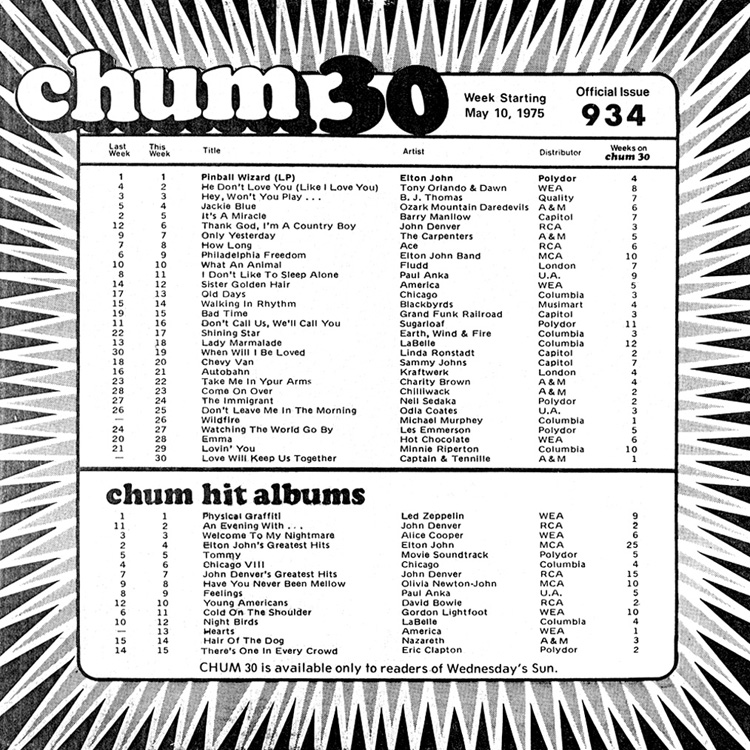
[edit]In Toronto, "Pinball Wizard" spent two weeks at number one on the CHUM survey.[19] In Chicago, "Pinball Wizard" remained on the WLS Musicradio Survey as an "extra" for five and a half months, from mid-April to late September as an album track in heavy rotation.[20]
| Chart (1976) | Peak position |
|---|---|
| Australia[21] | 88 |
| Ireland (IRMA)[22] | 13 |
| UK[23] | 7 |
| US Radio & Records[24] | 9 |
Other cover versions
[edit]
- The song was featured in a medley with another song from Tommy ("See Me, Feel Me") in a recording by the British pop group the New Seekers in 1973. This version reached No.4 on the New Zealand Listener charts[25], No. 16 on the UK charts and in Australia, No. 28 in Canada,[26] and No. 29 on the U.S. Hot 100.[27]
- In 1977, Barry Williams performed the song during a "Songs from Movies" medley on an episode of The Brady Bunch Variety Hour.[28]
- Tenacious D also regularly perform the song as a part of a medley of songs from Tommy[29]
- British rock band McFly have also covered this song that was used in a promo for Two and a Half Men on Paramount Comedy in 2005.
Legacy
[edit]Bruce Springsteen makes a reference to the song in his song "4th of July, Asbury Park (Sandy)", in the album The Wild, the Innocent, & the E Street Shuffle, with the lyric "And the wizards play down on Pinball Way".[30] The track is also featured on the video games Rock Band 2, Rock Band Unplugged and Karaoke Revolution: American Idol Encore 2.[citation needed]
Using the phrase "pinball wizard" to describe a high-quality pinball player is common, both in works of media and among the general public. Several pinball tables feature a "wizard mode", a state of play which is meant to be reached only by skilled players. Within the pinball community, the phrase's use is sometimes controversial: this is primarily due to its ubiquity, with many players having become tired of hearing it.[5]
Several pinball machines have been produced with a "Pinball Wizard" theme. Two of these, produced at the time of the Tommy feature film's release, have only an oblique relation to the song: Wizard was wholly unlicensed, only taking inspiration from the song and film, while Capt. Fantastic and the Brown Dirt Cowboy, a table ostensibly with an Elton John licence, used the singer's likeness as he appeared in the film, where he played the "Pinball Wizard". Both of these machines were produced in the mid-1970s by Bally Manufacturing. Two decades later, Data East Pinball also produced The Who's Tommy Pinball Wizard, a licensed machine capitalising on the album's stage adaptation.[5]
References
[edit]- ^ Bosso, Joe (11 May 2016). "The 25 Greatest Acoustic Songs in Hard Rock". Guitar Player. NewBay Media. Retrieved 5 August 2016.
- ^ Stanley, Bob (13 September 2013). Yeah Yeah Yeah: The Story of Modern Pop. Faber & Faber. p. 348. ISBN 978-0-571-28198-5.
- ^ "Pinball Wizard Lyrics". lyrics.com.
- ^ Remaster Liner Notes to Tommy "Deaf, Dumb and Blind kid" by Richard Barnes
- ^ a b c Alsheimer, Colin. "Are You a Pinball Wizard? Everything You Ever Wanted to Know About a Pinhead's Least Favorite Phrase". Kineticist.
- ^ "CashBox Record Reviews" (PDF). Cash Box. 22 March 1969. p. 18. Retrieved 9 May 2023.
- ^ "Spotlight Singles" (PDF). Billboard. 22 March 1969. p. 71. Retrieved 20 February 2021.
- ^ "Single Picks of the Week" (PDF). Record World. 22 March 1969. p. 1. Retrieved 9 May 2023.
- ^ "Item Display – RPM – Library and Archives Canada". Collectionscanada.gc.ca. 26 May 1969. Retrieved 1 July 2019.
- ^ Nyman, Jake (2005). Suomi soi 4: Suuri suomalainen listakirja (in Finnish) (1st ed.). Helsinki: Tammi. p. 135. ISBN 951-31-2503-3.
- ^ https://www.flavourofnz.co.nz/index.php?qpageID=search%20listener&qsongid=1817#n_view_location search Listener retrieved 05-12-2025
- ^ "SA Charts 1965 – March 1989". Retrieved 5 September 2018.
- ^ "Official Singles Chart on 23/4/1969". Official Charts. 12 November 2021. Retrieved 28 January 2026.
- ^ [Joel Whitburn's Top Pop Singles 1955–2002]
- ^ "Cash Box Top 100 5/31/69". 30 June 2016.
- ^ "Sixties City – Pop Music Charts – Every Week of the Sixties".
- ^ "British single certifications – Who – Pinball Wizard". British Phonographic Industry. Retrieved 2 December 2022.
- ^ Sexton, Paul (20 March 2018). "Elton John Sure Played A Mean Cover Of 'Pinball Wizard'".
- ^ CHUM Hit Parade, May 10, 1975
- ^ "Wls092775".
- ^ Kent, David (1993). Australian Chart Book 1970–1992 (doc). Australian Chart Book, St Ives, N.S.W. ISBN 0-646-11917-6.
- ^ "The Irish Charts – Search Results – Pinball Wizard". Irish Singles Chart. Retrieved 22 June 2017.
- ^ "pinball+wizard – full Official Chart History – Official Charts Company". Official Charts Company.
- ^ Whitburn, Joel (2019). Radio & Records Top Pop Hits 1973–2009. Sheridan Books. p. 70. ISBN 978-0-89820-231-1.
- ^ "flavour of new zealand - search listener". www.flavourofnz.co.nz. Retrieved 4 December 2025.
- ^ "RPM Top 100 Singles – May 5, 1973" (PDF).
- ^ Whitburn, Joel (2013). Joel Whitburn's Top Pop Singles, 14th Edition: 1955-2012. Record Research. p. 611.
- ^ Nichelson, Ted (2009). Love to Love You Bradys: The Bizarre Story of the Brady Bunch Variety Hour. ECW Press. p. 291. ISBN 9781550228885.
- ^ "Tenacious D Dig Into Who Catalog for Concert Medley". Ultimate Classic Rock. 30 June 2012.
- ^ "Bruce Springsteen Lyrics database : 4th of July, Asbury Park (Sandy)". brucespringsteen.it. Retrieved 29 November 2016.
External links
[edit]


Pinball Wizard
View on GrokipediaBackground
Inspiration and writing
Pete Townshend composed "Pinball Wizard" in late 1968 or early 1969 amid a tight deadline for completing the rock opera Tommy, drawing inspiration from a conversation with music critic Nik Cohn. Cohn, a known pinball enthusiast who was penning a book titled Arfur: Teenage Pinball Queen, had listened to an early rough mix of the album and dismissed it as overly somber and lacking flair. In response, Townshend hastily reimagined the protagonist Tommy as an unparalleled pinball player to inject excitement and appeal to Cohn's interests, writing the song in a single night to rescue the project's momentum.[5][1] Townshend described the creative process as a desperate pivot, likening the addition to a strategic adjustment that transformed the narrative's tone. By framing Tommy—a deaf, dumb, and blind boy—as a "pinball wizard," the song positioned him as a messianic figure whose extraordinary talent elevates him to near-divine status among followers, blending spiritual allegory with accessible, high-energy spectacle. This element not only won Cohn's favor but also balanced the opera's deeper themes of trauma and enlightenment.[6] In his 2012 autobiography Who I Am, Townshend reflected on the decision as a "huge leap into the absurd," deliberately lightening the story's heavy spiritual undertones by replacing a more conventional guru archetype with the vibrant, game-centric heroism of pinball mastery. The rapid composition underscored Townshend's commitment to evolving Tommy into a multifaceted rock opera that resonated beyond its philosophical core.[7]Role in Tommy
"Pinball Wizard" is the final track on side two (track 10) of The Who's 1969 rock opera album Tommy, serving as a key narrative pivot that introduces the eponymous Pinball Wizard as a formidable challenger to the protagonist Tommy, a deaf, dumb, and blind boy whose latent talents are beginning to emerge.[8][9] In the story's progression, the local pinball champion confronts Tommy in a high-stakes match, only to be decisively defeated, thereby validating Tommy's prodigious skills and marking the first major public demonstration of his extraordinary potential.[10] The song's lyrics, written by Pete Townshend, unfold from the challenger's viewpoint, vividly detailing Tommy's uncanny mastery of the game through non-visual senses like touch and intuition, as in lines such as "He plays by intuition / The seats below turn into a whirligig / He do the 'cancan' and the 'dirty dig'."[11] The iconic chorus reinforces this with "That deaf, dumb, and blind kid sure plays a mean pinball," portraying Tommy's prowess not as mere physical dexterity but as a manifestation of deeper, almost supernatural insight.[11] Through this depiction, pinball becomes a metaphor for Tommy's spiritual awakening, symbolizing his transcendence over sensory limitations and connection to an inner divine essence amid the opera's themes of enlightenment and self-realization.[12] Thematically, "Pinball Wizard" bridges Tommy's early life of trauma and withdrawal—stemming from witnessing his father's presumed death and subsequent abuse—with his ascent to societal recognition, establishing the foundation for his later role as a revered guru who guides followers toward personal salvation.[13] Townshend incorporated the song to counter initial doubts about the album's structural unity and accessibility after rock critic Nik Cohn expressed skepticism, providing a dynamic, character-driven episode that injects excitement and narrative momentum into the opera's second half.[2]Recording and musical elements
Studio sessions
The recording of "Pinball Wizard" occurred at Morgan Studios in Willesden, London, on February 7, 1969, under the production of Kit Lambert as part of the larger Tommy rock opera sessions.[3] This single-day session captured the track shortly after its composition, with the full band contributing to the basic rhythm section and subsequent overdubs to flesh out the arrangement.[14] Technically, the song begins with an acoustic guitar intro played by Pete Townshend on his Gibson J-200, featuring a distinctive percussive strumming pattern designed to mimic the rhythmic clatter of a pinball machine.[15] This acoustic foundation transitions into electric guitar layers and full band instrumentation, escalating to a high-energy rock climax that underscores the track's dynamic structure.[16] Engineer Damon Lyon-Shaw oversaw the session, ensuring the mix preserved the song's blend of folk-like intimacy and explosive rock drive.[3] The sessions presented challenges in integrating the song's rock elements with the overarching operatic ambitions of Tommy.[14] Lambert's direction emphasized maintaining the narrative's thematic coherence while amplifying the band's raw energy, a balance that ultimately defined the track's impact within the album's story of a deaf, dumb, and blind boy who triumphs at pinball.[14]Personnel
"Pinball Wizard" was performed by the core members of The Who, who handled all instrumentation on the track.[17] Roger Daltrey provided the lead vocals, delivering a powerful and emotive performance particularly on the chorus that captures the song's dramatic intensity.[18] Pete Townshend played lead and rhythm guitar, including the distinctive acoustic picking intro that sets a folk-rock tone before transitioning to electric elements, along with backing vocals.[16] John Entwistle contributed the bass guitar, featuring a walking bass line that evokes the movement of a pinball machine through its rhythmic propulsion.[17] Keith Moon supplied the drums, his dynamic and explosive style adding urgency and drive to the arrangement.[17] The track relied on a traditional rock instrumentation setup without synthesizers, utilizing guitars, bass, drums, and vocals to create its sound, with guitar effects simulating additional textures.[17] Production was led by Kit Lambert, who shaped the song's sonic landscape to mimic pinball machine elements through layered arrangements.[19] Damon Lyon-Shaw served as the chief recording engineer, capturing the sessions at Morgan Studios in Willesden, London.[20] No guest musicians appear on the original recording.[21]Release and commercial performance
Single details
"Pinball Wizard" was released as a single in the United Kingdom on 7 March 1969 through Track Records with catalogue number 604 027, and in the United States on 22 March 1969 through Decca Records with catalogue number 732 465.[4][22] The B-side featured the instrumental track "Dogs Part Two," composed by Keith Moon with contributions from Pete Townshend's dog Towser and John Entwistle's dog Jason, also appearing on the forthcoming album Tommy.[3][4] The US release included a picture sleeve with a photograph of the band members and promotional text emphasizing its connection to the rock opera, reading "From the soon to be released Rock Opera 'Tommy (1914/1984)'."[3][23] In contrast, the UK edition was issued in a standard plain die-cut paper sleeve.[24] This packaging underscored the single's thematic ties to pinball and the broader narrative of Tommy, where the protagonist excels as a pinball champion despite his disabilities. As the lead single from the rock opera Tommy, "Pinball Wizard" was promoted to build anticipation for the album's launch, receiving significant radio airplay—marking one of the band's first stereo singles played on FM stations in the US—and generating press interest in the innovative concept of a cohesive rock opera storyline.[3]Chart performance
"Pinball Wizard" was released as a single in March 1969 and performed strongly on international charts, reflecting the growing popularity of The Who's rock opera Tommy. In the United Kingdom, it debuted on the Official Singles Chart on 22 March 1969, climbing to its peak position of number 4 on 3 May and remaining on the chart for a total of 13 weeks.[25][26] In the United States, the single entered the Billboard Hot 100 on 5 April 1969 at number 73, reaching a peak of number 19 on 14 June after 11 weeks on the chart.[27] The song also charted well in other territories, including Canada where it peaked at number 6 on the RPM Top Singles chart. In Australia, it reached number 45 on the Kent Music Report. For the year, "Pinball Wizard" ranked number 47 on the UK year-end singles chart of 1969.[28]| Chart (1969) | Peak Position |
|---|---|
| UK Singles (OCC) | 4 |
| US Billboard Hot 100 | 19 |
| Canada Top Singles (RPM) | 6 |
| Australia (Kent Music Report) | 45 |
| Ireland (IRMA) | 14 |
| Germany (Official German Charts) | 25 |
| New Zealand (Recorded Music NZ) | 8 |