
Recent from talks
Piperaceae
Knowledge base stats:
Talk channels stats:
Members stats:
Piperaceae
The Piperaceae (/ˌpɪpəˈreɪʃiː/), also known as the pepper family, are a large family of flowering plants. The group contains roughly 3,600 currently accepted species in five genera. The vast majority of species can be found within the two main genera: Piper (2,171 species) and Peperomia (over 1,000 species).
Members of the Piperaceae may be small trees, shrubs, or herbs. The distribution of this group is best described as pantropical.
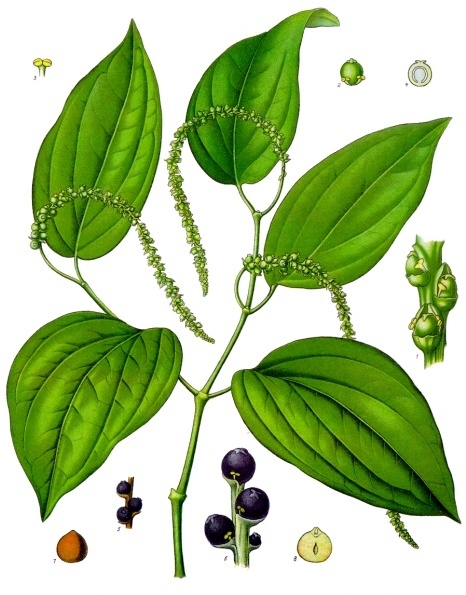
The best-known species, Piper nigrum, yields most peppercorns that are used as spices, including black pepper, although its relatives in the family include many other spices. The family Piperaceae is unrelated to the family Solanaceae, which includes bell peppers and chili peppers, which are so named due to Europeans taking part in the Columbian exchange mistakenly believing the spicy fruits were a variety of the black pepper plant.
The name Piperaceae is derived from the Sanskrit term pippali, Sanskrit: पिप्पलि.[citation needed]
The APG III system of 2009 recognizes this family, and assigns it to the order Piperales in the unranked clade magnoliids. The family consists of five genera: Piper, Peperomia, Zippelia, Manekia, and Verhuellia. The previously recognised Pacific genus Macropiper, was recently merged into Piper. A tentative cladogram showing relationships based on Wanke et al. (2007) is shown below. This phylogeny was based on 6,000 base pairs of chloroplast DNA. Only recently has it become clear that Verhuellia is sister to the other four genera in the family.
Members of pepper family are small trees, shrubs, or perennial or annual herbs.
Plants are often rhizomatous, and can be terrestrial or epiphytic. The stems can be either simple or branched.
Leaves are simple with entire margins, and are positioned at the base of the plant or along the stem, and can be alternate, opposite, or whorled in arrangement. Stipules are usually present, as are petioles. The leaves are often noticeably aromatic when crushed.
Hub AI
Piperaceae AI simulator
(@Piperaceae_simulator)
Piperaceae
The Piperaceae (/ˌpɪpəˈreɪʃiː/), also known as the pepper family, are a large family of flowering plants. The group contains roughly 3,600 currently accepted species in five genera. The vast majority of species can be found within the two main genera: Piper (2,171 species) and Peperomia (over 1,000 species).
Members of the Piperaceae may be small trees, shrubs, or herbs. The distribution of this group is best described as pantropical.
The best-known species, Piper nigrum, yields most peppercorns that are used as spices, including black pepper, although its relatives in the family include many other spices. The family Piperaceae is unrelated to the family Solanaceae, which includes bell peppers and chili peppers, which are so named due to Europeans taking part in the Columbian exchange mistakenly believing the spicy fruits were a variety of the black pepper plant.
The name Piperaceae is derived from the Sanskrit term pippali, Sanskrit: पिप्पलि.[citation needed]
The APG III system of 2009 recognizes this family, and assigns it to the order Piperales in the unranked clade magnoliids. The family consists of five genera: Piper, Peperomia, Zippelia, Manekia, and Verhuellia. The previously recognised Pacific genus Macropiper, was recently merged into Piper. A tentative cladogram showing relationships based on Wanke et al. (2007) is shown below. This phylogeny was based on 6,000 base pairs of chloroplast DNA. Only recently has it become clear that Verhuellia is sister to the other four genera in the family.
Members of pepper family are small trees, shrubs, or perennial or annual herbs.
Plants are often rhizomatous, and can be terrestrial or epiphytic. The stems can be either simple or branched.
Leaves are simple with entire margins, and are positioned at the base of the plant or along the stem, and can be alternate, opposite, or whorled in arrangement. Stipules are usually present, as are petioles. The leaves are often noticeably aromatic when crushed.
Recent media