Hubbry Logo
Base pairBase pairMain
Open search
Base pair
Community hub
Base pair
logo
8 pages, 0 posts
0 subscribers
Be the first to start a discussion here.
Base pair
Base pair
from Wikipedia
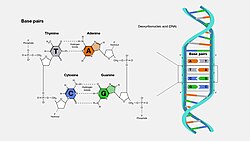
The chemical structure of DNA base-pairs

A base pair (bp) is a fundamental unit of double-stranded nucleic acids consisting of two nucleobases bound to each other by hydrogen bonds. They form the building blocks of the DNA double helix and contribute to the folded structure of both DNA and RNA. Dictated by specific hydrogen bonding patterns, "Watson–Crick" (or "Watson–Crick–Franklin") base pairs (guaninecytosine and adeninethymine/uracil)[1] allow the DNA helix to maintain a regular helical structure that is subtly dependent on its nucleotide sequence.[2] The complementary nature of this based-paired structure provides a redundant copy of the genetic information encoded within each strand of DNA. The regular structure and data redundancy provided by the DNA double helix make DNA well suited to the storage of genetic information, while base-pairing between DNA and incoming nucleotides provides the mechanism through which DNA polymerase replicates DNA and RNA polymerase transcribes DNA into RNA. Many DNA-binding proteins can recognize specific base-pairing patterns that identify particular regulatory regions of genes.

Intramolecular base pairs can occur within single-stranded nucleic acids. This is particularly important in RNA molecules (e.g., transfer RNA), where Watson–Crick base pairs (guanine–cytosine and adenine-uracil) permit the formation of short double-stranded helices, and a wide variety of non–Watson–Crick interactions (e.g., G–U or A–A) allow RNAs to fold into a vast range of specific three-dimensional structures. In addition, base-pairing between transfer RNA (tRNA) and messenger RNA (mRNA) forms the basis for the molecular recognition events that result in the nucleotide sequence of mRNA becoming translated into the amino acid sequence of proteins via the genetic code.

The size of an individual gene or an organism's entire genome is often measured in base pairs because DNA is usually double-stranded. Hence, the number of total base pairs is equal to the number of nucleotides in one of the strands (with the exception of non-coding single-stranded regions of telomeres). The haploid human genome (23 chromosomes) is estimated to be about 3.2 billion base pairs long and to contain 20,000–25,000 distinct protein-coding genes.[3][4][5][6] A kilobase (kb) is a unit of measurement in molecular biology equal to 1000 base pairs of DNA or RNA.[7] The total number of DNA base pairs on Earth is estimated at 5.0×1037 with a weight of 50 billion tonnes.[8] In comparison, the total mass of the biosphere has been estimated to be as much as 4 TtC (trillion tons of carbon).[9]

Notation

[edit]

This article employs the "•" character in describing any noncovalant interaction, which includes all types of base pairs, in line with IUPAC's 1970 recommendation.[10]: N3.4.2 

According to the IUPAC, "-" is not acceptable because it implies covalent linkage and neither are ":" and "/" because they can be mistaken as ratios. Not using any symbol is also unacceptable because it can be confused with a (covalent) polymer sequence.[10]: N3.4.2 

IUPAC makes no specific recommendation for differentiating types of noncovalant bonds. When it is necessary to differentiate, this article uses "*" for the Hogsteen pair.

Hydrogen bonding and stability

[edit]
Top, a G•C base pair with three hydrogen bonds. Bottom, an A•T base pair with two hydrogen bonds. Non-covalent hydrogen bonds between the bases are shown as dashed lines. The wiggly lines stand for the connection to the pentose sugar and point in the direction of the minor groove.

Hydrogen bonding is the chemical interaction that underlies the base-pairing rules described above. Appropriate geometrical correspondence of hydrogen bond donors and acceptors allows only the "right" pairs to form stably. DNA with high GC-content is more stable than DNA with low GC-content. Crucially, however, stacking interactions are primarily responsible for stabilising the double-helical structure; Watson-Crick base pairing's contribution to global structural stability is minimal, but its role in the specificity underlying complementarity is, by contrast, of maximal importance as this underlies the template-dependent processes of the central dogma (e.g. DNA replication).[11]

The bigger nucleobases, adenine and guanine, are members of a class of double-ringed chemical structures called purines; the smaller nucleobases, cytosine and thymine (and uracil), are members of a class of single-ringed chemical structures called pyrimidines. Purines are complementary only with pyrimidines: pyrimidine–pyrimidine pairings are energetically unfavorable because the molecules are too far apart for hydrogen bonding to be established; purine–purine pairings are energetically unfavorable because the molecules are too close, leading to overlap repulsion. Purine–pyrimidine base-pairing of AT or GC or UA (in RNA) results in proper duplex structure. The only other purine–pyrimidine pairings would be AC and GT and UG (in RNA); these pairings are mismatches because the patterns of hydrogen donors and acceptors do not correspond. The GU pairing, with two hydrogen bonds, does occur fairly often in RNA (see wobble base pair).

Paired DNA and RNA molecules are comparatively stable at room temperature, but the two nucleotide strands will separate above a melting point that is determined by the length of the molecules, the extent of mispairing (if any), and the GC content. Higher GC content results in higher melting temperatures; it is, therefore, unsurprising that the genomes of extremophile organisms such as Thermus thermophilus are particularly GC-rich. On the converse, regions of a genome that need to separate frequently — for example, the promoter regions for often-transcribed genes — are comparatively GC-poor (for example, see TATA box). GC content and melting temperature must also be taken into account when designing primers for PCR reactions.[citation needed]

Examples

[edit]

The following DNA sequences illustrate pair double-stranded patterns. By convention, the top strand is written from the 5′-end to the 3′-end; thus, the bottom strand (complementary strand) is written 3′ to 5′.

A base-paired DNA sequence:
ATCGATTGAGCTCTAGCG
TAGCTAACTCGAGATCGC
The corresponding RNA sequence, in which uracil is substituted for thymine in the RNA strand:
AUCGAUUGAGCUCUAGCG
UAGCUAACUCGAGAUCGC

Non-canonical base pairing

[edit]
Wobble base pairs
Comparison of Hoogsteen to Watson–Crick base pairs.[12]

In addition to the canonical Watson–Crick pairing (A•T/U G•C), some conditions can also favour base-pairing with alternative base orientation, and number and geometry of hydrogen bonds. These pairings are accompanied by alterations to the local backbone shape.[citation needed]

The most common of these is the wobble base pairing that occurs between tRNAs and mRNAs at the third base position of many codons during transcription[13] and during the charging of tRNAs by some tRNA synthetases.[14] They have also been observed in the secondary structures of some RNA sequences.[15]

Additionally, Hoogsteen base pairing (typically written as A*U/T and G*C) can happen when a different "face" of a purine base is used for pairing. This happens in some DNA sequences (e.g. CA and TA dinucleotides) in dynamic equilibrium with standard Watson–Crick pairing.[12] They have also been observed in some protein–DNA complexes.[16] There is also a kind of reverse Hoogsteen base pair in tRNA where both a purine and a pyrimidine uses a different "face".[17][18]

In addition to these alternative base pairings, a wide range of base-base hydrogen bonding is observed in RNA secondary and tertiary structure.[19] These bonds are often necessary for the precise, complex shape of an RNA, as well as its binding to interaction partners.[19]

Base pairs and mutation

[edit]

Mismatch repair

[edit]

Mismatched base pairs can be generated by errors of DNA replication and as intermediates during homologous recombination. The process of mismatch repair ordinarily must recognize and correctly repair a small number of base mispairs within a long sequence of normal DNA base pairs. To repair mismatches formed during DNA replication, several distinctive repair processes have evolved to distinguish between the template strand and the newly formed strand so that only the newly inserted incorrect nucleotide is removed (in order to avoid generating a mutation).[20] The proteins employed in mismatch repair during DNA replication, and the clinical significance of defects in this process are described in the article DNA mismatch repair. The process of mispair correction during recombination is described in the article gene conversion.

Base analogs and intercalators

[edit]

Chemical analogs of nucleotides can take the place of proper nucleotides and establish non-canonical base-pairing, leading to errors (mostly point mutations) in DNA replication and DNA transcription. This is due to their isosteric chemistry. One common mutagenic base analog is 5-bromouracil, which resembles thymine but can base-pair to guanine in its enol form.[21]

Other chemicals, known as DNA intercalators, fit into the gap between adjacent bases on a single strand and induce frameshift mutations by "masquerading" as a base, causing the DNA replication machinery to skip or insert additional nucleotides at the intercalated site. Most intercalators are large polyaromatic compounds and are known or suspected carcinogens. Examples include ethidium bromide and acridine.[22]

As a unit of length

[edit]

Schematic karyogram of a human. The blue scale to the left of each nuclear chromosome pair (as well as the mitochondrial genome at bottom left) shows its length in terms of mega–base-pairs.

The following abbreviations are commonly used to describe the length of a D/RNA molecule:

  • bp = base pair—one bp corresponds to approximately 3.4 Å (340 pm)[23] of length along the strand, and to roughly 618 or 643 daltons for DNA and RNA respectively.
  • kb (= kbp) = kilo–base-pair = 1,000 bp
  • Mb (= Mbp) = mega–base-pair = 1,000,000 bp
  • Gb (= Gbp) = giga–base-pair = 1,000,000,000 bp

For single-stranded DNA/RNA, units of nucleotides are used—abbreviated nt (or knt, Mnt, Gnt)—as they are not paired. To distinguish between units of computer storage and bases, kbp, Mbp, Gbp, etc. may be used for base pairs.

The centimorgan is also often used to imply distance along a chromosome, but the number of base pairs it corresponds to varies widely depending on the patterns of chromosomal crossover. In the human genome, the centimorgan is about 1 million base pairs.[24][25]

Unnatural base pair (UBP)

[edit]

An unnatural base pair (UBP) is a designed subunit (or nucleobase) of DNA which is created in a laboratory and does not occur in nature. DNA sequences have been described which use newly created nucleobases to form a third base pair, in addition to the two base pairs found in nature, A•T (adeninethymine) and G•C (guaninecytosine). A few research groups have been searching for a third base pair for DNA, including teams led by Steven A. Benner, Philippe Marliere, Floyd E. Romesberg and Ichiro Hirao.[26] Some new base pairs based on alternative hydrogen bonding, hydrophobic interactions and metal coordination have been reported.[27][28][29][30]

In 1989 Steven Benner (then working at the Swiss Federal Institute of Technology in Zurich) and his team led with modified forms of cytosine and guanine into DNA molecules in vitro.[31] The nucleotides, which encoded RNA and proteins, were successfully replicated in vitro. Since then, Benner's team has been trying to engineer cells that can make foreign bases from scratch, obviating the need for a feedstock.[32]

In 2002, Ichiro Hirao's group in Japan developed an unnatural base pair between 2-amino-8-(2-thienyl)purine (s) and pyridine-2-one (y) that functions in transcription and translation, for the site-specific incorporation of non-standard amino acids into proteins.[33] In 2006, they created 7-(2-thienyl)imidazo[4,5-b]pyridine (Ds) and pyrrole-2-carbaldehyde (Pa) as a third base pair for replication and transcription.[34] Afterward, Ds and 4-[3-(6-aminohexanamido)-1-propynyl]-2-nitropyrrole (Px) was discovered as a high fidelity pair in PCR amplification.[35][28] In 2013, they applied the Ds-Px pair to DNA aptamer generation by in vitro selection (SELEX) and demonstrated the genetic alphabet expansion significantly augment DNA aptamer affinities to target proteins.[36]

In 2012, a group of American scientists led by Floyd Romesberg, a chemical biologist at the Scripps Research Institute in San Diego, California, published that his team designed an unnatural base pair (UBP).[29] The two new artificial nucleotides or Unnatural Base Pair (UBP) were named d5SICS and dNaM. More technically, these artificial nucleotides bearing hydrophobic nucleobases, feature two fused aromatic rings that form a (d5SICS–dNaM) complex or base pair in DNA.[32][37] His team designed a variety of in vitro or "test tube" templates containing the unnatural base pair and they confirmed that it was efficiently replicated with high fidelity in virtually all sequence contexts using the modern standard in vitro techniques, namely PCR amplification of DNA and PCR-based applications.[29] Their results show that for PCR and PCR-based applications, the d5SICS–dNaM unnatural base pair is functionally equivalent to a natural base pair, and when combined with the other two natural base pairs used by all organisms, A–T and G–C, they provide a fully functional and expanded six-letter "genetic alphabet".[37]

In 2014 the same team from the Scripps Research Institute reported that they synthesized a stretch of circular DNA known as a plasmid containing natural T-A and C-G base pairs along with the best-performing UBP Romesberg's laboratory had designed and inserted it into cells of the common bacterium E. coli that successfully replicated the unnatural base pairs through multiple generations.[26] The transfection did not hamper the growth of the E. coli cells and showed no sign of losing its unnatural base pairs to its natural DNA repair mechanisms. This is the first known example of a living organism passing along an expanded genetic code to subsequent generations.[37][38] Romesberg said he and his colleagues created 300 variants to refine the design of nucleotides that would be stable enough and would be replicated as easily as the natural ones when the cells divide. This was in part achieved by the addition of a supportive algal gene that expresses a nucleotide triphosphate transporter which efficiently imports the triphosphates of both d5SICSTP and dNaMTP into E. coli bacteria.[37] Then, the natural bacterial replication pathways use them to accurately replicate a plasmid containing d5SICS–dNaM. Other researchers were surprised that the bacteria replicated these human-made DNA subunits.[39]

The successful incorporation of a third base pair is a significant breakthrough toward the goal of greatly expanding the number of amino acids which can be encoded by DNA, from the existing 20 amino acids to a theoretically possible 172, thereby expanding the potential for living organisms to produce novel proteins.[26] The artificial strings of DNA do not encode for anything yet, but scientists speculate they could be designed to manufacture new proteins which could have industrial or pharmaceutical uses.[40] Experts said the synthetic DNA incorporating the unnatural base pair raises the possibility of life forms based on a different DNA code.[39][40]

Data sources for base pair strengths

[edit]

The following sources have information on the free energy (thermodynamic measures of strength) of base pairs:

  • Vendeix et al. 2009, Table 1. Obtained by molecular simulation of RNA including canonical and modified bases. Free energy for 300 K.[41]

However, simply knowing what the minimal-energy hydrogen-bonded state between two nucleobases is not enough. The stability of a nucleic acid molecule also comes from base stacking, the stengths of which can vary with modified bases with respect to the original version. The optimal hydrogen-bonded state for two bases can also turn out to require an unnatural amount of bending of the nucleic acid backbone. All of these contribute to the "effective" strength of a base pair in the context of nucleic acid secondary structure, which is why predicting such structures need "nearest neighbor" models that describe base pairs in terms of free energy (at 37 °C) and enthalpy (for rescaling to different temperatures) of:[42]

  • helix fragments such as AA•UU and GGUC•CUGG (the sequence on the left of the colon is in usual 5'-to-3' direction, but the one on the right is written in reversed 3'-to-5' direction)
  • terminal mismatches (non-pairs at the end of helices, e.g. CA•GA).

A list of "nearest neighbor" models can be found at Nucleic acid structure prediction § Thermodynamic models.

See also

[edit]

References

[edit]

Further reading

[edit]
[edit]
Revisions and contributorsEdit on WikipediaRead on Wikipedia
from Grokipedia
A base pair is a fundamental unit in the structure of nucleic acids, consisting of two complementary nitrogenous bases linked by bonds that stabilize in DNA or contribute to folding in RNA. In DNA, the four nucleotide bases— (A), thymine (T), guanine (G), and cytosine (C)—pair specifically: A with T through two bonds and G with C through three bonds, ensuring uniform spacing and structural integrity of as elucidated by James D. Watson and Francis H. C. Crick in their 1953 model. This complementary pairing, where purines (A and G) bond with pyrimidines (T and C), positions the bases inward while sugar-phosphate backbones form the outer rails of the helical ladder. In RNA, which is typically single-stranded, the base composition shifts with uracil (U) substituting for thymine; thus, A pairs with U via two bonds, and G pairs with C via three, facilitating intramolecular folding into complex secondary structures such as stem-loops and pseudoknots. Base pairing underpins critical biological processes, including , where each parental strand templates the synthesis of a complementary strand via semiconservative mechanisms, preserving genetic fidelity across cell divisions. In transcription, base pairing between DNA and nascent RNA ensures accurate copying of genetic information, while in RNA molecules like and , it enables precise codon-anticodon interactions during protein synthesis. Non-canonical base pairs, such as G-U wobbles, further diversify RNA structures and functions in regulatory roles. The , for instance, comprises approximately 3 billion such base pairs distributed across 23 chromosome pairs, underscoring their scale in encoding life's blueprint.

Fundamentals

Definition and Occurrence

A base pair consists of two complementary nitrogenous bases—one purine and one pyrimidine—held together by hydrogen bonds within the structure of double-stranded nucleic acids. The purines are and , while the pyrimidines are , in DNA, or uracil (U) in RNA. These bases form the core of , where each base is covalently linked to a sugar molecule ( in DNA or in RNA) to create a , which is then incorporated into the polynucleotide chain. The concept of base pairing was first proposed by James D. Watson and Francis H. C. Crick in their 1953 description of the DNA double helix, where they identified specific pairings of A with T and G with C as essential to the molecule's structure and function. This model provided a mechanism for genetic replication, as the sequence of bases on one strand determines the complementary sequence on the other. The principle was soon extended to RNA, where U substitutes for T in pairing with A, enabling the formation of double-stranded regions in RNA molecules. Base pairs occur primarily in the antiparallel double helix of DNA, which adopts the right-handed B-form conformation characterized by a smooth, uniform twist with approximately 10.5 base pairs per helical turn. In RNA, base pairing is found in double-stranded segments of secondary structures, such as the stems of hairpins and loops, forming A-form helices that are shorter and wider than the B-form due to the 2'-hydroxyl group on ribose. These pairings are crucial for storing genetic information in DNA, facilitating its accurate replication during cell division, and supporting RNA functions in transcription and translation for protein synthesis.

Canonical Base Pairs

Canonical base pairs refer to the standard Watson-Crick pairings that form the foundation of double-stranded nucleic acids, consisting of adenine (A) with thymine (T) in DNA or uracil (U) in RNA, and guanine (G) with cytosine (C). These pairs occur between a purine base on one strand and a pyrimidine base on the complementary strand, maintaining consistent width in the double helix. The adenine-thymine (A-T) or adenine-uracil (A-U) pair forms through two hydrogen bonds: the N1 of adenine bonds to N3 of thymine or uracil, and the O4 (or O2 in uracil) of thymine/uracil bonds to the amino group at C6 of adenine. In contrast, the guanine-cytosine (G-C) pair involves three hydrogen bonds: O6 of guanine to amino at C4 of cytosine, N1 of guanine to N3 of cytosine, and amino at C2 of guanine to O2 of cytosine. This specific hydrogen bonding pattern, along with the complementary shapes of the bases, ensures precise alignment within the helical structure. The geometry of these pairs positions the bases perpendicular to the helix axis, fitting snugly into the grooves while allowing the sugar-phosphate backbones to form the outer scaffold. The G-C pair's three bonds provide greater stability than the A-T/U pair's two, influencing the overall of duplexes, though this difference arises directly from the bonding count. underpin the equivalence observed in base compositions of double-stranded DNA, stating that the proportion of equals (A = T) and equals (G = C), a direct consequence of the complementary pairing across strands. These rules were established through quantitative analyses of DNA from various organisms, revealing species-specific but internally balanced base ratios. In double-stranded , similar equivalence holds with A = U and G = C. A key distinction between DNA and RNA canonical pairing lies in the use of thymine versus uracil. DNA employs thymine to pair with adenine, offering enhanced resistance to spontaneous cytosine deamination (which produces uracil). It also provides better protection against UV-induced photodimers, as uracil is more prone to such damage. Thymine also facilitates 5-methylcytosine formation for epigenetic marking without confusing repair systems. RNA, being shorter-lived and single-stranded in many contexts, uses uracil, which is energetically cheaper to synthesize as it derives directly from orotate without methylation. Despite this substitution, A-U pairing mirrors A-T in hydrogen bonding and specificity. The resulting duplexes exhibit subtle structural variations: DNA favors the right-handed B-form helix with ~10.5 base pairs per turn and a wide major groove, while RNA duplexes adopt the A-form with ~11 base pairs per turn, a narrower major groove, and greater base tilting due to the 2'-hydroxyl group on ribose, yet both preserve the canonical pairing geometry. The specificity of canonical base pairs is crucial for fidelity in genetic processes, as the unique hydrogen bonding sites and steric complementarity prevent mismatched pairings, such as A-C or G-T, which would distort the helix and lead to replication or transcription errors. This selective recognition enables accurate information transfer, with purine-pyrimidine matching ensuring uniform helix dimensions and groove accessibility for proteins.

Notation

In scientific literature, base pairs are conventionally denoted using single-letter symbols for the nucleobases: adenine (A) pairs with thymine (T) in DNA or uracil (U) in RNA, while guanine (G) pairs with cytosine (C) in both, as established by the Watson-Crick model. These pairings are often represented with hyphens or lines to indicate hydrogen bonding, such as A-T or G-C for DNA and A-U or G-C for RNA. For nucleotide sequences, double-stranded DNA or RNA is typically written in a 5' to 3' direction for the forward strand, with the complementary strand shown in the antiparallel 3' to 5' orientation, connected by lines or spaces to highlight pairings; for example, the sequence 5'-ATGC-3' pairs with 3'-TACG-5'. This convention uses the International Union of Pure and Applied Chemistry (IUPAC) single-letter codes, where A denotes adenine, C cytosine, G guanine, T thymine (or U for uracil in RNA), ensuring standardized representation across diagrams and sequences. In structural diagrams, base pairs are illustrated following the Watson-Crick model, depicting antiparallel strands as parallel lines or ribbons with horizontal rods or bonds connecting the paired bases, emphasizing their orientation and complementarity without detailing bond specifics. To handle ambiguity in mixed DNA/RNA contexts or uncertain bases, IUPAC ambiguity codes are employed, such as Y for pyrimidines (C, T, or U), R for purines (A or G), and N for any base (A, C, G, T/U). The notation evolved historically from Erwin Chargaff's 1940s observations of base composition equalities (A ≈ T, G ≈ C) in DNA, which informed Watson and Crick's proposal of specific pairings, leading to modern bioinformatics formats like , where paired sequences are represented by separate entries for each strand with implied complementarity.

Chemical Properties

Hydrogen Bonding

Hydrogen bonding serves as the primary chemical interaction stabilizing canonical base pairs in nucleic acids, involving electrostatic attractions between a hydrogen atom covalently bound to an electronegative atom (typically nitrogen or oxygen) acting as a donor and another electronegative atom serving as an acceptor. This donor-acceptor mechanism ensures specific pairing between complementary bases, with the hydrogen bonds forming between precise atomic sites on the and rings. For instance, in the - (A-T) or -uracil (A-U) pair, bonds occur between the N1 of adenine (acceptor) and the N3-H of /uracil (donor), as well as between the N6-H of adenine (donor) and the O4 of /uracil (acceptor). Similarly, in the - (G-C) pair, three bonds form: O6 of (acceptor) to N4-H of cytosine (donor), N1-H of (donor) to N3 of cytosine (acceptor), and N2-H of (donor) to O2 of cytosine (acceptor). The number of hydrogen bonds differs between pairs, contributing to their relative strengths: two bonds in A-T/U and three in G-C, which promotes the observed base composition biases in DNA sequences. These interactions occur exclusively via the Watson-Crick edges of the bases, where the donor and acceptor sites align in a complementary fashion to maximize bond formation without steric clashes. Geometrically, the hydrogen bonds enforce a planar configuration of the base pairs, with the glycosidic bonds adopting an anti-parallel orientation relative to the sugar-phosphate backbones, ensuring uniform helical parameters in the double helix. This planarity arises from the sp² hybridization of the ring atoms involved, allowing the bases to lie flat and stack efficiently while the bonds hold them in register. From a quantum mechanical perspective, each in these pairs has an energy of approximately 5-30 kJ/mol, reflecting partial covalent character and directionality that enhances specificity. The complementary hydrogen-bonding patterns, dictated by the predominant keto and amino tautomeric forms of the bases, ensure selective pairing; for example, the keto form of provides the necessary O4 acceptor, while rare tautomers could disrupt this fidelity but are minimized . These patterns create a lock-and-key-like recognition, where mismatches result in suboptimal bonding geometries and energies. In aqueous environments, solvent molecules like water compete for hydrogen-bonding sites on the bases, weakening individual inter-base bonds by stabilizing the lone pairs and hydrogens involved, often leading to slight lengthening of bond distances. However, this competition is counterbalanced by the overall stabilization of the double helix through desolvation effects and the hydrophobic burial of bases, maintaining the integrity of the paired structure.

Stability Factors

The stability of base pairs in nucleic acid duplexes is influenced by several factors beyond hydrogen bonding, with base stacking emerging as a dominant contributor through hydrophobic and π-π interactions between adjacent base pairs along the helix axis. These stacking interactions, which involve the overlap of aromatic rings in the bases, provide the majority of the duplex's thermal stability, accounting for approximately 50-70% of the overall free energy stabilization in double-stranded DNA. Sequence dependence plays a key role here, as purine-pyrimidine stacks like those involving guanine-cytosine (GC) exhibit stronger interactions due to better orbital overlap and higher electron density compared to adenine-thymine (AT) stacks, leading to enhanced stability in GC-rich regions. Electrostatic interactions also significantly affect base pair durability, primarily through the repulsion between negatively charged groups in the sugar-phosphate backbone. This repulsion, which can destabilize the duplex by up to 30% of the energy required for structural deformations like , is counterbalanced by the screening effects of cations such as Na⁺ and Mg²⁺, which condense around the phosphates to neutralize charges and reduce the overall electrostatic penalty. Additionally, a penalty arises during duplex formation, as the hydrophobic bases must exclude molecules from their interior, contributing an entropic cost that is partially offset by the release of structured from the grooves. The conformational context of the helix further modulates stability, with distinct parameters for B-DNA and A-form influencing base pair accessibility and interactions. In B-DNA, the right-handed features approximately 10.5 base pairs per turn and a rise of 0.34 nm per base pair, resulting in a wider major groove (about 1.2 nm) that exposes edges of the bases for interactions, while the minor groove is narrower (0.6 nm). In contrast, A-form adopts a more compact structure with 11 base pairs per turn and a rise of 0.26 nm per base pair, producing a deep, narrow major groove (~0.3 nm wide, 1.3 nm deep) and a shallow, wide minor groove (~1.1 nm wide, 0.3 nm deep), which limits solvent access and enhances stacking efficiency but can hinder protein binding. These geometric differences affect the overall rigidity and environmental sensitivity of the duplex. significantly influences stability; higher salt concentrations screen repulsions, raising the melting temperature (Tm) according to relations like ΔTm ≈ 16.6 log₁₀([Na⁺]/0.1 M) °C. Thermodynamically, base pair stability is quantified through parameters that capture the energetic contributions of these interactions. The change (ΔH) primarily arises from hydrogen bonds and base stacking, typically ranging from -7 to -10 kcal/mol per base pair, while the change (ΔS) reflects the ordering of strands and loss of freedom, often negative at around -20 to -25 cal/mol·K per base pair. The of duplex formation is given by ΔG=ΔHTΔS\Delta G = \Delta H - T \Delta S where T is the temperature in ; this relation underpins predictions of the melting temperature (Tm), the point at which half the duplex dissociates, with higher stability correlating to elevated Tm values. Sequence composition exerts a profound influence on these thermodynamic properties, particularly through , which elevates Tm by 0.4–0.5°C per 1% increase due to the three bonds in GC pairs and their superior stacking strength compared to the two-bond AT pairs. This effect is evident in polymers where poly(dG·dC) exhibits a Tm approximately 30–40°C higher than poly(dA·dT) under similar ionic conditions, underscoring the role of base identity in modulating duplex resilience.

Examples

One illustrative measure of base pair stability is the melting temperature (Tm), the temperature at which half of the double-stranded DNA dissociates into single strands, which can be approximated for short oligonucleotides in ~1 M NaCl using the empirical equation Tm=69.3+0.41×(%GC)T_m = 69.3 + 0.41 \times (\%GC), where %GC is the percentage of guanine-cytosine base pairs. This formula highlights the stabilizing effect of G-C pairs, which contribute more to Tm than A-T pairs due to their additional hydrogen bond. For example, under low salt conditions (e.g., 10 mM Na⁺), poly(dA-dT) sequences exhibit a relatively low Tm of approximately 39°C, reflecting the weaker stability from two hydrogen bonds per pair, whereas poly(dG-dC) sequences display a high Tm around 94°C, underscoring the robustness from three hydrogen bonds. In higher salt (e.g., 0.2 M NaCl), these values increase, with poly(dA-dT) around 65°C and poly(dG-dC) over 100°C. The nearest-neighbor model provides a more detailed prediction of duplex stability by considering the additive effects of adjacent base pair stacks, with parameters derived from experimental thermodynamic data. In this model, the free energy of stacking interactions varies such that AA/TT stacks are weaker (less stable) compared to GG/CC stacks, which are among the strongest, allowing for accurate Tm predictions within about 2°C for diverse sequences. These parameters, compiled in SantaLucia tables, account for sequence-specific contributions beyond simple %. Environmental factors further modulate base pair stability, as seen in the influence of salt concentration and on Tm. Increasing salt concentration raises Tm by shielding the negative charges on backbones, reducing electrostatic repulsion between strands and thereby enhancing duplex stability. At low , of (with a pKa around 4.5) disrupts G-C pairing by introducing positive charges that alter hydrogen bonding patterns and increase repulsion. In pathological contexts, the triple hydrogen bonds of G-C pairs contribute to structural transitions, such as the formation of left-handed in G-C-rich sequences under high salt conditions, where the zigzag backbone conformation is stabilized by the dense bonding network. For , base pair stability is exemplified in tRNA stem-loops, where short stretches of Watson-Crick pairs maintain structural integrity primarily through base stacking interactions, enabling functional folding even with limited hydrogen bonding. Stacking and hydrogen bonding, as outlined in prior sections, underpin these examples by providing the energetic basis for observed stability variations.

Variations

Non-Canonical Base Pairing

Non-canonical base pairing involves -bonded interactions between nucleobases that deviate from the standard Watson-Crick geometry, often utilizing alternative faces such as the Hoogsteen edge of s or the sugar edge, enabling structural flexibility in nucleic acids. Common types include Hoogsteen pairs, where a uses its Hoogsteen face to pair with a pyrimidine's Watson-Crick face, forming two or three bonds; reverse Hoogsteen pairs, which invert this orientation; sheared pairs, characterized by parallel strand geometry and sugar-edge interactions, such as the sheared G:A pair; and wobble pairs, featuring a shifted alignment with typically two bonds, exemplified by the G:T in DNA or G:U in RNA. These pairings contrast with canonical Watson-Crick pairs by promoting adaptability in folding and function, though they are less prevalent overall. In DNA, non-canonical base pairs frequently arise as mismatches during replication or repair processes, such as the A:C mismatch, which adopts conformations like a protonated C paired with A via two hydrogen bonds in repair intermediates, influencing recognition by mismatch repair enzymes. The G:T wobble pair, with its two hydrogen bonds and displaced geometry, also occurs in such contexts, contributing to transient instabilities that trigger correction mechanisms. Additionally, Hoogsteen and reverse Hoogsteen pairs appear in Holliday junctions during , where they facilitate branch migration and structural isomerization, as seen in four-way DNA junctions with non-canonical G:C Hoogsteen pairings that induce kinking. In , non-canonical base pairs are more abundant and integral to tertiary structure formation, particularly in loops and motifs. The G:U wobble pair, stabilized by two hydrogen bonds between guanine's Watson-Crick face and uracil's Hoogsteen face, is ubiquitous and plays key roles in stabilizing tRNA anticodon loops and structures. Sheared G:A pairs, involving sugar-edge contacts, and reverse Hoogsteen A:U pairs commonly occur in these regions, enabling compact folds in functional RNAs like ribozymes. While many non-canonical pairs exhibit lower stability than ones due to fewer hydrogen bonds (typically 1-2 versus 2-3 in some cases), resulting in higher free energies and greater susceptibility to disruption, wobble pairs like G:U often have stability comparable to Watson-Crick pairs (around 80-100% depending on context) owing to similar bonding and stacking. Surrounding stacking interactions and ionic environments can compensate to maintain viability in context-specific roles like triplex or quadruplex formation. For instance, in duplex contexts, G:U wobble contributions are around -7 to -10 kcal/mol, similar to A:U pairs. Detection of non-canonical base pairs relies on high-resolution techniques such as and (NMR) spectroscopy, which reveal their geometries through atomic coordinates and chemical shift patterns. Cryo-electron has recently enabled visualization of such pairs in large complexes (as of 2025). In analyzed RNA structures from crystal databases, non-canonical pairs account for approximately 30-40% of total interactions, with wobble and sheared types being most frequent. NMR relaxation dispersion further identifies transient Hoogsteen forms in DNA duplexes at rates up to milliseconds.

Wobble Pairs and RNA-Specific Interactions

The wobble hypothesis, proposed by in 1966, posits that the third position of the codon-anticodon interaction during allows for non-standard base pairing, thereby accommodating degeneracy in the without requiring a unique tRNA for each codon. Specifically, uracil (U) in the anticodon's first position can pair with (A) or (G) in the codon's , while (I), a modified base common in tRNA anticodons, can pair with uracil (U), (C), or (A). This flexibility arises from the structural geometry of the wobble pairs, which permit hydrogen bonding despite deviations from strict Watson-Crick rules, enabling a single tRNA to recognize multiple synonymous codons. In RNA, wobble and other non-canonical interactions contribute to the formation of complex motifs essential for and function. Pseudoknots, for instance, feature interlocking helical stems where non-canonical pairs, including wobbles, bridge loops and adjacent regions to create tertiary architectures critical for processes like ribosomal frameshifting. Base triples in often involve a wobble pair in a interacting with a third base from a distant strand, facilitating long-range contacts that assemble the ribosome's functional core. G-quadruplexes in RNA, while primarily stabilized by Hoogsteen hydrogen bonds and stacking interactions rather than pairwise canonical or wobble pairing, incorporate non-canonical elements that enhance folding in guanine-rich sequences, influencing RNA localization and regulation. These interactions underpin key biological roles in RNA functionality. The wobble hypothesis directly enables the decoding of 61 sense codons using fewer than 61 tRNAs, optimizing translational efficiency across organisms. In ribozymes, wobble pairs provide structural plasticity; for example, in the hammerhead ribozyme, GU wobble pairs within the core maintain catalytic competence by allowing conformational adjustments during self-cleavage, while allosteric variants use ligand-induced stabilization of wobble pairs to enhance activity. Similarly, in the delta virus (HDV) ribozyme, multiple GU wobbles contribute to the active site's stability, with mutations disrupting them impairing cleavage rates. Wobble pairs exhibit thermodynamic stability comparable to Watson-Crick pairs, often around 80-100% of their strength depending on sequence context, due to similar bonding patterns and stacking energies. In flexible structures, they are entropy-favored, as the looser permits greater conformational freedom, reducing energetic penalties in dynamic environments like tRNA-mRNA interactions. Recent studies have expanded understanding of wobble and related non-canonical interactions in regulation. In microRNAs (miRNAs), pairing beyond the seed (positions 2-8) via wobble or mismatch-tolerant modes at positions 9-13 enhances target specificity and efficacy, as revealed by abasic modifications and structural mapping in 2025 experiments. Dynamics of U-U mismatches, a type of non-canonical pair, in A-form helices show sequence-dependent flexibility, where local strain from the mismatch promotes base flipping and helix breathing; such effects influence viral stability, as observed in structures via simulations in 2024 and general contexts in 2025.

Synthetic and Unnatural Pairs

Development of Unnatural Base Pairs

The development of unnatural base pairs (UBPs) aimed to expand the genetic beyond the canonical A-T and G-C pairs, enabling new biological functions such as encoding additional or creating novel diagnostic tools. Early efforts in the focused on -bonding mimics that could form stable, orthogonal pairs without interfering with natural bases. In 1962, Alexander Rich proposed the isoguanine (isoG)-isocytosine (isoC) pair, which features three hydrogen bonds similar to G-C, suggesting it could serve as a third base pair in an expanded genetic system. By the 1990s, synthetic chemistry advanced these concepts, with Steven Benner's group synthesizing isoG and isoC nucleosides and demonstrating their incorporation into , enzymatic replication, and even using a dedicated codon, though challenges like chemical instability (e.g., isoG to ) and tautomerism reduced selectivity to around 93% per PCR cycle. Concurrently, Eric Kool's group introduced hydrophobic pairs, such as the nonpolar difluorotoluene (F)- mimic in 1997, emphasizing shape complementarity and pi-stacking over hydrogen bonding to achieve pairing stability in DNA duplexes without relying on traditional H-bonds. Key UBP systems emerged in the 2000s, prioritizing orthogonality to natural bases for reliable replication by polymerases. Benner's group developed the 2-amino-imidazo[1,2-a]-1,3,5-triazin-4(8H)-one (P) and 6-amino-5-nitropyridin-2(1H)-one (Z) pair around 2003-2006, using a non-standard hydrogen-bonding pattern to achieve up to 99.9% fidelity in PCR amplification after optimizations. In 2006, Ichiro Hirao's group reported the 7-(2-thienyl)imidazo[4,5-b]pyridine-2(3H)-one (Ds)-pyrrole-2-carbaldehyde (Pa) pair, a hydrophobic system that relies on minor-groove interactions and achieves >99% selectivity per replication cycle when using modified triphosphates. Floyd Romesberg's group introduced the 5-(6-aminopyridin-3-yl)-2'-deoxyuridine-5'-triphosphate (d5SICS) and 2-amino-8-(2-thienyl) (NaM) pair in the early , designed for high orthogonality and efficient polymerase-mediated replication with fidelities up to 99.8%. Design principles for these UBPs emphasize geometric fit within the DNA helix and avoidance of natural base interference, often favoring hydrophobic and pi-stacking forces over hydrogen bonding to minimize mispairing, while ensuring recognition by cellular enzymes through subtle modifications like halogen substitutions or fused rings. A major milestone came in 2014, when Romesberg's team engineered an E. coli strain to stably replicate and transcribe DNA containing the d5SICS-NaM pair, creating the first semi-synthetic organism with a six-letter genetic alphabet. Building on this, in 2019, a collaboration between Romesberg and Benner's groups developed "hachimoji" DNA, an eight-letter system incorporating two orthogonal UBPs (P-Z and S-B) alongside natural bases, which forms stable duplexes and supports PCR amplification in vitro, paving the way for more complex synthetic genetics. Despite progress, challenges persist in achieving consistent enzymatic fidelity across diverse polymerases and in vivo contexts, as UBPs can compete with natural substrates, leading to retention rates as low as 80% in early cellular uptake experiments. Additionally, imbalances in unnatural triphosphate pools can cause cellular toxicity by perturbing natural and inducing mutations.

Recent Advances and Applications

In 2025, researchers developed an unnatural base pair system utilizing the MfC:D pair for -free detection of the epigenetic modification 5-formylcytosine (5fC) in , with potential extension to (5mC) and (5hmC) via chemical conversion. This pair achieves enhanced duplex stability through three hydrogen bonds, allowing selective incorporation opposite modified cytosines without the DNA degradation associated with traditional methods. The approach facilitates base-resolution analysis of these markers, advancing epigenetic profiling in complex genomes. Recent studies in 2024 have explored metal-mediated unnatural base pairs derived from imidazole nucleobases, which coordinate with ions like Cu²⁺ or Ag⁺ to provide tunable stability in DNA duplexes. These pairs enable dynamic control of hybridization strength by varying metal concentration or type, with Ag⁺-mediated imidazole pairs demonstrating reversible switching in DNAzyme activity for sensor applications. Such systems offer precise modulation of nucleic acid structures, with thermal stabilities adjustable over a range of 10–20°C depending on the metal ligand. Unnatural base pairs have expanded applications in , notably by enabling an eight-letter genetic alphabet that supports 512 possible codons for incorporating non-standard into proteins. This expansion, building on systems like d5SICS-NaM, allows site-specific insertion of diverse functionalities during translation, enhancing for therapeutic designs. In engineering, unnatural base pair mutants have been integrated to boost binding affinity and specificity. Further applications include xeno-nucleic acids (XNAs), synthetic polymers with unnatural backbones like or that pair with unnatural bases for orthogonal replication. These ubp-XNAs enable high-fidelity and evolution of novel enzymes resistant to natural nucleases, expanding the toolkit for selection. In biosensor development, unnatural base pair variants have optimized detection platforms, reducing response times in fluorescence-based assays for small molecules by enhancing . Emerging research points to unnatural base pairs' potential in in vivo therapeutics, where stable incorporation supports targeted gene modulation. Additionally, efforts to develop CRISPR-compatible unnatural base pairs aim to enable precise, off-target-free editing by introducing orthogonal pairing in guide RNAs, with preliminary studies showing improved specificity in non-Watson-Crick contexts.

Biological Roles

Mutations and Mismatches

Base pair mismatches occur primarily during DNA replication or transcription when incorrect nucleotides are incorporated opposite template bases, leading to genetic errors that introduce variation. These mismatches can arise from spontaneous chemical changes in nucleotides or external factors. One key cause is tautomerization, where bases shift between keto and enol (or amino and imino) forms, altering hydrogen bonding patterns; for instance, the enol form of thymine can pair with guanine instead of adenine, resulting in a T-G mispair. Depurination, the loss of a purine base (adenine or guanine) from the DNA backbone, or apyrimidination, the analogous loss of a pyrimidine, creates abasic sites that increase the likelihood of incorrect base insertion during replication, as the polymerase may insert any nucleotide opposite the gap. Environmental mutagens, such as ultraviolet radiation or chemical agents like alkylating compounds, further promote mismatches by damaging bases; UV light, for example, induces cyclobutane pyrimidine dimers that distort pairing fidelity upon replication bypass. Mismatches are classified into two main types based on the chemical nature of the substitution: transitions and transversions. Transitions involve the replacement of one purine by another (adenine to guanine or vice versa) or one pyrimidine by another (cytosine to thymine or vice versa), such as an A-T pair mutating to G-C through an A-to-G change. Transversions, in contrast, swap a purine for a pyrimidine or vice versa, like an A-T pair becoming C-G via an A-to-C substitution, which often requires more significant structural adjustments in the helix. These errors occur at a frequency of approximately 10^{-5} mismatches per base pair during eukaryotic DNA replication without proofreading, though proofreading reduces this to approximately 10^{-7}, and MMR further lowers the overall error rate to around 10^{-10} errors per base pair per replication cycle. The consequences of uncorrected base pair mismatches manifest as point mutations, where a single substitution alters the , potentially leading to amino acid changes (missense mutations), premature stop codons ( mutations), or silent changes. In cases of polymerase slippage on repetitive sequences, mismatches can also cause small insertions or deletions, resulting in frameshift mutations that disrupt reading frames downstream. While these mutations drive evolutionary adaptation by generating , they pose risks such as oncogenic transformations in somatic cells, contributing to cancer development when proto-oncogenes or tumor suppressors are affected. Detection of mismatches relies on the structural distortions they induce in the DNA double helix; an incorrect base pair creates a local "bubble" or bulge that deviates from the standard B-form geometry, making it recognizable by cellular proteins that scan for such anomalies. Some non-canonical base pairs, like G-U in RNA, can similarly function as transient mismatches during replication or transcription.

Repair Mechanisms

Cellular repair mechanisms are essential for recognizing and correcting distortions in base pairing caused by replication errors or environmental damage, thereby preserving genomic integrity. These pathways primarily target mismatches, damaged bases, or bulky lesions that disrupt normal Watson-Crick pairing, employing specialized enzymes to excise erroneous segments and resynthesize accurate sequences. In DNA, the main systems include mismatch repair (MMR), (BER), and (NER), which collectively reduce replication errors from an initial rate of about 10^{-5} to as low as 10^{-10} per . In RNA, repair is less prevalent but includes editing mechanisms that modify base pairing without excision. Mismatch repair (MMR) operates post-replication to correct base-base mismatches and small insertion/deletion loops that evade proofreading by DNA polymerases. In prokaryotes like Escherichia coli, the process begins with MutS protein recognizing the distortion caused by a mismatched base pair, forming an ATP-bound sliding clamp that diffuses along the DNA to recruit MutL. MutL then coordinates excision by interacting with MutH endonuclease, which nicks the unmethylated daughter strand at a nearby hemimethylated GATC site, enabling strand-specific repair. Exonucleases such as ExoI (5'→3') or RecJ (3'→5'), aided by UvrD helicase, remove the segment containing the mismatch, after which DNA polymerase III resynthesizes the gap using the parental strand as a template, and ligase seals the nick. Strand discrimination in prokaryotes relies on transient hemimethylation by Dam methylase, where the newly synthesized strand remains unmethylated for several minutes, directing repair exclusively to it. In eukaryotes, homologs such as MSH2/MSH6 (MutSα) and MLH1/PMS2 (MutLα) perform analogous roles, using nicks or PCNA at replication forks for strand bias. Defects in human MMR genes, particularly germline mutations in MLH1 (∼50% of cases) or MSH2 (∼40%), lead to microsatellite instability and hereditary nonpolyposis colorectal cancer, known as Lynch syndrome. Base excision repair (BER) addresses single-base damage that alters pairing, such as spontaneous deamination of cytosine to uracil, creating a U·G mismatch. The pathway initiates with a DNA glycosylase, like uracil-DNA glycosylase (UNG), which specifically recognizes and excises the aberrant base by flipping it out of the helix and cleaving the N-glycosidic bond, generating an apyrimidinic (AP) site. AP endonuclease 1 (APE1) then incises the phosphodiester backbone at the AP site, creating a single-nucleotide gap. DNA polymerase β fills this gap by inserting the correct base (cytosine opposite guanine), and DNA ligase III, often with XRCC1, seals the repair. This short-patch BER predominates for uracil repair, preventing C·G to T·A transition mutations, and occurs frequently—up to 10,000 times per day in human cells—to counter oxidative and hydrolytic damage. Nucleotide excision repair (NER) targets bulky, helix-distorting lesions that severely impair base pairing, such as UV-induced cyclobutane (CPDs) or (6-4) photoproducts. Recognition begins with the XPC-RAD23B-CETN2 complex binding to unpaired bases adjacent to the , often aided by UV-damaged DNA-binding protein (UV-DDB) for and enhanced detection of CPDs. TFIIH, containing the XPD , verifies the damage by attempting to unwind the DNA; blockage at the recruits XPA and RPA for stabilization, leading to dual incisions (∼24 nucleotides 5' and ∼5-6 nucleotides 3' to the ) by XPG and ERCC1-XPF endonucleases. The excised is removed, and the gap is filled by polymerases δ/ε with PCNA, followed by ligation via XRCC1-LIG3 or LIG1. NER operates in two subpathways—global genome NER for non-transcribed regions and transcription-coupled NER for active genes—ensuring efficient removal of UV dimers that would otherwise block replication and transcription. These DNA repair mechanisms collectively enhance replication fidelity, reducing the intrinsic polymerase error rate of ∼10^{-5} by 100- to 1,000-fold through and an additional 100- to 1,000-fold via MMR and other pathways, achieving an overall of ∼10^{-10} per base pair. In RNA, repair is rarer and typically involves site-specific editing rather than excision; adenosine deaminases acting on RNA (ADARs), particularly ADAR1 and ADAR2, convert to in double-stranded regions, which is read as during and base pairs with like G·C. This A-to-I editing alters codon meaning (e.g., to ) or RNA structure, contributing to diversity but not directly correcting mismatches.

Base Analogs and Intercalators

Base analogs are synthetic nucleoside or nucleotide mimics that can be incorporated into DNA or RNA during replication or transcription, often leading to errors in base pairing. For instance, 5-bromouracil (BrU) serves as an antimetabolite that substitutes for thymine in DNA, typically pairing with adenine like thymine, but under certain conditions, such as enol tautomerization, it pairs with guanine, inducing A-T to G-C transition mutations. Another example is azidothymidine (AZT), a thymidine analog that lacks a 3'-hydroxyl group; after phosphorylation to AZT-triphosphate, it is incorporated into nascent DNA by HIV reverse transcriptase, acting as a chain terminator that halts viral DNA synthesis. Similarly, acyclovir, a guanosine analog, is selectively phosphorylated by viral thymidine kinase and incorporated into herpesvirus DNA, where it terminates chain elongation by inhibiting viral DNA polymerase. DNA intercalators are planar aromatic molecules that insert between adjacent base pairs of the double helix, distorting its structure and interfering with enzymatic processes. , a phenanthridinium , intercalates via π-stacking interactions with bases, unwinding the by approximately 26 degrees per bound and increasing the contour length of DNA. , an , similarly inserts between base pairs through its planar aglycone ring, which stabilizes the complex and inhibits II by trapping the enzyme-DNA cleavage complex. , a close of daunomycin, binds DNA with high affinity (Kd ~ 0.1-1 μM), unwinding the and promoting DNA strand breaks via II poisoning. The mechanisms of these agents exploit vulnerabilities in nucleic acid synthesis. Base analogs like BrU and AZT induce point mutations or replication arrest by promoting mispairing or lacking extension sites, respectively, with BrU specifically favoring transition mutations through altered hydrogen bonding. Intercalators such as ethidium bromide and daunomycin elevate mutation rates by stabilizing non-Watson-Crick base pairs or impeding helicase and polymerase progression, often causing frameshift mutations due to slippage during replication of repetitive sequences. These distortions can also block transcription and replication forks, indirectly increasing mutagenesis by prolonging exposure to error-prone repair pathways. In applications, base analogs have revolutionized antiviral therapy; AZT was the first approved treatment for , reducing by targeting , while acyclovir treats infections with minimal host toxicity due to poor mammalian kinase activation. Intercalators like serve as cornerstone anticancer agents, used in regimens for , , and solid tumors, where DNA intercalation disrupts rapidly dividing cancer cell proliferation. Both classes are employed in mutagenesis studies: BrU and help map replication fidelity in model organisms by inducing targeted genetic changes. Toxicity arises from their genotoxic effects, with intercalators like promoting frameshift mutations and chromosomal aberrations in non-target cells, particularly those undergoing division. Base analogs such as AZT exhibit mitochondrial toxicity in long-term use, leading to via inhibited synthesis. Both agent types induce in sensitive cells; for example, triggers activation and through DNA damage signaling pathways, contributing to its therapeutic efficacy but also dose-limiting .

Measurements

As a Structural Unit

In the B-form of DNA, which represents the predominant physiological conformation, each base pair contributes an axial rise of 0.34 nm along the helical axis, with approximately 10 base pairs completing one full turn of the right-handed helix. This uniform spacing results in a helical pitch of 3.4 nm and defines the structural scaffold for genetic information storage. The cross-sectional area of the double helix, with a of roughly 2 nm, yields an approximate of 1.1 nm³ per base pair, accounting for the cylindrical geometry of the molecule. Helical parameters further characterize the base pair as a structural unit, including the twist of 36° per base pair in B-DNA, which orients successive pairs relative to the axis. Local variations are described by roll ( about the long axis of the base pair) and tilt ( about the short axis), with average values near 0° in ideal B-DNA but allowing flexibility for sequence-dependent bending. In alternative conformations, such as , the axial rise shortens to about 0.28 nm with 11 base pairs per turn and a wider, shallower major groove, while features a left-handed with 12 base pairs per turn and an axial rise of approximately 0.37 nm, often stabilized in high-salt conditions or specific sequences like alternating purine-pyrimidines. These parameters enable the base pair to serve as a modular unit in diverse architectures. The consistent dimensions of base pairs facilitate practical applications in biophysics and genomics, such as estimating the physical length of genomes; for instance, the human haploid genome of approximately 3.2 billion base pairs extends to about 1.1 meters when linearized, assuming B-form geometry. Atomic force microscopy (AFM) leverages this scale for high-resolution imaging, achieving sub-nanometer precision to visualize individual base pairs or helical turns on surfaces, aiding in the study of DNA nanostructures and topology. In , which typically adopts an A-form , the base pair exhibits a shorter axial rise of 0.28 nm and about 11 base pairs per turn, resulting in a more compact, elongated suited to functional folds like hairpins and ribozymes. This influences RNA's role in designing synthetic nanostructures, where A-form parameters guide the assembly of RNA tiles or hybrid DNA-RNA scaffolds for precise molecular patterning. The evolutionary conservation of base pair spacing across domains of life underscores its fundamental role in architecture, enabling polymerases to translocate uniformly during replication and transcription regardless of variation. This uniformity, preserved over billions of years, ensures compatibility with conserved enzymatic mechanisms.

Data Sources for Strengths

Experimental quantification of base pair interaction strengths in DNA and RNA relies on several biophysical techniques that probe thermodynamic stability and hydrogen bonding. Ultraviolet (UV) melting analysis measures melting temperature (Tm) curves by monitoring hyperchromicity at 260 nm as duplexes dissociate with increasing temperature, providing insights into overall stability influenced by base pairing. Differential scanning calorimetry (DSC) directly determines enthalpy (ΔH) and entropy (ΔS) changes during thermal denaturation by tracking heat capacity, revealing the energetic contributions of base pair formation and stacking. Nuclear magnetic resonance (NMR) spectroscopy assesses hydrogen bond strengths through chemical shifts of imino protons (typically 10-15 ppm for Watson-Crick pairs) and scalar couplings across H-bonds (e.g., ³J_{H-N} ≈ 1-2 Hz), offering atom-level resolution of pairing geometry and dynamics. Optical tweezers enable single-molecule force spectroscopy, rupturing individual base pairs at forces around 15 pN, which quantifies mechanical stability under tension. Key databases compile these experimental data into nearest-neighbor (NN) parameters for predictive modeling. The unified NN parameters for DNA, originally derived from UV melting and calorimetry data across oligonucleotides, polymers, and dumbbells, were established in 1998 and provide a standardized set for ΔG°_{37} calculations. These have been updated in the 2020s through expanded datasets like the Nearest Neighbor Database (NNDB), which incorporates additional DNA and RNA parameters, including modifications such as m⁶A, for improved accuracy in thermodynamic predictions. For RNA, RNAstructure software utilizes Turner rules, a comprehensive NN model based on optical melting experiments, to estimate helix stabilities. The DINAMelt server integrates these unified DNA parameters (SantaLucia) and RNA Turner rules to simulate melting profiles online, facilitating access to NN-based computations. Strength metrics from these sources emphasize free energy increments (ΔΔG°) for NN base pair steps, which capture both hydrogen bonding and stacking interactions. For DNA at 37°C and 1 M NaCl, an AT/TA pair contributes approximately -0.9 kcal/mol, while a GC/CG pair provides -2.2 kcal/mol, highlighting the greater stability of GC due to three hydrogen bonds versus two in AT. Similar values apply to RNA AU/UA (-0.9 kcal/mol) and GC/CG (-2.1 kcal/mol), with stacking matrices adjusting for sequence context in duplex formation. These parameters enable predictions of duplex free energies via summation: ΔG° = ΔG°_init + Σ ΔG°_NN + corrections. Recent updates from 2023-2025 include datasets on metal-mediated unnatural base pair (UBP) stability, where ions like Gd³⁺ coordinate 5-hydroxyuracil pairs, enhancing Tm by up to 26°C compared to pairs, as measured by UV in synthetic duplexes. For RNA mismatches, (MD) simulations have generated datasets revealing sequence-dependent dynamics, such as U:U wobble pairs exhibiting rapid opening-closing (lifetimes ~10-100 ns) flanked by stable helices, validated against NMR data. Despite their utility, these data sources exhibit limitations due to context-dependence, where NN parameters overlook tertiary interactions or long-range effects that can alter stabilities by 1-2 kcal/mol in complex structures. Additionally, measurements (e.g., high salt, 1 M NaCl) often overestimate duplex stability compared to conditions (crowded cellular environments, ~150 mM ions), necessitating adjusted "in vivo-like" parameters for better physiological predictions.

References

Add your contribution
Related Hubs
User Avatar
No comments yet.