
Recent from talks
Planetarium
Knowledge base stats:
Talk channels stats:
Members stats:
Planetarium
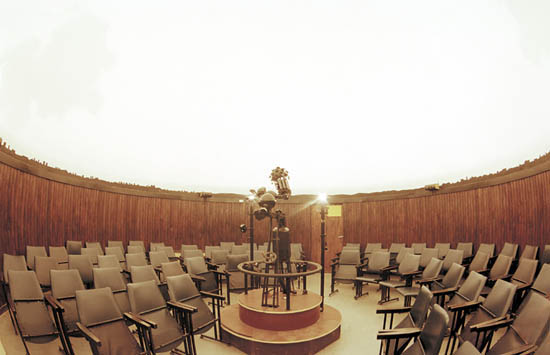
A planetarium (pl.: planetariums or planetaria) is a theatre built primarily for presenting educational and entertaining shows about astronomy and the night sky, or for training in celestial navigation.
A dominant feature of most planetariums is the large dome-shaped projection screen onto which scenes of stars, planets, and other celestial objects can be made to appear and move realistically to simulate their motion. The projection can be created in various ways, such as a star ball, slide projector, video, fulldome projector systems, and lasers. Typical systems can be set to simulate the sky at any point in time, past or present, and often to depict the night sky as it would appear from any point of latitude on Earth.
Planetaria range in size from the 37 meter dome in St. Petersburg, Russia (called "Planetarium No 1") to three-meter inflatable portable domes where attendees sit on the floor. The largest planetarium in the Western Hemisphere is the Jennifer Chalsty Planetarium at Liberty Science Center in New Jersey, its dome measuring 27 meters in diameter. The Birla Planetarium, Kolkata in India is the largest by seating capacity, having 630 seats. In North America, the Hayden Planetarium at the American Museum of Natural History in New York City has the greatest number of seats, at 423.
The term planetarium is sometimes used generically to describe other devices which illustrate the Solar System, such as a computer simulation or an orrery. Planetarium software refers to a software application that renders a three-dimensional image of the sky onto a two-dimensional computer screen, or in a virtual reality headset for a 3D representation. The term planetarian is used to describe a member of the professional staff of a planetarium.
The ancient Greek polymath Archimedes is attributed with creating a primitive planetarium device that could predict the movements of the Sun and the Moon and the planets. The discovery of the Antikythera mechanism proved that such devices already existed during antiquity, though likely after Archimedes' lifetime. Campanus of Novara described a planetary equatorium in his Theorica Planetarum, and included instructions on how to build one. The Globe of Gottorf built around 1650 had constellations painted on the inside. These devices would today usually be referred to as orreries (named for the Earl of Orrery). In fact, many planetariums today have projection orreries, which project onto the dome the Solar System (including the Sun and planets up to Saturn) in their regular orbital paths.
In 1229, following the conclusion of the Fifth Crusade, Holy Roman Emperor Frederick II of Hohenstaufen brought back a tent with scattered holes representing stars or planets. The device was operated internally with a spinnable table that rotated the tent.
The small size of typical 18th century orreries limited their impact, and towards the end of that century a number of educators attempted to create a larger sized version. The efforts of Adam Walker (1730–1821) and his sons are noteworthy in their attempts to fuse theatrical illusions with education. Walker's Eidouranion was the heart of his public lectures or theatrical presentations. Walker's son describes this "Elaborate Machine" as "twenty feet high, and twenty-seven in diameter: it stands vertically before the spectators, and its globes are so large, that they are distinctly seen in the most distant parts of the Theatre. Every Planet and Satellite seems suspended in space, without any support; performing their annual and diurnal revolutions without any apparent cause". Other lecturers promoted their own devices: R E Lloyd advertised his Dioastrodoxon, or Grand Transparent Orrery, and by 1825 William Kitchener was offering his Ouranologia, which was 42 feet (13 m) in diameter. These devices most probably sacrificed astronomical accuracy for crowd-pleasing spectacle and sensational and awe-provoking imagery.
The oldest still-working planetarium can be found in the Frisian city of Franeker. It was built by Eise Eisinga (1744–1828) in the living room of his house. It took Eisinga seven years to build his planetarium, which was completed in 1781.
Hub AI
Planetarium AI simulator
(@Planetarium_simulator)
Planetarium
A planetarium (pl.: planetariums or planetaria) is a theatre built primarily for presenting educational and entertaining shows about astronomy and the night sky, or for training in celestial navigation.
A dominant feature of most planetariums is the large dome-shaped projection screen onto which scenes of stars, planets, and other celestial objects can be made to appear and move realistically to simulate their motion. The projection can be created in various ways, such as a star ball, slide projector, video, fulldome projector systems, and lasers. Typical systems can be set to simulate the sky at any point in time, past or present, and often to depict the night sky as it would appear from any point of latitude on Earth.
Planetaria range in size from the 37 meter dome in St. Petersburg, Russia (called "Planetarium No 1") to three-meter inflatable portable domes where attendees sit on the floor. The largest planetarium in the Western Hemisphere is the Jennifer Chalsty Planetarium at Liberty Science Center in New Jersey, its dome measuring 27 meters in diameter. The Birla Planetarium, Kolkata in India is the largest by seating capacity, having 630 seats. In North America, the Hayden Planetarium at the American Museum of Natural History in New York City has the greatest number of seats, at 423.
The term planetarium is sometimes used generically to describe other devices which illustrate the Solar System, such as a computer simulation or an orrery. Planetarium software refers to a software application that renders a three-dimensional image of the sky onto a two-dimensional computer screen, or in a virtual reality headset for a 3D representation. The term planetarian is used to describe a member of the professional staff of a planetarium.
The ancient Greek polymath Archimedes is attributed with creating a primitive planetarium device that could predict the movements of the Sun and the Moon and the planets. The discovery of the Antikythera mechanism proved that such devices already existed during antiquity, though likely after Archimedes' lifetime. Campanus of Novara described a planetary equatorium in his Theorica Planetarum, and included instructions on how to build one. The Globe of Gottorf built around 1650 had constellations painted on the inside. These devices would today usually be referred to as orreries (named for the Earl of Orrery). In fact, many planetariums today have projection orreries, which project onto the dome the Solar System (including the Sun and planets up to Saturn) in their regular orbital paths.
In 1229, following the conclusion of the Fifth Crusade, Holy Roman Emperor Frederick II of Hohenstaufen brought back a tent with scattered holes representing stars or planets. The device was operated internally with a spinnable table that rotated the tent.
The small size of typical 18th century orreries limited their impact, and towards the end of that century a number of educators attempted to create a larger sized version. The efforts of Adam Walker (1730–1821) and his sons are noteworthy in their attempts to fuse theatrical illusions with education. Walker's Eidouranion was the heart of his public lectures or theatrical presentations. Walker's son describes this "Elaborate Machine" as "twenty feet high, and twenty-seven in diameter: it stands vertically before the spectators, and its globes are so large, that they are distinctly seen in the most distant parts of the Theatre. Every Planet and Satellite seems suspended in space, without any support; performing their annual and diurnal revolutions without any apparent cause". Other lecturers promoted their own devices: R E Lloyd advertised his Dioastrodoxon, or Grand Transparent Orrery, and by 1825 William Kitchener was offering his Ouranologia, which was 42 feet (13 m) in diameter. These devices most probably sacrificed astronomical accuracy for crowd-pleasing spectacle and sensational and awe-provoking imagery.
The oldest still-working planetarium can be found in the Frisian city of Franeker. It was built by Eise Eisinga (1744–1828) in the living room of his house. It took Eisinga seven years to build his planetarium, which was completed in 1781.
Recent media