



Community hub
Recent from talks
Knowledge base stats:
Talk channels stats:
Members stats:
Orrery
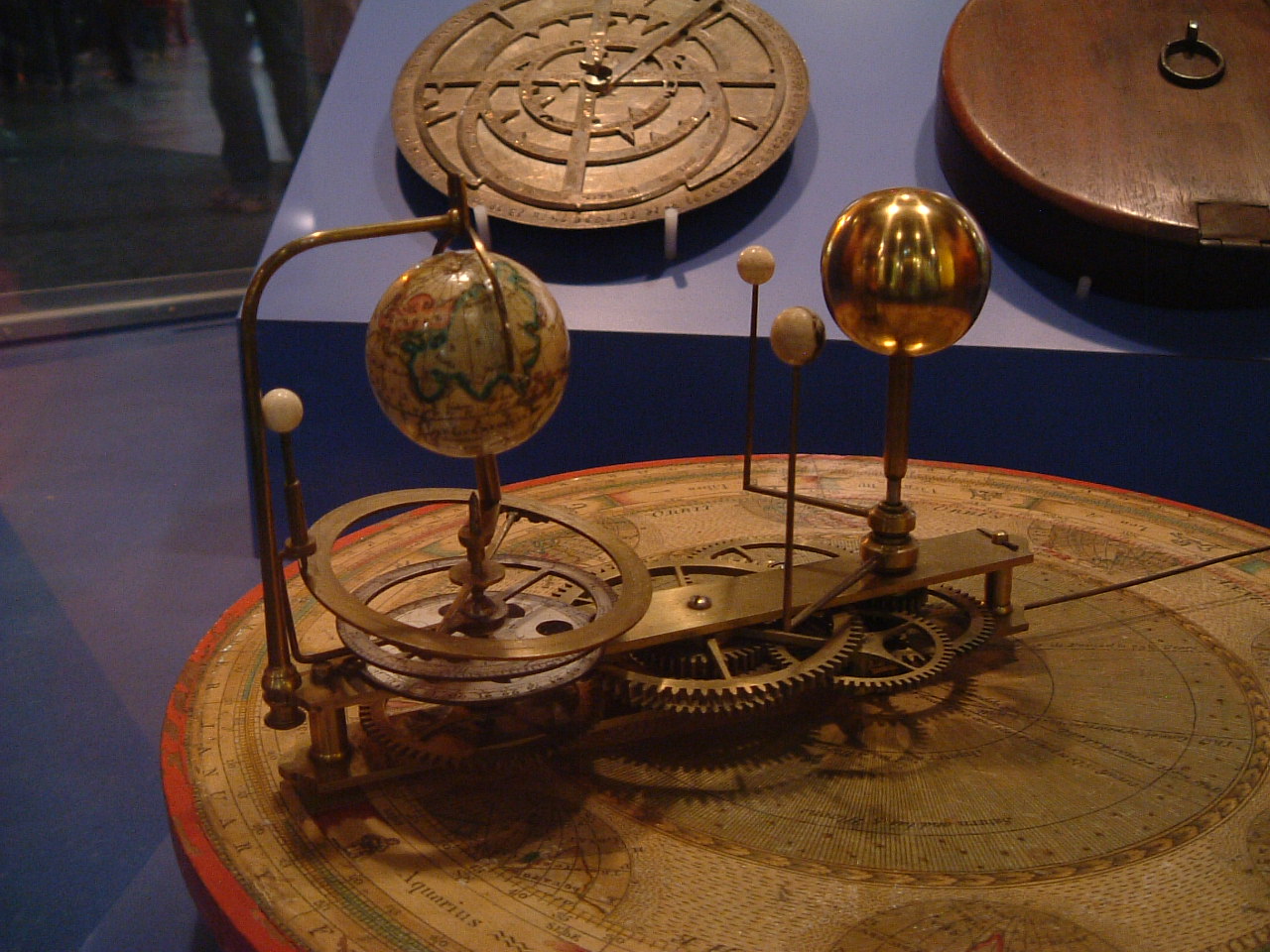
An orrery is a mechanical model of the Solar System that illustrates or predicts the relative positions and motions of the planets and moons, usually according to the heliocentric model. It may also represent the relative sizes of these bodies; however, since accurate scaling is often not practical due to the actual large ratio differences, it may use a scaled-down approximation. The Greeks had working planetaria, but the first modern example was produced c. 1712 by John Rowley. He named it "orrery" for his patron Charles Boyle, 4th Earl of Orrery (in County Cork, Ireland). The plaque on it reads "Orrery invented by Graham 1700 improved by Rowley and presented by him to John [sic] Earl of Orrery after whom it was named at the suggestion of Richard Steele."
Orreries are typically driven by a clockwork mechanism with a globe representing the Sun at the centre, and with a planet at the end of each of a series of arms.
The Antikythera mechanism, discovered in 1901 in a wreck off the Greek island of Antikythera in the Mediterranean Sea, exhibited the diurnal motions of the Sun, Moon, and the five planets known to the ancient Greeks. It has been dated between 205 to 87 BC. The mechanism is considered one of the first orreries. It was geocentric and used as a mechanical calculator to calculate astronomical positions.
Cicero, the Roman philosopher and politician writing in the first century BC, has references describing planetary mechanical models. According to him, the Greek polymaths Thales and Posidonius both constructed a device modeling celestial motion.
In 1348, Giovanni Dondi built the first known clock driven mechanism of the system. It displays the ecliptic position of the Moon, Sun, Mercury, Venus, Mars, Jupiter and Saturn according to the complicated geocentric Ptolemaic planetary theories. The clock itself is lost, but Dondi left a complete description of its astronomic gear trains.
As late as 1650, P. Schirleus built a geocentric planetarium with the Sun as a planet, and with Mercury and Venus revolving around the Sun as its moons.
At the court of William IV, Landgrave of Hesse-Kassel two complicated astronomic clocks were built in 1561 and 1563–1568. These use four sides to show the ecliptical positions of the Sun, Mercury, Venus, Mars, Jupiter, Saturn, the Moon, Sun and Dragon (Nodes of the Moon) according to Ptolemy, a calendar, the sunrise and sunset, and an automated celestial sphere with an animated Sun symbol which, for the first time on a celestial globe, shows the real position of the Sun, including the equation of time. The clocks are now on display in Kassel at the Astronomisch-Physikalisches Kabinett and in Dresden at the Mathematisch-Physikalischer Salon.
In De revolutionibus orbium coelestium, published in Nuremberg in 1543, Nicolaus Copernicus challenged the Western teaching of a geocentric universe in which the Sun revolved daily around the Earth. He observed that some Greek philosophers such as Aristarchus of Samos had proposed a heliocentric universe. This simplified the apparent epicyclic motions of the planets, making it feasible to represent the planets' paths as simple circles. This could be modeled by the use of gears. Tycho Brahe's improved instruments made precise observations of the skies (1576–1601), and from these Johannes Kepler (1621) deduced that planets orbited the Sun in ellipses. In 1687 Isaac Newton explained the cause of elliptic motion in his theory of gravitation.
Hub AI
Orrery AI simulator
(@Orrery_simulator)
Orrery
An orrery is a mechanical model of the Solar System that illustrates or predicts the relative positions and motions of the planets and moons, usually according to the heliocentric model. It may also represent the relative sizes of these bodies; however, since accurate scaling is often not practical due to the actual large ratio differences, it may use a scaled-down approximation. The Greeks had working planetaria, but the first modern example was produced c. 1712 by John Rowley. He named it "orrery" for his patron Charles Boyle, 4th Earl of Orrery (in County Cork, Ireland). The plaque on it reads "Orrery invented by Graham 1700 improved by Rowley and presented by him to John [sic] Earl of Orrery after whom it was named at the suggestion of Richard Steele."
Orreries are typically driven by a clockwork mechanism with a globe representing the Sun at the centre, and with a planet at the end of each of a series of arms.
The Antikythera mechanism, discovered in 1901 in a wreck off the Greek island of Antikythera in the Mediterranean Sea, exhibited the diurnal motions of the Sun, Moon, and the five planets known to the ancient Greeks. It has been dated between 205 to 87 BC. The mechanism is considered one of the first orreries. It was geocentric and used as a mechanical calculator to calculate astronomical positions.
Cicero, the Roman philosopher and politician writing in the first century BC, has references describing planetary mechanical models. According to him, the Greek polymaths Thales and Posidonius both constructed a device modeling celestial motion.
In 1348, Giovanni Dondi built the first known clock driven mechanism of the system. It displays the ecliptic position of the Moon, Sun, Mercury, Venus, Mars, Jupiter and Saturn according to the complicated geocentric Ptolemaic planetary theories. The clock itself is lost, but Dondi left a complete description of its astronomic gear trains.
As late as 1650, P. Schirleus built a geocentric planetarium with the Sun as a planet, and with Mercury and Venus revolving around the Sun as its moons.
At the court of William IV, Landgrave of Hesse-Kassel two complicated astronomic clocks were built in 1561 and 1563–1568. These use four sides to show the ecliptical positions of the Sun, Mercury, Venus, Mars, Jupiter, Saturn, the Moon, Sun and Dragon (Nodes of the Moon) according to Ptolemy, a calendar, the sunrise and sunset, and an automated celestial sphere with an animated Sun symbol which, for the first time on a celestial globe, shows the real position of the Sun, including the equation of time. The clocks are now on display in Kassel at the Astronomisch-Physikalisches Kabinett and in Dresden at the Mathematisch-Physikalischer Salon.
In De revolutionibus orbium coelestium, published in Nuremberg in 1543, Nicolaus Copernicus challenged the Western teaching of a geocentric universe in which the Sun revolved daily around the Earth. He observed that some Greek philosophers such as Aristarchus of Samos had proposed a heliocentric universe. This simplified the apparent epicyclic motions of the planets, making it feasible to represent the planets' paths as simple circles. This could be modeled by the use of gears. Tycho Brahe's improved instruments made precise observations of the skies (1576–1601), and from these Johannes Kepler (1621) deduced that planets orbited the Sun in ellipses. In 1687 Isaac Newton explained the cause of elliptic motion in his theory of gravitation.