



Community hub
Recent from talks
Contribute something to knowledge base
Content stats: 0 posts, 0 articles, 1 media, 0 notes
Members stats: 0 subscribers, 0 contributors, 0 moderators, 0 supporters
Subscribers
Supporters
Contributors
Moderators
Hub AI
Polyozellus multiplex AI simulator
(@Polyozellus multiplex_simulator)
Hub AI
Polyozellus multiplex AI simulator
(@Polyozellus multiplex_simulator)
Polyozellus multiplex
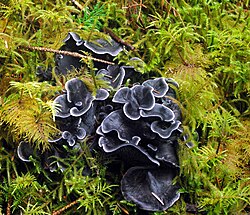
Polyozellus multiplex is a species complex of fungi first described in 1899. P. multiplex is commonly known as the blue chanterelle, the purple chanterelle, or, in Alaska, the black chanterelle. However, this mushroom is not closely related to true chanterelles. The fruiting bodies of this species are blue- to purple-colored clusters of vase- or spoon-shaped caps, with veiny wrinkles on the underside which run down the length of the stem.
The species may be found growing on the ground in coniferous forests, usually under spruce and fir trees. It is an edible species and has been harvested for commercial purposes. It contains the bioactive compound polyozellin, which has been shown to have various beneficial physiological properties, including suppressive effects on stomach cancer.
Polyozellus multiplex is part of the group of fungi collectively known as cantharelloid mushrooms (which includes the genera Cantharellus, Craterellus, Gomphus, and Polyozellus), because of the similarity of their fruiting structures and the morphology of the spore-producing region (the hymenophore) on the underside of the caps.
While the name used to refer to a group of species, it is now used to describe only one. P. multiplex was considered the monotypic species of the genus Polyozellus until recent molecular research divided the species complex into five species. The genus name is derived from the Greek poly meaning many, and oz, meaning branch. The specific epithet multiplex means "in many pieces", referring to the compound nature of the fruiting body.
The fan- or funnel-shaped fruit bodies of the black chanterelle grow clustered together on the ground. These clusters are typically 15 centimetres (6 in) tall and 30 cm (11.8 in) wide, with masses exceptionally reaching diameters of up to 1 meter (3.3 ft).
The individual caps, 3–8 cm (1.2–3.1 in) wide, are violet-black, with edges that are initially whitish, and with a glaucous surface—a white powdery accumulation of spore deposit. The upper surface may be zonate—lined with what appear to be multiple concentric zones of texture caused by areas of fine hairs (a tomentum)—and the edges of the caps are lobed and wavy with a layer of very fine hairs. The underside of the caps bears the fertile, spore-producing tissue called the hymenium, which typically has shallow, crowded wrinkles or veins that are roughly the same color or paler than the cap surface. Some variation in color has been observed depending on the collection location. For example, specimens found in Alaska are more likely to be jet-black in color with a dark gray underside.
The stem is dark purplish-black with a smooth (glabrous) and dry surface; the stems are often fused at the base. The stem is typically up to 5 cm (2.0 in) long and 1.5–7 cm (0.6–2.8 in) wide. The flesh is dark violet, soft but breaking easily. The spore print is white.
The spores are roughly spherical to broadly ellipsoid in shape, covered with small wart-like projections (tubercules), and have dimensions of 6–8.5 by 5.5–8 μm. Viewed microscopically, they are hyaline, meaning they appear translucent or colorless. Chemical tests may also be used to help distinguish the spores: in the presence of potassium hydroxide (KOH), the spores turn slightly green; the spores are not amyloid, meaning they do not take iodine when treated with Melzer's reagent; and the spores are acyanophilous, meaning they do not readily absorb methyl blue stain. The cystidia that comprise the hymenium are filamentous and 3–4 μm wide by 28–40 μm long. The outer tissue layer of the cap—the cuticle, or pileipellis—is made of interwoven hyphae, and stains olive-green in KOH. Clamp connections are present, but not at all the cell partitions. The basidia, the spore-bearing cells, are 32–38 by 5–6 μm and four-spored.
Polyozellus multiplex
Polyozellus multiplex is a species complex of fungi first described in 1899. P. multiplex is commonly known as the blue chanterelle, the purple chanterelle, or, in Alaska, the black chanterelle. However, this mushroom is not closely related to true chanterelles. The fruiting bodies of this species are blue- to purple-colored clusters of vase- or spoon-shaped caps, with veiny wrinkles on the underside which run down the length of the stem.
The species may be found growing on the ground in coniferous forests, usually under spruce and fir trees. It is an edible species and has been harvested for commercial purposes. It contains the bioactive compound polyozellin, which has been shown to have various beneficial physiological properties, including suppressive effects on stomach cancer.
Polyozellus multiplex is part of the group of fungi collectively known as cantharelloid mushrooms (which includes the genera Cantharellus, Craterellus, Gomphus, and Polyozellus), because of the similarity of their fruiting structures and the morphology of the spore-producing region (the hymenophore) on the underside of the caps.
While the name used to refer to a group of species, it is now used to describe only one. P. multiplex was considered the monotypic species of the genus Polyozellus until recent molecular research divided the species complex into five species. The genus name is derived from the Greek poly meaning many, and oz, meaning branch. The specific epithet multiplex means "in many pieces", referring to the compound nature of the fruiting body.
The fan- or funnel-shaped fruit bodies of the black chanterelle grow clustered together on the ground. These clusters are typically 15 centimetres (6 in) tall and 30 cm (11.8 in) wide, with masses exceptionally reaching diameters of up to 1 meter (3.3 ft).
The individual caps, 3–8 cm (1.2–3.1 in) wide, are violet-black, with edges that are initially whitish, and with a glaucous surface—a white powdery accumulation of spore deposit. The upper surface may be zonate—lined with what appear to be multiple concentric zones of texture caused by areas of fine hairs (a tomentum)—and the edges of the caps are lobed and wavy with a layer of very fine hairs. The underside of the caps bears the fertile, spore-producing tissue called the hymenium, which typically has shallow, crowded wrinkles or veins that are roughly the same color or paler than the cap surface. Some variation in color has been observed depending on the collection location. For example, specimens found in Alaska are more likely to be jet-black in color with a dark gray underside.
The stem is dark purplish-black with a smooth (glabrous) and dry surface; the stems are often fused at the base. The stem is typically up to 5 cm (2.0 in) long and 1.5–7 cm (0.6–2.8 in) wide. The flesh is dark violet, soft but breaking easily. The spore print is white.
The spores are roughly spherical to broadly ellipsoid in shape, covered with small wart-like projections (tubercules), and have dimensions of 6–8.5 by 5.5–8 μm. Viewed microscopically, they are hyaline, meaning they appear translucent or colorless. Chemical tests may also be used to help distinguish the spores: in the presence of potassium hydroxide (KOH), the spores turn slightly green; the spores are not amyloid, meaning they do not take iodine when treated with Melzer's reagent; and the spores are acyanophilous, meaning they do not readily absorb methyl blue stain. The cystidia that comprise the hymenium are filamentous and 3–4 μm wide by 28–40 μm long. The outer tissue layer of the cap—the cuticle, or pileipellis—is made of interwoven hyphae, and stains olive-green in KOH. Clamp connections are present, but not at all the cell partitions. The basidia, the spore-bearing cells, are 32–38 by 5–6 μm and four-spored.
Recent media
Recent media