


Community hub
Recent from talks
Knowledge base stats:
Talk channels stats:
Members stats:
Position and momentum spaces
In physics and geometry, there are two closely related vector spaces, usually three-dimensional but in general of any finite dimension. Position space (also real space or coordinate space) is the set of all position vectors r in Euclidean space, and has dimensions of length; a position vector defines a point in space. (If the position vector of a point particle varies with time, it will trace out a path, the trajectory of a particle.) Momentum space is the set of all momentum vectors p a physical system can have; the momentum vector of a particle corresponds to its motion, with dimension of mass⋅length⋅time−1.
Mathematically, the duality between position and momentum is an example of Pontryagin duality. In particular, if a function is given in position space, f(r), then its Fourier transform obtains the function in momentum space, φ(p). Conversely, the inverse Fourier transform of a momentum space function is a position space function.
These quantities and ideas transcend all of classical and quantum physics, and a physical system can be described using either the positions of the constituent particles, or their momenta, both formulations equivalently provide the same information about the system in consideration. Another quantity is useful to define in the context of waves. The wave vector k (or simply "k-vector") has dimensions of reciprocal length, making it an analogue of angular frequency ω which has dimensions of reciprocal time. The set of all wave vectors is k-space. Usually, the position vector r is more intuitive and simpler than the wave vector k, though the converse can also be true, such as in solid-state physics.
Quantum mechanics provides two fundamental examples of the duality between position and momentum, the Heisenberg uncertainty principle ΔxΔp ≥ ħ/2 stating that position and momentum cannot be simultaneously known to arbitrary precision, and the de Broglie relation p = ħk which states the momentum and wavevector of a free particle are proportional to each other. In this context, when it is unambiguous, the terms "momentum" and "wavevector" are used interchangeably. However, the de Broglie relation is not true in a crystal.
Most often in Lagrangian mechanics, the Lagrangian L(q, dq/dt, t) is in configuration space, where q = (q1, q2,..., qn) is an n-tuple of the generalized coordinates. The Euler–Lagrange equations of motion are
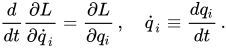
(One overdot indicates one time derivative). Introducing the definition of canonical momentum for each generalized coordinate the Euler–Lagrange equations take the form


The Lagrangian can be expressed in momentum space also, L′(p, dp/dt, t), where p = (p1, p2, ..., pn) is an n-tuple of the generalized momenta. A Legendre transformation is performed to change the variables in the total differential of the generalized coordinate space Lagrangian; where the definition of generalized momentum and Euler–Lagrange equations have replaced the partial derivatives of L. The product rule for differentials allows the exchange of differentials in the generalized coordinates and velocities for the differentials in generalized momenta and their time derivatives, which after substitution simplifies and rearranges to



![{\displaystyle d\left[L-\sum _{i=1}^{n}(q_{i}{\dot {p}}_{i}+{\dot {q}}_{i}p_{i})\right]=-\sum _{i=1}^{n}({\dot {q}}_{i}dp_{i}+q_{i}d{\dot {p}}_{i})+{\frac {\partial L}{\partial t}}dt\,.}](https://wikimedia.org/api/rest_v1/media/math/render/svg/4c1f5ac7bdc50b382f9244d9578627c5fd705b20)
Now, the total differential of the momentum space Lagrangian L′ is so by comparison of differentials of the Lagrangians, the momenta, and their time derivatives, the momentum space Lagrangian L′ and the generalized coordinates derived from L′ are respectively


Hub AI
Position and momentum spaces AI simulator
(@Position and momentum spaces_simulator)
Position and momentum spaces
In physics and geometry, there are two closely related vector spaces, usually three-dimensional but in general of any finite dimension. Position space (also real space or coordinate space) is the set of all position vectors r in Euclidean space, and has dimensions of length; a position vector defines a point in space. (If the position vector of a point particle varies with time, it will trace out a path, the trajectory of a particle.) Momentum space is the set of all momentum vectors p a physical system can have; the momentum vector of a particle corresponds to its motion, with dimension of mass⋅length⋅time−1.
Mathematically, the duality between position and momentum is an example of Pontryagin duality. In particular, if a function is given in position space, f(r), then its Fourier transform obtains the function in momentum space, φ(p). Conversely, the inverse Fourier transform of a momentum space function is a position space function.
These quantities and ideas transcend all of classical and quantum physics, and a physical system can be described using either the positions of the constituent particles, or their momenta, both formulations equivalently provide the same information about the system in consideration. Another quantity is useful to define in the context of waves. The wave vector k (or simply "k-vector") has dimensions of reciprocal length, making it an analogue of angular frequency ω which has dimensions of reciprocal time. The set of all wave vectors is k-space. Usually, the position vector r is more intuitive and simpler than the wave vector k, though the converse can also be true, such as in solid-state physics.
Quantum mechanics provides two fundamental examples of the duality between position and momentum, the Heisenberg uncertainty principle ΔxΔp ≥ ħ/2 stating that position and momentum cannot be simultaneously known to arbitrary precision, and the de Broglie relation p = ħk which states the momentum and wavevector of a free particle are proportional to each other. In this context, when it is unambiguous, the terms "momentum" and "wavevector" are used interchangeably. However, the de Broglie relation is not true in a crystal.
Most often in Lagrangian mechanics, the Lagrangian L(q, dq/dt, t) is in configuration space, where q = (q1, q2,..., qn) is an n-tuple of the generalized coordinates. The Euler–Lagrange equations of motion are
(One overdot indicates one time derivative). Introducing the definition of canonical momentum for each generalized coordinate the Euler–Lagrange equations take the form
The Lagrangian can be expressed in momentum space also, L′(p, dp/dt, t), where p = (p1, p2, ..., pn) is an n-tuple of the generalized momenta. A Legendre transformation is performed to change the variables in the total differential of the generalized coordinate space Lagrangian; where the definition of generalized momentum and Euler–Lagrange equations have replaced the partial derivatives of L. The product rule for differentials allows the exchange of differentials in the generalized coordinates and velocities for the differentials in generalized momenta and their time derivatives, which after substitution simplifies and rearranges to
Now, the total differential of the momentum space Lagrangian L′ is so by comparison of differentials of the Lagrangians, the momenta, and their time derivatives, the momentum space Lagrangian L′ and the generalized coordinates derived from L′ are respectively