Hubbry Logo
search
logo

Power rating

logo
Community Hub0 Subscribers
Read side by side
from Wikipedia

In electrical engineering and mechanical engineering, the power rating of equipment is the highest power input allowed to flow through particular equipment. According to the particular discipline, the term power may refer to electrical or mechanical power. A power rating can also involve average and maximum power, which may vary depending on the kind of equipment and its application.

Power rating limits are usually set as a guideline by the manufacturers, protecting the equipment, and simplifying the design of larger systems, by providing a level of operation under which the equipment will not be damaged while allowing for a certain safety margin.

Equipment types

[edit]

Dissipative equipment

[edit]

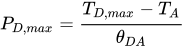
In equipment that primarily dissipates electric power or converts it into mechanical power, such as resistors, and speakers, the power rating given is usually the maximum power that can be safely dissipated by the equipment. The usual reason for this limit is heat, although in certain electromechanical devices, particularly speakers, it is to prevent mechanical damage. When heat is the limiting factor, the power rating is easily calculated. First, the amount of heat that can be safely dissipated by the device, , must be calculated. This is related to the maximum safe operating temperature, the ambient temperature or temperature range in which the device will be operated, and the method of cooling. If is the maximum safe operating temperature of the device, is the ambient temperature, and is the total thermal resistance between the device and ambient, then the maximum heat dissipation is given by

If all power in a device is dissipated as heat, then this is also the power rating.

Mechanical equipment

[edit]

Equipment is generally rated by the power it will deliver, for example, at the shaft of an electric or hydraulic motor. The power input to the equipment will be greater owing to the less than 100% efficiency of the device.[1][2][3] Efficiency of a device is often defined as the ratio of output power to the sum of output power and losses. In some types of equipment, it is possible to measure or calculate losses directly. This allows efficiency to be calculated with greater precision than the quotient of input power over output power, where relatively small measurement uncertainty will greatly affect the resulting calculated efficiency.

Power converting equipment

[edit]

In devices that primarily convert between different forms of electric power, such as transformers, or transport it from one location to another, such as transmission lines, the power rating almost always refers to the maximum power flow through the device, not dissipation within it. The usual reason for the limit is heat, and the maximum heat dissipation is calculated as above.

Power ratings are usually given in watts for real power and volt-amperes for apparent power, although for devices intended for use in large power systems, both may be given in a per-unit system. Cables are usually rated by giving their maximum voltage and their ampacity.[4] As the power rating depends on the method of cooling, different ratings may be specified for air cooling, water cooling, etc.[4]

Average vs. maximum

[edit]

For AC-operated devices (e.g. coaxial cable, loudspeakers), there may even be two power ratings, a maximum (peak) power rating and an average power rating.[5][6] For such devices, the peak power rating usually specifies the low frequency or pulse energy, while the average power rating limits high-frequency operation.[5] Average power calculation rating depends on some assumptions about how the device is going to be used. For example, the EIA rating method for loudspeakers uses a shaped noise signal that simulates music and allows peak excursion of 6 dB, so an EIA rating of 50 Watts corresponds to 200 Watts peak rating.[6]

Maximum continuous rating

[edit]

Maximum continuous rating (MCR) is defined as the maximum output (MW) that an electric power generating station is capable of producing continuously under normal conditions over a year. Under ideal conditions, the actual output could be higher than the MCR.[7]

Within shipping, ships usually operate at the nominal continuous rating (NCR) which is 85% of the 90% of MCR. The 90% MCR is usually the contractual output for which the propeller is designed. Thus, the usual output at which ships are operated is around 75% to 77% of MCR.[8]

Other definitions

[edit]

In some fields of engineering, even a more complex set of power ratings is used. For example, helicopter engines are rated for continuous power (which does not have a time constraint), takeoff and hover power rating (defined as half to one-hour operation), maximum contingency power (which can be sustained for two-three minutes), and emergency (half a minute) power rating.[9]

For electrical motors, a similar kind of information is conveyed by the service factor, which is a multiplier that, when applied to the rated output power, gives the power level a motor can sustain for shorter periods of time. The service factor is typically in the 1.15-1.4 range, with the figure being lower for higher-power motors. For every hour of operation at the service-factor-adjusted power rating, a motor loses two to three hours of life at nominal power, i.e. its service life is reduced to less than half for continued operation at this level.[4][10] The service factor is defined in the ANSI/NEMA MG 1 standard,[11] and is generally used in the United States.[12] There is no IEC standard for the service factor.[13]

Exceeding the power rating of a device by more than the margin of safety set by the manufacturer usually does damage to the device by causing its operating temperature to exceed safe levels. In semiconductors, irreparable damage can occur very quickly. Exceeding the power rating of most devices for a very short period of time is not harmful, although doing so regularly can sometimes cause cumulative damage.

Power ratings for electrical apparatus and transmission lines are a function of the duration of the proposed load and the ambient temperature; a transmission line or transformer, for example, can carry significantly more load in cold weather than in hot weather. Momentary overloads, causing high temperatures and deterioration of insulation, may be considered an acceptable trade-off in emergency situations. The power rating of switching devices varies depending on the circuit voltage as well as the current. In certain aerospace or military applications, a device may carry a much higher rating than would be accepted in devices intended to operate for long service life.

Examples

[edit]

Audio amplifiers

[edit]

Audio amplifier power ratings are typically established by driving the device under test to the onset of clipping, to a predetermined distortion level, variable per manufacturer or per product line. Driving an amplifier to 1% distortion levels will yield a higher rating than driving it to 0.01% distortion levels.[14] Similarly, testing an amplifier at a single mid-range frequency, or testing just one channel of a two-channel amplifier, will yield a higher rating than if it is tested throughout its intended frequency range with both channels working. Manufacturers can use these methods to market amplifiers whose published maximum power output includes some amount of clipping in order to show higher numbers.[14]

For instance, the Federal Trade Commission (FTC) established an amplifier rating system in which the device is tested with both channels driven throughout its advertised frequency range, at no more than its published distortion level. The Electronic Industries Association (EIA) rating system, however, determines amplifier power by measuring a single channel at 1,000 Hz, with a 1% distortion level—1% clipping. Using the EIA method rates an amplifier 10 to 20% higher than the FTC method.[14]

Photovoltaic modules

[edit]

The nominal power of a photovoltaic module is determined by measuring current and voltage while varying resistance under defined illumination. The conditions are specified in standards such as IEC 61215, IEC 61646 and UL 1703; specifically, the light intensity is 1000 W/m2, with a spectrum similar to sunlight hitting the Earth's surface at latitude 35° N in the summer (airmass 1.5) and temperature of the cells at 25 °C. The power is measured while varying the resistive load on the module between open and closed circuit.

The maximum power measured is the nominal power of the module in Watts. Colloquially, this is also written as "Wp"; this format is colloquial as it is outside the standard by adding suffixes to standardized units. The nominal power divided by the light power that falls on the module (area x 1000 W/m2) is the efficiency.

See also

[edit]

References

[edit]
Revisions and contributorsEdit on WikipediaRead on Wikipedia
from Grokipedia
In electrical and mechanical engineering, the power rating of a device, component, or system refers to the maximum amount of power it is designed to handle or deliver continuously under specified operating conditions without risk of damage, overheating, or performance degradation.[1] This rating ensures safe operation by defining limits based on factors such as material tolerances, thermal dissipation, and environmental conditions, often expressed in units like watts (W) for electrical applications or horsepower (hp) for mechanical ones.[2] Exceeding the power rating can lead to failure, such as in resistors where excessive dissipation causes overheating and potential failure, or in motors where it results in insulation breakdown and reduced lifespan.[3][4] Power ratings vary by application and duty cycle; for instance, continuous ratings allow unlimited operation at full load, while standby or peak ratings are for short-term, intermittent use in generators or amplifiers.[5][6] In energy storage systems, power rating determines the rate of charge/discharge to stabilize renewable energy fluctuations, calculated as $ P = I \times V $ for components like batteries.[7] Overall, adhering to power ratings is essential for system reliability, regulatory compliance, and preventing hazards in fields from consumer electronics to industrial machinery.[1]

Fundamentals

Definition

A power rating specifies the maximum power, typically measured in watts (W) for electrical systems or horsepower (hp) for mechanical ones, that a component or system can safely dissipate, convert, or transmit without exceeding operational temperature limits, mechanical stress thresholds, or risking structural failure. This rating ensures reliable performance by preventing overheating or degradation, which could lead to reduced lifespan or catastrophic breakdown. It applies across electrical and mechanical engineering contexts, from simple resistors to complex machinery, and is determined under standardized ambient conditions to maintain thermal balance.[8][3] The concept of power rating in mechanical engineering dates to the late 18th century with James Watt's development of the horsepower unit for steam engines, while in electrical engineering it emerged in the early 20th century amid the rapid expansion of electrical infrastructure, with foundational standards developed by the American Institute of Electrical Engineers (AIEE, established 1884 and later merged into IEEE) and the International Electrotechnical Commission (IEC, founded 1906). These organizations formalized power limits in the 1920s and 1930s to address safety in growing power systems, drawing from empirical testing on heat dissipation and material endurance to mitigate risks like insulation failure or conductor melting. Early definitions emphasized conservative margins to account for real-world variability in voltage and load.[9][10] At its core, power rating derives from fundamental equations for power. In electrical systems, it is $ P = V \times I $, where $ V $ represents voltage and $ I $ denotes current, quantifying the energy transfer rate in direct current or alternating current systems. For dissipative elements, such as resistors, the relationship ties to Joule heating via $ P = I^2 R $, with $ R $ as resistance, highlighting how current flow generates heat proportional to resistance. In mechanical systems, power is given by $ P = \tau \times \omega $, where $ \tau $ is torque and $ \omega $ is angular velocity, ensuring limits on load and speed to prevent failure. The rating corresponds to the point of thermal or mechanical equilibrium, where energy input equals dissipation or output through relevant mechanisms, keeping internal conditions below critical thresholds (e.g., 70–150°C for electrical materials). This assumes foundational understanding of relevant quantities, ensuring the system stabilizes without progressive damage.[8][3][11]

Measurement Units and Standards

Power ratings are primarily quantified using the watt (W), the SI unit for power in both direct current (DC) and alternating current (AC) systems, representing the rate of energy transfer at one joule per second.[12] In mechanical and electromechanical contexts, such as engines or motors, power is often expressed in horsepower (hp), where 1 hp is approximately equivalent to 746 W, facilitating comparisons between electrical and mechanical systems.[12] For AC systems, power ratings distinguish between real power, measured in watts (W) as the actual energy consumed or delivered, apparent power in volt-amperes (VA) as the total power including reactive components, and the power factor (PF) defined as the ratio of real power to apparent power (PF = P / S).[13] This differentiation accounts for inefficiencies due to phase differences in voltage and current, ensuring accurate sizing of equipment like transformers and motors.[14] International standards govern power rating specifications to ensure safety, performance, and interoperability. The IEC 60076 series establishes requirements for power transformers, including rated power, voltage levels, and efficiency under specified conditions, applicable to units up to 765 kV.[15] UL 94 provides flammability classifications for plastic materials in electrical devices, influencing power ratings by limiting heat buildup and fire risks in enclosures rated for high-power operation.[16] Similarly, ISO 8528 defines performance classes and power ratings for reciprocating internal combustion engine-driven alternating current generator sets, categorizing outputs like emergency standby and prime power based on load factors and operational limits.[17] Testing methods for verifying power ratings include steady-state load testing, where equipment operates at nominal conditions to measure sustained output and efficiency, often under controlled ambient temperatures.[18] Thermal imaging detects hotspots during load application, correlating temperature rises with power dissipation to validate thermal limits and prevent failures.[19] Compliance certification involves third-party audits against these standards, confirming adherence through documented test data and performance metrics before market deployment.[15]

Rating Types

Continuous vs. Intermittent

The continuous power rating specifies the maximum power level that electrical equipment, such as motors or transformers, can sustain indefinitely under specified operating conditions without exceeding allowable temperature limits or causing damage, primarily governed by steady-state thermal dissipation where heat generation equals heat loss. This rating ensures reliable operation over extended periods by maintaining thermal equilibrium, often tied to the equipment's design for constant load application as defined in IEEE Std 96-1969, which describes continuous duty as operation at a substantially constant load for an indefinitely long time.[20] In contrast, the intermittent power rating permits higher power levels than the continuous rating but only for limited durations within a defined duty cycle, allowing the equipment to handle short bursts of load followed by rest or reduced-load periods without thermal overload. For instance, in applications like crane motors or servo drives with periodic operation, the average power over a cycle is determined by the formula $ P_{\text{avg}} = P_{\text{intermittent}} \times D $, where $ D $ is the duty cycle (the fraction of time under load, e.g., 0.5 for 50% on/off).[21] This approach equates intermittent operation to an effective continuous loading, ensuring the cumulative thermal stress does not exceed design limits. Key factors influencing the distinction between continuous and intermittent ratings include the equipment's thermal time constants, which represent the time required for temperature to reach approximately 63% of its final value during heating or cooling, affecting heat accumulation during on-periods and dissipation during off-periods.[22] Cooling mechanisms, such as natural convection in enclosed housings or forced air via fans, further modulate these ratings by enhancing heat transfer rates, with forced air enabling higher intermittent capacities compared to passive convection in the same equipment.[22] Exceeding intermittent ratings poses significant safety risks, as prolonged or excessive overloading can cause rapid heat accumulation beyond thermal limits, leading to insulation breakdown in windings or cables due to dielectric degradation and potential arcing. In mechanical components like motor rotors, this may induce fatigue from thermal expansion stresses, increasing the likelihood of failure, fires, or electrical shocks in industrial settings.[23]

Average vs. Peak

In electrical systems, peak power represents the instantaneous maximum power delivered at the moment when voltage and current simultaneously attain their highest values. For sinusoidal alternating current (AC) waveforms in resistive circuits, this is expressed as $ P_{\peak} = V_{\peak} \times I_{\peak} $, where $ V_{\peak} $ and $ I_{\peak} $ are the peak voltage and current, respectively.[24] This metric is crucial for assessing the transient stress on components during signal peaks.[25] Average power, in contrast, is the time-averaged value of instantaneous power over one complete cycle, providing a measure of sustained energy delivery. In sinusoidal AC circuits, it is calculated using root mean square (RMS) values as $ P_{\avg} = V_{\rms} \times I_{\rms} \times \PF $, where $ V_{\rms} = \frac{V_{\peak}}{\sqrt{2}} $ (and similarly for current), and \PF\PF is the power factor accounting for phase differences between voltage and current.[24] The RMS value equates the effective heating or work done by the AC signal to that of a direct current (DC) equivalent.[26] The crest factor, defined as the ratio of the peak amplitude to the RMS amplitude of the waveform, highlights differences between peak and average levels by indicating signal "peakiness." For pure sinusoidal waves, it equals $ \sqrt{2} \approx 1.414 $.[27] Elevated crest factors heighten the risk of clipping in amplification systems, where insufficient peak handling capacity leads to waveform distortion and potential component damage during transients.[28] For non-sinusoidal loads, such as pulsed DC or harmonically distorted waveforms, the crest factor often exceeds 1.414—reaching values like 4 or higher—due to sharp transients that demand robust peak power ratings to avoid overload.[28] In pulsed applications, peak power is the pulse energy divided by pulse duration ($ P_{\peak} = \frac{E}{\Delta t} ),whileaveragepoweristhe[energy](/page/Energy)perperiod(), while average power is the [energy](/page/Energy) per period ( P_{\avg} = \frac{E}{T} $), underscoring the need for devices to tolerate brief high-power surges without compromising overall performance.[25]

Equipment Categories

Dissipative Devices

Dissipative devices are electrical components designed primarily to convert electrical energy into heat through resistive losses, with their power ratings specifying the maximum continuous power they can safely dissipate without failure. These ratings are fundamentally based on the Joule heating effect, where the power dissipated follows the relation $ P = I^2 R $, with $ I $ representing current and $ R $ the resistance of the component. Common examples include resistors used in current limiting or voltage dropping applications and dedicated heaters such as those in industrial processes or consumer appliances. The power rating ensures that the generated heat can be adequately managed by the device's thermal design and surrounding environment to prevent damage. For resistors and heaters, power ratings account for $ I^2 R $ losses and incorporate derating factors to maintain safe operating temperatures under varying conditions. Standard ratings are often defined at an ambient temperature of 70°C, beyond which derating curves linearly reduce the allowable power; for instance, many fixed resistors allow approximately 65% of rated power at 100°C (a 35% reduction), based on linear derating to 0% at 155°C.[3] Wirewound resistors, valued for their high thermal mass, typically achieve ratings up to 100 W, making them suitable for power electronics where substantial heat must be dissipated. Similarly, incandescent light bulbs operate with filament power limits, such as 60 W for standard household types, where the tungsten filament is engineered to withstand the resulting thermal stress at around 2500–2800 K without premature evaporation or rupture. A primary failure mode in dissipative devices is thermal runaway, occurring when the dissipated power exceeds the device's cooling capacity, causing a rapid temperature rise that can lead to material degradation or melting. In this scenario, as temperature increases, the resistance may change (often decreasing in semiconductors or NTC thermistors), further amplifying current flow per Ohm's law and exacerbating $ I^2 R $ losses in a positive feedback loop. This can result in catastrophic failure, such as filament breakage in bulbs or resistor element burnout, underscoring the need to operate well below rated limits in high-ambient conditions. Design considerations for dissipative devices emphasize optimizing heat dissipation to sustain rated power levels. Surface area plays a critical role, as larger exposed areas enhance convective and radiative cooling, allowing higher power handling without excessive hotspot formation. Potting compounds, such as thermally conductive epoxies or silicones, are often applied to encapsulate components, improving heat transfer to external heatsinks or enclosures while providing mechanical protection and electrical insulation. These materials, with thermal conductivities up to 2–3 W/m·K, help distribute heat evenly and prevent localized overheating in compact assemblies.

Mechanical Equipment

In mechanical equipment, power ratings quantify the output capability of devices that convert energy into motion and force, such as motors and engines. For electric motors and internal combustion engines, the mechanical output power is defined as the product of torque ($ \tau ,measuredinnewtonmeters,Nm)andangularspeed(, measured in newton-meters, Nm) and angular speed ( \omega $, in radians per second, rad/s), expressed by the equation $ P = \tau \times \omega $.[29][30][31] This rating indicates the maximum sustainable work the device can perform under specified conditions, often expressed in watts (W) or horsepower (hp), where 1 hp equals approximately 746 W. Operational limits for these devices are critical to prevent damage and ensure longevity. Torque curves illustrate how output torque varies with speed, typically peaking at low speeds and declining as angular velocity increases due to inherent design trade-offs.[32] In electric motors, stall current represents the maximum current drawn when the rotor is prevented from turning ($ I_{\text{stall}} = V / R $, where $ V $ is supply voltage and $ R $ is armature resistance), which can lead to overheating if sustained.[33] Additionally, vibration-induced fatigue arises from resonant frequencies in motor components, such as rotors or bearings, causing material stress accumulation and potential failure over time.[34][35] Hydraulic and pneumatic actuators derive their power ratings from fluid dynamics principles, where power is calculated as the product of volumetric flow rate ($ Q ,inliterspersecondorcubicmeterspersecond)and[pressure](/page/Pressure)differential(, in liters per second or cubic meters per second) and [pressure](/page/Pressure) differential ( \Delta P $, in pascals), given by $ P = Q \times \Delta P $. This formulation captures the actuator's ability to generate linear or rotary motion through pressurized fluid flow, with ratings scaled to system pressure limits (often 100-400 bar for hydraulics) and flow capacities to avoid cavitation or excessive wear.[36] Overload protection in mechanical equipment integrates safeguards calibrated to these power ratings to mitigate risks from excessive mechanical loads. Thermal fuses and circuit breakers are employed to interrupt operation when temperatures exceed thresholds tied to rated torque and speed, preventing insulation degradation or mechanical seizure.[37][38] These devices respond to prolonged overloads by monitoring current draw, which correlates with mechanical stress, ensuring the equipment operates within its specified power envelope.[39]

Power Conversion Systems

Power conversion systems, such as transformers, inverters, rectifiers, and switching supplies, are rated based on their ability to handle electrical power while minimizing losses during the transformation between AC and DC forms or voltage levels. These ratings emphasize apparent power in volt-amperes (VA) for devices dealing with reactive components, alongside considerations for efficiency, thermal limits, and transient responses to ensure reliable operation under varying loads. Transformers are typically rated in kVA to account for apparent power, which is the product of voltage and current without regard to power factor, allowing them to manage both real and reactive power in AC systems. Efficiency in transformers is defined as $ \eta = \frac{P_{out}}{P_{in}} $, where $ P_{out} $ is the output power and $ P_{in} $ is the input power, often achieving 95-99% under nominal conditions due to minimized core and copper losses.[40] Inverters, which convert DC to AC, similarly use VA ratings to specify their capacity for apparent power delivery, particularly in applications like renewable energy integration where reactive power support is critical. High-efficiency inverters reach up to 98% under optimal loading, reflecting advanced topologies that reduce switching and conduction losses. Switching power supplies, common in DC-DC conversion, incorporate ratings for ripple current limits to prevent excessive voltage fluctuations that could degrade output stability and component lifespan. These limits are typically set to below 1-5% of the DC output to maintain low noise, with designs optimizing inductor selection to handle peak-to-peak ripples without exceeding thermal bounds.[41] Frequency-dependent losses arise from core saturation in inductors, where high switching frequencies (e.g., 100-600 kHz) can push the magnetic core into nonlinear regions, increasing hysteresis and eddy current losses beyond linear operation.[42] Intentional partial saturation in saturable inductors can enhance power density in these supplies by allowing higher current handling while controlling EMI, though it requires precise modeling to avoid efficiency drops.[43] Rectifiers, used for AC-DC conversion, have power ratings influenced by the forward voltage drop ($ V_f $) across diodes, approximately 0.7 V for silicon types, which introduces conduction losses proportional to load current and reduces overall efficiency at low input voltages. This drop limits the rectifier's power handling capability, as $ P_{\text{loss}} = I \times V_f $, potentially accounting for 5-10% of total losses in high-current scenarios, necessitating Schottky diodes or synchronous rectification for improved performance in high-power applications. Ratings in power conversion systems also address harmonics and transients, where harmonic distortion from nonlinear switching can elevate RMS currents and heating, requiring derated operation to stay within thermal limits per standards like IEEE 519. For transients, surge withstand capabilities are specified, for example, some systems are rated for short-term overloads such as 150% of nominal power for 1 minute, per applicable standards like IEEE C57.91.[44]

Specialized Ratings

Maximum Continuous Rating

The maximum continuous rating (MCR) is defined as the highest power output or load that an electrical, mechanical, or thermal device can sustain indefinitely under normal operating conditions without exceeding specified temperature, voltage, or safety limits.[45] This rating ensures reliable, long-term performance and is typically specified for continuous operation, distinguishing it from short-term overload capacities. For electric motors, the MCR corresponds to the nameplate horsepower, indicating the continuous mechanical output power the motor can deliver at rated voltage and frequency.[46] In steam boilers, the MCR represents the maximum continuous evaporation rate, defined by ASME Boiler and Pressure Vessel Code as the boiler's designed capacity to produce steam in pounds per hour under steady-state conditions.[47] This is often quantified in boiler horsepower, where one boiler horsepower equates to the evaporation of 34.5 pounds of water per hour from and at 212°F into dry saturated steam.[48] For marine diesel engines, the MCR is the peak power level listed on the engine's nameplate and technical documentation, allowing unlimited operation at safe parameters such as fuel quality and cooling.[49] The MCR is fundamentally determined by thermal steady-state analysis to prevent overheating. In power electronics, such as transistors, the maximum allowable power dissipation under continuous conditions is calculated as $ P_{\max} = \frac{T_{j,\max} - T_a}{\theta_{ja}} $, where $ T_{j,\max} $ is the maximum permissible junction temperature, $ T_a $ is the ambient temperature, and $ \theta_{ja} $ is the junction-to-ambient thermal resistance in °C/W.[50] This formula ensures the device's internal temperatures stabilize below critical thresholds during prolonged use. Operating beyond the MCR risks gradual component degradation, particularly in insulation systems of motors and windings. The Arrhenius equation models this thermal aging, predicting that insulation life expectancy halves for every 10°C increase above the rated operating temperature, leading to reduced reliability and potential failure over time.[51]

Derating and Environmental Factors

Derating refers to the deliberate reduction of a component's or system's rated power capacity to account for non-ideal operating conditions, ensuring reliability and preventing thermal runaway or mechanical failure. This adjustment is particularly critical for power-rated devices, where environmental stressors can exceed design assumptions, leading to accelerated degradation or outright failure. Derating curves graphically illustrate these reductions, typically plotting allowable power dissipation or current against variables like temperature, showing a linear or piecewise linear decline beyond nominal conditions.[52] For semiconductors, such as power transistors and diodes, derating curves often assume a baseline rating at 25°C ambient temperature, with a linear reduction of approximately 1% in maximum power dissipation per °C above this threshold to maintain safe junction temperatures. This linear approximation stems from the inverse relationship between thermal resistance and allowable power, as higher temperatures reduce the margin before reaching critical limits like 150°C junction temperature. For instance, a device rated at 100 W at 25°C might be limited to 40 W at 85°C under this guideline, emphasizing the need for enhanced cooling in elevated-temperature environments.[53][54] Environmental factors beyond temperature further necessitate derating. At higher altitudes, reduced air density impairs convective cooling, typically requiring a power reduction to compensate for diminished heat transfer efficiency. Humidity accelerates corrosion in metallic contacts and encapsulants, potentially increasing electrical resistance and leakage currents, which can warrant derating in high-moisture settings (e.g., >85% relative humidity) to mitigate long-term reliability risks. Vibration introduces mechanical stresses that fatigue solder joints and wire bonds in power components, often leading to derating in high-vibration profiles (e.g., >5 g RMS) to avoid intermittent failures or reduced lifespan.[55][56][57] Standardized guidelines provide frameworks for applying these deratings. The MIL-STD-810 series outlines environmental testing and derating protocols for military-grade components, including procedures for altitude, humidity, and vibration exposure to simulate operational stresses and derive appropriate reductions in power ratings. For integrated circuits, JEDEC standards like JEP-149 detail thermal derating methodologies, recommending, for example, operation at 70% of rated power at 85°C for many plastic packages to align with thermal characterization under JESD51 conditions. These guidelines ensure derating aligns with verified thermal models and failure mechanisms.[58][59] When multiple factors are present, their effects are combined using a multiplicative derating approach, where the overall derating factor is the product of individual factors (each typically ≤1). For example, a temperature derating factor of 0.75 combined with an altitude factor of 0.95 yields a cumulative factor of 0.7125, reducing the baseline power rating accordingly; this method accounts for independent stressors without over- or under-compensating. Such calculations promote conservative design margins, enhancing system longevity in varied environments.[60]

Applications

Audio and Signal Processing

In audio and signal processing, power ratings for amplifiers distinguish between root mean square (RMS) power, which represents the continuous power output deliverable at low distortion levels over a specified bandwidth, and peak music power output (PMPO), a non-standard metric often used in consumer marketing.[61] PMPO typically inflates the peak power figure by a factor of approximately 8 to 10 times the RMS value through arbitrary calculations, such as multiplying RMS by (2√2)^2, rendering it unreliable for assessing sustained performance.[61] This practice emerged prominently in the 1990s for budget audio equipment, persisting despite U.S. Federal Trade Commission regulations from 1974 that mandated truthful RMS-based claims for amplifiers to curb deceptive advertising.[62] For speaker drivers, power ratings are constrained by the thermal limits of the voice coil, which typically handles 50-200 W RMS in standard designs before overheating risks damage.[63] At high power levels, thermal compression occurs as the voice coil temperature rises—often exceeding 200°C—causing increased resistance (e.g., from 6 Ω at 25°C to 10.2 Ω at 200°C) and reduced electrical-to-acoustic efficiency, resulting in output drops of 3-7 dB.[63] This compression prioritizes voice coil materials like Kapton or fiberglass formers with insulation ratings up to class H (220°C) to maintain integrity under prolonged drive.[63] Distortion thresholds in audio systems are tied to power ratings, where total harmonic distortion (THD) remains below 1% within rated limits but rises sharply beyond them due to clipping.[6] Clipping happens when the output voltage saturates at the power supply rails, approximated by the equation $ V_{out} = \min(\max(V_{in} \cdot G, -V_{rail}), V_{rail}) $, where $ G $ is the gain and $ V_{rail} $ is the supply voltage, introducing odd harmonics that elevate THD to 10% or more at clipped power levels (e.g., 108.5 W vs. 87 W unclipped for a 4 Ω load).[6] Such operation not only degrades signal fidelity but also risks thermal stress on components. Industry standards like EIA-426-B address these concerns by specifying speaker power handling tests using band-limited pink noise (85 Hz to 15 kHz) with a 6 dB crest factor, applied continuously for 2 hours at incremental power levels until a 10% change in parameters occurs.[64] This method simulates dynamic audio signals while emphasizing sustained thermal endurance, with the rated power defined as the highest level withstandable without permanent degradation.[64] The weighting curve ensures full-range excitation resembling music, providing a reproducible benchmark for comparing driver reliability.[64]

Photovoltaic and Renewable Energy

In photovoltaic systems, power ratings for modules are standardized under Standard Test Conditions (STC), defined as 1000 W/m² irradiance, 25°C cell temperature, and an air mass 1.5 spectrum to ensure consistent performance evaluation across manufacturers.[65] This rating represents the maximum power output under ideal laboratory conditions, but real-world performance varies due to environmental factors.[66] For crystalline silicon modules, the temperature coefficient of power is typically -0.4%/°C, indicating a reduction in output for every degree Celsius above 25°C, which necessitates derating in hot climates.[67] Over time, PV modules experience gradual degradation, with median annual rates of 0.5-1% based on extensive field data from various installations. However, as of 2025, advanced modules exhibit lower rates of around 0.4-0.5% per year.[68][69] The IEC 61215:2021 standard for crystalline silicon terrestrial PV modules qualifies designs for durability, requiring at least 80% of initial rated power retention after accelerated stress tests simulating 25 years of exposure to long-term environmental effects.[70][71] This warranty level accounts for cumulative losses from factors like ultraviolet exposure, thermal cycling, and mechanical stress, ensuring reliable energy production over the module's lifespan. Solar inverters, which convert DC output from PV modules to AC, incorporate Maximum Power Point Tracking (MPPT) to optimize energy harvest, achieving efficiencies of around 96% at rated DC input during peak solar irradiance hours.[72] This high efficiency minimizes losses in power conversion, particularly when module output aligns with the inverter's optimal operating window.[73] In wind energy systems, turbine power ratings specify the maximum continuous output at a designated rated wind speed, typically 12 m/s for onshore turbines in the 1-5 MW range, operating between a cut-in speed of about 3 m/s and a cut-out speed of 25 m/s to protect against extreme conditions.[74] This rating ensures the turbine achieves full capacity in moderate winds common to many sites, with power curving to zero below cut-in and above cut-out for safety.[75]

Industrial and Automotive Systems

In industrial applications, electric motors are rated according to standards set by the National Electrical Manufacturers Association (NEMA), which define insulation classes and service factors to ensure reliable operation under specified loads and temperatures. For instance, NEMA Class A insulation is designed for a maximum operating temperature of 105°C, with an allowable temperature rise of 60°C above ambient for motors operating at their full rated load (1.0 service factor).[76] When equipped with a 1.15 service factor, as commonly specified in NEMA MG 1 standards, these motors can handle continuous overloads up to 15% of their rated horsepower without exceeding a temperature rise of 70°C, providing a margin for intermittent peak demands in machinery like pumps and conveyors.[77] This service factor enhances durability in industrial environments where loads may vary, allowing motors rated at, for example, 400 horsepower to sustain 460 horsepower indefinitely under controlled conditions.[78] In automotive systems, alternators supply electrical power to vehicle components and recharge the battery, typically rated at 100-150 amperes output at 13.5-14 volts, delivering 1.4-2.1 kilowatts of power to meet demands from lights, ignition, and accessories.[79] These ratings often specify dual values, such as 50 amperes at idle and up to 120 amperes at higher engine speeds, reflecting the alternator's performance curve under varying rotational inputs from the engine belt.[79] Due to the high ambient temperatures in engine bays, which can exceed 100°C, alternators incorporate derating mechanisms to limit output and prevent overheating, reducing current delivery by up to 20-30% in extreme heat to maintain component integrity and efficiency.[80] Electric vehicle (EV) batteries rely on C-rate specifications to define safe discharge and charge rates relative to their capacity, where a 1C rate corresponds to fully discharging the battery in one hour at a current equal to its ampere-hour rating—for example, a 60 Ah battery at 1C delivers 60 amperes of current. The corresponding power output is this current multiplied by the battery's nominal voltage (P = I × V), typically around 3.7 V per cell for lithium-ion batteries.[81] Higher C-rates, such as 2C or 3C, enable rapid acceleration in EVs by providing bursts of power (e.g., 120-180 amperes for the same battery), but they generate significant internal heat proportional to the square of the current, necessitating advanced thermal management.[82] Battery management systems (BMS) monitor cell temperatures and actively regulate power flow, often integrating liquid cooling or phase-change materials to dissipate heat and prevent thermal runaway, ensuring the battery operates within safe limits of 20-60°C during high-discharge scenarios. Safety and performance in industrial and automotive systems are governed by standardized testing norms to verify power ratings under realistic conditions. SAE J1349 outlines procedures for engine dynamometer testing, measuring net power output while accounting for accessories and environmental corrections like temperature and altitude, enabling consistent comparisons across manufacturers for engines up to several hundred kilowatts.[83] Complementing this, ISO 16750 specifies environmental conditions and tests for automotive electrical and electronic components, including vibration, temperature cycles from -40°C to 125°C, and electrical transients, to ensure power-rated systems withstand vehicle-specific stresses without failure.[84]

References

User Avatar
No comments yet.