Hubbry Logo
Power transformPower transformMain
Open search
Power transform
Community hub
Power transform
logo
7 pages, 0 posts
0 subscribers
Be the first to start a discussion here.
Power transform
Power transform
from Wikipedia

In statistics, a power transform is a family of functions applied to create a monotonic transformation of data using power functions. It is a data transformation technique used to stabilize variance, make the data more normal distribution-like, improve the validity of measures of association (such as the Pearson correlation between variables), and for other data stabilization procedures.

Power transforms are used in multiple fields, including multi-resolution and wavelet analysis,[1] statistical data analysis, medical research, modeling of physical processes,[2] geochemical data analysis,[3] epidemiology[4] and many other clinical, environmental and social research areas.

Definition

[edit]

The power transformation is defined as a continuous function of power parameter λ, typically given in piece-wise form that makes it continuous at the point of singularity (λ = 0). For data vectors (y1,..., yn) in which each yi > 0, the power transform is

where

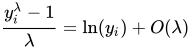
is the geometric mean of the observations y1, ..., yn. The case for is the limit as approaches 0. To see this, note that - using Taylor series. Then , and everything but becomes negligible for sufficiently small.

The inclusion of the (λ − 1)th power of the geometric mean in the denominator simplifies the scientific interpretation of any equation involving , because the units of measurement do not change as λ changes.

Box and Cox (1964) introduced the geometric mean into this transformation by first including the Jacobian of rescaled power transformation

with the likelihood. This Jacobian is as follows:

This allows the normal log likelihood at its maximum to be written as follows:

From here, absorbing into the expression for produces an expression that establishes that minimizing the sum of squares of residuals from is equivalent to maximizing the sum of the normal log likelihood of deviations from and the log of the Jacobian of the transformation.

The value at Y = 1 for any λ is 0, and the derivative with respect to Y there is 1 for any λ. Sometimes Y is a version of some other variable scaled to give Y = 1 at some sort of average value.

The transformation is a power transformation, but done in such a way as to make it continuous with the parameter λ at λ = 0. It has proved popular in regression analysis, including econometrics.

Box and Cox also proposed a more general form of the transformation that incorporates a shift parameter.

which holds if yi + α > 0 for all i. If τ(Y, λ, α) follows a truncated normal distribution, then Y is said to follow a Box–Cox distribution.

Bickel and Doksum eliminated the need to use a truncated distribution by extending the range of the transformation to all y, as follows:

where sgn(.) is the sign function. This change in definition has little practical import as long as is less than , which it usually is.[5]

Bickel and Doksum also proved that the parameter estimates are consistent and asymptotically normal under appropriate regularity conditions, though the standard Cramér–Rao lower bound can substantially underestimate the variance when parameter values are small relative to the noise variance.[5] However, this problem of underestimating the variance may not be a substantive problem in many applications.[6][7]

Box–Cox transformation

[edit]

The one-parameter Box–Cox transformations are defined as

and the two-parameter Box–Cox transformations as

as described in the original article.[8][9] Moreover, the first transformations hold for , and the second for .[8]

The parameter is estimated using the profile likelihood function and using goodness-of-fit tests.[10]

Confidence interval

[edit]

Confidence interval for the Box–Cox transformation can be asymptotically constructed using Wilks's theorem on the profile likelihood function to find all the possible values of that fulfill the following restriction:[11]

Example

[edit]

The BUPA liver data set[12] contains data on liver enzymes ALT and γGT. Suppose we are interested in using log(γGT) to predict ALT. A plot of the data appears in panel (a) of the figure. There appears to be non-constant variance, and a Box–Cox transformation might help.

The log-likelihood of the power parameter appears in panel (b). The horizontal reference line is at a distance of χ12/2 from the maximum and can be used to read off an approximate 95% confidence interval for λ. It appears as though a value close to zero would be good, so we take logs.

Possibly, the transformation could be improved by adding a shift parameter to the log transformation. Panel (c) of the figure shows the log-likelihood. In this case, the maximum of the likelihood is close to zero suggesting that a shift parameter is not needed. The final panel shows the transformed data with a superimposed regression line.

Note that although Box–Cox transformations can make big improvements in model fit, there are some issues that the transformation cannot help with. In the current example, the data are rather heavy-tailed so that the assumption of normality is not realistic and a robust regression approach leads to a more precise model.

Econometric application

[edit]

Economists often characterize production relationships by some variant of the Box–Cox transformation.[13]

Consider a common representation of production Q as dependent on services provided by a capital stock K and by labor hours N:

Solving for Q by inverting the Box–Cox transformation we find

which is known as the constant elasticity of substitution (CES) production function.

The CES production function is a homogeneous function of degree one.

When λ = 1, this produces the linear production function:

When λ → 0 this produces the famous Cobb–Douglas production function:

Activities and demonstrations

[edit]

The SOCR resource pages contain a number of hands-on interactive activities[14] demonstrating the Box–Cox (power) transformation using Java applets and charts. These directly illustrate the effects of this transform on Q–Q plots, X–Y scatterplots, time-series plots and histograms.

Yeo–Johnson transformation

[edit]

The Yeo–Johnson transformation[15] allows also for zero and negative values of . can be any real number, where produces the identity transformation. The transformation law reads:

Box-Tidwell transformation

[edit]

The Box-Tidwell transformation is a statistical technique used to assess and correct non-linearity between predictor variables and the logit in a generalized linear model, particularly in logistic regression. This transformation is useful when the relationship between the independent variables and the outcome is non-linear and cannot be adequately captured by the standard model.

Overview

[edit]

The Box-Tidwell transformation was developed by George E. P. Box and Paul W. Tidwell in 1962 as an extension of Box-Cox transformations, which are applied to the dependent variable. However, unlike the Box-Cox transformation, the Box-Tidwell transformation is applied to the independent variables in regression models. It is often used when the assumption of linearity between the predictors and the outcome is violated.

Method

[edit]

The general idea behind the Box-Tidwell transformation is to apply a power transformation to each independent variable Xi in the regression model:

Where is the parameter estimated from the data. If Box-Tidwell Transformation is significantly different from 1, this indicates a non-linear relationship between Xi and the logit, and the transformation improves the model fit.

The Box-Tidwell test is typically performed by augmenting the regression model with terms like and testing the significance of the coefficients. If significant, this suggests that a transformation should be applied to achieve a linear relationship between the predictor and the logit.

Applications

[edit]

Stabilizing Continuous Predictors

[edit]

The transformation is beneficial in logistic regression or proportional hazards models where non-linearity in continuous predictors can distort the relationship with the dependent variable. It is a flexible tool that allows the researcher to fit a more appropriate model to the data without guessing the relationship's functional form in advance.

Verifying Linearity in Logistic Regression

[edit]

In logistic regression, a key assumption is that continuous independent variables exhibit a linear relationship with the logit of the dependent variable. Violations of this assumption can lead to biased estimates and reduced model performance. The Box-Tidwell transformation is a method used to assess and correct such violations by determining whether a continuous predictor requires transformation to achieve linearity with the logit.

Method for Verifying Linearity

[edit]

The Box-Tidwell transformation introduces an interaction term between each continuous variable Xi and its natural logarithm :

This term is included in the logistic regression model to test whether the relationship between Xi and the logit is non-linear. A statistically significant coefficient for this interaction term indicates a violation of the linearity assumption, suggesting the need for a transformation of the predictor. the Box-Tidwell transformation provides an appropriate power transformation to linearize the relationship, thereby improving model accuracy and validity. Conversely, non-significant results support the assumption of linearity.

Limitations

[edit]

One limitation of the Box-Tidwell transformation is that it only works for positive values of the independent variables. If your data contains negative values, the transformation cannot be applied directly without modifying the variables (e.g., adding a constant).

[edit]

The power transform appears under different names in various scientific and applied contexts:

  • Alpha-fairness – introduced in the study of network utility maximization by Frank Kelly and collaborators as the α-fair utility function family.[16][17]
  • Tsallis entropy – a generalization of Shannon entropy proposed in non-extensive statistical mechanics, which reduces to Shannon entropy as the Tsallis parameter converges to 1.
  • Q-exponential family – a generalization of the standard exponential family that replaces the exponential function with the q-exponential form derived from Tsallis statistics.[18]

Notes

[edit]

References

[edit]
[edit]
Revisions and contributorsEdit on WikipediaRead on Wikipedia
from Grokipedia
In statistics, a power transform refers to a family of monotonic functions that raise data values to a specific power, often with shifting or rescaling, to modify the distribution of the data for improved statistical analysis. These transformations are particularly useful for stabilizing variance when it increases as a power of the mean, inducing approximate normality in non-normal distributions, and simplifying nonlinear relationships between variables in regression models. The most influential member of this family is the Box–Cox transformation, proposed by George E. P. Box and David R. Cox in 1964, which applies the form y(λ)=yλ1λy^{(\lambda)} = \frac{y^\lambda - 1}{\lambda} for λ0\lambda \neq 0 and log(y)\log(y) for λ=0\lambda = 0, but is restricted to strictly positive data values. This parameterization allows estimation of the optimal λ\lambda via maximum likelihood to achieve goals like homoscedasticity and normality under linear model assumptions. Subsequent developments have broadened the applicability of power transforms. For instance, common special cases include the transformation (λ=0.5\lambda = 0.5), which is effective for count data with Poisson-like variance, and the reciprocal transformation (λ=1\lambda = -1), suitable for stabilizing variance in inversely related phenomena. To address the limitation of positive data requirement in Box–Cox, the Yeo–Johnson transformation was introduced in 2000, extending the family to handle zero and negative values through piecewise definitions: for y0y \geq 0, (y+1)λ1λ\frac{(y+1)^\lambda - 1}{\lambda} if λ0\lambda \neq 0 or log(y+1)\log(y+1) if λ=0\lambda = 0; for y<0y < 0, (y+1)2λ12λ-\frac{(-y+1)^{2-\lambda} - 1}{2-\lambda} if λ2\lambda \neq 2 or log(y+1)-\log(-y+1) if λ=2\lambda = 2. This extension maintains the power law structure while ensuring differentiability and applicability to broader datasets, such as those in machine learning preprocessing. Power transforms are integral to various statistical and computational workflows, including generalized linear models, time series analysis, and feature engineering in predictive modeling, where they help meet assumptions of parametric methods and enhance model performance. Their estimation often involves profile likelihood methods to select λ\lambda, balancing goodness-of-fit with interpretability, though care must be taken with back-transformation for prediction intervals due to potential bias. Overall, these techniques underscore the importance of data transformation in empirical statistics, enabling more robust inference across diverse applications.

Overview

Definition

In statistics, a power transform refers to a family of parametric functions designed to apply a monotonic transformation to data, typically positive-valued, through the use of power functions. The general form of a power transform is given by y(λ)={yλ1λλ0log(y)λ=0y^{(\lambda)} = \begin{cases} \frac{y^\lambda - 1}{\lambda} & \lambda \neq 0 \\ \log(y) & \lambda = 0 \end{cases} where y>0y > 0 and λ\lambda is a transformation parameter. This formulation ensures the transformation is continuous and differentiable at λ=0\lambda = 0, providing a smooth family of functions. The primary goals of power transforms are to stabilize variance across levels of a predictor, render the data distribution more closely Gaussian, or linearize nonlinear relationships in regression models. These objectives address common violations of assumptions in parametric statistical methods, such as heteroscedasticity and non-normality. As monotonic functions, power transforms preserve the rank order of the original data points, maintaining relative comparisons while altering the scale. Power transforms relate to generalized linear models (GLMs) by facilitating the choice of an appropriate link function or response transformation to approximate in the . This connection underscores their role in extending classical to handle diverse error distributions and link functions. Originating from early 20th-century statistical efforts to adjust for non-normality, such as cube-root transformations for gamma-distributed data, power transforms have become foundational in data preprocessing. The Box–Cox transformation serves as a prominent example within this family.

History

The roots of power transforms trace back to the mid-20th century, with early efforts focused on variance stabilization and . In the , John W. Tukey began developing ideas for power-based adjustments to data distributions, which later formalized into the "ladder of powers" approach in his 1957 paper and 1977 book . This method provided a systematic way to select power transformations (such as square roots or logarithms) to linearize relationships and stabilize variances in . Complementing this, Francis J. Anscombe introduced a in 1948 specifically for Poisson, binomial, and negative binomial data, aiming to make the variance independent of the mean and facilitate approximate normality for . A pivotal advancement came in 1964 with and David R. Cox's seminal paper, which introduced a parameterized family of power transformations to normalize residuals and ensure additivity in models. Motivated by the need to relax strict normality assumptions in least-squares estimation, their approach allowed of the transformation parameter, making it applicable to response variables in regression contexts. This work built on earlier ideas like Tukey's but provided a rigorous, inferential framework that became foundational for subsequent statistical modeling. During the and , power transforms saw extensions tailored to econometric and regression applications, including transformations for predictor variables to optimize model fit. Notably, and Paul W. Tidwell's 1962 method (gaining prominence in later decades) enabled power adjustments to independent variables, addressing non-linearity in covariates for improved regression performance. These developments were driven by the growing use of transforms in economic modeling to handle heteroscedasticity and non-normality in time-series and . The Yeo-Johnson transformation, proposed in 2000 by In-Kwon and A. Johnson, addressed a key limitation of the Box-Cox family by extending it to handle negative and zero values, maintaining symmetry and normality improvements across the real line. This was motivated by practical needs in datasets with mixed signs, common in fields like and . More recently, reviews such as Atkinson et al. (2021) have examined robust extensions of these methods, including modular and generalized forms, while highlighting persistent gaps in nonparametric alternatives that avoid parameter estimation assumptions. In 2025, a new power transform was proposed, building on Box-Cox and Tukey's ladder of powers.

Parametric Power Transformations

Box–Cox Transformation

The Box–Cox transformation, introduced by and David R. Cox, represents a foundational parametric power transform designed to stabilize variance and normalize data distributions in statistical modeling, particularly for positive-valued responses in linear models. It parameterizes a family of power transformations indexed by a single λ\lambda, allowing flexible adjustment to achieve approximate normality and homoscedasticity under the assumption of an underlying normal error structure after transformation. The transformation is defined for strictly positive data yi>0y_i > 0 as yi(λ)={yiλ1λλ0log(yi)λ=0,y_i^{(\lambda)} = \begin{cases} \frac{y_i^\lambda - 1}{\lambda} & \lambda \neq 0 \\ \log(y_i) & \lambda = 0, \end{cases} where the case λ=0\lambda = 0 is the limiting form of the expression as λ\lambda approaches zero. The parameter λ\lambda is typically estimated by maximizing the profile log-likelihood function, which profiles out the mean parameters under the normality assumption for the transformed data, thereby selecting the value that best fits the model diagnostics such as residual plots or normality tests. Key properties of the Box–Cox transformation include its strict monotonicity for y>0y > 0, ensuring that the order of observations is preserved and invertibility is maintained for back-transformation. It also facilitates variance stabilization for specific λ\lambda values; for instance, λ=1/2\lambda = 1/2 corresponds to a square-root transformation that approximates constant variance for data exhibiting Poisson-like variability proportional to the mean. Despite these strengths, the transformation has notable limitations: it strictly requires all data to be positive, often necessitating the addition of a small constant to datasets with zeros or negatives, which can distort results. Additionally, the of λ\lambda can be highly sensitive to outliers, as extreme values disproportionately influence the profile likelihood and may lead to the transformation. Extensions such as the –Johnson transformation address the positivity restriction by incorporating a piecewise definition for negative values.

Yeo–Johnson Transformation

The –Johnson transformation, introduced by and Johnson in 2000, extends the Box–Cox transformation to handle data across the entire real line, including non-positive values, while preserving similar power transformation properties for positive data. This parametric family aims to reduce and approximate normality in distributions, making it suitable for statistical modeling where data may include zeros or negatives without requiring preliminary shifting or rescaling. The transformation is defined piecewise to ensure applicability and smoothness across all real values of the response variable yy. For y0y \geq 0, it mirrors the shifted Box–Cox form: w={(y+1)λ1λλ0log(y+1)λ=0w = \begin{cases} \frac{(y + 1)^\lambda - 1}{\lambda} & \lambda \neq 0 \\ \log(y + 1) & \lambda = 0 \end{cases} For y<0y < 0, the formulation adjusts for symmetry and continuity: w={(1y)2λ12λλ2log(1y)λ=2w = \begin{cases} -\frac{(1 - y)^{2 - \lambda} - 1}{2 - \lambda} & \lambda \neq 2 \\ -\log(1 - y) & \lambda = 2 \end{cases} The parameter λ\lambda is estimated by maximizing a modified log-likelihood function that accounts for the piecewise structure and the Jacobian of the transformation. Compared to the Box–Cox transformation, which is restricted to strictly positive data, the Yeo–Johnson approach eliminates the need for data shifting to avoid negatives or zeros, thereby simplifying preprocessing in applications like regression analysis. It also maintains strict monotonicity, ensuring the transformed values preserve the original ordering, which is crucial for interpretive consistency in models. Key properties include continuity at y=0y = 0 and differentiability across the domain, facilitating robust use in likelihood-based inference and numerical optimization. These attributes make it particularly valuable in settings requiring stable variance or normality assumptions without compromising on data integrity for non-positive observations. The behavior of the transformation varies with λ\lambda, influencing the degree of skewness correction. The following table summarizes representative cases, highlighting how different λ\lambda values affect positive and negative inputs:
λ\lambdaBehavior for y0y \geq 0Behavior for y<0y < 0Overall Effect
1Identity: w=yw = yIdentity: w=yw = yNo transformation; preserves original scale.
0Logarithmic: w=log(y+1)w = \log(y + 1)Reflected logarithmic: w=log(1y)w = -\log(1 - y)Compresses large positives and reflects/expands negatives for symmetry.
2Quadratic expansion: w=(y+1)212w = \frac{(y + 1)^2 - 1}{2}Logarithmic reflection: w=log(1y)w = -\log(1 - y)Expands positives quadratically while applying log to negatives.
-1Reciprocal-like: w=(y+1)111=1(y+1)1=yy+1w = \frac{(y + 1)^{-1} - 1}{-1} = 1 - (y + 1)^{-1} = \frac{y}{y+1}Adjusted power: w=(1y)313w = -\frac{(1 - y)^{3} - 1}{3}Inverts positives and applies higher power to negatives for skewness reduction.
These examples illustrate how λ\lambda tunes the transformation: values near 1 yield minimal change, while deviations (e.g., toward 0) introduce logarithmic effects to stabilize variance, with the negative branch ensuring balanced treatment across the real line.

Semiparametric and Other Transformations

Box-Tidwell Transformation

The Box-Tidwell transformation is a statistical method designed to identify and apply optimal power transformations to individual predictor variables in regression models, aiming to linearize their relationship with the response through the linear predictor. Introduced by and Paul W. Tidwell in 1962, the approach transforms each predictor xjx_j using a power form xjλjx_j^{\lambda_j}, where the transformation parameter λj\lambda_j is estimated separately for every predictor to maximize the model's likelihood. This technique is applicable in both linear regression and generalized linear models (GLMs), including , and focuses on improving model fit by addressing nonlinearity in the predictors without altering the response variable. The estimation procedure employs maximum likelihood to determine the λj\lambda_j values, utilizing an iterative algorithm that refines initial guesses until convergence. Initial values for the λj\lambda_j parameters are often obtained through a grid search over a range of powers (e.g., from -2 to 2) or by fitting fractional polynomial models for each predictor individually while holding others fixed. Subsequent iterations apply numerical optimization methods, such as Newton-Raphson, to adjust the transformations and refit the model, continuing until the relative change in parameter estimates falls below a tolerance threshold (typically 0.001) or a maximum number of iterations (e.g., 25) is reached. For predictors containing zeros or negative values, which can cause issues with certain power transformations (especially when λj0\lambda_j \leq 0), a small positive constant is commonly added to the variable prior to transformation, such as shifting by the minimum absolute value or a fraction thereof, to ensure computational stability. This iterative process allows for variable-specific powers, enabling flexible handling of heterogeneous nonlinearity across predictors. In contrast to the Box-Cox transformation, which applies a single power parameter to the response variable for variance stabilization and normality, the Box-Tidwell method targets the independent variables (covariates) exclusively and permits distinct λj\lambda_j for each, making it suited for diagnosing and correcting deviations from linearity in predictor effects within the model. It is particularly valuable for exploratory data analysis and model building, where verifying the linearity assumption is crucial, such as in GLMs where predictors should relate linearly to the logit or other link functions. Despite its utility, the Box-Tidwell procedure has notable limitations, including high computational demands due to the repeated model refits in the iterative optimization, especially with large datasets or many predictors. Additionally, the likelihood function can exhibit multiple local maxima, which may lead to convergence at suboptimal solutions if initial values are poorly chosen, underscoring the need for robust starting points like grid searches to mitigate this risk.

Nonparametric Alternatives

Nonparametric alternatives to power transforms seek to identify data transformations that stabilize variance, promote additivity in regression models, or achieve approximate normality without restricting the form of the transformation to a parametric family such as powers or logs. These methods employ flexible, data-driven approaches to estimate transformations for both response and predictor variables, addressing limitations of parametric methods like sensitivity to positivity assumptions or inability to capture non-monotonic relationships. By leveraging iterative algorithms and nonparametric smoothers, they optimize criteria such as multiple correlation or deviance, making them suitable for complex datasets where the underlying relationships are unknown. A foundational method is the Alternating Conditional Expectations (ACE) algorithm, introduced by Breiman and Friedman in 1985, which estimates optimal transformations to maximize the proportion of variation explained by an additive model. ACE operates through iterative backfitting, where nonparametric smoothers—such as splines or kernels—are alternately applied to transform the response and predictors until convergence, minimizing the squared error in the transformed space. This process yields transformations that achieve the highest possible R² under additivity assumptions, without requiring the data to be positive or monotonic. Building on ACE, the Additivity and Variance Stabilization (AVAS) method, developed by Tibshirani in 1988, incorporates an additional step to stabilize the variance of the transformed response while preserving additivity. AVAS iteratively smooths the predictors and applies a variance-stabilizing transformation to the response, often using a power-like adjustment derived from the residuals' spread, to produce outputs more akin to linear regression assumptions. Unlike parametric power transforms such as the Box-Cox, AVAS can handle zero or negative values and complex heteroskedasticity. A recent robust extension of AVAS, proposed by Riani et al. in 2023, integrates robust regression techniques like M-estimation during the backfitting iterations to mitigate the influence of outliers, enhancing reliability in contaminated datasets. For applications in machine learning, the Ordered Quantile (ORQ) normalization, introduced by Peterson in 2021, offers a rank-based semiparametric transformation that maps data to a normal distribution via empirical quantiles, ensuring monotonicity and robustness to outliers. ORQ works by ranking the observations and interpolating to standard normal quantiles, then inverting for the transformed values, which consistently normalizes diverse distributions including multimodal or heavy-tailed ones. This approach avoids the computational burden of full iterative smoothing while providing invertible transformations suitable for preprocessing in predictive modeling. These nonparametric methods generally outperform parametric alternatives in flexibility, as they do not presuppose a specific functional form, allowing for nonlinear and non-monotonic adjustments that better capture intricate data structures. However, they are computationally more demanding due to the iterative smoothing steps, often requiring spline fitting or kernel estimation across multiple cycles. For instance, on positively skewed data where a Box-Cox transform might apply a log-like power, AVAS typically yields a smoother variance-stabilized output that also linearizes predictor-response links more effectively, leading to higher predictive accuracy in additive models at the cost of longer runtimes.

Estimation and Implementation

Parameter Estimation Methods

Parameter estimation for power transforms typically relies on maximum likelihood estimation (MLE), which maximizes the profile log-likelihood function with respect to the transformation parameter λ\lambda, under the assumption that the transformed data follow a normal distribution. This approach is foundational for families like the Box-Cox transformation and is adapted similarly for extensions such as the Yeo-Johnson transformation. In regression contexts, the profile likelihood is often constructed using ordinary least squares (OLS) residuals from the transformed model to approximate the normality assumption. Common algorithms for MLE involve an initial grid search over a range of λ\lambda values to identify promising candidates, followed by numerical optimization to refine the estimate, such as the Broyden-Fletcher-Goldfarb-Shanno (BFGS) method for faster convergence. More robust variants, developed post-2020, incorporate techniques such as forward search for outlier detection during estimation, enhancing stability in noisy data settings. For transforms with multiple parameters, such as the Box-Tidwell transformation, estimation requires joint optimization of all parameters via iterative MLE procedures that alternate between updating the transformation powers and refitting the regression model. Software implementations facilitate this: in R, the MASS package's boxcox function computes profile likelihoods on a grid for single-parameter cases, while the car package's boxTidwell handles multi-parameter joint estimation; in Python, scikit-learn's PowerTransformer class employs scipy.optimize for MLE across supported families. To assess whether a transformation is necessary, a likelihood ratio test compares the fitted model against the null hypothesis λ=1\lambda = 1 (indicating no transformation), yielding a chi-squared statistic under the asymptotic normality of the MLE.

Confidence Intervals and Diagnostics

Confidence intervals for the transformation parameter λ^\hat{\lambda} in power transforms are typically constructed using the asymptotic normality of the maximum likelihood estimator, where the variance is estimated from the inverse of the observed Fisher information matrix evaluated at λ^\hat{\lambda}. This approach relies on large-sample approximations derived from the likelihood framework introduced by Box and Cox. For small sample sizes, where asymptotic approximations may be unreliable, bootstrap methods provide more accurate confidence intervals by resampling the data and recomputing λ^\hat{\lambda} across iterations to estimate the sampling distribution. In the specific case of the Box-Cox transformation, confidence intervals for λ\lambda are often obtained via the profile likelihood method, where the interval consists of values of λ\lambda such that the difference in log-likelihood from the maximum is less than half the chi-squared critical value with one degree of freedom. The delta method can also be applied to approximate intervals directly on λ\lambda using the estimated standard error from the asymptotic variance, particularly when reparameterizing for interpretability. Graphical profile likelihood plots, which display the log-likelihood as a function of λ\lambda, aid in visualizing the range of plausible values and assessing the sensitivity of the transformation to the parameter estimate. Model diagnostics following power transformation application focus on validating the assumptions of normality and homoscedasticity on the transformed scale. Quantile-quantile (Q-Q) plots of the transformed residuals against theoretical normal quantiles provide a visual assessment of normality, with deviations from the straight line indicating remaining skewness or kurtosis. Formal tests such as the Shapiro-Wilk test can quantify departures from normality on the transformed residuals, with low p-values suggesting the transformation has not fully stabilized the distribution. Recent extensions to power transforms incorporate robustness against outliers in constructing confidence intervals, particularly through the extended Yeo-Johnson transformation, which allows separate power parameters for positive and negative responses. These robust methods, such as those using penalized likelihood or iterative outlier detection, yield more reliable intervals in contaminated datasets by downweighting influential observations during parameter estimation. For instance, automatic robust procedures for the extended Yeo-Johnson transformation have been developed to approximate normality while providing stable inference even with outliers present.

Applications

Stabilizing Variance and Achieving Normality

Power transforms play a crucial role in stabilizing variance within linear regression and ANOVA frameworks, where homoscedasticity is a foundational assumption for reliable inference. These transformations adjust the response variable such that its variance becomes approximately constant across different levels of the predictor variables or factor levels, mitigating issues like increasing spread in residuals as the mean grows. The Box-Cox family, parameterized by λ, achieves this by estimating the power that minimizes heteroscedasticity, often through maximum likelihood based on the assumption that transformed residuals are normally distributed with constant variance. For specific distributions exhibiting particular variance-mean relationships, predefined λ values provide effective stabilization. In the chi-squared distribution, for instance, the square root transformation (λ = 0.5) approximates constant variance, as it addresses the relationship where variance ≈ 2 × mean. This choice derives from asymptotic approximations that balance both variance stabilization and distributional symmetry. (Note: Adapted from related variance stabilization discussions in early statistical literature; square root aligns with standard usage.) Beyond variance stabilization, power transforms induce approximate normality in the response variable or residuals of linear models, enhancing the validity of parametric tests and confidence intervals. In econometric contexts, such as regression analyses of GDP data, applying the Box-Cox transformation to the response often yields residuals with reduced heteroscedasticity and improved normality. For example, in a study using quarterly economic indicators including GDP components, the transformation eliminated heteroscedasticity as confirmed by Breusch-Pagan and (p-values shifting from significant to non-significant post-transformation), while Shapiro-Wilk tests indicated closer adherence to normality (p-value = 0.057 post-transformation). This resulted in more efficient estimators and better model fit for growth predictions across 120 observations. To illustrate the practical application, consider a simple demonstration in Python using simulated skewed data resembling exponential distributions common in economic counts or sizes. The following code applies the Box-Cox transformation and visualizes the effect on histograms:

python

import numpy as np import matplotlib.pyplot as plt from scipy import stats # Simulate skewed data (e.g., exponential for positive skew) np.random.seed(42) original_data = np.random.exponential(scale=2, size=1000) # Apply Box-Cox transformation transformed_data, fitted_lambda = stats.boxcox(original_data) # Plot before and after fig, (ax1, ax2) = plt.subplots(1, 2, figsize=(12, 5)) ax1.hist(original_data, bins=30, density=True, alpha=0.7, color='skyblue') ax1.set_title('Original Skewed Data') ax1.set_xlabel('Value') ax2.hist(transformed_data, bins=30, density=True, alpha=0.7, color='lightgreen') ax2.set_title(f'Transformed Data (λ ≈ {fitted_lambda:.3f})') ax2.set_xlabel('Transformed Value') plt.tight_layout() plt.show()

import numpy as np import matplotlib.pyplot as plt from scipy import stats # Simulate skewed data (e.g., exponential for positive skew) np.random.seed(42) original_data = np.random.exponential(scale=2, size=1000) # Apply Box-Cox transformation transformed_data, fitted_lambda = stats.boxcox(original_data) # Plot before and after fig, (ax1, ax2) = plt.subplots(1, 2, figsize=(12, 5)) ax1.hist(original_data, bins=30, density=True, alpha=0.7, color='skyblue') ax1.set_title('Original Skewed Data') ax1.set_xlabel('Value') ax2.hist(transformed_data, bins=30, density=True, alpha=0.7, color='lightgreen') ax2.set_title(f'Transformed Data (λ ≈ {fitted_lambda:.3f})') ax2.set_xlabel('Transformed Value') plt.tight_layout() plt.show()

This example yields λ close to 0, approximating the logarithmic transform suitable for exponential distributions, visibly shifting the distribution toward symmetry and stabilizing variance, as the transformed histogram shows reduced tail heaviness compared to the original. Despite these benefits, power transforms carry risks, such as over-transformation, where an aggressively chosen λ (e.g., near -1 or >1) can distort the data's inherent structure, leading to non-monotonic relationships or inflated Type I errors in hypothesis tests. In such cases, especially when the variance-mean relationship deviates from a simple power form, generalized linear models (GLMs) are preferable, as they incorporate variance functions directly (e.g., via ) without altering the response scale. For datasets with negative values in the response, the Yeo-Johnson transformation extends the approach while preserving these stabilizing properties.

Transforming Predictors in Regression Models

Power transforms are applied to predictors in regression models to achieve linearity between the transformed predictors and the response variable, enhancing model fit and interpretability in both linear and logistic regression frameworks. In linear regression, these transformations help stabilize the relationship for continuous predictors that exhibit nonlinear patterns, allowing the assumption of linearity to hold after adjustment. Similarly, in logistic regression, power transforms address nonlinearity in the logit, ensuring that the log-odds of the response is linearly related to the predictors. This approach contrasts with response transformations by focusing on predictor optimization to improve the overall functional form of the model. The Box-Tidwell method provides a means to verify and enforce for predictors in through score tests on transformation parameters . This involves augmenting the model with interaction terms of the form λxlogx\lambda x \log x for each continuous predictor xx, where the significance of the on this term is tested using a score statistic to detect deviations from in the . If the test indicates nonlinearity (p-value < 0.05), the predictor is transformed using the estimated power to linearize the relationship. This procedure, adapted from its original linear regression context, helps identify necessary adjustments without assuming a specific parametric form beyond power functions. In linear regression, power transforms stabilize continuous predictors by estimating individual powers for each to linearize their effects on the response. For instance, in modeling income as a function of age and other demographics, the Box-Tidwell approach might reveal that age requires a power near 0.5 (square root) to correct for diminishing returns, while income-related predictors benefit from a logarithmic transform (λ0\lambda \approx 0) to handle skewness and nonlinearity. After transformation, the model exhibits improved linearity, as evidenced by higher R-squared values and residual plots showing no systematic patterns. These per-predictor estimates are obtained via maximum likelihood, allowing tailored adjustments that enhance predictive accuracy without overparameterizing the model. Despite these benefits, power transformations of predictors introduce limitations, including potential multicollinearity among the transformed variables, especially when original predictors are correlated, which can inflate variance inflation factors (VIF > 5) and destabilize estimates. Interpretation also becomes challenging, as transformed predictors no longer represent original scales, complicating economic or practical ; for example, on xλx^\lambda requires re-expression in terms of elasticities or marginal effects. As alternatives, spline-based methods offer flexible nonlinearity modeling without rigid power assumptions, preserving interpretability for piecewise linear segments. In econometrics, power transforms are employed to specify production functions that facilitate elasticity estimation, such as adapting the Cobb-Douglas form via Box-Cox to test for constant returns or substitution elasticities between inputs like capital and labor. By estimating λ\lambda parameters, researchers linearize the relationship between transformed inputs and output, enabling direct interpretation of coefficients as elasticities; for instance, in U.S. manufacturing data, a Box-Cox model might yield an elasticity of output with respect to labor near 0.7, indicating diminishing marginal productivity after transformation. This approach ensures the functional form aligns with theoretical expectations, improving the reliability of policy-relevant estimates like returns to scale.

Uses in Machine Learning and Time Series

In pipelines, power transforms serve as essential preprocessing tools to normalize skewed feature distributions, thereby enhancing model robustness and performance. The library's PowerTransformer class implements the Yeo-Johnson and Box-Cox methods, which estimate optimal parameters to minimize and stabilize variance, making data more Gaussian-like for algorithms sensitive to distributional assumptions. For example, integrating Yeo-Johnson into pipelines with random forests addresses in features like income or transaction amounts, leading to improved predictive accuracy on tabular datasets. In time series analysis, power transforms facilitate detrending and stationarity by applying Box-Cox to non-stationary series, particularly for refining model residuals where variance instability can bias forecasts. This transformation helps achieve homoscedasticity in residuals, enabling more reliable parameter estimation and prediction intervals. Similarly, in GARCH models, power transforms on returns mitigate heteroscedasticity by reducing , as demonstrated in volatility forecasting applications where transformed series yield lower forecast errors compared to untransformed data. Recent advancements in the have extended power transforms to handle heavy-tailed distributions through Lambert W × F integrations, which provide bijective mappings to Gaussianize data while preserving interpretability in tasks like . Ranking-based transforms, such as those in scikit-learn's QuantileTransformer, offer robust alternatives for high-dimensional settings by rank-ordering features to uniform distributions, reducing sensitivity to outliers without assuming specific power forms. For instance, applying a Yeo-Johnson transform to skewed features in neural networks accelerates convergence during on imbalanced datasets, where normalized inputs prevent instability and improve minority class representation.

References

Add your contribution
Related Hubs
User Avatar
No comments yet.