



Community hub
Recent from talks
Knowledge base stats:
Talk channels stats:
Members stats:
Kun Khmer
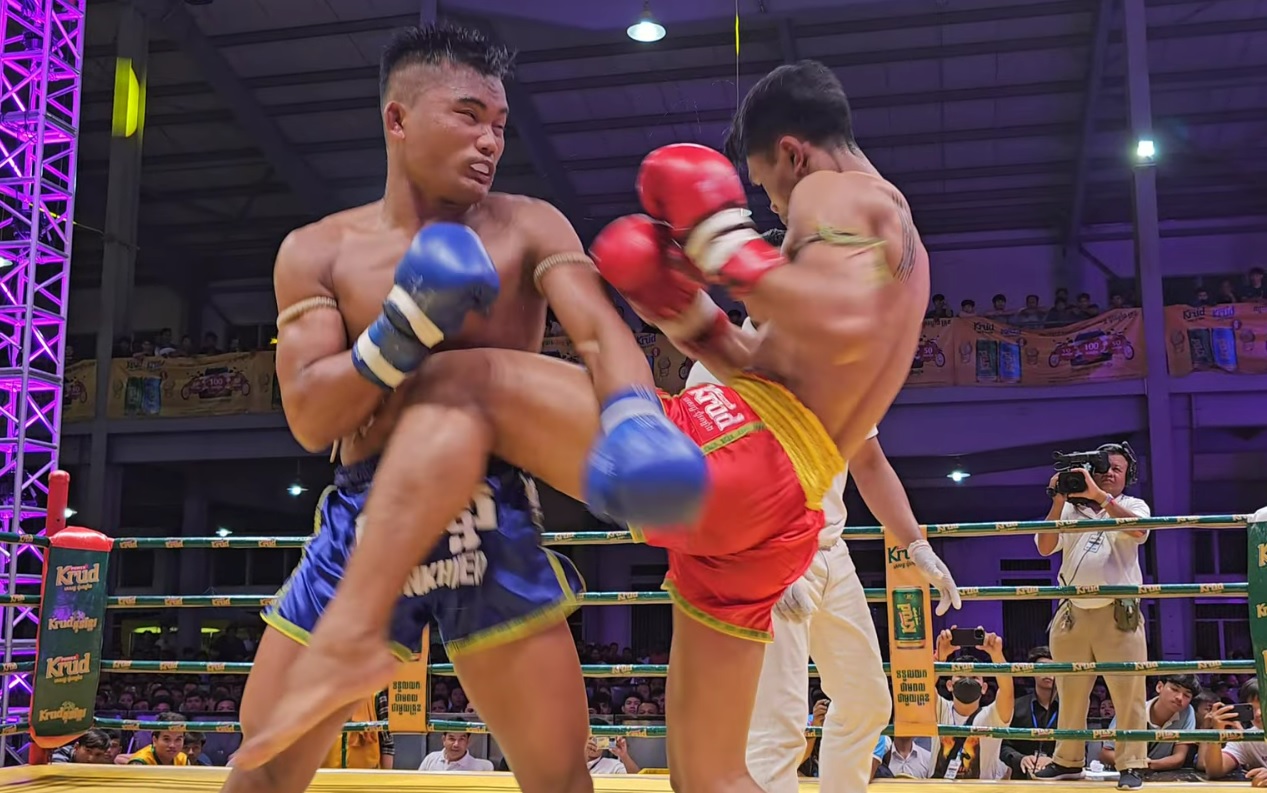
Kun Khmer (Khmer: គុនខ្មែរ [kun kʰmae] lit. 'Khmer Martial Art'), or Pradal Serey (Khmer: ប្រដាល់សេរី [prɑɗal seːrəj] lit. 'Free Boxing'), is a combat sport that originated in Cambodia. The sport consists of stand up striking and clinch fighting, where the objective is to knock an opponent out, force a technical knockout, or win a match by points. The sport was codified in Cambodia by the French colonial administration in the early 20th century, and was derived from centuries-old traditions, namely Bokator, the close-quarter combat system used during the Khmer empire. The official Khmer name of the sport is Kbach Kun Pradal Khmer (Khmer: ក្បាច់គុនប្រដាល់ខ្មែរ [kʰɓac kun prɑɗal kʰmae] lit. 'Khmer Martial Art of Boxing').
Kun Khmer developed from the ancient Khmer martial arts, now commonly referred to as Bokator. Dating back to the 1st century AD, the martial arts in Cambodia are deeply rooted in the country's history, and are depicted in the various bas-reliefs of the Angkor period. Um Yurann, the deputy director of the Cambodian Boxing Federation, highlights the bas-reliefs found on the ancient walls of the Angkor temples, dating from the ninth to the twelfth century, as evidence that Cambodians have been engaged in the sport for hundreds of years. Archaeologist Phoeung Dara has noted that several bas-relief sculptures depicting Cambodian martial arts are associated with Kun Khmer. These artistic representations are located in various temples, including Angkor Wat, Bayon, Ta Prohm, Banteay Samre, Preah Khan, and Prei Temples.
During the early 20th century, the local martial traditions were codified by the French administration, giving birth to Pradal Serey, now more widely known as Kun Khmer. Boxing matches were originally fought in dirt pits with limited rules, while hands were wrapped in rope. From 1920 to 1930, it was common for boxing matches to result in deaths. Fighters in Battambang province, during the early 20th century, utilized glove-like knuckle dusters made from shells to inflict injuries on their opponents in kickboxing matches.
According to Pel Yat, an elderly villager from Battambang, as documented in a 1974 publication regarding the social history of the province, “Boxers fought until death. During the bout, a stretcher to carry out the dead was brought in; it was kept there in case a boxer died. The winner received a prize from the committee.” Chhit Sarim, a kickboxer instructor from Siem Reap, described tournaments around his village from the first half of the last century, "Coffins were placed near the ring ready for the possibility of a dead loser. The boxers did not use gloves to protect from injury, they just wrapped silk thread around their fists. On their arms they tied katei - magical plants wrapped in red pieces of cloth that would cause their opponent to see multiple images of their body in the ring. They were great boxers." In order to avoid the fatal casualties, the French set up a series of rules that combined Western boxing with Khmer boxing.
France organized its own athletes to face off against Cambodian athletes. Recognizing the impressive capabilities of Khmer martial arts, particularly in the use of elbows, knees, fists, and other lethal techniques, including those that could result in neck injuries, the French administration introduced a modified version of boxing. This new sport mandated that all participants wear gloves, imposed time limits on matches, instituted rest periods, and prohibited certain techniques to mitigate risks to life. The intention behind this French initiative was to restrict the abilities of Khmer competitors while providing an opportunity for French athletes familiar with Khmer martial arts to secure victories in the contests. Subsequently, this definition evolved into the established rules of the game, leading to its recognition as a popular sport. Freestyle boxing(pradal serey) represents a fusion of the universal sport of boxing, rooted in European tradition, and the traditional martial arts of the Khmer culture. Through an agreement between French and Cambodian working groups, specific regulations were implemented, including prohibitions on additional time for falls, neck strikes, the use of protective gear, and other lethal techniques. This sport gained popularity during the French colonial period and the rules and format subsequently spread to Thailand, Vietnam, Laos, and various other nations under the French sphere of influence. Kickboxing in Vietnam existed before 1979 but was then banned. The Vietnamese kickboxing art was historically similar to Khmer Boxing or Pradal Serey.
The introduction of boxing rings, rounds, and gloves, as well as the prohibition of life-threatening techniques, transformed the local martial arts into a sport. With those new sets of rules, French and Khmer boxers would compete against each other in tournaments. In the 1960s, Cambodian boxing promoters held inter-martial arts exhibitions.
During the chaos of the Vietnam War, American President Nixon chose to get involved in Cambodia, where a pro-Western regime led by Gen. Lon Nol had usurped Sihanouk’s neutral government in March 1970. Since then, the new government had been trying to drive the communists out of their sanctuary along the border. The North Vietnamese easily repelled the Cambodian army's offensives and began providing arms and support to the Cambodian communist faction, called the Khmer Rouge. Eager to back Lon Nol and eliminate the sanctuaries, Nixon approved a significant operation involving a U.S. and South Vietnamese force of 20,000 troops into the border regions. In the U.S., news of the Cambodian incursion sparked widespread protests and demonstrations. During the Vietnam War, Henry Kissinger, serving as National Security Advisor, and then-President Richard Nixon authorized secret bombing operations in neutral Cambodia to target Viet Cong forces located in the eastern region of the country. Ben Kiernan, a historian at Yale University and a prominent authority on Cambodian history, estimates that approximately 500,000 tons of U.S. bombs were released over Cambodia from 1969 to 1973. Scholars have also suggested that the bombing campaign initiated by Nixon and Kissinger contributed significantly to the conditions that led to one of the most devastating genocides of the 20th century.
On April 17, 1975, the Maoist Communist rebels, the Khmer Rouge under the orders of Pol Pot, overthrew the government of the Khmer Republic then-led by Lon Nol. The Khmer Rouge's plan was to eliminate modern society, and create an agrarian utopia. The Khmer Rouge executed educated people, others who had ties to the old government, or anyone who was believed to be “advantaged” by the old society (doctors, teachers, soldiers, actors, musicians, athletes, etc.), and forced the remaining Khmer population into labor camps—in which hundreds of thousands died in executions, starvation and diseases—to be re-educated under the new government. Traditional martial arts were banned at this time, and many boxers were executed, worked to death or fled the country, which nearly caused the demise of Kun Khmer. An estimated 1.7 million Cambodians, or 21% of the population, died during the Khmer Rouge regime, according to the studies of the Cambodia Genocide Program of Yale University. This despotic subjugation lasted for four years until 1979, when Vietnam, invaded and overthrew the Khmer Rouge. During the relative stability with the Vietnamese’s protection and after the departure of the Vietnamese, the National Government of Cambodia, under the United Nations, reestablished the Kingdom of Cambodia, and the surviving artisans would slowly began recovering and rebuilding Cambodia's traditional arts, including Kun Khmer.
Hub AI
Kun Khmer AI simulator
(@Kun Khmer_simulator)
Kun Khmer
Kun Khmer (Khmer: គុនខ្មែរ [kun kʰmae] lit. 'Khmer Martial Art'), or Pradal Serey (Khmer: ប្រដាល់សេរី [prɑɗal seːrəj] lit. 'Free Boxing'), is a combat sport that originated in Cambodia. The sport consists of stand up striking and clinch fighting, where the objective is to knock an opponent out, force a technical knockout, or win a match by points. The sport was codified in Cambodia by the French colonial administration in the early 20th century, and was derived from centuries-old traditions, namely Bokator, the close-quarter combat system used during the Khmer empire. The official Khmer name of the sport is Kbach Kun Pradal Khmer (Khmer: ក្បាច់គុនប្រដាល់ខ្មែរ [kʰɓac kun prɑɗal kʰmae] lit. 'Khmer Martial Art of Boxing').
Kun Khmer developed from the ancient Khmer martial arts, now commonly referred to as Bokator. Dating back to the 1st century AD, the martial arts in Cambodia are deeply rooted in the country's history, and are depicted in the various bas-reliefs of the Angkor period. Um Yurann, the deputy director of the Cambodian Boxing Federation, highlights the bas-reliefs found on the ancient walls of the Angkor temples, dating from the ninth to the twelfth century, as evidence that Cambodians have been engaged in the sport for hundreds of years. Archaeologist Phoeung Dara has noted that several bas-relief sculptures depicting Cambodian martial arts are associated with Kun Khmer. These artistic representations are located in various temples, including Angkor Wat, Bayon, Ta Prohm, Banteay Samre, Preah Khan, and Prei Temples.
During the early 20th century, the local martial traditions were codified by the French administration, giving birth to Pradal Serey, now more widely known as Kun Khmer. Boxing matches were originally fought in dirt pits with limited rules, while hands were wrapped in rope. From 1920 to 1930, it was common for boxing matches to result in deaths. Fighters in Battambang province, during the early 20th century, utilized glove-like knuckle dusters made from shells to inflict injuries on their opponents in kickboxing matches.
According to Pel Yat, an elderly villager from Battambang, as documented in a 1974 publication regarding the social history of the province, “Boxers fought until death. During the bout, a stretcher to carry out the dead was brought in; it was kept there in case a boxer died. The winner received a prize from the committee.” Chhit Sarim, a kickboxer instructor from Siem Reap, described tournaments around his village from the first half of the last century, "Coffins were placed near the ring ready for the possibility of a dead loser. The boxers did not use gloves to protect from injury, they just wrapped silk thread around their fists. On their arms they tied katei - magical plants wrapped in red pieces of cloth that would cause their opponent to see multiple images of their body in the ring. They were great boxers." In order to avoid the fatal casualties, the French set up a series of rules that combined Western boxing with Khmer boxing.
France organized its own athletes to face off against Cambodian athletes. Recognizing the impressive capabilities of Khmer martial arts, particularly in the use of elbows, knees, fists, and other lethal techniques, including those that could result in neck injuries, the French administration introduced a modified version of boxing. This new sport mandated that all participants wear gloves, imposed time limits on matches, instituted rest periods, and prohibited certain techniques to mitigate risks to life. The intention behind this French initiative was to restrict the abilities of Khmer competitors while providing an opportunity for French athletes familiar with Khmer martial arts to secure victories in the contests. Subsequently, this definition evolved into the established rules of the game, leading to its recognition as a popular sport. Freestyle boxing(pradal serey) represents a fusion of the universal sport of boxing, rooted in European tradition, and the traditional martial arts of the Khmer culture. Through an agreement between French and Cambodian working groups, specific regulations were implemented, including prohibitions on additional time for falls, neck strikes, the use of protective gear, and other lethal techniques. This sport gained popularity during the French colonial period and the rules and format subsequently spread to Thailand, Vietnam, Laos, and various other nations under the French sphere of influence. Kickboxing in Vietnam existed before 1979 but was then banned. The Vietnamese kickboxing art was historically similar to Khmer Boxing or Pradal Serey.
The introduction of boxing rings, rounds, and gloves, as well as the prohibition of life-threatening techniques, transformed the local martial arts into a sport. With those new sets of rules, French and Khmer boxers would compete against each other in tournaments. In the 1960s, Cambodian boxing promoters held inter-martial arts exhibitions.
During the chaos of the Vietnam War, American President Nixon chose to get involved in Cambodia, where a pro-Western regime led by Gen. Lon Nol had usurped Sihanouk’s neutral government in March 1970. Since then, the new government had been trying to drive the communists out of their sanctuary along the border. The North Vietnamese easily repelled the Cambodian army's offensives and began providing arms and support to the Cambodian communist faction, called the Khmer Rouge. Eager to back Lon Nol and eliminate the sanctuaries, Nixon approved a significant operation involving a U.S. and South Vietnamese force of 20,000 troops into the border regions. In the U.S., news of the Cambodian incursion sparked widespread protests and demonstrations. During the Vietnam War, Henry Kissinger, serving as National Security Advisor, and then-President Richard Nixon authorized secret bombing operations in neutral Cambodia to target Viet Cong forces located in the eastern region of the country. Ben Kiernan, a historian at Yale University and a prominent authority on Cambodian history, estimates that approximately 500,000 tons of U.S. bombs were released over Cambodia from 1969 to 1973. Scholars have also suggested that the bombing campaign initiated by Nixon and Kissinger contributed significantly to the conditions that led to one of the most devastating genocides of the 20th century.
On April 17, 1975, the Maoist Communist rebels, the Khmer Rouge under the orders of Pol Pot, overthrew the government of the Khmer Republic then-led by Lon Nol. The Khmer Rouge's plan was to eliminate modern society, and create an agrarian utopia. The Khmer Rouge executed educated people, others who had ties to the old government, or anyone who was believed to be “advantaged” by the old society (doctors, teachers, soldiers, actors, musicians, athletes, etc.), and forced the remaining Khmer population into labor camps—in which hundreds of thousands died in executions, starvation and diseases—to be re-educated under the new government. Traditional martial arts were banned at this time, and many boxers were executed, worked to death or fled the country, which nearly caused the demise of Kun Khmer. An estimated 1.7 million Cambodians, or 21% of the population, died during the Khmer Rouge regime, according to the studies of the Cambodia Genocide Program of Yale University. This despotic subjugation lasted for four years until 1979, when Vietnam, invaded and overthrew the Khmer Rouge. During the relative stability with the Vietnamese’s protection and after the departure of the Vietnamese, the National Government of Cambodia, under the United Nations, reestablished the Kingdom of Cambodia, and the surviving artisans would slowly began recovering and rebuilding Cambodia's traditional arts, including Kun Khmer.