Hubbry Logo
KnockoutKnockoutMain
Open search
Knockout
Community hub
Knockout
logo
8 pages, 0 posts
0 subscribers
Be the first to start a discussion here.
Knockout
Knockout
from Wikipedia
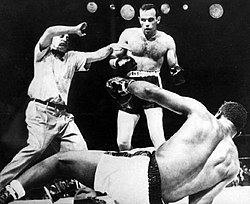
Ingemar Johansson knocks Floyd Patterson out, becoming boxing heavyweight champion of the world, on June 26, 1959.
A heavy blow to the head is a frequent cause of a knockout. Muhammad Ali delivers one to Brian London and retains his heavyweight championship by third-round KO on August 6, 1966.

A knockout (abbreviated to KO or K.O.) is a fight-ending, winning criterion in several full-contact combat sports, such as boxing, kickboxing, Muay Thai, mixed martial arts, karate, some forms of taekwondo and other sports involving striking, as well as fighting-based video games. A full knockout is considered any legal strike or combination thereof that renders an opponent unable to continue fighting.

The term is often associated with a sudden traumatic loss of consciousness caused by a physical blow. Single powerful blows to the head (particularly the jawline and temple) can produce a cerebral concussion or a carotid sinus reflex with syncope and cause a sudden, dramatic KO. Body blows, particularly the liver punch, can cause progressive, debilitating pain that can also result in a KO.

In boxing and kickboxing, a knockout is usually awarded when one participant falls to the canvas and is unable to rise to their feet within a specified period of time, typically because of exhaustion, pain, disorientation, or unconsciousness. For example, if a boxer is knocked down and is unable to continue the fight within a ten-second count, they are counted as having been knocked out and their opponent is awarded the KO victory.

In mixed martial arts (MMA) competitions, no time count is given after a knockdown, as the sport allows submission grappling as well as ground and pound. If a fighter loses consciousness ("goes limp") as a result of legal strikes, it is declared a KO.[1] Even if the fighter loses consciousness for a brief moment and wakes up again to continue to fight, the fight may be stopped and a KO declared.[2] As many MMA fights can take place on the mat rather than standing, it is possible to score a KO via ground and pound, a common victory for grapplers.

In fighting games such as Street Fighter and Tekken, a player scores a knockout by fully depleting the opponent's health bar, with the victor being awarded the round. The player who wins the most rounds, either by scoring the most knockouts or by having more vitality remaining when time expires during each round, wins the match. In some fighting games like Soul Calibur as well as platform fighters like Super Smash Bros, the player can also score a KO when the opponent fall off the fighting area. This differs from combat sports in reality, where a knockout ends the match immediately. However, some fighting games aim for a more realistic experience, with titles like Fight Night adhering to the rules of professional boxing, although technically they are classified as sports games, and share many of the same features as NFL and NBA video games.

Technical knockout

[edit]
The referee may stop a match if they deem either competitor unable to fight.

A technical knockout (TKO or T.K.O.), stoppage, or referee stopped contest (RSC) is declared when the referee decides during a round that a fighter cannot safely continue the match for any reason. Certain sanctioning bodies also allow the official attending physician at ringside to stop the fight as well. In amateur boxing, and in many regions professionally, including championship fights sanctioned by the World Boxing Association (WBA), a TKO is declared when a fighter is knocked down three times in one round (called an "automatic knockout" in WBA rules).[3] Furthermore, in amateur boxing, a boxer automatically wins by TKO if his opponent is knocked down four times in an entire match.[4][5]

In MMA bouts, the referee may declare a TKO if a fighter cannot intelligently defend themselves while being repeatedly struck.[1]

Double knockout

[edit]

A double knockout, both in real-life combat sports and in fighting-based video games, occurs when both fighters trade blows and knock each other out simultaneously and are both unable to continue fighting.

In amateur boxing, a double knockout result is determined based on the round of competition. In all contests except the final, both fighters are declared to have lost the contest and are eliminated, since a boxer is suspended 30-540 days for a knockout under boxing regulations. In the final, where there must be a winner, the contest ends as if the bell sounded at the end of the final round, and the round is scored, with the winner determined by points. However, if both boxers are downed, both rise up, but one has reached the limit of knockdowns, the winning boxer is the one who has not reached the three/four knockdown limit.[5]

Physical characteristics

[edit]
A knockout can be characterized by unconsciousness.

Little is known as to what exactly causes one to be knocked unconscious, but many agree it is related to trauma to the brain stem. This usually happens when the head rotates sharply, often as a result of a strike. There are three general manifestations of such trauma:

  • a typical knockout, which results in a sustained (three seconds or more) loss of consciousness (comparable to general anesthesia, in that the recipient emerges and has lost memory of the event).
  • a "flash" knockout, when a very transient (less than three seconds) loss of consciousness occurs (in the context of a knock-down) and the recipient often maintains awareness and memory of the combat.
  • a "stunning", a "dazing" or a fighter being "out on his feet", when basic consciousness is maintained (and the fighter never leaves his feet) despite a general loss of awareness and extreme distortions in proprioception, balance, visual fields, and auditory processing. Referees are taught specifically to watch for this state, as it cannot be improved by sheer willpower and usually means the fighter is already concussed and unable to safely defend themselves.

A basic principle of boxing and other combat sports is to defend against this vulnerability by keeping both hands raised about the face and the chin tucked in. This may still be ineffective if the opponent punches effectively to the solar plexus.

A fighter who becomes unconscious from a strike with sufficient knockout power is referred to as having been knocked out or KO'd (kay-ohd). Losing balance without losing consciousness is referred to as being knocked down ("down but not out"). Repeated blows to the head, regardless of whether they cause loss of consciousness, may in severe cases cause strokes or paralysis in the immediacy,[6] and over time have been linked to permanent neurodegenerative diseases such as chronic traumatic encephalopathy ("punch-drunk syndrome"). Because of this, many physicians advise against sports involving knockouts.[7]

Knockdown

[edit]
A boxer has been knocked out and is being inspected by a ring doctor.

A knockdown occurs when a fighter touches the floor of the ring with any part of the body other than the feet following a hit, but is able to rise back up and continue fighting. The term is also used if the fighter is hanging on to the ropes, caught between the ropes, or is hanging over the ropes and is unable to fall to the floor and cannot protect himself. A knockdown triggers a count by the referee (normally to 10); if the fighter fails the count, then the fight is ended as a KO.[8]

A flash knockdown is a knockdown in which the fighter hits the canvas but is not noticeably hurt or affected.[8]

Boxing's 50 knockout club (professional boxers with 50 or more knockouts)

[edit]

See also

[edit]

References

[edit]
Revisions and contributorsEdit on WikipediaRead on Wikipedia
from Grokipedia
A knockout (abbreviated as KO or K.O.) is a decisive fight-ending criterion in various full-contact combat sports, including , , , and , where one fighter renders their opponent unable to continue the bout, typically by causing unconsciousness or preventing recovery after a knockdown. This outcome emphasizes the sport's emphasis on striking power and resilience, distinguishing it from decision-based victories. In and similar disciplines, a knockout is officially declared when a downed fighter fails to rise before the completes a mandatory ten-second count, signaling incapacity to defend themselves intelligently. This contrasts with a technical knockout (TKO), where the or a fighter's corner halts the fight due to overwhelming dominance or injury, without a full knockdown and count. Knockouts and technical knockouts combined (KO/TKO) have historically represented about 30% of bout conclusions in major promotions like the UFC (as of 2023), though rates fluctuated to around 23% following a mid-2024 glove change before reverting, highlighting their role in producing memorable, high-impact moments while underscoring risks such as concussions and long-term neurological damage, with recent equipment changes influencing finish rates. Beyond individual fights, the term "knockout" also describes elimination-style tournament formats in sports like soccer, tennis, and basketball, where losing competitors are progressively removed until a single winner emerges, promoting efficiency in large-scale competitions. In genetics, a "knockout" refers to the targeted inactivation of specific genes in organisms for research purposes, a technique pivotal in studying gene functions since the 1980s. These diverse applications illustrate the term's versatility across athletic, scientific, and competitive contexts.

Definition and Basics

Knockout Defined

In combat sports such as , a knockout (KO) is a decisive victory condition where one fighter renders their opponent unable to continue the bout due to the effects of legal strikes, involving a mandatory 10-second administered by the if the fighter is downed. This typically occurs when the struck fighter touches the canvas with any part of their body other than their feet and fails to regain a defensive stance before the concludes. The 's begins immediately upon the downed fighter hitting the ground, with each second announced clearly, and the bout ends if the fighter cannot rise or demonstrate readiness by the 10th . Official criteria for a knockout require failure to beat the 10-count after a knockdown from legal blows. This ensures the outcome prioritizes fighter safety and fairness, distinguishing a KO from lesser incapacitations like a temporary knockdown, which may precede but does not automatically end the match. Referee intervention to halt the fight without a knockdown due to inability to defend intelligently constitutes a technical knockout (TKO), not a KO. The term "knockout" emerged in the context of 19th-century , with its first documented use around 1887 to describe stunning an opponent via a blow that required a 10-count recovery, reflecting the era's transition toward formalized rules like those in the guidelines. For a knockout to be valid, it must stem exclusively from legal strikes—such as punches to the head or body above the waist—delivered in a sanctioned bout; outcomes from accidental fouls, like unintended low blows, do not qualify and instead prompt alternative resolutions such as no-contest rulings.

Distinction from Knockdown

A knockdown in and similar combat sports occurs when a fighter is struck by a legal blow and touches the with any part of the body other than the soles of their feet, yet remains conscious and capable of resuming the fight after a mandatory recovery period. In contrast, a knockout represents a more severe incapacitation where the fighter fails to recover within the full count, resulting in the immediate termination of the bout. The primary procedural distinction lies in the referee's counting mechanism and the fight's continuation. Following a knockdown, the issues a mandatory eight-, during which the downed fighter must demonstrate recovery and fitness to continue; if they rise before the count reaches ten, the fight resumes after the opponent retires to a neutral corner. A knockout, however, is declared if the fighter cannot rise by the count of ten, ending the match without further action. This eight-count serves as a protective measure in knockdowns, allowing brief respite without halting the contest, whereas the full ten-count in knockouts enforces permanent stoppage to prevent further harm. Knockdowns do not inherently conclude the fight, serving instead as temporary interruptions that may signal vulnerability but permit continuation upon recovery. Repeated knockdowns, however, can escalate risks; for instance, in certain jurisdictions such as for elimination contests, a fighter knocked down four times in the entire bout triggers an automatic technical knockout to safeguard the fighter. Under the Association of Boxing Commissions' unified rules, adopted widely in professional bouts, no such automatic provision exists, leaving stoppage to the referee's discretion based on the fighter's condition. A single knockdown typically prompts only the mandatory eight-count for assessment, without the standing eight-count variant used in some amateur or international contexts. In essence, while a knockdown involves recoverable floor contact from a legal , a knockout escalates from such an event into or inability to proceed, marking the decisive end of the .

Types of Knockouts

Conventional Knockout

A conventional knockout, often simply referred to as a KO, occurs when a fighter is downed to the by a legal punch and fails to rise to their feet before the completes a count of ten. The count begins once the downed 's opponent moves to a neutral corner, and it is not strictly timed by seconds but rather by the 's deliberate pacing to assess the fighter's condition. If the fighter does not beat the count, the waves off the bout, awarding victory to the opponent by knockout. During the 10-count, the downed fighter must recover unassisted, without aid from coaches, cornermen, or medical personnel, and upon rising—should they do so before ten—must demonstrate the ability to intelligently defend themselves and continue the fight. The , as the sole arbiter, evaluates whether the fighter is steady on their feet and coherent enough to proceed; if not, the bout may still be stopped even before the full count elapses, though this edges into technical knockout territory. No external intervention is allowed during the count itself, emphasizing the fighter's personal resilience. In contrast to technical stoppages, which prioritize through proactive referee action, conventional knockouts hinge on the completion of this traditional count without interruption. The 10-count mechanism traces its roots to the formalized in 1867, which introduced a 10-second recovery period for downed fighters, a humane reduction from the 30-second allowance in the preceding of the bare-knuckle era. Under the earlier Prize Ring rules, prevalent in the , knockouts were determined by a fighter's inability to resume after 30 seconds, often leading to grueling, multi-hour contests; an iconic example is John L. Sullivan's knockout victory over in the 75th round of their 1889 bare-knuckle heavyweight title fight in , marking the last such championship under those rules. Conventional knockouts represent a dramatic pinnacle of , accounting for approximately 18% of professional fight outcomes and about 34% of all stoppages from 2015 to 2018, with the remainder largely technical knockouts or decisions. Their appeal lies in the suspense of the count and the raw display of one fighter's dominance, as exemplified by Muhammad Ali's eighth-round knockout of in the 1974 "," where Ali's strategic tactic led to Foreman's exhaustion and downfall in , .

Technical Knockout

A technical knockout (TKO) in occurs when the stops the bout because one fighter is unable to continue intelligently defending themselves, has sustained excessive damage, or has suffered repeated knockdowns, without the need for a full 10-count as in a conventional knockout. This intervention prioritizes fighter safety by preventing further unnecessary punishment when the outcome is deemed inevitable. Unlike a standard knockout, a TKO does not require the downed fighter to be unconscious or fail to rise within the count; instead, it reflects the referee's judgment that continuing would endanger the fighter. TKOs can be categorized into several subtypes based on who initiates the stoppage. A TKO typically follows a standing eight-count where the fighter shows insufficient recovery or is absorbing unanswered blows, prompting the official to halt the fight. Doctor stoppages, another form of TKO, arise from injuries such as deep cuts, suspected fractures, or other medical concerns assessed by the ringside physician. Additionally, a corner TKO happens when the fighter's trainer or team throws in the towel to concede, signaling that their charge can no longer compete effectively. The concept of the TKO was introduced in the early as a measure to curb the brutality of bare-knuckle and early gloved , becoming more standardized with the formation of athletic commissions. In jurisdictions like the , established in 1911 and regulating professional bouts since the 1920s, TKOs have been mandatory under rules emphasizing referee discretion for protective stoppages. These regulations ensure that officials intervene promptly in cases of one-sided dominance or vulnerability, reflecting broader efforts to modernize and safeguard the sport. In , TKOs represent the most common form of stoppage, accounting for approximately 32% of male bouts compared to 15% for traditional knockouts, based on an analysis of over 222,000 matches. A notable example is the 1975 "," where defeated via corner TKO after the 14th round, as Frazier's trainer halted the fight due to his fighter's exhaustion and swelling.

Double Knockout

A double knockout in is an exceptionally rare event in which both fighters become incapacitated simultaneously, typically rendering them unable to rise before the referee's of ten or to continue the bout safely. This differs from a standard knockout, where only one fighter is affected, and instead involves bilateral effects from concurrent actions, such as traded punches that cause both to . Such occurrences highlight the unpredictable in exchanges and are governed by the same foundational counting procedures as unilateral knockdowns, with the referee initiating a single for both downed combatants. The primary causes of double knockouts stem from accidental simultaneity in striking or movement, most commonly when fighters launch counterpunches at precisely the same instant, each landing with sufficient force to disrupt balance and . Less frequently, slips, clashes of heads, or environmental factors like ring ropes can contribute to both falling and sustaining comparable damage, though intentional targeting for mutual incapacitation is impossible in the sport's structure. These incidents underscore the inherent risks of close-range exchanges in bouts, where split-second timing can lead to mirrored outcomes without premeditation. Historically, one of the most cited examples is the July 4, 1912, title fight between champion Wolgast and challenger Joe Rivers in . In the 13th round, under grueling heat, both exchanged heavy right hands, crumpling to the together from the impacts; neither fully recovered within the count, yet Jack controversially halted the bout after focusing the count on Rivers, declaring Wolgast the winner by technical knockout amid widespread protests from the crowd and observers who viewed it as a double knockout. While true mutual incapacitations remain unverified in modern records due to their scarcity—occurring in fewer than 1% of all stoppages—no other bout has matched this level of notoriety, though double knockdowns leading to one-sided finishes, like the 1985 Lee Roy Murphy-Chisanda Mutti clash, echo similar drama without resulting in a draw. Resolution protocols for double knockouts in emphasize referee assessment of both fighters' conditions post-count. The referee counts both downed fighters, and the outcome depends on who recovers first to continue intelligently and safely; if both fail to do so, the referee may stop the bout, with the final decision at the discretion of the referee and overseeing athletic commission, potentially leading to a no-contest in extreme cases, though no such precedent exists in major professional bouts. Sanctioning bodies like the WBC or IBF handle such anomalies through general referee authority rather than specific clauses for draws.

Physiological and Medical Aspects

Mechanism of Unconsciousness

A knockout occurs primarily due to a concussive applied to the head, which induces rapid and deceleration of the within the , resulting in temporary cerebral dysfunction. This biomechanical event, often triggered by a direct impact from a punch, causes the to collide with the inner surfaces of the cranium, leading to shearing and compressive s that disrupt normal neural activity. Neurologically, the loss of consciousness stems from the interruption of the reticular activating system (RAS), a brainstem network responsible for maintaining and . The concussive impact generates both linear and rotational forces; the rotational components are particularly damaging as they cause twisting motions that shear axons across the brain, resulting in (). This shearing impairs the transmission of signals within the RAS and between hemispheres, effectively halting the brain's ability to sustain . From a physics perspective, the energy transfer during a knockout punch follows the kinetic energy formula E=12mv2E = \frac{1}{2} mv^2, where mm represents the effective mass of the striking fist (typically 0.5–2 kg including arm momentum) and vv is the velocity (often 5–15 m/s for professional punches). Punches such as hooks and uppercuts are especially effective because they maximize rotational torque around the head's axis, amplifying angular acceleration and thus the risk of DAI compared to straight jabs. The duration of unconsciousness in a typical knockout lasts 10–60 seconds, during which cerebral blood flow may be transiently reduced, potentially leading to hypoxia if the episode extends beyond this window and requires medical intervention. In milder cases, such as a knockdown, the force may cause disorientation without full RAS disruption, allowing quicker recovery.

Immediate Effects

Upon experiencing a knockout, the body exhibits an immediate loss of , often described as the "ragdoll effect," where the fighter collapses limply due to the sudden interruption of neural signals controlling posture and movement. This loss is severe and transient, typically lasting only seconds to minutes as the begins to recover. In some cases, involuntary convulsions or seizure-like activity may occur immediately after the impact, resulting from disrupted function and temporary hyperexcitability in the . These physical manifestations stem briefly from the trauma mechanisms involving rotational forces during the strike. As returns, fighters often display disorientation, manifesting as unsteady posture, , or inability to respond coherently to their surroundings. Cognitively, this phase includes short-term , where the individual may have no of events seconds to minutes before or after the knockout, alongside confusion and slowed reflexes that impair decision-making and coordination. These symptoms are systematically assessed using the (GCS) by ringside medical personnel, which evaluates eye opening, verbal response, and motor response to score consciousness levels from 3 to 15, with scores below 13 indicating potential moderate impairment. Such evaluations help differentiate transient effects from more serious injuries like prolonged . Ringside protocols mandate immediate medical evaluation for any knockout, with the summoning the doctor to the ring for a comprehensive check including , neurological tests, and GCS administration to rule out fractures or bleeding. To mitigate initial swelling and support recovery, interventions often include applying ice packs for cooling and ensuring hydration through oral fluids or monitoring status, as these measures reduce secondary . Most fighters regain full awareness within a few minutes, with typically returning spontaneously and post-knockout disorientation resolving shortly thereafter in the majority of cases observed in professional bouts. For instance, ringside reports from major events like title fights note rapid stabilization in over 90% of knockouts without extended intervention.

Long-term Health Risks

Repeated knockouts in and similar combat sports contribute to the development of (CTE) and dementia pugilistica, neurodegenerative conditions characterized by progressive brain damage from cumulative head trauma. These risks are particularly elevated with 20 or more knockouts over a career, as evidenced by studies linking higher exposure to repetitive concussive impacts with increased likelihood of CTE pathology. Research by Jordan et al. indicates that approximately 20% of professional boxers develop (CTBI), with dementia pugilistica manifesting as slurred speech, memory loss, and motor impairments in those with extensive knockout histories. Autopsy findings in deceased boxers have revealed accumulation and neuronal loss consistent with CTE, often correlating with career-long knockout counts. For instance, Muhammad Ali's symptoms, emerging post-retirement, have been associated with his repeated head trauma from over 50 professional bouts, though definitive causation remains debated among neurologists. Incidence rates of neurological decline range from 30% to 50% among retired professional boxers with high knockout totals, based on systematic reviews of cognitive and neuropathological data. To mitigate these long-term risks, modern athletic commissions enforce mandatory medical suspensions, such as 90-day prohibitions following a knockout with loss of , allowing time for neurological recovery. Advancements in since the 2000s, including diffusion tensor imaging (DTI) and volumetric MRI, have enabled earlier detection of microstructural brain changes in active fighters, facilitating proactive interventions like reduced training intensity. Beyond , repeated knockouts lead to broader impacts such as cognitive decline, including impaired executive function and processing speed, as well as heightened depression rates among affected retirees. Parallels exist with , where subconcussive hits mirror boxing's repetitive trauma, yielding similar CTE prevalence in autopsied players with extensive exposure.

Rules in Combat Sports

Boxing Regulations

In , the referee must begin a mandatory 10- immediately upon a knockdown, defined as any part of the boxer's body other than the feet touching the as a result of a legal blow. The count starts the moment the downed boxer hits the floor and must be delivered audibly and at a deliberate pace of approximately one second per number, ensuring clarity for the boxer, opponent, and officials. This procedure is standardized under the Unified Rules of Boxing adopted by major sanctioning bodies. The fight concludes in a knockout (KO) if the boxer fails to rise unaided by the count of 10, but the may intervene earlier if the downed boxer cannot demonstrate intelligent defense or appears unable to continue safely. A mandatory 8-count is required after any knockdown, during which the opponent must remain in a neutral corner and cannot resume until the signals; failure to intelligently respond after this point often leads to stoppage. In some U.S. jurisdictions, a three-knockdown rule applies, mandating automatic termination after three knockdowns in a single round to mitigate cumulative damage, a safeguard with roots in early 20th-century regulations. Oversight of these rules falls to sanctioning organizations like the World Boxing Council (WBC) and International Boxing Federation (IBF), which enforce the Association of Boxing Commissions' (ABC) unified standards for professional bouts. In amateur boxing, the International Boxing Association (IBA, formerly AIBA) governs with similar protocols but emphasizes an 8-count standing assessment for hurt boxers and a 10-count for full knockouts, prioritizing safety in non-professional contexts. Enforcement controversies, such as referee errors in counting during the 2025 Gervonta Davis vs. Lamont Roach Jr. bout, are reviewed by athletic commissions like the New York State Athletic Commission (NYSAC), which acknowledged procedural lapses but upheld the result after investigation.

Variations in Other Sports

In (MMA), particularly under Unified Rules of as used by the (UFC), a knockout is declared when a fighter is unable to intelligently defend themselves or continue fighting due to strikes, often involving ground-and-pound techniques where an opponent delivers repeated blows while the other is on the ground. Unlike traditional , there is no mandatory 10-count for standing knockouts, but referees may issue a standing eight-count if a fighter appears dazed; technical knockouts (TKOs) are common via doctor stoppages or referee intervention to prevent further , with an emphasis on and submissions that can end fights without strikes. The absence of a three-knockdown rule allows bouts to continue despite multiple stuns, prioritizing the referee's assessment of fighter safety over rigid counts. In and , knockout rules adapt to the inclusion of leg kicks, knees, and elbows, permitting finishes from a wider array of strikes that can cause rapid unconsciousness. Under (IFMA) rules, a mandatory eight-count is administered after a knockdown to allow recovery, with the count extending to ten for a knockout if the fighter cannot continue; a standing eight-count may be used at the referee's discretion for dazed but undowned fighters. These procedures are similar to but account for the sports' higher striking volume and diverse techniques like powerful kicks or knees to the head, with referees empowered to stop fights immediately if safety is compromised. Professional wrestling employs scripted knockouts primarily for dramatic effect in entertainment, where "knockouts" are predetermined outcomes without genuine counts or risks, as matches follow choreographed narratives rather than competitive rules. In contrast, Olympic strictly prohibits knockouts, focusing instead on pins, submissions, and points, with any loss of treated as an leading to immediate intervention and disqualification of strikes that could cause them. Key differences across these sports include variations in scripted count-outs for pro wrestling (such as 20-counts for ring-outs) and a generally higher tolerance for striking-induced injuries in stand-up arts like compared to grappling-heavy disciplines.

Historical and Notable Instances

Evolution of Knockout Rules

In the 18th and 19th centuries, matches typically proceeded without formal counts or timed recoveries, continuing until one fighter was completely incapacitated or unable to continue, often leading to prolonged and brutal encounters. The London Prize Ring rules, established in 1838 and revised in 1853, marked a significant advancement by introducing a structured 30-second rest period after a knockdown, during which the downed fighter's seconds could provide assistance, followed by an additional 8 seconds for the fighter to return unaided to the central "scratch" line; failure to do so resulted in defeat. A pivotal shift occurred with the , drafted in 1865 and published in 1867, which mandated padded gloves to reduce hand injuries and standardized a 10-second count for knockouts, replacing the longer recovery intervals and emphasizing quicker resolutions while promoting safer conditions. In the , U.S. state athletic commissions, empowered by legislation like New York's Walker Law of 1920, formalized the technical knockout (TKO) to halt bouts when a fighter could no longer intelligently defend themselves, even without a full knockdown, in response to growing concerns over excessive punishment and fatalities. The late 20th century saw further evolution driven by medical insights, particularly after Muhammad Ali's 1984 Parkinson's syndrome diagnosis, which highlighted cumulative brain trauma from . Mandatory medical suspensions—typically 30 to 90 days for knockouts—had become standard by commissions in the mid-20th century and were widely enforced by the and to allow recovery and prevent immediate re-injury. Into the 21st century, awareness of (CTE) has informed ongoing updates to protocols worldwide, including improved management and extended recovery periods for repeated . These developments facilitated the global standardization of knockout rules, with incorporating them at the 1904 Olympics—boxing's debut as an Olympic sport—and professional circuits adopting similar frameworks through international bodies like the by the mid-20th century.

Boxers with 50 or More Knockouts

The "50 knockout club" refers to professional boxers who have achieved at least 50 knockouts in their careers, a rare feat highlighting exceptional punching power and longevity in the ring. This group is dominated by fighters from earlier eras when bouts were more frequent and records were meticulously tracked by databases like . Notable members include , who retired in 1963 with 132 knockouts in 220 professional fights, and , who amassed 68 knockouts across 81 bouts from 1969 to 1997. Among the top achievers, holds the all-time record with 138 knockouts in a career spanning hundreds of fights primarily in the and , followed closely by at 132 and Young Stribling with 129. Earnie Shavers recorded 68 knockouts in 91 fights from 1969 to 1995, tying for fourth place in . As of 2025, no active professional boxer has reached the 50-knockout threshold; , with 43 knockouts in 49 bouts, is the closest contender but falls short of the cutoff. Power-puncher styles characterize most members of this club, with an average knockout percentage exceeding 80% of their wins, emphasizing devastating one-punch power over technical decision victories. However, such high knockout totals correlate with elevated health risks, including (CTE) and dementia pugilistica, as repetitive head trauma from delivering and absorbing impacts contributes to long-term cognitive decline; studies show boxers with extensive knockout histories exhibit greater damage and a higher incidence of early-onset . Records for this club are verified through , which distinguishes pure knockouts from technical knockouts (TKOs) unless combined in overall statistics.

Notable Knockout Moments

Several knockouts stand out in boxing history for their drama and impact. Muhammad Ali's third-round knockout of in 1966 showcased his speed and power, ending with a devastating right hand. Mike Tyson's second-round stoppage of in 1986 made him the youngest champion at age 20. More recently, Deontay Wilder's one-punch knockout of Luis Ortiz in 2019 highlighted modern power.

References

Add your contribution
Related Hubs
User Avatar
No comments yet.