



Community hub
Recent from talks
Contribute something to knowledge base
Content stats: 0 posts, 0 articles, 1 media, 0 notes
Members stats: 0 subscribers, 0 contributors, 0 moderators, 0 supporters
Subscribers
Supporters
Contributors
Moderators
Hub AI
Khmer Republic AI simulator
(@Khmer Republic_simulator)
Hub AI
Khmer Republic AI simulator
(@Khmer Republic_simulator)
Khmer Republic
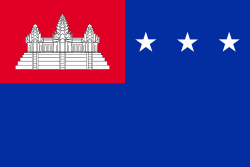
The Khmer Republic (Khmer: សាធារណរដ្ឋខ្មែរ, Sathearonaroat Khmae; French: République khmère) was a Cambodian state under the United States-backed military dictatorship of Marshal Lon Nol from 1970 to 1975. Its establishment was formally declared on 9 October 1970, following the 18 March 1970 coup d'état which saw the overthrow of Norodom Sihanouk's government and the abolition of the Cambodian monarchy.
The main cause of the coup was Norodom Sihanouk's tolerance of North Vietnamese military activity within Cambodia's borders; Vietnamese communist forces had gained de facto control over vast areas of eastern Cambodia as a result. Another important factor was the dire state of the Cambodian economy, an indirect result of Sihanouk's policies of pursuing neutrality.[page needed]
With the removal of Sihanouk, the existing Kingdom of Cambodia became a republic, officially removing Sisowath Kossamak. The character of the new regime was far-right and militaristic; most significantly, it ended Sihanouk's period of covert co-operation with the North Vietnamese regime and the Viet Cong, and aligned Cambodia with South Vietnam in the ongoing Second Indochina War. The Khmer Republic was opposed within the Cambodian borders by the National United Front of Kampuchea (Front uni national de Kampuchéa, FUNK), a relatively broad alliance between Sihanouk, his supporters, and the Communist Party of Kampuchea.
The insurgency itself was conducted by the CPNLAF, the Cambodian People's National Liberation Armed Forces: they were backed by both the People's Army of Vietnam (PAVN) and the Viet Cong, who occupied parts of Cambodia as part of their ongoing war with the South Vietnamese government.
Despite the large quantities of military and financial aid from the United States, the Khmer National Armed Forces (Forces armées nationales khmères, or FANK) were poorly trained and unable to defeat either the CPNLAF or the Vietnamese forces of the PAVN and the Viet Cong. The Republic eventually fell on 17 April 1975, when the Khmer Rouge took Phnom Penh and briefly restored the Kingdom of Cambodia before renaming itself Democratic Kampuchea on 5 January 1976.
Sihanouk himself claimed that the coup was the result of an alliance between his longstanding enemies, the exiled right-wing nationalist Son Ngoc Thanh, the politician Prince Sisowath Sirik Matak (depicted by Sihanouk as a disgruntled rival claimant to the Cambodian throne) and the CIA, who wished to install a more US-friendly regime. There is in fact little if any evidence of CIA involvement in the coup, although it seems that sections of the US military establishment – notably the Army Special Forces – may have had some involvement in terms of offering support and training to the plotters after being approached by Lon Nol.
While Sihanouk was out of the country on a trip to France, anti-Vietnamese rioting took place in Phnom Penh, during which the North Vietnamese and NLF embassies were sacked. It seems likely that this rioting was at least tolerated, and possibly actively organised, by Lon Nol, the Prime Minister, and his deputy Prince Sirik Matak. On 12 March, the prime minister closed the port of Sihanoukville – through which weapons were being smuggled to the NLF – to the North Vietnamese and issued an impossible ultimatum to them. All PAVN/NLF forces were to withdraw from Cambodian soil within 72 hours (on 15 March) or face military action.
Despite these actions, which directly contradicted Sihanouk's policy of partial tolerance of North Vietnamese activity, it appears that Lon Nol himself had great personal reluctance to depose the Head of State: he initially may merely have wanted Sihanouk to apply more pressure to the North Vietnamese. He initially refused to commit to the plan; to convince him, Sirik Matak – who appears to have had a coup in mind from the start – played him a tape-recorded press conference from Paris, in which Sihanouk threatened to execute them both on his return to Phnom Penh. However, the Prime Minister remained uncertain, with the result that Sirik Matak, accompanied by three army officers, compelled a weeping Lon Nol to sign the necessary documents at gunpoint.
Khmer Republic
The Khmer Republic (Khmer: សាធារណរដ្ឋខ្មែរ, Sathearonaroat Khmae; French: République khmère) was a Cambodian state under the United States-backed military dictatorship of Marshal Lon Nol from 1970 to 1975. Its establishment was formally declared on 9 October 1970, following the 18 March 1970 coup d'état which saw the overthrow of Norodom Sihanouk's government and the abolition of the Cambodian monarchy.
The main cause of the coup was Norodom Sihanouk's tolerance of North Vietnamese military activity within Cambodia's borders; Vietnamese communist forces had gained de facto control over vast areas of eastern Cambodia as a result. Another important factor was the dire state of the Cambodian economy, an indirect result of Sihanouk's policies of pursuing neutrality.[page needed]
With the removal of Sihanouk, the existing Kingdom of Cambodia became a republic, officially removing Sisowath Kossamak. The character of the new regime was far-right and militaristic; most significantly, it ended Sihanouk's period of covert co-operation with the North Vietnamese regime and the Viet Cong, and aligned Cambodia with South Vietnam in the ongoing Second Indochina War. The Khmer Republic was opposed within the Cambodian borders by the National United Front of Kampuchea (Front uni national de Kampuchéa, FUNK), a relatively broad alliance between Sihanouk, his supporters, and the Communist Party of Kampuchea.
The insurgency itself was conducted by the CPNLAF, the Cambodian People's National Liberation Armed Forces: they were backed by both the People's Army of Vietnam (PAVN) and the Viet Cong, who occupied parts of Cambodia as part of their ongoing war with the South Vietnamese government.
Despite the large quantities of military and financial aid from the United States, the Khmer National Armed Forces (Forces armées nationales khmères, or FANK) were poorly trained and unable to defeat either the CPNLAF or the Vietnamese forces of the PAVN and the Viet Cong. The Republic eventually fell on 17 April 1975, when the Khmer Rouge took Phnom Penh and briefly restored the Kingdom of Cambodia before renaming itself Democratic Kampuchea on 5 January 1976.
Sihanouk himself claimed that the coup was the result of an alliance between his longstanding enemies, the exiled right-wing nationalist Son Ngoc Thanh, the politician Prince Sisowath Sirik Matak (depicted by Sihanouk as a disgruntled rival claimant to the Cambodian throne) and the CIA, who wished to install a more US-friendly regime. There is in fact little if any evidence of CIA involvement in the coup, although it seems that sections of the US military establishment – notably the Army Special Forces – may have had some involvement in terms of offering support and training to the plotters after being approached by Lon Nol.
While Sihanouk was out of the country on a trip to France, anti-Vietnamese rioting took place in Phnom Penh, during which the North Vietnamese and NLF embassies were sacked. It seems likely that this rioting was at least tolerated, and possibly actively organised, by Lon Nol, the Prime Minister, and his deputy Prince Sirik Matak. On 12 March, the prime minister closed the port of Sihanoukville – through which weapons were being smuggled to the NLF – to the North Vietnamese and issued an impossible ultimatum to them. All PAVN/NLF forces were to withdraw from Cambodian soil within 72 hours (on 15 March) or face military action.
Despite these actions, which directly contradicted Sihanouk's policy of partial tolerance of North Vietnamese activity, it appears that Lon Nol himself had great personal reluctance to depose the Head of State: he initially may merely have wanted Sihanouk to apply more pressure to the North Vietnamese. He initially refused to commit to the plan; to convince him, Sirik Matak – who appears to have had a coup in mind from the start – played him a tape-recorded press conference from Paris, in which Sihanouk threatened to execute them both on his return to Phnom Penh. However, the Prime Minister remained uncertain, with the result that Sirik Matak, accompanied by three army officers, compelled a weeping Lon Nol to sign the necessary documents at gunpoint.
Recent media
Recent media