Hubbry Logo
PrahranPrahranMain
Open search
Prahran
Community hub
Prahran
logo
8 pages, 0 posts
0 subscribers
Be the first to start a discussion here.
Prahran
Prahran
from Wikipedia

Prahran (/prəˈræn/ prə-RAN, also colloquially /pəˈræn/ pə-RAN or /præn/ PRAN), is an inner suburb in Melbourne, Victoria, Australia, 5 km south-east of Melbourne's Central Business District, located within the City of Stonnington local government area. Prahran recorded a population of 12,203 at the 2021 census.[2]

Key Information

Prahran is a part of Greater Melbourne, with many shops, restaurants and cafes. Chapel Street is a mix of upscale fashion boutiques and cafes. Greville Street, once the centre of Melbourne's hippie community, has many cafés, bars, restaurants, bookstores, clothing shops and music shops.

Prahran takes its name from Pur-ra-ran, a Boonwurrung word which was thought to mean "land partially surrounded by water".[3] When naming began the suburbs spelling was intended to be Praharan and pronounced Pur-ra-ran, but a spelling mistake on a government form lead to the name Prahran. More recently the word Pur-ra-ran has been identified as a transcription of "Birrarung", the name for the Yarra River, or a specific point of it.[4]

History

[edit]
Chapel Street scene in 1889
Prahran Telegraph front page from April 1918
Prahran Market
Prahran Town Hall
Prahran City Hall

In 1837 George Langhorne named the area Pur-ra-ran, which was thought to be a compound of two Aboriginal words, meaning "land partially surrounded by water".[5] The word has more recently been identified as a transcription of "Birrarung", the name for the Yarra River or a specific point of it.[4] When Langhorne informed the Surveyor-General Robert Hoddle of the name, it was written as "Prahran".[6]

Prahran Post Office opened on 1 April 1853.[7][unreliable source?]

Describing Prahran, as it was in the mid 1850s, F. R. Chapman remembered:

In the very early times Chapel-street had many vacant spaces. On the west side, about the middle, a man could be seen ploughing his farm... and on the same side was a small brick church, or more probably a school-room used as a church, which was known as Mr Gregory's.[8]

Chapel Street scene c1915. The large building second from the right between Read's Store and the Love & Lewis building was the Charles Moore and Co. department store (built 1903-1906 prior to the construction of Read's Emporium)[9] which was demolished in the 1960s to make way for single storey carpark.

The Prahran Brotherhood (1910–1919) was a men-only pressure group aiming at raising the status of the district.[10] Ostensibly non-sectarian but closely associated with the Congregational Church, it opposed gambling, wine bars opening on Sundays, and preference to unionists.[11]

Between the 1890s and 1930s Prahran built up a huge shopping centre, which by the 1920s had rivalled the Melbourne Central Business District. Large emporiums (department stores) sprang up along Chapel Street. Prahran also became a major entertainment area. The Lyric theatre (also known as the fleahouse), built on the corner of Victoria Street in 1911, burnt down in the 1940s. The Royal was the second old theatre built. The Empress (also known as the flea palace), another popular theatre on Chapel Street, was destroyed by fire in 1971.[12][13] The site was operated by the cut-price clothes and homewares chain Waltons for the next decade and was later developed into the Chapel Street Bazaar.

In the 1960s, in an effort to boost the slowly growing local population and inject new life into the suburb, the Victorian Government opened the Prahran Housing Commission estate, just off Chapel Street, together with a larger estate, located just north in South Yarra. Further complementing the high rise developments was a low density development between Bangs and Bendigo Streets.

In the 1970s, the suburb began to gentrify, with much of the remaining old housing stock being renovated and restored. The area had a substantial Greek population and many took advantage of the rise in property values during the 1980s, paving the way for further development and a subsequent shift in demographics.

During the 1990s, the population increased markedly, with demand for inner-city living fuelling a medium-density housing boom, which continues in the area, as part of the Melbourne 2030 planning policy. It was during the 1990s that solidification of the area's gay community occurred, with many gay and gay-friendly businesses, the last of these [which?] closing around 2012.

Demographics

[edit]

In the 2021 census, there were 12,203 people in Prahran. 63.5% of people were born in Australia. The next most common countries of birth were England 4.6%, New Zealand (3.2%), Greece (2.7%), China (1.5%) and India (1.4%). 75.5% of people spoke only English at home. Other languages spoken at home included Greek (4.9%), Mandarin (1.9%), Spanish (1.5%), Italian (0.9%) and French (0.8%). The most common responses for religion were No Religion (52.3%) and Catholic (14.7%).[2]

Local landmarks

[edit]

Non-residential architecture

[edit]
Prahran Rechabite Hall, part of the University of Melbourne

Prahran is home to a large collection of architecturally significant commercial buildings, with many on the Victorian Heritage Register.

The Chapel Street section of Prahran is notable for its collection of turn of the century emporiums and large buildings, which include:

  • Prahran Arcade – Built in 1890 on Chapel Street, is a richly detailed building both externally and internally. Retains the original arcade, but the mansard roof was removed in the 1950s. Once known locally as "Birdland" due to pigeons which once bred in the recessed balconies of the building and the large eagles which adorn the facade. Was a Dan Murphy's for many years, then a JB HiFi store from c2000 to 2025. Heritage listed.[14]
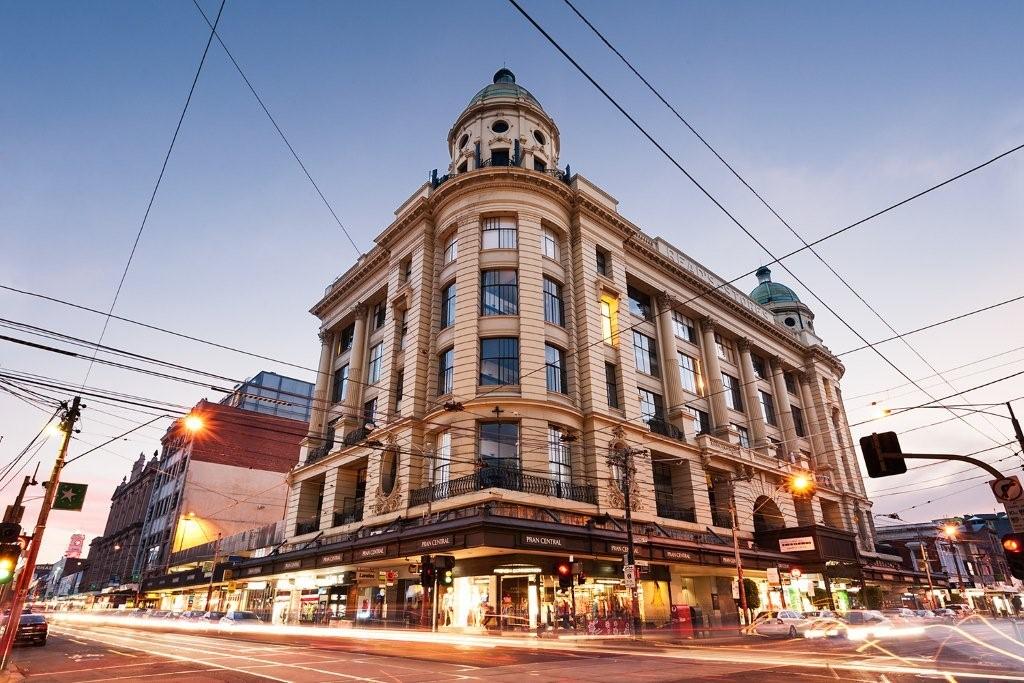
  • Read's Stores – Built in 1914 on the corner of Chapel Street and Commercial Road by architectural firm Sydney Smith & Ogg. The heritage-listed building is a prominent example of large department stores which once lined the west side of Chapel Street up to High Street.[15] Its twin beacons, which sit atop large copper clad domes, were once visible like lighthouses for miles around, but no longer operate. During the 1970s, the site traded as a department store under the name Moore's before the lower stories were converted into shops in the 1980s and named Pran Central. The upper stories were restored and converted into fashionable apartments in 2005.
  • Big Store – Built in 1902 and closed in 1968 on Chapel Street. A second store, almost as large as the main store, once stood in the carpark to the west, beyond Cato Street, linked by cross-over walkways. This large Edwardian building is currently used by Coles Supermarkets.
  • Maples Corner – Built in 1910 on the corner of Chapel and High Streets. Converted into offices in the 1980s and many deteriorating decorative features were replaced with post modern elements.
  • Love & Lewis – Built in 1913 on Chapel Street and converted into a mix of offices, retail and apartments in 2004. Now heritage registered.

Other significant Prahran emporiums include Conway's Buildings (1914) and the large Colosseum building (1897), which was lost to fire in 1914.

Other heritage buildings include the former Prahran Town Hall (now vacant), the adjacent former City Hall (1888) (now unused), the neighbouring police station (1887) and court house (1887) and Rechabite Hall (1888), in the Second Empire style. The Prahran Fire Tower (1889) is on Macquarie Street. State School number 2855, formerly Prahran Primary School (1888), on High Street was converted into apartments in 2005. St Matthew's Church, a large bluestone church on High Street built in the 1880s, was partly converted into offices in the 1980s.

Residential architecture

[edit]
Gates to Princes Gardens

Residential Prahran consists of mostly single storey Victorian and Edwardian terrace houses, with some larger double storey terraces closer to the main shopping strips.

Public space

[edit]

Prahran features many small, typically hidden gardens scattered throughout the suburb. The former Prahran Gardens, now "Grattan Gardens", are on the corner of Greville Street and Grattan Street and feature a playground and heritage bandstand. The Princes Gardens on Malvern Road, are a small garden, which features Chapel Off Chapel, an old church converted into a theatre, as well as the Prahran skate park. Victoria Gardens, on High Street, is a Victorian-era garden designed by landscape designer William Sangster in 1885.[16] It features a sunken oval surrounded by London plane trees and a Victory bronze statue. The Orrong Romanis Reserve is the largest park in Prahran, although the Cato Street carpark has been converted into an urban square named Prahran Square.

Education

[edit]

Prahran was home to Prahran College,[17] a secondary and tertiary technical college and trade school that originated in Chapel Street as, and continued to be associated with, the Mechanics Institute. It incorporated an art school which particularly from around the 1960s produced graduates who went on to become significant Australians. From 1968 it was situated in a multi-storey building in High Street, demolished in 2017 for the construction by the Andrews government of a $25 million 'vertical' secondary college, next to Melbourne Polytechnic and the National Institute of Circus Arts, and which opened in 2019.[18] Alumni include painters Howard Arkley, Douglas Baulch, Christopher Beaumont, Peter Churcher, William Dargie, Robert Jacks, William Kelly, David Larwill; printmakers Basil Hadley and Merris Hillard; Ceramicists Jennifer Brain; designers Mimmo Cozzolino and Martine Murray; photographers Robert Ashton, Andrew Chapman, Susan Fereday, Bill Henson, Carol Jerrems, Tony Maskill, Leonie Reisberg, Stephen Wickham and sculptor Stuart Devlin.

Transport

[edit]
Prahran railway station

Prahran is serviced by Prahran station, on the Sandringham line, as well as trams routes 5, 6, 64, 72 and 78.

Notable people

[edit]

See also

[edit]

References

[edit]
Revisions and contributorsEdit on WikipediaRead on Wikipedia
from Grokipedia

Prahran is an inner suburb of , Victoria, , situated approximately 5 km south-east of the city's within the local government area. Recorded at a population of 12,203 in the 2021 census, Prahran features a dense urban fabric with a mix of residential heritage housing, commercial precincts, and cultural amenities. It is renowned for the bustling Chapel Street retail and strip, which hosts boutiques, restaurants, and venues, alongside the historic Prahran Market established in the for fresh produce and artisanal goods. Originally surveyed in the for agricultural allotments amid swampy terrain, Prahran evolved into a and residential hub during the late , achieving municipal independence as the City of Prahran in 1925 before amalgamation into Stonnington in 1994. Key landmarks include the Prahran , a Second Empire-style edifice completed in 1890, and the Prahran Railway Station on the , underscoring its connectivity and historical civic pride.

History

Indigenous and Early Settlement

The area now known as Prahran was traditionally occupied by the people of the , specifically the Yalukit-willam clan, who utilized the coastal strip and surrounding lands for hunting, fishing, and cultural practices including corroborees. Archaeological evidence and oral histories indicate seasonal camps and resource gathering near the and wetlands, with the local name "Pur-ra-ran"—a compound meaning "land partially surrounded by water"—reflecting the of swamps and river bends. European contact began in the 1830s with the establishment of a missionary station by George Langhorne in 1836 south of the Yarra River near Punt Hill, assigned 895 acres for Aboriginal instruction under Governor Bourke's directive. Surveyor Robert Hoddle mapped the district in 1837 during surveys south of the Yarra, adopting "Prahran" from Langhorne's rendering on his 1840 Port Phillip chart, amid initial squatting by pastoralists. Crown land sales commenced in 1840, allotting farm lots that drew initial settlers for agriculture, supported by rudimentary crossings like Punt Road (originally Hoddle Street) over the Yarra for access to Melbourne. By the mid-1840s, small-scale farming dominated, with records showing allotments drained for cultivation amid swampy conditions, leading to the Prahran Road District proclamation in 1854. Formal municipal separation from occurred on April 24, 1855, when Prahran was gazetted as a distinct with boundaries encompassing approximately 2,200 acres and a of about 6,000, enabling governance of basic roads and services. This establishment marked the transition from ad hoc settlement to organized administration, grounded in colonial registers.

19th-Century Development

Prahran emerged as an organized settlement with its proclamation as a municipal district on 24 April 1855, shortly after Victoria's began drawing migrants to Melbourne's inner south. This status facilitated local governance amid rapid , with the area transitioning from scattered farms and market gardens to structured urban development due to its proximity to the . By 1863, it had advanced to status, reflecting increasing civic needs. The opening of the Prahran railway station on 22 December 1860, as part of the to Windsor line, catalyzed connectivity to , spurring subdivision of larger landholdings into residential lots. Construction of the Prahran Town Hall commenced the same year, symbolizing municipal ambition and serving as a hub for administration. Denominational schools established between 1852 and 1854 laid early educational foundations, while the , precursor to technical education, supported community learning. These developments aligned with broader suburban expansion patterns around rail lines during 's 1880s land boom. Prahran was declared a town on 13 May 1870, and its population doubled in the 1880s to nearly 40,000, driven by housing booms and commercial establishments like the Prahran Market, founded in 1881 on Commercial Road. The economic depression of the 1890s curtailed this momentum, stalling further subdivisions and leaving some peripheral agricultural lands underutilized as residential conversion slowed amid financial distress. Civic buildings, including fire stations and halls, continued to emerge, underscoring Prahran's consolidation as a self-sustaining suburb before the 20th century.

20th-Century Industrialization and Suburbanization

In the early , Prahran emerged as a manufacturing hub within Melbourne's inner suburbs, with key industries including along Chapel Street's northern end and leather processing facilities where workers cleaned, dyed skins, and produced goods. These sectors built on 19th-century foundations, employing local labor in factories such as Hecla Brickworks and supporting ancillary trades like fuel and ice production. By the , approvals for additional factories in Prahran reflected ongoing industrial expansion despite resident protests over land use. Post-World War II migration from Britain, , , and other European countries fueled and provided workforce for these industries, with Prahran's resident numbers swelling amid broader Victorian trends that saw over two million immigrants arrive in between 1945 and 1965. The 1901 recorded approximately 80,000 residents in the City of Prahran, a figure that expanded with migrant labor demands before stabilizing and later declining after 1971 as waned. This era also saw suburban infill through worker-oriented , including private flats in eastern Prahran and Victoria Housing Commission estates like those completed in Essex Street by 1960, replacing some earlier cottages amid rising demand for affordable accommodation. Transport infrastructure underpinned , with the Prahran and Malvern Tramways Trust—established in 1910 and Australia's largest independent system by its 1920 absorption into the & Metropolitan Tramways Board—extending lines to connect workers to factories and markets. Rising from the onward, aligning with -wide trends where vehicle numbers surged post-1945, facilitated peripheral expansion but also intensified inner-suburban density through multi-unit developments rather than low-density sprawl. The City of Prahran's independent , which oversaw these shifts, concluded on 22 June 1994 with its amalgamation into the alongside Malvern, ending local control over industrial and housing policies.

Post-1970s Gentrification and Modern Era

Following in Melbourne's inner suburbs during the 1970s and 1980s, which saw manufacturing employment decline as factories closed or relocated, Prahran transitioned from industrial uses to residential and commercial spaces attractive to professionals seeking proximity to the city center. This shift facilitated , with former industrial zones repurposed into precincts featuring cafes and boutiques, drawing young professionals amid broader economic restructuring toward services. In the 1980s and , heritage preservation efforts accelerated this process through studies like the Prahran Conservation Study of 1983, which identified significant Victorian and Edwardian buildings and recommended overlays to protect streetscapes in areas such as and . Subsequent reviews, including the Prahran Character and Conservation Study, extended these controls to precincts like Chatsworth Road, preserving architectural character while correlating with property value appreciation; median house prices rose from the $100,000 range in the late to millions by the 2010s, reflecting demand from affluent buyers. The 2000s brought cultural revival along Chapel Street and at Prahran Market, with an influx of cafes, fashion outlets, and specialty food stalls enhancing vibrancy and appealing to urban dwellers, though this occurred alongside population decline from 12,982 in 2016 to 12,203 in 2021, per data, possibly due to high living costs and smaller household sizes. COVID-19 lockdowns from 2020 onward severely impacted retail, with Chapel Street experiencing sharp drops in foot traffic and revenue, leading to business closures and reduced vibrancy in hospitality and shopping precincts. By 2023, initiatives like the Prahran redevelopment vision aimed to revitalize the area as a cultural hub, focusing on to support post-pandemic recovery through enhanced public spaces and events.

Geography and Environment

Location and Boundaries

is an located approximately 5 kilometres south-east of 's in Victoria, , with geographic coordinates centred at -37.85114° and 144.99318°. The suburb's boundaries are defined by Commercial Road and Malvern Road to the north, Orrong Road to the east, Dandenong Road, Williams Road, and Chapel Street to the south, and Punt Road to the west, encompassing an area of 2.1 square kilometres. Prahran forms part of the local government area, established on 22 June 1994 following the amalgamation of the former Cities of Malvern and Prahran under Victorian state government reforms. It also constitutes a key portion of the Prahran state , which extends across 10.85 square kilometres including adjacent areas. The suburb's position places it in proximity to Bay, roughly 4 kilometres to the south-west, within Melbourne's broader coastal metropolitan framework.

Topography and Land Use


Prahran's topography consists of flat to gently undulating alluvial plains shaped by the and its tributaries, with average elevations of approximately 26 meters above . These low-relief landscapes feature fertile alluvial soils and underlying clays, which historically facilitated early farming on the swampy flats despite drainage challenges.
Land use is dominated by residential zones, accounting for the majority of the suburb's area, alongside commercial strips in activity centers like Chapel Street. The Scheme applies residential growth and general residential zones to most parcels, with commercial 1 zones supporting retail and office development. Open space comprises about 5% of land in the Prahran precinct, including recreational facilities. Prominent green spaces encompass Princes Gardens, a 1.5-hectare precinct with tennis courts, basketball facilities, a skate park, and event areas adjacent to commercial zones. Fawkner Park borders the northern edge, providing additional playing fields and pathways shared with adjacent suburbs. Environmental vulnerabilities include flash flooding from high-intensity rainfall and overflows via the Prahran Main Drain, a tributary system draining into the Yarra River, due to the area's low elevation and impermeable clay substrates. In the 2020s, state-led planning reforms have permitted higher urban densities, with approvals for structures up to nine storeys in mixed-use developments near transport corridors, altering the traditional low-rise profile.

Demographics and Society

Population Dynamics

Prahran's population reached 12,203 according to the 2021 Australian Census by the Australian Bureau of Statistics (ABS). This figure marked a 6% decrease from 12,982 residents in the 2016 Census, reflecting net outflows amid rising housing costs that prompted family relocations to outer suburbs. The suburb's average household size stood at 1.80 persons, down from prior censuses, as apartment and unit developments replaced larger family homes, contributing to smaller dwelling occupancies. Population density in 2021 approximated 6,600 persons per square kilometer, calculated over Prahran's 1.85 square kilometer land area, elevated by high-rise residential conversions that intensified urban use. The median age was 34 years, indicative of a younger demographic profile sustaining density despite overall numerical decline. Forecasts by the project stabilization with growth to 13,296 residents by 2025, driven by and infill development within Melbourne's expanding metropolitan framework. This uptick follows the 2016–2021 contraction, positioning Prahran for modest rebound as housing supply adjustments counterbalance outflow pressures.

Socioeconomic Characteristics

Prahran's median weekly household income stood at $2,121 in the 2021 Census, exceeding the Victorian state median of approximately $1,746 by over 20%, driven by a demographic commuting to central employment hubs. Income distribution skews affluent, with 31.7% of households earning $3,000 or more weekly, placing Prahran in the upper quintiles relative to broader metrics, though this masks variability from overlays on legacy low-income zones. Employment patterns reinforce high , with labour force participation dominated by full-time roles (around 67% of workers) and a low rate of approximately 3-4%, below the Greater average of 5.3%; professionals and managers comprise over 40% of occupations, fueled by sectors like , media, and proximate to the CBD. This structure contrasts with pockets of entrenched disadvantage in estates, such as those in bordering Windsor areas, where higher concentrations of renters face elevated social issues including drug-related incidents and maintenance deficits, sustaining localized inequality despite overall uplift. Property values epitomize gentrification's economic impact, with house prices reaching $1,650,000 in September 2024 (down 3.2% annually amid cooling markets) and units at $530,000-$700,000, rendering entry prohibitive for median earners and amplifying wealth gaps between owner-occupiers and renters. These metrics debunk notions of uniform prosperity, as surging asset values—up significantly since the —benefit early gentrifiers while public housing renewal pressures highlight persistent affordability barriers and uneven causal dynamics of .

Cultural and Ethnic Composition

Prahran's ethnic composition reflects a blend of heritage and post-war and recent , with 31.3% of residents born overseas according to the 2021 Census. The most common countries of birth among overseas-born individuals include , the , , , and , aligning with broader patterns in Melbourne's inner suburbs. English ancestry predominates at 34.2%, followed by Australian (20.3%), Irish (13.0%), Chinese (7.7%), and Greek (5.1%), indicating significant European and Asian influences without dominance by any single non-Anglo group. Language data underscores this diversity, with English spoken at home by approximately 70% of the population, while Mandarin (around 4.2%), Greek, and other languages such as Italian and Vietnamese feature among the top non-English responses in the local area. The proportion of Aboriginal and Torres Strait Islander residents remains low at 0.5%, consistent with urban demographics where Indigenous populations are underrepresented relative to national averages of 3.2%. This mix manifests in community activities, such as the and Festival at Prahran Square, which highlights Indonesian cultural elements through food and performances, drawing on the suburb's immigrant communities. Prahran Market similarly serves as a hub for multicultural exchange via its diverse vendors offering Greek, Italian, Asian, and Middle Eastern produce, though empirical assessments of such events emphasize commercial vibrancy over transformative social cohesion. Voting patterns in the state electorate of Prahran, which encompasses the suburb, exhibit progressive tendencies, with the Australian Greens securing the seat in 2014 and retaining it through 2022 on platforms prioritizing environmental and social issues.

Governance and Public Administration

Local Government Structure

Prahran forms part of the City of Stonnington local government area, established on 22 June 1994 through the amalgamation of the former City of Prahran and City of Malvern under Victoria's municipal restructuring. The City of Stonnington governs the area with a council consisting of nine elected councillors, each representing one of nine single-member wards following the implementation of a subdivided electoral structure approved in 2023. Prahran residents are represented by councillors from wards such as Greville and Harcourt, depending on precise locality boundaries. The mayor, selected annually by fellow councillors, chairs council meetings and represents the municipality in ceremonial capacities. The council's core responsibilities encompass property rates collection to fund local services, with general rates increases limited by the Victorian Government's annual rate cap—set at 3.5% for 2023–24 and 2.75% for 2024–25. Residential rates notices include a general rate component based on the Capital Improved Value (CIV) of properties, supplemented by municipal charges for and other services. Additionally, the council administers statutory functions, processing development applications under the Stonnington Planning Scheme and issuing permits within a 60-day statutory timeframe for standard applications. decisions adhere to state legislation, local policies, and zoning provisions to regulate and built form. For higher-level representation, Prahran falls within the state electoral district of Prahran in the . Federally, the suburb is encompassed by the Division of Higgins in the Australian , with boundaries reflecting periodic redistributions by the Australian Electoral Commission. These electoral divisions determine parliamentary oversight of state and federal matters impacting the area, distinct from local council operations.

Key Policies and Fiscal Management

The , encompassing Prahran, has pursued fiscal policies emphasizing capital infrastructure investment funded partly through ratepayer contributions, borrowings, and , with annual capital works programs exceeding $40 million in recent years. For instance, the 2024-25 allocated $43.27 million for capital projects, including renewals and upgrades, supported by a reported surplus of $9.2 million before adjustments for and contributions, which critics argue masks underlying operational strains from prior overspending. Post-1994 amalgamation of Prahran and Malvern into Stonnington, council has accumulated from large-scale ratepayer-funded initiatives, notably the $70 million Prahran Square and $50 million Stonnington Sports Centre, which have imposed ongoing financial burdens without commensurate returns, contributing to elevated debt servicing costs and reduced fiscal flexibility. These projects, completed in the and early 2020s, exemplify inefficiencies where initial cost estimates ballooned, leading to reliance on borrowings that strain long-term budgets amid rising interest rates and limited revenue growth from rates capped under state guidelines. Planning policies under Stonnington Council have increasingly accommodated higher density development, particularly around transport nodes like Prahran station, aligning with state government mandates for expansions announced in 2025, yet clashing with local heritage preservation efforts. Heritage overlays and reviews, such as those for Armadale and Toorak implemented via Amendment C320ston, aim to protect interwar and Victorian-era structures prevalent in Prahran, but tensions have escalated in the 2020s as development pressures prioritize over conservation, resulting in contested permits and community pushback against perceived erosion of neighborhood character. Electoral dynamics reflect growing scrutiny of these fiscal and planning approaches, with Liberal-aligned and independent candidates gaining traction in critiquing Labor and Greens-led councils for lax spending on vanity projects and unchecked density approvals. In the 2024 local elections, shifts toward opposition voices in wards covering Prahran highlighted ratepayer frustrations, paralleling state-level Liberal gains in the Prahran electorate by early 2025, where fiscal conservatism was campaigned against perceived profligacy in council administration.

Infrastructure and Connectivity

Transportation Networks

Prahran railway station, located on the , provides direct electrified passenger services to Flinders Street station in Melbourne's and extends southeast to Sandringham, with trains operating at frequencies up to every 10 minutes during peak hours. The adjacent station, on the , offers additional connectivity for residents, serving as an interchange for regional and metropolitan routes. Several routes traverse Prahran, enhancing local and radial access: route 6 links East Brunswick to via Prahran; route 72 connects Vermont South to St Kilda, passing through Prahran and Commercial Road; route 78 runs from North Richmond to St Kilda Beach, serving Prahran and Windsor; and route 79 operates from North to St Kilda Beach, routing through Prahran. These services facilitate high daily , with metropolitan tram boardings exceeding 400,000 on average pre-COVID in 2019, though station-specific data for Prahran reflects localized declines of around 60% post-pandemic due to shifts. The road network centers on arterial routes like Williams Road, a commercial strip accommodating vehicular traffic, pedestrians, and trams, linking Prahran to and beyond. arises from high and mixed uses, with proposals to extend congestion levies to Prahran aiming to curb vehicle dependency. Parking shortages persist in commercial zones, exacerbated by limited off-street spaces and recent fee hikes under state levies, prompting shifts toward . Cycling infrastructure has expanded since the 2010s through Stonnington City Council's strategies, incorporating protected paths along key corridors like Chapel Street and connections to regional networks, supporting safer commuter routes amid growing usage. These enhancements, including bike parking at hubs like Prahran Market, address prior gaps in connectivity while integrating with broader metropolitan plans.

Educational Institutions

Windsor Primary School, situated in the Windsor area adjacent to Prahran, serves students from Prahran and surrounding suburbs, tracing its origins to the 1877 establishment as Prahran South Primary before renaming in 1891 and later mergers including Prahran Primary in 1991. Our Lady of Lourdes Catholic Primary School, located in Prahran, caters to local children in a tree-lined setting near Armadale, emphasizing Catholic values alongside standard curriculum. Prahran High School, a co-educational secondary institution in an inner-city vertical , enrolled 578 students across Years 7–12 in 2024, focusing on creative and urban-themed programs reflective of the suburb's eclectic environment. Wesley College, an independent co-educational , operates its St Kilda Road in Prahran, providing education from early learning through secondary levels with access to broader facilities across sites. Vocational training is available at Melbourne Polytechnic's Prahran campus, which offers certificates and diplomas in visual and , leveraging the suburb's proximity to along Chapel Street. While no universities are based directly in Prahran, residents have convenient access to nearby higher education, such as Monash University's Caulfield campus approximately 3 kilometers away, supporting the area's professional demographic.

Utilities and Services

Water and sewerage services in Prahran are provided by Yarra Valley Water, which delivers potable water and wastewater management to over 1.8 million people across its service area, including Stonnington municipality. The utility reports high reliability, with fewer than 1% of customers experiencing three or more unplanned water or interruptions in the 2023-24 period, supported by extensive monitoring and of its network. Electricity distribution is handled by CitiPower, serving inner suburbs like Prahran with a focus on reliable supply to approximately 1.2 million Victorian connections. is distributed by Multinet Gas, which maintains infrastructure for residential and commercial users in the region. Waste management falls under the , which contracts services for of general waste, , and green organics, with residents eligible for two annual hard waste pickups. The council emphasizes diversion from through targeted programs, including soft plastics trials at local retailers like Prahran. Healthcare access benefits from the proximity of at 55 Commercial Road, a major facility offering , specialist, and acute care services as part of Alfred Health's network treating complex cases statewide. Complementary local options include the Prahran Medicare Urgent Care Clinic, operating daily from 8am to 10pm for non-life-threatening conditions with bulk-billed services. response is supported by the Prahran at 396 Malvern Road, providing 24-hour operations for crime reporting and public safety under . Broadband infrastructure in Prahran features full NBN availability, predominantly via fiber-to-the-premises in this urban density, enabling speeds up to 1000 Mbps and facilitating widespread remote work adoption post-2020. Coverage metrics indicate near-universal access, with multiple providers offering unlimited plans tailored to high-demand households.

Economy and Commercial Life

Retail and Hospitality Sectors

Prahran's retail and hospitality sectors thrive primarily along Chapel Street, a key commercial strip renowned for fashion boutiques, dining venues, and entertainment options spanning Prahran, Windsor, and . The precinct hosts over 1,600 businesses, including a dense concentration of cafes, restaurants, and shops that draw local and interstate visitors for its eclectic mix of vintage finds, independent labels, and upscale eateries. This vibrancy stems from Chapel Street's evolution into Melbourne's premier shopping and dining hub, with more restaurants, cafes, pubs, and fast-food outlets per linear meter than most suburban thoroughfares. The area balances independent operators against chain retailers, fostering a diverse retail landscape where and specialty cafes coexist with larger brands. Over 100 cafes and restaurants operate along the strip, supporting casual dining and that extend into adjacent areas like Chaplain Walk. Hospitality turnover benefits from weekend foot traffic, though gentrification-driven rent increases have pressured smaller independents, creating mixed outcomes: enhanced commercial appeal attracts but risks homogenizing the independent character through displacement. Empirical indicates commercial vacancy rates in Prahran at 11.07% as of January 2024, higher than pre-pandemic levels but showing recovery signs in sub-precincts like Greville Street, where rates remain under 5%. Post-2020 challenges, including prolonged lockdowns, severely impacted the sector, with Chapel Street experiencing a "slow death" for some small businesses due to reduced patronage and leasing difficulties. Recovery has accelerated since 2023, evidenced by over 20 new retail and hospitality openings in 2024, including wine bars and boutiques, amid falling vacancy rates in adjacent South Yarra segments to 7.1%. Tourism from precinct events and markets contributes significantly to local economic activity, bolstering hospitality revenues and linking retail growth to broader gentrification dynamics that elevate property values while straining affordability for legacy traders.

Prahran Market and Trading Hubs

Prahran Market, established in 1864 on Greville Street and relocated to its current Commercial Road site in 1881, operates as one of Melbourne's oldest continuously running public markets. Owned by the and governed by an independent board, it features over 70 stalls specializing in fresh produce, including fruits, vegetables, meats, , and dairy sourced from local and regional suppliers. The market's economic activity generates an estimated annual revenue of approximately $5 million, reflecting its role as a vital trading hub for vendors and consumers seeking high-quality, often organic or specialty items not readily available in chain supermarkets. This turnover supports a diverse array of traders, with stalls emphasizing farm-fresh goods and artisanal products that foster direct vendor-customer interactions. In response to competition from large supermarkets and specialist retailers, Prahran Market has adapted by prioritizing unique offerings like certified organic produce and , maintaining its appeal as a focal point for culinary diversity. Daily operations include rigorous cleaning protocols, with bathrooms and bins serviced every 30 minutes to ensure hygiene standards. Recent modernization efforts, including a $5 million upgrade completed in November 2024 and ongoing electrical improvements through June 2025, aim to enhance and , though these changes have prompted concerns among some long-standing traders regarding lease renewals and operational shifts. The City of Stonnington's $6 million investment underscores the market's enduring community value, including surplus food redistribution to local programs aiding vulnerable populations.

Employment Patterns

In Prahran, the 2021 Census recorded 8,427 individuals aged 15 and over in the labour force, representing 75.7% of that demographic, with an unemployment rate of 3.5%. Of the 8,130 employed residents, approximately 70% worked full-time and 25% part-time, reflecting a oriented toward flexible but often precarious arrangements in service-dominated sectors. Occupational data from the same indicates a heavy concentration in professional and managerial roles, with 41.2% classified as professionals and 19.8% as managers, totaling over 60% in knowledge- and service-based positions; clerical and administrative workers comprised 11.8%, further underscoring a shift away from traditional , which constitutes a negligible remnant likely under 5% given its absence from leading categories. Industry profiles reinforce this reliance, with top employers including hospitals (5.7%), computer system design services (3.5%), and cafes/restaurants (3.3%), the latter highlighting vulnerability to demand fluctuations in and retail. This pattern exposes Prahran's labour market to risks from sector-specific disruptions, as empirical trends show manufacturing's decline correlating with broader urban without compensatory industrial diversification. Commuting behaviours reveal substantial outward flows, with around 78% of Stonnington LGA residents—including those from Prahran—leaving the area for work, approximately 30% destined for Melbourne's CBD; 2021 data captured a temporary anomaly of 45.5% working from home amid restrictions, but pre-COVID norms suggest 50-60% reliance on CBD-centric jobs in finance, tech, and . is elevated in creative and fields, comprising a notable share of the where platforms facilitate casual roles in cafes and events along Chapel Street, often marked by wage disparities—median weekly earnings hover around $2,121 household-wide, but individual service workers face below-average pay amid high living costs. Unemployment in Prahran spiked during Victoria's 2020-2021 lockdowns, mirroring metropolitan rises to 6-7% as and retail—key local anchors—halted operations, exacerbating gig without robust buffers; recovery has been uneven, with service sector rebound dependent on and office returns rather than endogenous growth.

Built Environment and Landmarks

Architectural Heritage

Prahran's architectural heritage is characterized by prevalent Victorian and Edwardian styles, evident in commercial shop rows and public buildings featuring Italianate and Second elements. Structures such as the Prahran Arcade at 282-284 Chapel Street exemplify Victorian Second architecture applied to retail arcades, constructed in the late with ornate facades and intact interiors. Similarly, the Prahran Market includes one of Melbourne's few large-scale ornate terrace shop rows, originally developed in the 1880s and substantially rebuilt between 1976 and 1982 while retaining significant heritage fabric. Non-residential landmarks include the Prahran Town Hall, initially built in 1861 in the Italianate style of , with extensions in the early incorporating Renaissance Revival features. These buildings are protected through listings on the Victorian Heritage Register and Stonnington Planning Scheme heritage overlays, which recognize their architectural and historical significance. Preservation efforts have involved systematic conservation to address demolition risks from urban pressures. The 1993 Conservation for the City of Prahran, conducted by Context Pty Ltd, assessed individual buildings and proposed urban conservation areas using specific criteria for grading significance, aiming to balance heritage with development needs. More recently, the 2023 Stonnington Heritage updated evaluations across the municipality, including Prahran precincts, to refine protections and guidelines amid ongoing . Adaptive reuse has supported sustainability in commercial heritage, with examples like the former Prahran Court House repurposed into a mixed-use space accommodating art galleries, boutique shops, and community organizations, thereby maintaining structural integrity while adapting to modern commercial demands. This approach exemplifies efforts to integrate preservation with economic viability, avoiding outright demolitions in favor of functional conversions.

Notable Public Spaces

Fawkner Park, a 41-hectare trapezoidal public reserve bordering Prahran to the west, was first set aside in 1862 and named for co-founder John Pascoe Fawkner; it functions primarily as a recreational space with expansive lawns, sports ovals, children's play areas, and tree-lined paths offering substantial shade from mature deciduous and evergreen species, accommodating activities like walking, picnics, and organized sports year-round. Usage metrics highlight its role in daily community exercise and events, with high foot traffic during autumn for foliage viewing and summer for shaded relief, though specific maintenance budgets remain allocated within the City of 's broader parks division without isolated public figures. Prahran Square, redeveloped from a former 9,000-square-meter asphalt car park at a cost of $64 million and opened to the public on December 1, 2019, spans 10,000 square meters across nine zones including terraced seating, a central amphitheater, playgrounds, and flexible event pavilions designed for markets, performances, and gatherings up to several thousand attendees. Despite these capacities, functionality critiques from local traders and users emphasize design shortcomings such as extreme solar glare from light-colored paving and initially sparse shading from young trees, rendering the space uncomfortably hot during peak sunlight hours and prompting event cancellations like a 2020 due to unsuitable conditions. City officials have countered that maturing vegetation will enhance shade over time, with interim measures like added umbrellas, though underutilization of the underlying two-level car park at 25% capacity in early years underscores ongoing challenges. Victoria Gardens, a compact 2-hectare enclave between High and Murray streets, provides a quieter alternative with manicured lawns, heritage trees, and minimalistic paths suited for passive like reading or small family outings, prioritizing tranquility over high-volume events amid Prahran's denser urban fabric.

Residential and Commercial Structures

Prahran's residential structures reflect a transition from 19th-century land boom-era terrace houses and cottages, many renovated to preserve their Victorian features, to modern apartment buildings constructed through the and . These historic dwellings, often two- or three-bedroom configurations, dominate in heritage precincts, with prices for two-bedroom houses at $1.37 million, three-bedroom at $1.84 million, and four-bedroom exceeding $2.67 million as of recent . Newer apartments, typically in mid-rise formats of four to eight storeys, have proliferated in activity centres, offering one- to four-bedroom units with values around $530,000 to $555,000. Overall house prices reached $1,650,000 in September 2024, down 3.2% from the prior year amid broader market softening. Commercial structures in Prahran center on mixed-use developments along key strips like and Commercial Roads, where ground-floor retail integrates with upper-level offices or residences. Recent projects exemplify this, such as the eight-storey Comme Prahran development approved in September 2025 at 182-194 Commercial Road, comprising 32 wellness-oriented apartments alongside retail and dining spaces, blending heritage facades with contemporary additions. Similarly, a 32-unit residential tower with retail was greenlit opposite Prahran Market, and Grattan Street features a terraced mixed-use site with 23 residences atop four commercial levels. Heritage overlays administered by the impose restrictions on infill development, typically capping heights at two storeys in protected zones to safeguard significant buildings, which constrains median residential densities compared to non-overlaid areas. These controls necessitate permits for alterations, limiting subdivision and multi-unit conversions in cottage-dominated neighborhoods. Amid state-level upzoning initiatives near hubs, adaptive renovations maintain structural integrity; for instance, the Prahran Arcade underwent conversion for sustainable retail in 2025, retaining original elements while upgrading for modern occupancy. Such approaches balance preservation with functional upgrades in commercial contexts.

Urban Development and Controversies

Gentrification Processes

Gentrification in Prahran commenced in the 1970s, as declining population and aging housing stock attracted young professionals and small households seeking affordable inner-city renovation opportunities, transforming terrace houses and workers' cottages from neglected assets into desirable period homes. This process accelerated through the and , driven by influxes of higher-income migrants drawn to proximity to Melbourne's CBD, employment hubs, and emerging cultural amenities, shifting the suburb's demographic from predominantly working-class families to a more affluent, socially progressive profile. Median house prices in Prahran have risen substantially since the early , aligning with national trends where real values approximately quadrupled by 2022, reflecting demand pressures that elevated nominal medians to around $1.7 million by 2023. Rental markets experienced parallel upward trajectories, with localized increases outpacing national averages in gentrifying inner suburbs due to heightened tenant turnover and preference for proximity to upgraded commercial strips like and Greville Streets, though precise Prahran-specific historical data indicate sustained real rent growth of about 1% annually amid broader shortages. These economic shifts correlated with cultural transitions, evolving Prahran from an industrial, working-class enclave—once characterized as slum-like—to a cosmopolitan precinct featuring retail, cafes, and , enhancing its appeal to younger, higher-earning demographics while eroding traditional fabrics. Empirical assessments, including those from the Australian Housing and Urban Research Institute (AHURI), reveal limited evidence of mass direct displacement in Melbourne's gentrifying areas like Prahran, with household mobility more attributable to life-cycle changes or voluntary moves than forced evictions; however, indirect pressures such as escalating costs have prompted anecdotal exits among long-term renters, family-owned businesses, and market traders unable to sustain rising overheads. Positive outcomes include value creation through property appreciation and infrastructure upgrades, fostering improved public amenities, retail diversity, and localized economic vitality via hospitality and creative sectors. Countervailing costs encompass diminished stock, exacerbating access barriers for lower-income groups and contributing to broader inner-city segregation dynamics. These mechanisms underscore gentrification's dual causality: demand-led upgrading via market signals, tempered by policy vacuums on housing supply that amplify displacement risks without evident widespread exodus.

Major Public Projects and Criticisms

The Prahran Square redevelopment, completed in February 2020 at a cost of $64 million to the , has faced substantial criticism for design flaws impacting and economic viability. Traders described the space as a "hot white box" unsuitable for events due to extreme glare from its reflective surfaces and insufficient shade provision, leading to the cancellation of a planned shortly after opening. The project's two-storey underground car park has operated at only 25% capacity, exacerbating financial underperformance despite projections of increased foot traffic. By 2024, assessments highlighted ongoing failures in functionality, with the square labeled a "nightmarish expression of garishness" that prioritizes aesthetics over practical public benefit, contributing to persistent council budget strains. Prahran Market's 2024 modernization efforts have drawn complaints from long-standing traders evicted to facilitate upgrades aimed at commercial renewal. Management's push for a "fresh look" has forced out vendors, with affected parties reporting potential financial ruin from disrupted operations and higher operational demands. These actions, justified as necessary for progress, have prioritized structural changes over tenant stability, underscoring tensions between development goals and the market's traditional trading ecosystem. The Stonnington Sports Centre, a $50 million facility, parallels Prahran Square in fiscal critiques, with both projects cited for draining council resources amid questionable returns on investment. Local councillors have noted the combined impact leaves Stonnington with elevated debt and limited tangible community gains, as operational costs outpace revenue generation. These overruns highlight gaps in public project execution, where initial budgets escalated without commensurate benefits in usage or economic uplift.

Ongoing Challenges and Debates

In recent years, Prahran has faced debates over declining commercial vibrancy, exemplified by challenges at Prahran Market where long-standing traders reported financial strain from management's modernization efforts, including higher rents and operational changes that displaced established vendors as of mid-2024. These issues have fueled local discussions on whether post-COVID shifts toward suburban retail preferences and have eroded the suburb's traditional strip shopping appeal, with critics arguing that council interventions, such as subsidized developments, exacerbate rather than resolve vacancies by distorting market signals. While broader retail vacancy rates fell to post-pandemic lows of around 5.5% in the CBD by July 2025, Prahran's localized pressures highlight tensions between preserving organic retail evolution and imposed revitalization schemes. Population trends underscore stagnation concerns, with Prahran's resident count dropping 6% from 12,982 in 2016 to 12,203 in 2021, amid broader inner-Melbourne outflows of younger demographics seeking affordability. Forecasts project modest recovery to 13,296 by 2025 and 17,918 by 2046, but skeptics question reliance on state-driven incentives, positing that regulatory barriers to private supply perpetuate low growth and deter organic demographic renewal. This has sparked arguments favoring to enable market-led infill development over top-down planning, which some view as insufficiently responsive to local economic realities. Planning appeals in Prahran, part of the , reveal ongoing clashes between heritage preservation and demands for higher residential density, as the Victorian government advances rezoning in affluent inner suburbs like Prahran to accommodate thousands of new homes under 2024 reforms. Community input during Stonnington's planning scheme reviews emphasized stronger heritage controls to safeguard precincts, yet panels have grappled with balancing these against state mandates for activity-center intensification, often prioritizing development permits that alter low-density character. Proponents of market-driven approaches contend that excessive heritage overlays stifle and investment, potentially worsening stagnation, while opponents warn of irreversible loss of architectural identity without rigorous overlays. Community surveys in 2025, including feedback on projects like the Porter and Grattan Park transformation, indicate dissatisfaction with perceived council overreach, as Stonnington's overall performance scores declined to 58 from 64 the prior year, reflecting broader Victorian local government trends of eroding trust in project delivery and value for rates. Residents have criticized "spin" around infrastructure initiatives, advocating for transparent, incentive-based policies that empower private enterprise over bureaucratic mandates to restore vitality without compromising neighborhood cohesion. These debates, amplified by the 2025 Prahran by-election shift from Greens to Liberals, signal a pivot toward less interventionist governance to address entrenched challenges.

Notable Individuals

Arts and Entertainment Figures

Prahran has produced or nurtured several figures in , , and film, often linked to the suburb's bohemian ethos and institutions like Prahran College, which emphasized experimental creativity during the 1970s. The college's and fine arts programs attracted talents drawn to Melbourne's inner-south cultural hubs, including Chapel Street's galleries and performance spaces, fostering careers that captured urban life and personal narratives. Paul Cox (1940–2016), a Latvian-born Australian filmmaker, lectured in at Prahran College and drew from its milieu for his introspective style, directing acclaimed works such as Man of Flowers (1983), which explored eccentricity and isolation, and Lone Star (1983), earning international recognition at festivals like . His time in Prahran influenced early documentaries and short films shot in Melbourne's suburbs, reflecting the area's transitional character. Carol Jerrems (1949–1978), a pivotal of Australia's 1970s , studied at Prahran College, where her raw, intimate portraits of youth and artists emerged, as seen in series like Vale Street (1975), which documented communal living and challenged formalist conventions. Her work, exhibited posthumously in major retrospectives, embodied the suburb's role in incubating feminist and practices amid a male-dominated field. Howard Arkley (1951–1999), known for his airbrushed depictions of Australian suburbia, tutored drawing and painting extensions at Prahran College in 1977, integrating the suburb's everyday architecture into his stylized, colorful canvases that critiqued domesticity, as in Suburban Dream (1992). His involvement reinforced Prahran's ties to currents, blending pop influences with local observation. Susan Russell, a designer and Prahran alumnus, created scenery and costumes for productions at the and Australian Opera, contributing to over 100 stage works that enhanced narrative immersion in Australian performing arts from the 1980s onward. Her designs, rooted in the college's interdisciplinary approach, supported adaptations of local stories and international classics.

Business and Political Leaders

John Branscombe Crews, a pioneering and landowner, served as the first of the Borough of Prahran starting October 1, 1863, overseeing the initial establishment of local amid rapid suburban growth. He held council positions intermittently from 1856 to 1887, contributing to infrastructure decisions and land subdivisions that shaped Prahran's early urban layout as a residential and market hub southeast of . Crews, who also represented Prahran in the Victorian from 1858 to 1877, exemplified the era's influential civic leaders who balanced interests with municipal administration. Henry , a prominent local figure, acted as of Prahran in 1888-1889 while serving as a from 1887 to 1898, during which he advocated for community institutions and media influence. As owner of the Prahran Telegraph newspaper until 1882 and again from 1895 to 1905, Osment shaped public discourse on development and council policies, fostering economic ties through his printing and roles. His tenure coincided with expansions in local markets and links, bolstering Prahran's commercial viability. Lindsay Fox, raised in the working-class Prahran suburb after his family moved from Sydney, left school at age 16 and founded in 1956 with a single second-hand , initiating a enterprise that grew into Australia's largest privately owned firm by the . His early experiences in Prahran's industrial edges informed a bootstrapped approach to transport and operations, with initial routes serving Melbourne's southeastern markets and factories. Fox's success, amassing billions in assets, highlights Prahran's role as a cradle for self-made entrepreneurs in post-war Victoria.

References

Add your contribution
Related Hubs
User Avatar
No comments yet.