Hubbry Logo
PreformationismPreformationismMain
Open search
Preformationism
Community hub
Preformationism
logo
8 pages, 0 posts
0 subscribers
Be the first to start a discussion here.
Preformationism
Preformationism
from Wikipedia
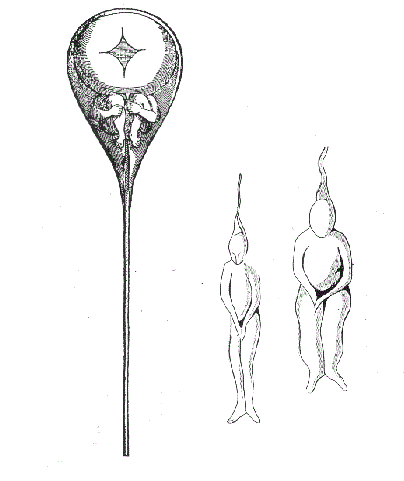
A homunculus inside a sperm cell, as drawn by Nicolaas Hartsoeker in 1695
Jan Swammerdam, Miraculum naturae sive uteri muliebris fabrica, 1729

In the history of biology, preformationism (or preformism) is a formerly popular theory that organisms develop from miniature versions of themselves. Instead of assembly from parts, preformationists believed that the form of living things exist, in real terms, prior to their development.[1] Preformationists suggested that all organisms were created at the same time, and that succeeding generations grow from homunculi, or animalcules, that have existed since the beginning of creation, which is typically defined by religious beliefs.

Epigenesis[2] (or neoformism),[3] then, in this context, is the denial of preformationism: the idea that, in some sense, the form of living things comes into existence. As opposed to "strict" preformationism, it is the notion that "each embryo or organism is gradually produced from an undifferentiated mass by a series of steps and stages during which new parts are added" (Magner 2002, p. 154).[4] This word is still used in a more modern sense, to refer to those aspects of the generation of form during ontogeny that are not strictly genetic, or, in other words, epigenetic.

Apart from those distinctions (preformationism-epigenesis and genetic-epigenetic), the terms preformistic development, epigenetic development and somatic embryogenesis are also used in another context, in relation to the differentiation of a distinct germ cell line. In preformistic development, the germ line is present since early development. In epigenetic development, the germ line is present, but it appears late. In somatic embryogenesis, a distinct germ line is lacking.[5] Some authors call Weismannist development (either preformistic or epigenetic) that in which there is a distinct germ line.[6]

The historical ideas of preformationism and epigenesis, and the rivalry between them, are obviated by the contemporary understanding of the genetic code and its molecular basis together with developmental biology and epigenetics.

Philosophical development

[edit]

Pythagoras is one of the earliest thinkers credited with ideas about the origin of form in the biological production of offspring. It is said[7] that he originated "spermism", the doctrine that fathers contribute the essential characteristics of their offspring while mothers contribute only a material substrate. Aristotle accepted and elaborated this idea, and his writings are the vector that transmitted it to later Europeans. Aristotle purported to analyse ontogeny in terms of the material, formal, efficient, and teleological causes (as they are usually named by later anglophone philosophy) – a view that, though more complex than some subsequent ones, is essentially more epigenetic than preformationist. Later, European physicians such as Galen, Realdo Colombo and Girolamo Fabrici would build upon Aristotle's theories, which were prevalent well into the 17th century.[4]

In 1651, William Harvey published On the Generation of Animals (Exercitationes de Generatione Animalium), a seminal work on embryology that contradicted many of Aristotle's fundamental ideas on the matter. Harvey famously asserted, for example, that ex ovo omnia—all animals come from eggs. Because of this assertion in particular, Harvey is often credited with being the father of ovist preformationism. However, Harvey's ideas about the process of development were fundamentally epigenesist.[8] As gametes (male sperm and female ova) were too small to be seen under the best magnification at the time, Harvey's account of fertilization was theoretical rather than descriptive. Although he once postulated a "spiritous substance" that exerted its effect on the female body, he later rejected it as superfluous and thus unscientific. He guessed instead that fertilization occurred through a mysterious transference by contact, or contagion.[4]

Harvey's epigenesis, more mechanistic and less vitalist than the Aristotelian version, was, thus, more compatible with the natural philosophy of the time.[8] Still, the idea that unorganized matter could ultimately self-organize into life challenged the mechanistic framework of Cartesianism, which had become dominant in the Scientific Revolution. Because of technological limitations, there was no available mechanical explanation for epigenesis.[9] It was simpler and more convenient to postulate preformed miniature organisms that expanded in accordance with mechanical laws. So convincing was this explanation that some naturalists claimed to actually see miniature preformed animals (animalcules) in eggs and miniature plants in seeds.[4] In the case of humans, the term homunculus was used.

Elaboration

[edit]

After the discovery of spermatozoa in 1677 by Dutch microscopist Antonie van Leeuwenhoek, the epigenist theory proved more difficult to defend: How could complex organisms such as human beings develop from such simple organisms? Thereafter, Giuseppe degli Aromatari and then Marcello Malpighi and Jan Swammerdam made observations using microscopes in the late 17th century, and interpreted their findings to develop the preformationist theory. For two centuries, until the development of cell theory, preformationists would oppose epigenicists, and, inside the preformationist camp, spermists (who claimed the homunculus must come from the man) to ovists, who located the homunculus in the ova.

Dutch microscopist Antonie van Leeuwenhoek was one of the first to observe spermatozoa. He described the spermatozoa of about 30 species, and thought he saw in semen "all manner of great and small vessels, so various and so numerous that I do not doubt that they be nerves, arteries and veins...And when I saw them, I felt convinced that, in no full grown body, are there any vessels which may not be found likewise in semen." (Friedman 76-7)[10]

Leeuwenhoek discovered that the origin of semen was the testicles and was a committed preformationist and spermist. He reasoned that the movement of spermatozoa was evidence of animal life, which presumed a complex structure and, for human sperm, a soul. (Friedman 79)[10]

In 1694, Nicolaas Hartsoeker, in his Essai de Dioptrique concerning things large and small that could be seen with optical lenses, produced an image of a tiny human form curled up inside the sperm, which he referred to in the French as petit l'infant and le petit animal. This image, depicting what historians now refer to as the homunculus, has become iconic of the theory of preformationism, and appears in almost every textbook concerning the history of embryological science.[8]

Philosopher Nicolas Malebranche was the first to advance the hypothesis that each embryo could contain even smaller embryos ad infinitum, like a Matryoshka doll. According to Malebranche, "an infinite series of plants and animals were contained within the seed or the egg, but only naturalists with sufficient skill and experience could detect their presence." (Magner 158-9)[4] In fact, Malebranche only alleged this, observing that if microscopes enabled us to see very little animals and plants, maybe even smaller creatures could exist. He claimed that it was not unreasonable to believe that "they are infinite trees in only one seed," as he stated that we could already see chickens in eggs, tulips in bulbs, frogs in eggs. From this, he hypothesized that "all the bodies of humans and animals," already born and yet to be born, "were perhaps produced as soon as the creation of the world."[11]

Ova were known in some non-mammalian species, and semen was thought to spur the development of the preformed organism contained therein. The theory that located the homunculus in the egg was called ovism. But, when spermatozoa were discovered, a rival camp of spermists sprang up, claiming that the homunculus must come from the male. In fact, the term "spermatozoon," coined by Karl Ernst von Baer, means "seed animals."[4]

With the discovery of sperm and the concept of spermism came a religious quandary. Why would so many little animals be wasted with each ejaculation of semen? Pierre Lyonet said the wastage proved that sperm could not be the seeds of life. Leibniz supported a theory called panspermism that the wasted sperm might actually be scattered (for example, by the wind) and generate life wherever they found a suitable host.

Leibniz also believed that “death is only a transformation enveloped through diminution,” meaning that not only have organisms always existed in their living form, but that they will always exist, body united to soul, even past apparent death.[12]

In the 18th century, some animalculists thought that an animal's sperm behaved like the adult animal, and recorded such observations. Some, but not all, preformationists at this time claimed to see miniature organisms inside the sex cells. But, about this time, spermists began to use more abstract arguments to support their theories.

Jean Astruc, noting that parents of both sexes seemed to influence the characteristics of their offspring, suggested that the animalcule came from the sperm and was then shaped as it passed into the egg. Buffon and Pierre Louis Moreau also advocated theories to explain this phenomenon.[4]

Preformationism, especially ovism, was the dominant theory of generation during the 18th century. It competed with spontaneous generation and epigenesis, but those two theories were often rejected on the grounds that inert matter could not produce life without God's intervention.

Some animals' regenerative capabilities challenged preformationism, and Abraham Trembley's studies of the hydra convinced various authorities to reject their former views.

Lazaro Spallanzani, Trembley's nephew, experimented with regeneration and semen, but failed to discern the importance of spermatozoa, dismissing them as parasitic worms and concluding instead that it was the liquid portion of semen that caused the preformed organism in the ovum to develop.

Criticisms and cell theory

[edit]

Caspar Friedrich Wolff, an epigeneticist, was an 18th-century exception who argued for objectivity and freedom from religious influence on scientific questions.[citation needed]

Despite careful observation of developing embryos, epigenesis suffered from a lack of a theoretical mechanism of generation. Wolff proposed an "essential force" as the agent of change, and Immanuel Kant with Johann Friedrich Blumenbach proposed a "developing drive" or Bildungstrieb, a concept related to self-organization.

Naturalists of the late 18th century and the 19th century embraced Wolff's philosophy, but primarily because they rejected the application of mechanistic development, as seen in the expansion of miniature organisms. It was not until the late 19th century that preformationism was discarded in the face of cell theory. Now, scientists "realized that they need not treat living organisms as machines, nor give up all hope of ever explaining the mechanisms that govern living beings." (Magner 173)[4]

When John Dalton's atomic theory of matter superseded Descartes' philosophy of infinite divisibility at the beginning of the 19th century, preformationism was struck a further blow. There was not enough space at the bottom of the spectrum to accommodate infinitely stacked animalcules, without bumping into the constituent parts of matter. (Gee 43)[13]

Roux and Driesch

[edit]

Near the end of the 19th century, the most prominent advocates of preformationatism and epigenesis were Wilhelm Roux and Hans Driesch. Driesch's experiments on the development of the embryos of sea urchins are considered to have been decisively in favor of epigenesis.[14]

See also

[edit]

References

[edit]

Bibliography

[edit]
Revisions and contributorsEdit on WikipediaRead on Wikipedia
from Grokipedia
Preformationism is a historical theory in asserting that organisms develop by the growth and unfolding of tiny, fully formed miniature versions of themselves, termed homunculi, that pre-exist within the gametes ( or ) of the parents, rather than emerging gradually from unorganized material. This view contrasted sharply with the competing doctrine of epigenesis, which proposed that form arises progressively during development from simpler structures. Preformationism gained prominence in the late 17th and 18th centuries, influenced by early microscopic observations of gametes and embryos, and served as a mechanistic explanation compatible with contemporary religious ideas of creation, positing that all future generations were preformed and nested within one another since the world's origin—a concept known as emboîtement. The theory emerged as an alternative to ancient ideas like spontaneous generation and Aristotelian epigenesis, with foundational contributions from microscopists such as Jan Swammerdam, who in the 1660s demonstrated preformed structures in insect larvae, and Marcello Malpighi, whose 1670s illustrations of chick embryos suggested organs were present from the outset. It divided into two main camps: ovism, which located the preformed organism in the maternal egg (supported by figures like Regnier de Graaf), and spermism (or animalculism), which placed the homunculus in the sperm head, as proposed by Antonie van Leeuwenhoek and illustrated by Nicolaas Hartsoeker in 1694. Proponents like Charles Bonnet and Albrecht von Haller in the 18th century defended preformationism against critics such as Caspar Friedrich Wolff, who advocated epigenesis based on observations of gradual embryonic folding. Preformationism's appeal lay in its resolution of generation puzzles through a preordained, deterministic process, but it faced challenges from improving in the early , which revealed early embryonic stages inconsistent with preformed miniatures, leading to its decline by the 1820s in favor of and modern . Later echoes appeared in August Weismann's 1892 germ-plasm theory, which emphasized predetermined hereditary material, though without the literal homunculi. The debate highlighted tensions between mechanistic and vitalistic views of life, influencing the development of and .

Historical Origins

Ancient Philosophical Foundations

The origins of preformationist ideas can be traced to , particularly through the concept of spermism attributed to in the 6th century BCE. Pythagoras proposed that the male carried the essential form and characteristics of the offspring, functioning as a vehicle for preformed vital principles derived from the father's body, while the mother's role was limited to providing nutritive material for growth. This theory emphasized the paternal contribution as the source of the organism's complete blueprint, laying early groundwork for later preformationist views that miniature versions of the individual existed within reproductive fluids. Aristotle, in the 4th century BCE, offered a more nuanced perspective in his Generation of Animals, incorporating elements reminiscent of seed theory but ultimately rejecting strict preformation in favor of epigenesis. He described reproduction as involving the male semen acting as an efficient cause to impose form on the unorganized material supplied by the female's menstrual blood, resulting in sequential development from undifferentiated matter to a fully formed organism. Aristotle explicitly critiqued preformation-like notions, arguing that no miniature adult pre-exists in the semen or egg; instead, the embryo emerges gradually through stages guided by the soul's teleological principles, as observed in his dissections of chick embryos. His emphasis on potentiality actualized over time dominated subsequent thought, though it included pangenesis-inspired ideas of contributions from body parts influencing heredity. In the medieval Islamic world, (Ibn Sina, 980–1037 CE) synthesized and extended Aristotelian embryology in his , integrating it with philosophical and Galenic influences. Avicenna maintained that semen, as a refined residue of blood produced only by the male due to superior vital heat, contained the active principles or potentials necessary to shape the from the passive female contribution of catamenial fluid. This framework portrayed the embryo's development as unfolding from pre-contained formal potentials in the semen, bridging ancient ideas toward a more structured view of generation without endorsing fully formed miniatures. A key conceptual distinction in these ancient foundations lies between preformation—positing fully formed miniature organisms present from the outset in gametes—and pre-existence, which implies an infinite regress of nested embryos created at the beginning of time to account for all future generations. While Pythagorean spermism leaned toward preformation by locating form entirely in semen, Aristotle's epigenesis avoided both by stressing emergent organization, influencing medieval thinkers like Avicenna to conceptualize development as the realization of inherent potentials rather than static miniatures. These philosophical roots transitioned into early modern biology, as seen in William Harvey's 1651 Exercitationes de Generatione Animalium, which revived Aristotelian inquiries through empirical anatomy.

Early Modern Precursors

In the transition from to early modern during the 16th and 17th centuries, theories of evolved from Aristotelian epigenesis—where form emerges gradually from undifferentiated matter—to preformationist ideas that posited pre-existing structures unfolding in a mechanistic manner, aligning with the Scientific Revolution's emphasis on observable anatomy and rejection of vitalistic explanations. This shift reflected a broader mechanistic , influenced by figures like , which viewed living organisms as machine-like entities governed by physical laws rather than teleological forces. While rooted briefly in Aristotle's observations of chick development, early modern anatomists began prioritizing empirical dissections to challenge and seek visible origins of life. A key precursor was ab Aquapendente, whose 1604 treatise De Formatione Ovi et Pulli detailed anatomical studies of bird eggs, suggesting that embryonic structures were preformed within the ovum from the outset. Fabricius, a at the , illustrated early developmental stages of the chick embryo, interpreting them as evidence of a "little birdie" already present in the , thus bridging Aristotelian ideas with emerging preformationist views through direct observation. His work influenced his student , providing a foundation for systematic egg dissections that emphasized the ovum's role in . Building on Fabricius, William Harvey's 1651 Exercitationes de Generatione Animalium advanced the principle ex ovo omnia ("all things come from the ") based on extensive dissections of chick s across incubation days, rejecting and asserting that all life originates from eggs. Though Harvey described development as epigenetic—gradual formation from a simple point (cicatricula)—his focus on the egg as the universal generative source laid crucial groundwork for later ovist preformationism, where the entire was thought to be miniaturized within the ovum. Regnier de Graaf further solidified this anatomical basis in 1672 with De Mulierum Organis Generationi Inservientibus, identifying ovarian follicles in mammals as true "ova" through dissections, without reliance on . De Graaf argued these structures contained the preformed principles of generation, providing empirical support for ovism by linking female reproductive anatomy to embryonic origins and influencing subsequent preformationist models.

Core Theories and Variants

Ovism

Ovism, a variant of preformationism, posited that miniature versions of organisms, known as animalcules, pre-existed fully formed within the female ovum, with fertilization by male serving primarily to activate or stimulate their growth and unfolding rather than contribute genetic material. This theory emphasized the egg as the primary locus of hereditary potential. The mechanistic philosophy of René Descartes, articulated in his Discours de la méthode (1637), provided a foundational influence on ovism by portraying living organisms as intricate machines governed by physical laws rather than vital forces, suggesting that embryos could be preassembled structures within eggs that expand through predetermined mechanical processes. Building on this, Marcello Malpighi conducted pioneering microscopic examinations of chick embryos in , interpreting the yolk's vascular and organ-like structures as evidence of preformed miniature organs present from the egg's earliest stages, which merely enlarged during incubation. extended ovism theologically in 1674, proposing an infinite regress of nested embryos originating from biblical creation, where God preformed all generations within the first female's to reconcile finite matter with endless reproduction, akin to an emboîtement or encasement system. Illustrations of ovist concepts often depicted the ovum as a protective capsule enclosing a series of progressively smaller homunculi, each containing the next generation in a nested arrangement, visually representing Malebranche's and emphasizing the egg's role as a divine repository of preexistent life forms. This contrasted with the rival spermist theory, which located preformed animalcules in the male seed.

Spermism

Spermism, a variant of preformationism, held that fully formed miniature organisms, termed homunculi or animalcules, were pre-existing within the head of each spermatozoon, while the functioned mainly as a nutritive vessel to support their growth and unfolding during development. This theory emerged as an alternative to ovism, which located the preformed entity in the . The foundational observation supporting spermism came from in 1677, who used a primitive compound to identify spermatozoa in human samples, describing them as lively "animalcules" that he believed carried preformed within their structure. Working with collaborators like Johann Ham, Leeuwenhoek's detailed letters to the Royal Society detailed these microscopic entities, sparking widespread interest in their role in generation and reinforcing the idea that the active principle of reproduction resided in the male seed. Nicolaas Hartsoeker further advanced the spermist view in 1694 with his influential illustration in Essai de Dioptrique, depicting a tiny, curled complete with head, limbs, and torso inside the head of a spermatozoon, which he speculated might be visible inside the head if it could be peered into. This drawing became an iconic emblem of spermism, visually capturing the notion of a preformed encapsulated in the and popularizing the theory among natural philosophers despite debates over the accuracy of such microscopic visions. Spermism prominently featured in debates over paternal versus maternal inheritance, with proponents arguing that the preformed in the accounted for the transmission of the father's traits to , thereby emphasizing generative power. These discussions highlighted spermism's appeal in resolving perceived imbalances in trait resemblance between parents and children.

Development and Elaboration

Microscopic Discoveries

The development of improved microscopes in the late 17th century revolutionized biological observation by revealing previously invisible structures, providing empirical support for preformationist ideas. Robert Hooke advanced compound microscopy with his 1665 publication Micrographia, which detailed observations of cork cells and other minute features using a two-lens instrument he designed, likely crafted by Christopher Cock, achieving magnifications sufficient to visualize cellular structures for the first time. Concurrently, Antonie van Leeuwenhoek refined simple single-lens microscopes in the 1660s and 1670s, grinding his own high-quality lenses to achieve up to 200-fold magnification, enabling detailed views of tissues, blood cells, and microorganisms that were unattainable with earlier designs. These innovations, building on rudimentary compound microscopes invented around 1590, allowed scientists to probe embryonic and reproductive structures at unprecedented scales. Jan Swammerdam leveraged these microscopic tools in 1669 to challenge traditional views of development in his Historia Insectorum Generalis, where he dissected and observed larvae, pupae, and adults to demonstrate that was not a transformative process but rather the unfolding and enlargement of pre-existing parts. Through meticulous injections and examinations, Swammerdam classified life stages into four types, arguing that all anatomical features were already present in the and merely expanded during development, rejecting notions of or novel formation. He extended this interpretation to amphibians, identifying a black spot in eggs as a miniature preformed that grew without acquiring new structures, thus aligning his findings with a preformationist framework of orderly, predetermined growth. Antonie van Leeuwenhoek's microscopic examinations further bolstered such views through his reports on spermatozoa to the Royal Society from 1677 to 1695. In a 1677 letter, later transcribed in Philosophical Transactions, he described observing "wriggling animalcules" in from humans, dogs, and other animals, noting their tadpole-like motion and elongated forms under his lenses. Over subsequent years, Leeuwenhoek detailed these structures in various species, including rabbits and fish, emphasizing their vitality and role in generation, which contemporaries interpreted as evidence of preformed entities within reproductive fluids. Marcello Malpighi applied microscopy to embryonic studies in the 1670s, examining chicken eggs as early as 12 hours post-incubation in his 1673 treatise De Formatione Pulli in Ovo. He observed the heart, blood vessels, and neural structures emerging in sequence, interpreting these as preformed parts within the ovum that simply became visible and expanded rather than arising de novo. Malpighi's detailed illustrations of plant and animal embryos similarly suggested organized, miniature precursors, influencing later preformationist thought by providing visual evidence of structured development from the outset. Despite these advances, early suffered from significant limitations, including optical aberrations and poor resolution, which often produced artifacts mistaken for preformed homunculi. Single- and compound-lens instruments distorted images, leading observers like Nicolaas Hartsoeker to misinterpret the polarized structure of spermatozoa—head, midpiece, and —as miniaturized humans complete with limbs and an umbilicus, fueling illusory support for preformationism. Such misperceptions persisted until improved lenses in the revealed the true cellular nature of these structures, undermining claims of visible preformed individuals.

Key Proponents and Models

Albrecht von Haller, a prominent Swiss physiologist, became one of the foremost defenders of ovism in the mid-18th century through his detailed embryological investigations of chick development. In 1757, Haller published observations claiming to demonstrate the preexistence of the chick embryo within the unfertilized egg, interpreting early embryonic structures as evidence of fully formed miniature organisms rather than gradual formation. His systematic studies, including microscopic examinations of incubated eggs, argued against epigenesis by emphasizing the continuity of preformed parts from the outset, positing that development involved mere enlargement without novel organization. Haller's work reinforced ovist preformationism by attributing apparent changes in the embryo to the unfolding of inherent structures, influencing subsequent debates on generation. Caspar Friedrich Wolff, in his 1759 dissertation Theoria Generationis, advocated epigenesis based on detailed observations of chick and mammalian embryos that described formative processes emerging progressively from simpler structures. Some contemporaries read these accounts of sequential organ appearance from a central point as compatible with preformed germs, providing ammunition for ovists like Haller, though Wolff rejected strict preformation in favor of dynamic development guided by an "essential force." Abraham Trembley's 1744 experiments on hydra regeneration posed challenges to preformationism but were initially reconciled by proponents through the concept of "auxiliary" embryos. By sectioning hydra and observing complete regeneration from fragments, Trembley demonstrated remarkable restorative capacities, yet preformationists like his cousin interpreted these as evidence of latent, preformed subsidiary organisms within the parent, activated upon injury. This reconciliation preserved the doctrine by suggesting that regenerated structures were not novel creations but encapsulated miniatures, aligning with ovist models of inherent organization. Preformationist models often invoked an infinite series of encapsulated embryos to resolve theological paradoxes of creation, positing that formed all generations at the world's origin in a nested . This "emboîtement" or Russian-doll conception, where each contains successive generations within its germ cells, explained and endless without ongoing divine intervention, extending back to or . Such models addressed the of origins by limiting creation to a single act, with development as mere uncoiling of preexistent forms. Gottfried Wilhelm Leibniz's (1714) profoundly influenced preformationism by framing biological development as a "pre-established harmony" among monads, simple substances that precontain all future states. Leibniz integrated microscopic discoveries of preformed germs with his metaphysics, viewing organisms as aggregates of monads unfolding in perfect synchrony, thus supporting ovist and spermist variants as manifestations of divine order. This philosophical underpinning portrayed preformation not as mechanical but as harmoniously predetermined, resolving creation paradoxes through eternal, nested perfections.

Criticisms and Decline

Initial Challenges from Regeneration Studies

One of the earliest experimental challenges to preformationism emerged from studies on animal regeneration, which demonstrated the capacity of organisms to reconstruct complex structures from partial remnants, contradicting the idea that all parts must be preformed and merely unfold during development. In 1712, René-Antoine Ferchault de Réaumur reported observations of limb and claw regeneration in , noting that severed appendages could regrow fully functional replacements, a process that preformationists struggled to reconcile with their theory of encapsulated germs. These findings suggested an inherent organizational potential in living matter, rather than reliance on rigidly pre-existing miniature copies of body parts. Abraham Trembley's groundbreaking experiments in 1744 on the freshwater polyp Hydra (then called Polypus) intensified these critiques. By systematically cutting hydra into fragments—sometimes as small as one-eighth of the original body—Trembley observed that each piece could regenerate a complete, functional organism with head, foot, and tentacles, often within days. This phenomenon directly undermined preformationism's core tenet of wholeness, as it implied that vital structures could arise de novo from undifferentiated material, fueling the broader epigenesis-preformation debate and prompting naturalists to question whether development involved true novelty rather than mere expansion. Preformationists attempted to adapt their views to accommodate such evidence, but these efforts only highlighted mounting inconsistencies. , inspired by Trembley's work and his own regeneration studies on earthworms, proposed modifications to preformation to account for repair and regrowth. Similarly, Lazzaro Spallanzani's detailed 1760s investigations into tail and limb regeneration—documenting sequential regrowth of skeletal, muscular, and nervous tissues—reinforced the challenge, as he openly noted that such processes questioned strict preformation by revealing progressive formation over time. Spallanzani's observations, shared with Bonnet, emphasized that regeneration followed patterns akin to embryonic development, not simple uncoiling of latent structures. These biological findings intersected with philosophical objections, notably Georges-Louis Leclerc, Comte de Buffon's 1749 critique in , where he rejected preformation in favor of a theory positing that embryos form through the dynamic aggregation and organization of organic molecules, guided by species-specific internal molds and penetrating forces. Buffon's approach portrayed generation and regeneration as continuous, material processes without need for infinite pre-existing entities. Central to the debate was the logical absurdity of preformation under regeneration: if lost limbs regrow from preformed germs, each body part must contain infinitely regressing series of ever-smaller miniature limbs, an implication that rendered the theory untenable for many observers. By the mid-18th century, these regeneration studies had sown significant doubts, paving the way for alternative developmental paradigms.

Integration with Cell Theory and Epigenesis

The 19th-century revival of Caspar Friedrich Wolff's theory of epigenesis, originally proposed in his 1759 work Theoria Generationis, played a pivotal role in undermining preformationism by emphasizing that embryos develop through the action of formative forces on an undifferentiated material, rather than unfolding from pre-existing miniature forms. Wolff's ideas, which described development as a gradual process driven by vis essentialis (essential force), gained renewed traction amid advances in microscopy and cytology, providing a conceptual framework that contrasted sharply with the static, teleological view of preformation. This revival positioned epigenesis as a dynamic alternative, where organic structures emerge progressively from a homogeneous early embryo, incompatible with the notion of homunculi nested within gametes. Karl Ernst von Baer's seminal 1827 study on mammalian embryology further solidified epigenesis by documenting the gradual differentiation of embryos from an undifferentiated ovum, particularly in humans and other mammals, where he observed early cleavage stages and blastocyst formation evolving into complex forms without evidence of preformed parts. Baer's observations, detailed in De ovi mammalium et hominis genesi, demonstrated that development proceeds through sequential stages of specialization, directly refuting preformationist claims of instantaneous miniature replicas and supporting Wolff's formative processes. Building on earlier challenges from regeneration studies, such as Abraham Trembley's 1744 hydra experiments, Baer's work shifted focus toward observable cellular dynamics. The formulation of cell theory by Matthias Jakob Schleiden in 1838 and Theodor Schwann in 1839 marked a decisive blow to preformationism, asserting that all organisms are composed of discrete cells that arise through division from preexisting cells, rendering the idea of preformed homunculi mechanistically implausible. Schleiden's botanical observations and Schwann's extension to animals emphasized epigenesis as a process of cellular proliferation and differentiation, where new structures form via cytogenesis rather than expansion of tiny adults. This cellular perspective eliminated the need for preformation's infinite regress of nested organisms, promoting instead a mechanistic model of growth based on universal cellular units. Robert Remak's embryological investigations in the 1850s, particularly his studies on neuronal development in vertebrates, provided for progressive , showing that nerve cells and fibers emerge from embryonic tissue through successive divisions and specializations. In works like his 1855 treatise on embryonic development, Remak demonstrated that complex neural structures arise de novo from simpler cellular precursors, aligning with and epigenesis while contradicting preformation's preordained blueprint. Collectively, these advances fostered a conceptual shift from preformation's outdated —viewing development as mere enlargement of a divine plan—to a mechanistic, cell-based of growth and differentiation driven by natural processes.

Legacy

Influence on Later Biological Thought

Preformationism exerted a subtle but enduring influence on 19th-century biological theories of and development, particularly through its emphasis on particulate mechanisms of . Charles Darwin's theory of , outlined in The Variation of Animals and Plants under Domestication (1868), echoed preformationist ideas by positing that every cell in an emits tiny particles called , which carry information from all body parts and aggregate in the reproductive organs to influence offspring traits. These , modifiable by environmental influences and capable of blending in hybrids, represented a modified form of preformationist particles, adapted to support Darwin's evolutionary framework of and acquired characteristics. This approach addressed the preformationist challenge of explaining variation without invoking , though it ultimately faced criticism for lacking empirical support. August Weismann's germ plasm theory, detailed in Das Keimplasma (1892), further engaged with preformationist legacies by proposing a strict separation between the immortal —carried solely in reproductive cells—and the disposable somatic cells of the body. This discontinuity resolved key preformationist paradoxes, such as the apparent need for pre-existing structures to persist across generations without dilution, by asserting that hereditary determinants in the remain insulated from somatic changes, ensuring continuity while allowing for evolutionary adaptation. Weismann's model thus transformed preformationist notions of fixed, particulate into a cornerstone of , influencing later chromosomal theories without direct reliance on microscopic preformed organisms. Ernst Haeckel's , introduced in Generelle Morphologie der Organismen (1866), blended preformationist elements with evolutionary principles by arguing that individual recapitulates phylogeny, unfolding a predetermined sequence of ancestral forms during embryonic development. This biogenetic law portrayed development as the rapid reenactment of evolutionary history, where embryonic stages represent miniaturized adult forms of progenitors, thereby integrating preformation's idea of pre-scripted emergence with ontogenetic-phylogenetic linkages. Haeckel's framework provided a mechanistic bridge between preformation and Darwinian descent, though it later drew scrutiny for oversimplifying embryological evidence. The philosophical debates spurred by preformationism versus epigenesis profoundly shaped vitalist thought in the late 19th and early 20th centuries, emphasizing non-mechanistic forces in development. Hans Driesch, drawing from experiments on sea urchin embryos that demonstrated regulative capacity beyond simple unfolding, rejected preformationist determinism in favor of entelechy—a holistic, non-spatial vital force guiding morphogenesis toward wholeness. This concept, articulated in works like The Science and Philosophy of the Organism (1908), revived Aristotelian teleology to counter mechanistic interpretations, influencing ongoing discussions on emergence and purpose in biology. Beyond , preformation-like ideas in non-Western traditions paralleled Western theories, particularly in Indian Ayurvedic . Ancient texts such as the described the embryo (garbha) as arising from the union of paternal (semen) and maternal shonita (blood/ovum). In Chinese embryological traditions, such as those in the , formative essences (jing) from parental similarly prefigure embryonic structures, though with greater emphasis on dynamic harmony rather than strict preformation.

Modern Perspectives in Developmental Biology

In the late , experimental provided a bridge between preformationist ideas and modern , with Wilhelm Roux's work initially appearing to support aspects of preformation. In the 1880s, Roux conducted experiments on frog eggs, destroying one blastomere of two-cell embryos using a hot needle, resulting in the development of only half an organism, which he interpreted as evidence for mosaic development where each cell's fate is predetermined early on, akin to preformed structures unfolding. This approach, detailed in his 1888 publication, suggested that developmental potential is rigidly partitioned, echoing preformationist notions of fixed germinal organization. However, Roux's conclusions were later critiqued for overlooking regulative capacities in other systems, as subsequent studies revealed more flexible developmental mechanisms. Challenging Roux's mosaic model, Hans Driesch's experiments in the 1890s on sea urchin embryos demonstrated regulative development, reviving epigenesis and undermining strict preformationism. By mechanically separating the first two blastomeres of sea urchin embryos in 1891, Driesch found that each isolated cell developed into a complete, albeit smaller, larva, indicating that early embryonic cells possess totipotent potential rather than fixed fates. These results, published in his 1892 paper, showed that development is not rigidly preordained but can adjust to perturbations, supporting a dynamic, epigenetic view where form emerges through interactions. Driesch's findings shifted the field toward viewing development as holistic and regulative, influencing 20th-century biology by highlighting the limitations of preformationist determinism. Contemporary genetics partially revives preformationist ideas through the concept of DNA as a preformed blueprint, contrasted with epigenetic modifications that introduce dynamism. The genome is often described as a set of instructions encoding developmental outcomes, reminiscent of preformation, yet epigenetic factors like DNA methylation and histone modifications alter gene expression without changing the sequence, allowing environmental influences on development. Conrad Hal Waddington's 1942 introduction of canalization described developmental pathways as buffered channels that stabilize phenotypes despite genetic or environmental perturbations, blending genetic predetermination with epigenetic flexibility. This framework, illustrated in his epigenetic landscape model, posits that genes provide a pre-pattern while epigenetic mechanisms guide trajectories, partially rehabilitating preformation in neo-Darwinian synthesis. In (evo-devo), established in the post-1990s, serve as pre-patterns that blend preformationist stability with dynamic , connecting historical debates to modern synthesis. , conserved transcription factors, specify segmental identity along the anterior-posterior axis in bilaterians, acting as a genetic scaffold that prefigures organization before finer details emerge through regulatory networks. This modular control allows evolutionary tinkering, where changes in Hox expression drive morphological diversity, as seen in limb variations, integrating preformation-like genetic blueprints with epigenetic and environmental dynamics. Evo-devo thus reframes preformation not as literal miniature organisms but as conserved genetic programs that epigenetically unfold. Scholarly coverage of preformationism reveals gaps, particularly in non-Western parallels and recent computational modeling. Historical accounts predominantly focus on European traditions, with limited exploration of analogous concepts in non-Western sources.

References

Add your contribution
Related Hubs
User Avatar
No comments yet.