Hubbry Logo
Printer's devilPrinter's devilMain
Open search
Printer's devil
Community hub
Printer's devil
logo
8 pages, 0 posts
0 subscribers
Be the first to start a discussion here.
Printer's devil
Printer's devil
from Wikipedia

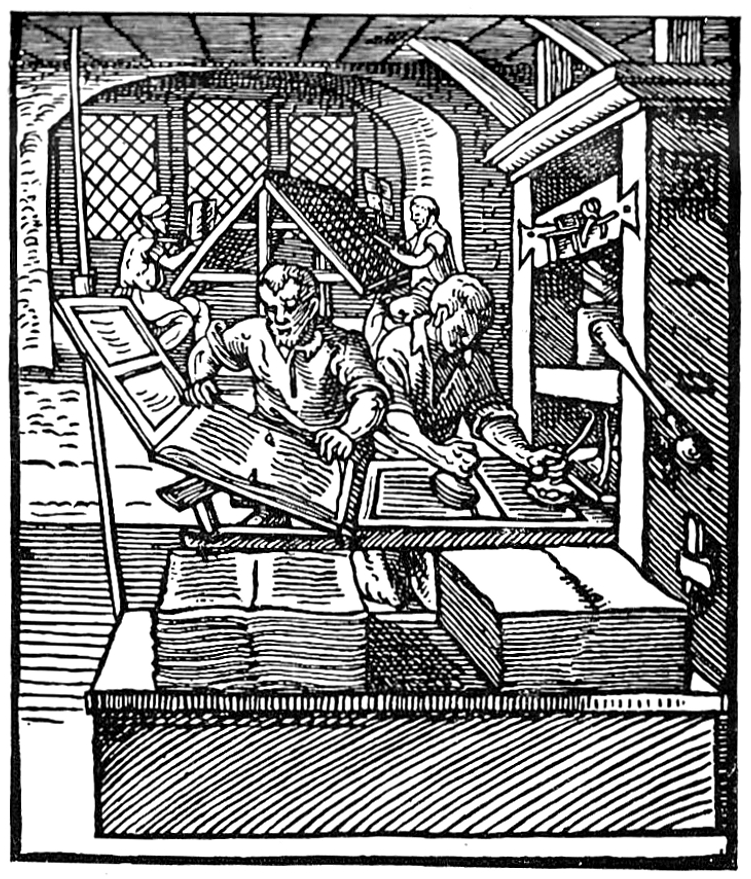
Printing press, circa 1568

A printer's devil was a young apprentice in a printing establishment who performed a number of tasks, such as mixing tubs of ink and fetching type. Writers including Benjamin Franklin, Walt Whitman, Ambrose Bierce, Bret Harte, Sherwood Anderson, and Mark Twain served as printer's devils in their youth along with indentured servants.

There are religious, literary, and linguistic hypotheses for the etymology. Printers blamed the mischievous devil Titivillus or confused a name with the legend Faust. Other theories include racism, Gallicisms, or misspellings.

Etymology

[edit]
York's little devil on a former printer shop in Stonegate, York

The term "printer's devil" has been ascribed to the apprentices' hands and skin getting stained black with ink when removing sheets of paper from the tympan.[1] In 1683, English printer Joseph Moxon wrote that "devil" was a humorous term for boys who were covered in ink: "whence the Workmen do Jocosely call them Devils; and sometimes Spirits, and sometimes Flies."[2][3] Once cast metal type was used, worn, or broken, it was thrown into a "hellbox", after which it was the printer's devil's job to either put it back in the job case, or take it to the furnace to be melted down and recast.[4]

Many explanations have been given for the religious or supernatural connotations of the term.[5] From the Middle Ages onward, particularly in Catholic countries, technological inventions such as the printing press were often regarded with suspicion, and associated with Satan and the "Dark Arts".[6][7] Some have suggested that the term was coined as an epithet by scribes who feared that the printing press would make the hand-copying of manuscripts obsolete.[8] Several theories of the term's origins are included below.

Titivillus

[edit]

One popular theory is linked to the fanciful belief among printers that a special demon, Titivillus (also referred to as "the original printer's devil"[9]), haunted every print shop, performing mischief such as inverting type, misspelling words, and removing entire lines of completed type.[citation needed] Titivillus was said to execute his pranks by influencing the young apprentices – or "printer's devils" – as they set up type, or by causing errors to occur during the actual casting of metal type.[10] High-profile printing errors "blamed" on Titivillus included the omission of the word not in the 1631 Authorised Version of the Bible, which resulted in Exodus 20:14 appearing as "Thou shalt commit adultery."[10] Often depicted as a creature with claw-like feet and horns on his head, the origins of the Titivillus legend date back to the Middle Ages, when he was said to collect "fragments of words" that were dropped or misspoken by the clergy or laiety in a sack to deliver to Satan daily, and later, to record poorly recited prayers and gossip overheard in church with a pen on parchment, for use on Judgement Day.[10][11] Over the centuries, Titivillus was also blamed for causing monks to make mistakes while copying manuscripts by hand; meddling with block and plate printing; and eventually, playing pranks with movable type.[10]

Johann Fust

[edit]

Regarding the origins of the term "devil" to refer to "the errand boy or youngest apprentice in a printing office", Pasko's American Dictionary of Printing and Bookmaking (1894) states: "It is said that it is derived from the belief that John Fust was In league with the devil, and the urchin covered with ink certainly made a very good representation of his Satanic majesty."[2] Johann Fust (c.1400–1466), also known as Faust, loaned money to Johannes Gutenberg to perfect his printing process using movable type, and sued Gutenberg for repayment, with interest, in 1455.[12] Fust, together with Gutenberg's son-in-law Peter Schoeffer, then set up their own printing business and published the Mainz Psalter, a Bible which introduced colour printing, in 1457.[12] Over the centuries, biographical accounts of Fust, the printer, have often become confused or intertwined with the legend of Johann Georg Faust (c.1480–1540), the alchemist and necromancer who became the subject of numerous "Faust books" published in Germany starting in 1587, which in turn inspired Christopher Marlowe's work, Doctor Faustus (c.1591–1593).[13] The legendary Faustus is said to have sold his soul to the demon Mephistopheles, in exchange for a book or encyclopedia of magical spells.[13] In 1570, even before publication of the first Faustbuch, English church historian John Foxe credited "a Germaine...named Joan. Faustus, a goldesmith" for the invention of the printing press, in the second edition of Actes and Monuments, although he had previously attributed its invention to "Jhon Guttenbergh".[13] Literary scholar Sarah Wall-Rendell argues that the association of the Doctor Faustus legend with books and printing technology reflected ongoing ambivalence among Reformation writers about the impact that books would have on an increasingly literate populace.[13]

Aldus Manutius

[edit]

Yet another possible origin is ascribed to Aldus Manutius, a Venetian printer (fl. 1450-1515), who was denounced by detractors for practicing the black arts as early printing was long associated with devilry.[14] The assistant to Manutius was a young boy of African descent who was accused of being the embodiment of Satan and dubbed the printer's devil.[15]

William Caxton

[edit]

Some boys claimed their names descended from an apprentice William Caxton had in the 1470s.[16] His name changed from De Vile, to DeVille and Deville.[16]

Malayalam root

[edit]

While the term "printer's devil" in India may stem from the European legend of Titivillus, another theory is that it might stem from the Malayalam term for "printing error" (achadi pisaku), which is only one change of a Malayalam letter away from "printing devil" (achadi pisachu).[17]

Famous devils

[edit]

Usage

[edit]

United States

[edit]

In North America during the late 18th and early 19th centuries, young boys were indentured to printers by their parents, or in the case of orphans, by the municipal or church authorities.[20] More than apprentices in other trades, printer's devils were boys who had expressed an interest in printing.[20] By 1894, American Dictionary of Printing and Bookmaking noted that with the decline of the apprenticeship system in the United States, the term "printer's devil" was going out of use.[2]

India

[edit]

The printer's devil is also known in other languages such as Bengali, where it is called Chhapakhanar Bhoot.[17]

References

[edit]
Revisions and contributorsEdit on WikipediaRead on Wikipedia
from Grokipedia
"Printer's Devil" is the ninth episode of the fourth season of the American television anthology series , and the 111th overall episode. It was the first episode of the season to run in the expanded 60-minute format and originally aired on on February 28, 1963. The teleplay was written by , based on his 1951 short story "The Devil, You Say", and directed by Ralph Senensky. The episode stars as Douglas Winter, the editor of a struggling small-town ; Pat as his reporter and fiancée Nina; and as the enigmatic Mr. Smith, a reporter who offers to work for free and reveals himself to be the Devil. Supporting roles include as the rival publisher and Charles Thompson as the managing editor. In the story, set in the town of Ridgeville, editor Winter faces closure due to competition from a larger . A mysterious stranger arrives, promising scoops that turn the Clarion into a success, but at the cost of Winter's soul. The title alludes to the historical "", a lowly printing apprentice, symbolizing the demonic figure's humble guise in the print shop.

Synopsis

Opening narration

Rod Serling's opening narration for the episode "Printer's Devil" establishes a mood of desperation and supernatural intrusion, setting the stage for a tale of temptation in a struggling small-town newspaper. The full narration reads: "Take away a man's dream, fill him with whiskey and despair, send him to a lonely bridge, let him stand there all by himself looking down at the black water, and try to imagine the thoughts that are in his mind. You can't, I can't, but there's someone who can, and that someone is seated next to Douglas Winter right now. The car is headed back toward town, but its real destination is the Twilight Zone." This monologue, delivered in Serling's signature somber tone, immediately evokes the protagonist's suicidal ideation amid professional failure, hinting at an otherworldly presence that will exploit his vulnerability. The term "" originates from the historical role of a in a print shop, responsible for menial tasks like mixing and running errands, often blamed for mishaps in early printing operations. In the episode, this phrase takes on a metaphorical double meaning, representing the himself infiltrating a failing as a seemingly helpful employee, symbolizing the seductive influence of compromise for material gain. Serling's narration foreshadows this moral dilemma by introducing Douglas Winter, the editor of the Dansburg , on the brink of ruin in the quiet town of Dansburg, where success might demand an infernal bargain. Through vivid imagery of isolation and inner turmoil, the opening builds atmospheric tension, priming viewers for the episode's exploration of ethical erosion in , where the allure of scoops and circulation could lead to soul-selling consequences, ultimately tied to a supernatural twist involving the newspaper's .

Plot summary

Douglas Winter, the editor and owner of the struggling Dansburg Courier newspaper, faces imminent financial collapse as competition from the larger threatens to drive his publication out of business. Desperate after his linotype operator, Andy, quits due to unpaid wages and with debts mounting, Winter contemplates on a bridge but is interrupted by a dapper stranger named Mr. Smith, who introduces himself as an experienced reporter and linotype operator willing to work for free until the paper turns a profit. Smith immediately proves invaluable by producing front-page stories with uncanny accuracy, such as a that occurs exactly as described and the revelation of a local high school principal's , causing the Courier's circulation to triple within two weeks and revitalizing the business. As the Courier's success grows, the Gazette's representative, Mr. Franklin, offers Winter $100,000 to sell the paper, an offer Winter rejects amid the newfound prosperity. Jackie Benson, Winter's devoted secretary and fiancée who doubles as a reporter, becomes increasingly suspicious of Smith's methods, especially after he loans Winter the exact amount needed to pay off debts—$4,861.23—and the stories begin predicting tragic events, including a fire that destroys the Gazette's offices and the drowning deaths of a newlywed couple. In a private moment, Smith reveals his true identity as the Devil, explaining that he has modified the linotype machine to not only predict but also cause the events it prints, and he pressures Winter to sign a contract trading his soul for the paper's eternal success; under duress and fearing ruin, Winter complies. Tensions escalate when Smith, spurned by Jackie's affection for Winter, uses the to print a story foretelling her death in a car accident at 11:30 p.m. on Bascomb Road. Jackie confronts Smith, urging him to leave the , and offers to drive him to , but during the drive, Smith attempts to cause the predicted crash by accelerating toward oncoming traffic. Meanwhile, Winter, realizing the machine's power, tricks Smith by composing and printing a front-page scoop announcing Smith's resignation from the and the voiding of the due to Winter's incomplete understanding of the terms of the . This forces Smith to honor the story he himself enabled the machine to create, causing him to vanish in a puff of smoke and the infernal linotype to disintegrate; with the nullified, Winter destroys the remaining machinery and vows to rebuild the paper through honest journalism, supported by Jackie and the local community.

Closing narration

In the closing narration of "Printer's Devil," delivers a reflective that encapsulates the episode's exploration of and redemption, emphasizing the Douglas Winter's narrow escape from a Faustian bargain through his own ingenuity. The full text of Serling's narration reads: "Exit the infernal machine, and with it his satanic majesty, , prince of darkness—otherwise known as Mr. Smith. He's gone, but not for good; that wouldn't be like him—he's gone for bad. And he might be back, with another ticket... to ." This narration underscores the moral that integrity and human cleverness can triumph over devilish shortcuts, as Winter voids his contract by destroying the enchanted , symbolizing the rejection of in favor of ethical resolve. The "infernal " serves as a potent emblem of the discarded allure of easy success, while Serling's parting words tie the ""—a traditional term for an apprentice printer but here reimagined as a literal demonic force—to the idea that such entities can be outwitted by mortal wit, leaving the door open to future perils.

Production

Writing and development

The episode "Printer's Devil" originated from Charles Beaumont's short story "The Devil, You Say?", his debut publication that appeared in the January 1951 issue of Amazing Stories. In adapting his own work for television, Beaumont expanded the narrative's focus on the newspaper environment, centering the story around a struggling print shop where supernatural temptation unfolds through journalistic dealings. Beaumont was commissioned to write the screenplay specifically for The Twilight Zone's fourth season, drawing thematic influences from the Faust legend of soul-selling pacts and Stephen Vincent Benét's "The Devil and Daniel Webster," which similarly explores bargains with infernal figures. This marked one of Beaumont's many contributions to the series; as a prolific writer, he penned 22 episodes overall, often infusing them with moral dilemmas involving temptation and human frailty, establishing him as the second-most frequent contributor after Rod Serling. Conceived amid season 4's experimental shift to hour-long formats—intended to allow deeper exploration of complex ideas but ultimately deemed less suited to the show's concise style—"" became production number 111, the ninth episode aired. Thematically, it echoes temptation arcs in Beaumont's earlier work, such as "" from season 2, where characters grapple with deceptive offers. Beaumont's script selection for in the devilish role stemmed directly from the story's sly, manipulative antagonist, aligning the actor's versatile persona with the character's charm.

Casting

portrayed Mr. Smith, the enigmatic linotype operator who is revealed to be the , infusing the character with a sly, eccentric charm that blended affable wit and underlying menace. This marked Meredith's fourth and final guest appearance on , following his iconic turns as the book-loving Henry Bemis in "Time Enough at Last" (1959), the defiant Romney Wordsworth in (1961), and the bumbling Luther Dingle in (1961). Meredith's performance drew on his established versatility in playing cunning antagonists, making him an ideal fit for the story's devilish figure who manipulates events with subtle guile. Robert Sterling starred as Douglas Winter, the beleaguered newspaper editor facing financial ruin, conveying a mix of desperation and determination central to the episode's tension. Sterling, a seasoned television actor best known for leading the sitcom Topper (1953–1955) alongside his wife Anne Jeffreys, brought a grounded everyman quality to the role, drawing from his prior dramatic appearances in series like Ichabod and Me (1961–1962). Pat Crowley played Jackie Benson, Winter's sharp-witted reporter fiancée, whose supportive presence introduced a layer of romantic and emotional stakes to the narrative. Crowley's portrayal highlighted the character's loyalty and perceptiveness, enhancing the interpersonal dynamics without overshadowing the central conflict. The supporting cast included as Mr. Franklin, the owner of the rival newspaper The Gazette, and as Andy Praskins, the newspaper's original linotype operator, alongside brief appearances by actors such as Doris Kemper as the Landlady, providing atmospheric depth to the small-town setting. Director Ralph Senensky assembled this ensemble for their reliability in character roles, noting the overall cast's impressive cohesion in delivering the episode's blend of and . No significant casting controversies or last-minute changes were reported in production accounts.

Direction and music

"Printer's Devil" was directed by Ralph Senensky. The episode marked Senensky's work on The Twilight Zone, where he preplanned staging and camera coverage directly in the script to ensure efficient production. He employed shadowy lighting in key scenes, such as the bridge sequence, to heighten a sense of mystery and danger, though some lighting choices were adjusted during filming. The 60-minute runtime of season 4 episodes permitted a slower pacing, allowing for extended character interactions, including a climactic 6.5-minute dialogue between the leads. Filming took place entirely at MGM Studios in November 1962, with no major on-location shoots beyond studio exteriors on Lot 2 for New York street scenes. Key sets included a large newspaper office comprising the printing room, editorial space, and entry area, constructed to evoke a sense of through added window shades. The served as a central , prominently featured and manipulated by the character Mr. Smith to advance the plot, with adjustments made during production to align with the story's mechanics. The episode utilized stock library music cues rather than an original score. These selections, drawn from composers including and , provided an eerie and suspenseful underscore during Mr. Smith's arrivals and key revelations, enhancing the supernatural tension. Black-and-white cinematography was handled by George T. Clemens, who examined sets in advance and insisted on painting them green to optimize lighting effects. Clemens' work emphasized close-ups, particularly during the contract reveal scene, to intensify emotional impact and draw focus to critical details. This directorial framing amplified Burgess Meredith's performance as Mr. Smith, underscoring his enigmatic presence.

Broadcast and release

Original airing

"Printer's Devil" premiered on CBS on February 28, 1963, as the ninth episode of the fourth season of , bearing production code 4864. This installment marked a key point in the series' experimental expansion to hour-long episodes during season 4, which ran from January 3 to May 23, 1963. The episode aired in the Thursday night time slot from 9:00 to 10:00 PM ET, filling 's anthology programming block without significant preemptions. As part of the season's style, it featured Rod Serling's characteristic on-air introduction, setting the supernatural tone: "Take away a man's dream, fill him with whiskey and facts... and you'll have an editor. But take away his dreams, and chances are you have also effectively removed his soul." Promotion for the episode highlighted its Faustian premise, teasing it in TV Guide as a "deal with the devil" story to draw viewers into the tale of a struggling newspaper editor's pact with a mysterious figure.

Home media

"Printer's Devil" has been made available through various home media formats since its original broadcast, primarily as part of comprehensive collections of The Twilight Zone series. The episode is included on the fourth-season disc of The Twilight Zone: The Complete Series DVD set, released in 2002 by Image Entertainment, which compiles all 156 episodes across 28 discs in remastered form. Subsequent physical releases expanded accessibility with high-definition options. It features on the Season 4 Blu-ray disc in the 2011 Image Entertainment release of that season, sourced from original 35mm negatives for enhanced visual clarity, and is also part of the 24-disc : The Complete Series Blu-ray set issued in 2021 by under Paramount, presenting all episodes in . Special features accompanying these editions provide deeper insights into the production. The Blu-ray sets include audio commentary tracks on select episodes by Twilight Zone historians like and Gary Gerani, along with interviews featuring director Senensky and writer , drawn from archival materials and new recordings to discuss creative decisions and episode-specific anecdotes. Digital streaming has further broadened availability. As of 2025, "" streams on Paramount+, where the full series is offered in high definition, and was previously accessible on from approximately 2014 until its removal in July 2021. Internationally, the episode appears in regional collections, such as the 2005 DVD release of 4 by 2 Entertain, integrating it into European home video distributions with localized packaging and .

Reception and legacy

Critical reception

Upon its 1963 broadcast, "Printer's Devil" elicited mixed responses from critics, who appreciated its engaging premise and Burgess Meredith's performance as the Devil while finding the plot's twist predictable. In The Twilight Zone Companion, notes that the episode, adapted from Charles Beaumont's short story "The Devil, You Say?", was seen as a solid but conventional Faustian bargain tale, with Meredith's charismatic portrayal adding wit and menace that compensated for toned-down from the source material. Modern reassessments have similarly highlighted strengths in performance amid criticisms of structure. The A.V. Club's 2013 review described the episode as a "minor" Twilight Zone entry, awarding it a B grade for its fun depiction of in a 1960s and Meredith's standout fourth and final appearance on the series, which outshone supporting cast members and Patricia Crowley. However, it faulted the hour-long format for dragging the pacing with extended scenes and an obvious early reveal of the Devil's identity, rendering the resolution—wherein the protagonist outwits Mr. Smith using the linotype machine—telegraphed and lacking surprise. The review also drew comparisons to Meredith's earlier Twilight Zone roles, such as the ill-fated Henry Bemis in "Time Enough at Last," underscoring his recurring knack for memorable character work despite formulaic storytelling. Audience reception remains positive, with an IMDb user rating of 8.1 out of 10 based on over 2,400 votes as of 2025, reflecting enduring enjoyment of the clever reversal where the editor saves both his soul and his love interest. Scholarly analyses emphasize the episode's exploration of Faustian themes, portraying the newspaper editor's moral transition from self-serving temptation to ethical redemption through the consequences of his pact. Zicree highlights the narrative's complexity in balancing temptation with accountability, crediting Beaumont's script and director Ralph Senensky's subtle effects for deepening the Devil's allure and the story's ironic outwitting. In The Twilight Zone and Philosophy, the episode illustrates a shift from aesthetic indulgence to ethical responsibility, underscoring the high stakes of supernatural bargains in Serling's anthology.

Cultural impact

"Printer's Devil" stands as one of season 4's lighter supernatural entries in , blending humor with a Faustian bargain motif where a struggling editor encounters a devilish figure offering success at the cost of his soul. The episode's whimsical tone, centered on temptation and moral compromise in , has contributed to its enduring place among the series' anthology tales exploring human frailty. Burgess Meredith's portrayal of the affable yet sinister Mr. Smith marked his fourth and final appearance in The Twilight Zone, following roles in "Time Enough at Last," "," and "." This performance further cemented Meredith's association with quirky, villainous characters, a he popularized as the Penguin in the 1966–1968 Batman television series. The acclaim for Meredith's charismatic depiction of temptation has enhanced the episode's memorability within the series' legacy. The episode's themes of media manipulation and ethical shortcuts resonate in broader cultural discussions of journalism, as seen in analyses framing it as a cautionary tale on the perils of prioritizing success over integrity. Its motifs of devilish deals for professional gain echo in later supernatural narratives, including crossroads demon bargains in Supernatural and satirical pacts in The Simpsons' parodies of anthology horror. In fan culture, "Printer's Devil" regularly features in The Twilight Zone marathons, such as Syfy's annual New Year's and milestone celebrations, where it airs alongside other hour-long episodes to highlight the series' diverse storytelling. These broadcasts sustain its visibility, drawing new audiences to its commentary on the press while honoring Meredith's contributions to the canon.

References

Add your contribution
Related Hubs
User Avatar
No comments yet.