Hubbry Logo
Project DianaProject DianaMain
Open search
Project Diana
Community hub
Project Diana
logo
8 pages, 0 posts
0 subscribers
Be the first to start a discussion here.
Project Diana
Project Diana
from Wikipedia
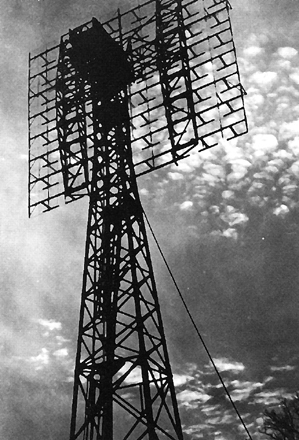
Project Diana radar antenna, Fort Monmouth, New Jersey
Oscilloscope display showing the radar signal.[1] The large pulse on the left is the transmitted signal, the small pulse on the right is the return signal from the Moon. The horizontal axis is time, but is calibrated in miles. It can be seen that the measured range is 238,000 mi (383,000 km), approximately the distance from the Earth to the Moon.
QSL card for reception reports

Project Diana, named for the Roman moon goddess Diana, was an experimental project of the US Army Signal Corps in 1946 to bounce radar signals off the Moon and receive the reflected signals.[1] This was the first experiment in radar astronomy and the first active attempt to probe another celestial body. It was the inspiration for later Earth–Moon–Earth communication (EME) techniques.

History

[edit]

Following the end of World War II, Col. John H. DeWitt Jr., Director of the Evans Signal Laboratory at Camp Evans (part of Fort Monmouth), in Wall Township, New Jersey, was directed by the Pentagon to determine whether the ionosphere could be penetrated by radar, in order to detect and track enemy ballistic missiles that might enter the ionosphere. He decided to address this charge by attempting to bounce radar waves off the Moon. For this task he assembled a team of engineers that included Chief Scientist E. King Stodola, Herbert Kauffman, Jacob Mofenson, and Harold Webb. Input from other Camp Evans units was sought on various issues, including most notably the mathematician Walter McAfee, who made the required mathematical calculations.[2][3][4]

On the Laboratory site, a large transmitter, receiver and antenna array were constructed for this purpose.[1] The transmitter, a highly modified SCR-271 radar set from World War II,[1] provided 3 kilowatts (later upgraded to 50 kilowatts) at 111.5 MHz in 14-second pulses, applied to the antenna, a "bedspring" reflective array antenna composed of an 8x8 array of half wave dipoles and reflectors that provided 24 dB of gain. Return signals were received about 2.5 seconds later, the time required for the radio waves to make the 768,000-kilometre (477,000 mi) round-trip journey from the Earth to the Moon and back.[1] The receiver had to compensate for the Doppler shift in frequency of the reflected signal due to the Moon's orbital motion relative to the Earth's surface, which was different each day, so this motion had to be carefully calculated for each trial.[1] The antenna could be rotated in azimuth only, so the attempt could be made only as the Moon passed through the 15 degree wide beam at moonrise and moonset, as the antenna's elevation angle was horizontal. About 40 minutes of observation was available on each pass as the Moon transited the various lobes of the antenna pattern.

The first successful echo detection came on 10 January 1946 at 11:58am local time by Harold Webb and Herbert Kauffman.[5]

Project Diana marked the birth of radar astronomy later used to map Venus and other nearby planets, and was a necessary precursor to the US space program. It was the first demonstration that terrestrial radio signals could penetrate the ionosphere,[1] opening the possibility of radio communications beyond the Earth for space probes and human explorers. It also established the practice of naming space projects after Roman gods, e.g., Mercury and Apollo.

Project Diana demonstrated the feasibility of using the Moon as a passive reflector to transmit radio signals from one point on the Earth to the other, around the curve of the Earth. This Earth-Moon-Earth (EME) or "moonbounce" path has been used in a few communication systems. One of the first was the secret US military espionage PAMOR (Passive Moon Relay) program in 1950, which sought to eavesdrop on Soviet Russian military radio communication by picking up stray signals reflected from the Moon. The return signals were extremely faint, and the US began secret construction of the largest parabolic antenna in the world at Sugar Grove, West Virginia, until the project was abandoned in 1962 as too expensive. A more successful spinoff was the US Navy Communication Moon Relay or Operation Moonbounce communication system, which used the EME path for US military communication. In January, 1960 the system was inaugurated with a lunar relay link between Hawaii and Washington DC. Moonbounce communication was abandoned by the military with the advent of communications satellites in the early 1960s. Since then it has been used by amateur radio operators.

Today, the Project Diana site is part of the Camp Evans Historic District, InfoAge Science History Learning Center and Museum, and is maintained by the Infoage Space Exploration Center,[6] and previously by the Ocean-Monmouth Amateur Radio Club.[7] The antenna array was removed earlier and is now presumably lost.

References

[edit]

Further reading

[edit]
Revisions and contributorsEdit on WikipediaRead on Wikipedia
from Grokipedia
Project Diana was an experimental project conducted by the in 1946, which achieved the first successful detection of radio signals echoed back from the , demonstrating the feasibility of extraterrestrial communication and laying foundational groundwork for . Named after the Roman of the , the project was led by John H. DeWitt Jr. at Camp Evans in , , with key contributions from scientists including E. King Stodola, Jacob Mofenson, Harold D. Webb, and Herbert Kauffman. The initiative stemmed from postwar concerns over long-range missile threats, such as the German , and aimed to test the propagation of radio waves through the Earth's while exploring potential applications for intercontinental detection and communication. On January 10, 1946, at 11:58 a.m., the team transmitted signals using a modified SCR-271 radar set operating at 111.9 MHz with a peak power of 25 kilowatts, directed via a large 60-foot by 60-foot array of 64 half-wave dipoles acting as a reflector antenna. The echoes, taking approximately 2.5 seconds for the round trip to the Moon (consistent with the speed of light), were detected during a brief 40-minute window at moonrise, confirming the Moon's viability as a passive reflector for radio signals. The project's success pioneered "moonbounce" or Earth-Moon-Earth (EME) communication techniques, which remain in use for and scientific applications, and it influenced subsequent efforts by validating for celestial mapping and tracking. In recognition of its historical impact, Project Diana was designated an IEEE Milestone in and Computing in 2019.

Background

Historical Context

Following the end of in 1945, the faced a landscape of demobilization within its military branches, including the , which released personnel and made surplus equipment widely available for repurposing. This availability of resources, such as modified SCR-271 radar sets from wartime production, enabled rapid experimentation without the need for extensive new development amid postwar budget constraints. The project's technological foundations were rooted in wartime radar innovations, particularly the early detection methods honed during the conflict. British advancements, such as the Chain Home early warning system, had demonstrated the potential of long-range radio wave propagation for aircraft detection, influencing U.S. efforts to adapt similar principles for extended distances beyond the atmosphere. American researchers built on these developments by experimenting with captured German and Japanese radar technologies, shifting focus from short-range tactical applications to probing extraterrestrial reflection. Emerging Cold War tensions in 1945 and 1946 further spurred such initiatives, as U.S. military planners grew concerned about Soviet advancements in rocketry, inspired by the German V-2 program, and potential threats from long-range ballistic missiles armed with nuclear warheads. These geopolitical pressures emphasized the need to test 's ability to penetrate the and detect distant objects, positioning space-related radar as a strategic priority in the intensifying U.S.-Soviet rivalry. Project Diana was initiated in late , specifically in the fall, at the U.S. Army Laboratory in Camp Evans, , under the leadership of Lt. Col. John H. DeWitt Jr., who assembled a team to explore lunar radar echoing as a for long-range detection. Initial tests commenced in December , leveraging the environment to advance amid these broader historical shifts.

Scientific Objectives

The primary scientific objective of Project Diana was to detect and verify a radar echo from the Moon's surface, serving as empirical proof of the feasibility of long-distance propagation beyond the Earth's atmosphere and enabling over-the-horizon communication techniques. This involved transmitting high-powered VHF pulses toward the , approximately 384,000 km away, and attempting to receive the reflected signals after a predicted of about 2.5 seconds, thereby testing the that such signals could traverse the vast interplanetary distance with sufficient strength to be detectable upon return. The project aimed to address uncertainties in signal attenuation and scattering over extraterrestrial paths, establishing whether artificial radio emissions could reliably interact with celestial bodies for communication relays. A key goal was to investigate the effects of the on VHF signals (around 111 MHz), particularly whether these layers would refract, absorb, or allow penetration of pulses for long-range applications. By using the as a passive reflector, the experiment sought to measure ionospheric influences on signal integrity, including potential Doppler shifts due to the 's orbital motion, and to confirm that VHF frequencies could support Earth-Moon-Earth (EME) paths without prohibitive degradation. This objective was driven by the need to validate 's role in detecting and tracking objects at extreme altitudes, such as missiles, where ionospheric interference had previously limited effectiveness. Project Diana also intended to pioneer by demonstrating active probing of solar system objects, laying a foundational baseline for future experiments in and . The objectives included gathering preliminary data on lunar reflectivity to inform models of planetary surface interactions with radio waves, which would support advancements in spacecraft communication, tracking, and astronomical mapping. Ultimately, the project hypothesized that successful lunar echoing would open pathways for interplanetary signal relay systems, influencing subsequent developments in space exploration technologies.

Development and Preparation

Team and Leadership

Project Diana was organized under the U.S. Army Laboratory at , , specifically at the Evans Signal Laboratory in Camp Evans, where a small team of researchers and technicians conducted the post-World War II experiment to explore peacetime applications of wartime technology. The project, initiated in , operated with limited resources and personnel, emphasizing collaboration among experts to test signal propagation beyond the . Lieutenant Colonel John H. DeWitt Jr. served as the chief signal officer and project director, overseeing all aspects of planning and execution from his position as director of the Evans Signal Laboratory since late 1943. A pioneer in , DeWitt had built Nashville's first radio station at age 16 and worked at Bell Laboratories before joining the , where during he led development efforts at Camp Evans, contributing to advancements in signal detection and propagation for military applications. Key team members included Harold D. Webb, a and who played a central role in and receiver modifications, including the innovative suggestion to use for improved reflection during tests. Webb, who held a PhD in physics from and joined the in 1942, collaborated closely with chief scientist E. King Stodola on calculations and was present alongside technician Herbert Kauffman when the first lunar echoes were detected. Other contributors, such as mathematician Walter McAfee and Jacob Mofenson, supported the effort in data analysis and equipment integration, forming a compact group of technicians dedicated to the project's success.

Equipment Design

The radar system for Project Diana utilized surplus World War II-era SCR-271 radar equipment, extensively modified at the Evans Signal Laboratory to detect faint lunar echoes over a round-trip distance of approximately 768,000 kilometers. The transmitter was adapted from the SCR-271 set, originally designed for long-range early-warning detection, with its oscillator retuned using crystal-controlled multiplication to generate a stable carrier frequency of 111.5 MHz, corresponding to a wavelength of about 2.7 meters. This frequency was selected to minimize ionospheric absorption while providing sufficient penetration beyond the Earth's atmosphere. The transmitter delivered a peak pulse power of 3 kW, with each pulse having a duration of 0.25 seconds to maximize transmitted energy for the weak return signal expected from the Moon's surface. Pulse repetition was kept low, on the order of once every few seconds, to prevent overlap with the 2.5-second round-trip propagation delay. The antenna system consisted of two modified SCR-271 "bedspring" arrays combined into a single fixed reflector structure, providing an azimuth-adjustable beam but no elevation movement, which limited observations to brief windows around moonrise or moonset. Each SCR-271 array featured 32 half-wave dipoles arranged in a planar backed by a reflector mesh, resulting in a total of 64 dipoles for the combined setup and an overall gain of approximately 24 dB (equivalent to 250 times that of an ). This high-gain configuration focused the transmitted power into a narrow beam toward the and collected the diffuse echo on return, improving the by about 15 dB compared to a single array. The arrays measured roughly 12 meters (40 feet) square, supported on a tower for optimal pointing. The receiver employed a superheterodyne , replacing the original SCR-271 components with a custom design incorporating a single crystal-controlled and a final intermediate frequency heterodyne stage tunable via crystal to achieve a narrow effective bandwidth of 50 Hz. This configuration suppressed noise while preserving the echo's spectral characteristics, including Doppler shifts from the Moon's orbital motion. Preamplifiers and transmission lines were optimized to handle both the high-power transmit pulses and the minuscule echo power, estimated at around 10^{-18} watts. These modifications, developed iteratively through 1945, addressed challenges like oscillator stability and vacuum tube durability under prolonged pulsing.

The Experiment

Site and Setup

Project Diana was conducted at Camp Evans, a U.S. Army Signal Corps research facility located in , approximately 50 miles south of . This site, now preserved as part of the InfoAge Science and History at Building 9162 on Marconi Road, was selected for its established infrastructure from radar development and relatively low levels of interference, which was critical for the high-sensitivity reception required in the experiment. The core of the setup involved installing a modified SCR-271 antenna system, a planar "bedspring" consisting of 64 half-wave dipoles arranged in an 8x8 configuration, atop a 100-foot tower equipped with a rotating mount. This mount allowed for azimuth-only rotation to track the Moon's horizontal position across the sky, providing a beamwidth of about 15 degrees and a gain of approximately 24 dB, while the fixed limited operations to brief windows during moonrise or moonset. The installation of two such side-by-side enhanced signal strength for both transmission and reception, with the system calibrated to operate at 111.5 MHz using a crystal-controlled oscillator for frequency stability. Calibration procedures focused on precise alignment with the 's position during its waxing phase, particularly the first quarter illumination on , 1946, which optimized visibility low on the horizon. Engineers adjusted the setup for potential Doppler shifts up to 327 Hz due to the 's orbital motion and employed a narrow 57 Hz receiver bandwidth to isolate the expected echo signals, ensuring minimal noise from terrestrial sources. The site's logistical preparations included shielding and grounding to further reduce interference, allowing sessions limited to about 30-40 minutes daily when the was within the antenna's trackable arc.

Signal Transmission and Reception

The transmission phase of Project Diana involved directing short bursts of radio waves toward the using a modified system operating at 111.5 MHz. On January 10, 1946, around noon local time at Camp Evans, , the team broadcast quarter-second pulses at intervals of approximately four seconds, with the antenna precisely aligned to track the 's position during its transit. These pulses, generated by a high-power transmitter derived from existing , were designed to propagate through the Earth's atmosphere and reach the lunar surface, approximately 384,000 kilometers away. Reception commenced immediately after each transmission, with the same monostatic radar setup—using a highly directive —monitoring for returning echoes. The team expected a of about 2.5 seconds, calculated from the and the average Earth-Moon distance, and observed the signals on a cathode-ray for visual confirmation, supplemented by audible output through a for real-time monitoring. The receiver employed a quadruple superheterodyne configuration with a final of 180 Hz and a narrow bandwidth of 57 Hz to enhance sensitivity. To isolate the faint lunar reflections from and interference, relied on narrowband filters and beat-frequency techniques, where the received was mixed with a to produce a detectable audio tone. This approach allowed the team to discern the weak returns, which were orders of magnitude fainter than the transmitted signal due to spherical spreading and lunar surface scattering. A key challenge was the Doppler shift in the echo frequency, arising from the relative motion between and , including effects from (up to about 20 Hz contribution) and the Moon's orbital velocity (around 1 km/s, causing shifts up to 300 Hz total). Lunar , the slight wobble in the Moon's orientation, further complicated precise frequency tracking by introducing small positional variations over the observation window. The team addressed these by manually tuning a crystal-controlled oscillator during the experiment, adjusting for the predicted shift based on data, ensuring the receiver remained locked on the expected echo band.

Results and Analysis

Detection of Echo

On January 10, 1946, at 11:58 a.m. EDT, the Project Diana team at Camp Evans, , achieved the first successful detection of a radar echo from the . The transmitted at 111.5 MHz returned after a delay of 2.5 seconds, matching the anticipated round-trip propagation time for radio waves traveling the approximately 384,400 km average distance to the lunar surface and back. This initial observation was made by engineers Harold D. Webb and Herbert P. Kauffman under the direction of Lt. Col. John H. DeWitt Jr. and chief scientist E. King Stodola. The echo was visually confirmed on an oscilloscope trace using a modified nine-inch Type A indicator, where it appeared as a distinct upward deflection from the baseline signal, with an consistent with the expected reflection from the lunar surface. The trace's position and shape aligned precisely with the predicted range, distinguishing it from or local interference. This immediate visual evidence provided the primary indication of success, as the weak returned signal required careful monitoring to isolate it from background thermal . To verify the detection and rule out potential artifacts such as equipment anomalies or atmospheric reflections, the conducted multiple transmissions over the subsequent several hours, observing the repeatedly at the consistent 2.5-second interval. Additional confirmation came from an audible 180 Hz beat note in the receiver and the measured Doppler shift in the frequency, which matched the Moon's orbital motion relative to . The 's power was approximately 101510^{-15} W, a level detectable only due to the high-gain receiving , which concentrated the feeble reflected energy.

Data Interpretation

The detected radar echoes from Project Diana were analyzed to verify their lunar origin through precise of the return delay. The signals returned approximately 2.5 seconds after transmission, precisely matching the calculated time for radio waves traveling at the over the round-trip distance to the Moon of about 768,800 km (based on the average Earth-Moon separation of 384,400 km). This temporal alignment, observed consistently across multiple pulses during moonrise on January 10, 1946, ruled out nearer-range reflections and confirmed extraterrestrial . To further distinguish the echoes from potential terrestrial interference, the team compared the received signal's frequency characteristics to the transmitted pulse. The receiver employed a narrow bandwidth of 57 Hz, centered on the expected Doppler shift (up to 300 Hz due to the Moon's orbital velocity relative to ), which filtered out ambient noise and local multipath signals operating at similar frequencies. Oscilloscope traces briefly referenced from the initial detection showed the echo peak at the predicted shifted frequency, reinforcing its non-local origin. Theoretical calculations prior to the experiment, performed by Dr. Walter S. McAfee, had estimated the Moon's cross-section and confirmed the feasibility of detection, providing the foundation for interpreting the echoes as lunar reflections. Atmospheric absorption and proved negligible at the 111.5 MHz operating frequency. These factors were accounted for in the overall , ensuring the echoes' authenticity despite reduced signal-to-noise ratios.

Significance and Legacy

Advancements in Radar Technology

Project Diana demonstrated the viability of very high frequency (VHF) radar for long-range detection beyond line-of-sight by successfully reflecting signals off the Moon at 111.5 MHz, a frequency that penetrated the ionosphere and traveled approximately 768,000 km round-trip. This achievement proved that VHF waves could overcome ionospheric limitations, which previously restricted radar ranges to about 400 km via skywave propagation, enabling potential applications in over-the-horizon detection. The project's lunar tracking techniques, involving a fixed aimed at the 's position at moonrise and transmission of quarter-second pulses every four seconds, provided foundational methods for tracking distant and informed the development of networks for long-range detection. By using the as a surrogate to simulate trajectories, these approaches highlighted the feasibility of systems for continental defense. In refining pulse radar for weak-signal environments, Project Diana employed extended pulse durations of 0.25 seconds—far longer than typical wartime s—to increase energy and improve detectability of faint echoes. This advanced noise rejection techniques that enhanced sensitivity in low-signal scenarios without requiring excessive power. The project's contributions to were formally recognized by the IEEE in 2019 through a designation for the "Detection of Radar Signals Reflected from the Moon, 1946," honoring its initiation of and advancements in long-range .

Influence on Space Exploration

Project Diana demonstrated the feasibility of using the as a passive reflector for radio signals, establishing a foundational principle for Earth-Moon communication links that contributed to later developments in space communications, including those used in the . This breakthrough proved that signals could penetrate the and return detectable echoes, paving the way for reliable interplanetary radio systems for beyond . The project's success directly inspired subsequent Earth-Moon-Earth (EME) experiments, most notably the U.S. Navy's Operation Moonbounce in , which adapted the technique for secure military voice and data transmission across vast distances without relying on vulnerable terrestrial relays. By confirming the detectability of lunar echoes, Project Diana shifted EME from theoretical speculation to practical application, influencing communities and early satellite communication designs. In the realm of , Project Diana initiated a new era of active observation, enabling scientists to map planetary surfaces by analyzing reflected signals for data on , rates, and surface composition. This approach was instrumental in early mappings of and Mercury, providing critical insights into their features before direct flybys became possible. Amid the intensifying rivalry with the , Project Diana bolstered U.S. technological prestige and accelerated national investments in space capabilities, serving as an early catalyst for the American space program and demonstrating America's lead in extraterrestrial signal technologies.

References

Add your contribution
Related Hubs
User Avatar
No comments yet.