
Recent from talks
Antenna array
Knowledge base stats:
Talk channels stats:
Members stats:
Antenna array
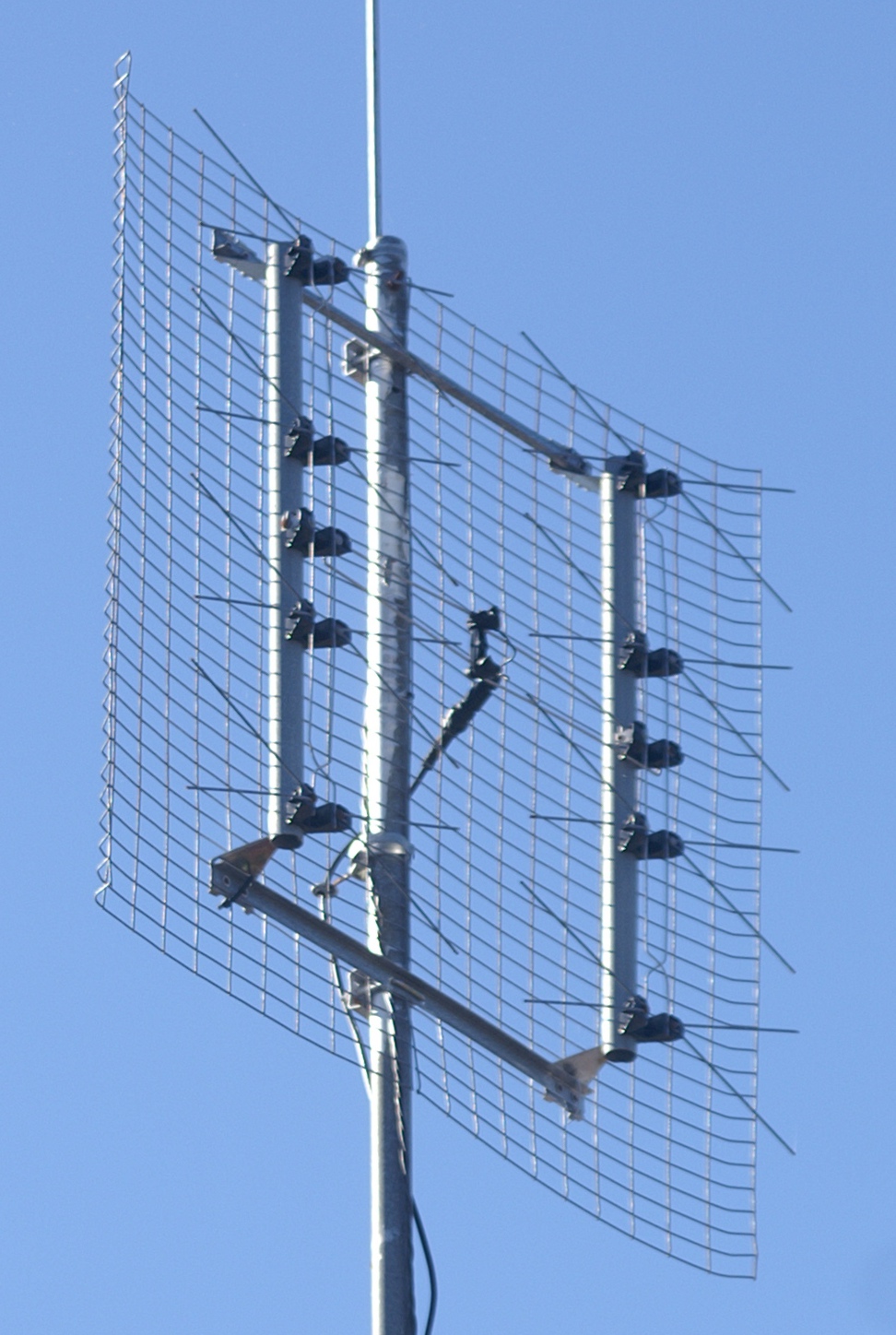
An antenna array (or array antenna) is a set of multiple connected antennas which work together as a single antenna, to transmit or receive radio waves. The individual antennas (called elements) are usually connected to a single receiver or transmitter by feedlines that feed the power to the elements in a specific phase relationship. The radio waves radiated by each individual antenna combine and superpose, adding together (interfering constructively) to enhance the power radiated in desired directions, and cancelling (interfering destructively) to reduce the power radiated in other directions. Similarly, when used for receiving, the separate radio frequency currents from the individual antennas combine in the receiver with the correct phase relationship to enhance signals received from the desired directions and cancel signals from undesired directions. More sophisticated array antennas may have multiple transmitter or receiver modules, each connected to a separate antenna element or group of elements.
An antenna array can achieve higher gain (directivity), that is a narrower beam of radio waves, than could be achieved by a single element. In general, the larger the number of individual antenna elements used, the higher the gain and the narrower the beam. Some antenna arrays (such as military phased array radars) are composed of thousands of individual antennas. Arrays can be used to achieve higher gain, to give path diversity (also called MIMO) which increases communication reliability, to cancel interference from specific directions, to steer the radio beam electronically to point in different directions, and for radio direction finding (RDF).
The term antenna array most commonly means a driven array consisting of multiple identical driven elements all connected to the receiver or transmitter. A parasitic array consists of a single driven element connected to the feedline, and other elements which are not, called parasitic elements. It is usually another name for a Yagi–Uda antenna.
A phased array usually means an electronically scanned array; a driven array antenna in which each individual element is connected to the transmitter or receiver through a phase shifter controlled by a computer. The beam of radio waves can be steered electronically to point instantly in any direction over a wide angle, without moving the antennas. However the term "phased array" is sometimes used to mean an ordinary array antenna.
From the Rayleigh criterion, the directivity of an antenna, the angular width of the beam of radio waves it emits, is proportional to the wavelength of the radio waves divided by the width of the antenna. Small antennas around one wavelength in size, such as quarter-wave monopoles and half-wave dipoles, don't have much directivity (gain); they are omnidirectional antennas which radiate radio waves over a wide angle. To create a directional antenna (high gain antenna), which radiates radio waves in a narrow beam, two general techniques can be used:
One technique is to use reflection by large metal surfaces such as parabolic reflectors or horns, or refraction by dielectric lenses to change the direction of the radio waves, to focus the radio waves from a single low gain antenna into a beam. This type is called an aperture antenna. A parabolic dish is an example of this type of antenna.
A second technique is to use multiple antennas which are fed from the same transmitter or receiver; this is called an array antenna, or antenna array. For a transmitting antenna the electromagnetic wave received at any point is the vector sum of the electromagnetic waves from each of the antenna elements. If the currents are fed to the antennas with the proper phase, due to the phenomenon of interference the spherical waves from the individual antennas combine (superpose) in front of the array to create plane waves, a beam of radio waves traveling in a specific direction. In directions in which the waves from the individual antennas arrive in phase, the waves add together (constructive interference) to enhance the power radiated. In directions in which the individual waves arrive out of phase, with the peak of one wave coinciding with the valley of another, the waves cancel (destructive interference) reducing the power radiated in that direction. Similarly, when receiving, the oscillating currents received by the separate antennas from radio waves received from desired directions are in phase and when combined in the receiver reinforce each other, while currents from radio waves received from other directions are out of phase and when combined in the receiver cancel each other.
The radiation pattern of such an antenna consists of a strong beam in one direction, the main lobe, plus a series of weaker beams at different angles called sidelobes, usually representing residual radiation in unwanted directions. The larger the width of the antenna and the greater the number of component antenna elements, the narrower the main lobe, and the higher the gain which can be achieved, and the smaller the sidelobes will be.
Hub AI
Antenna array AI simulator
(@Antenna array_simulator)
Antenna array
An antenna array (or array antenna) is a set of multiple connected antennas which work together as a single antenna, to transmit or receive radio waves. The individual antennas (called elements) are usually connected to a single receiver or transmitter by feedlines that feed the power to the elements in a specific phase relationship. The radio waves radiated by each individual antenna combine and superpose, adding together (interfering constructively) to enhance the power radiated in desired directions, and cancelling (interfering destructively) to reduce the power radiated in other directions. Similarly, when used for receiving, the separate radio frequency currents from the individual antennas combine in the receiver with the correct phase relationship to enhance signals received from the desired directions and cancel signals from undesired directions. More sophisticated array antennas may have multiple transmitter or receiver modules, each connected to a separate antenna element or group of elements.
An antenna array can achieve higher gain (directivity), that is a narrower beam of radio waves, than could be achieved by a single element. In general, the larger the number of individual antenna elements used, the higher the gain and the narrower the beam. Some antenna arrays (such as military phased array radars) are composed of thousands of individual antennas. Arrays can be used to achieve higher gain, to give path diversity (also called MIMO) which increases communication reliability, to cancel interference from specific directions, to steer the radio beam electronically to point in different directions, and for radio direction finding (RDF).
The term antenna array most commonly means a driven array consisting of multiple identical driven elements all connected to the receiver or transmitter. A parasitic array consists of a single driven element connected to the feedline, and other elements which are not, called parasitic elements. It is usually another name for a Yagi–Uda antenna.
A phased array usually means an electronically scanned array; a driven array antenna in which each individual element is connected to the transmitter or receiver through a phase shifter controlled by a computer. The beam of radio waves can be steered electronically to point instantly in any direction over a wide angle, without moving the antennas. However the term "phased array" is sometimes used to mean an ordinary array antenna.
From the Rayleigh criterion, the directivity of an antenna, the angular width of the beam of radio waves it emits, is proportional to the wavelength of the radio waves divided by the width of the antenna. Small antennas around one wavelength in size, such as quarter-wave monopoles and half-wave dipoles, don't have much directivity (gain); they are omnidirectional antennas which radiate radio waves over a wide angle. To create a directional antenna (high gain antenna), which radiates radio waves in a narrow beam, two general techniques can be used:
One technique is to use reflection by large metal surfaces such as parabolic reflectors or horns, or refraction by dielectric lenses to change the direction of the radio waves, to focus the radio waves from a single low gain antenna into a beam. This type is called an aperture antenna. A parabolic dish is an example of this type of antenna.
A second technique is to use multiple antennas which are fed from the same transmitter or receiver; this is called an array antenna, or antenna array. For a transmitting antenna the electromagnetic wave received at any point is the vector sum of the electromagnetic waves from each of the antenna elements. If the currents are fed to the antennas with the proper phase, due to the phenomenon of interference the spherical waves from the individual antennas combine (superpose) in front of the array to create plane waves, a beam of radio waves traveling in a specific direction. In directions in which the waves from the individual antennas arrive in phase, the waves add together (constructive interference) to enhance the power radiated. In directions in which the individual waves arrive out of phase, with the peak of one wave coinciding with the valley of another, the waves cancel (destructive interference) reducing the power radiated in that direction. Similarly, when receiving, the oscillating currents received by the separate antennas from radio waves received from desired directions are in phase and when combined in the receiver reinforce each other, while currents from radio waves received from other directions are out of phase and when combined in the receiver cancel each other.
The radiation pattern of such an antenna consists of a strong beam in one direction, the main lobe, plus a series of weaker beams at different angles called sidelobes, usually representing residual radiation in unwanted directions. The larger the width of the antenna and the greater the number of component antenna elements, the narrower the main lobe, and the higher the gain which can be achieved, and the smaller the sidelobes will be.
Recent media