



Community hub
Recent from talks
Contribute something
Nothing was collected or created yet.
Karmarkar's algorithm
View on WikipediaKarmarkar's algorithm is an algorithm introduced by Narendra Karmarkar in 1984 for solving linear programming problems. It was the first reasonably efficient algorithm that solves these problems in polynomial time. The ellipsoid method is also polynomial time but proved to be inefficient in practice.
Denoting by the number of variables, m the number of inequality constraints, and the number of bits of input to the algorithm, Karmarkar's algorithm requires operations on -digit numbers, as compared to such operations for the ellipsoid algorithm.[1] In "square" problems, when m is in O(n), Karmarkar's algorithm requires operations on -digit numbers, as compared to such operations for the ellipsoid algorithm. The runtime of Karmarkar's algorithm is thus using FFT-based multiplication (see Big O notation).






Karmarkar's algorithm falls within the class of interior-point methods: the current guess for the solution does not follow the boundary of the feasible set as in the simplex method, but moves through the interior of the feasible region, improving the approximation of the optimal solution by a definite fraction with every iteration and converging to an optimal solution with rational data.[2]
The algorithm
[edit]Consider a linear programming problem in matrix form:
| maximize cTx | |
| subject to | Ax ≤ b. |
Karmarkar's algorithm determines the next feasible direction toward optimality and scales back by a factor 0 < γ ≤ 1. It is described in a number of sources.[3][4][5][6][7][8] Karmarkar also has extended the method[9][10][11][12] to solve problems with integer constraints and non-convex problems.[13]
Algorithm Affine-Scaling
Since the actual algorithm is rather complicated, researchers looked for a more intuitive version of it, and in 1985 developed affine scaling, a version of Karmarkar's algorithm that uses affine transformations where Karmarkar used projective ones, only to realize four years later that they had rediscovered an algorithm published by Soviet mathematician I. I. Dikin in 1967.[14] The affine-scaling method can be described succinctly as follows.[15] While applicable to small scale problems, it is not a polynomial time algorithm.[14]
Input: A, b, c, , stopping criterion, γ.

do while stopping criterion not satisfied if then return unbounded end if end do

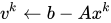







- "←" denotes assignment. For instance, "largest ← item" means that the value of largest changes to the value of item.
- "return" terminates the algorithm and outputs the following value.
Example
[edit]
Consider the linear program That is, there are 2 variables and 11 constraints associated with varying values of . This figure shows each iteration of the algorithm as red circle points. The constraints are shown as blue lines.



Patent controversy
[edit]At the time he invented the algorithm, Karmarkar was employed by IBM as a postdoctoral fellow in the IBM San Jose Research Laboratory in California. On August 11, 1983 he gave a seminar at Stanford University explaining the algorithm, with his affiliation still listed as IBM. By the fall of 1983 Karmarkar started to work at AT&T and submitted his paper to the 1984 ACM Symposium on Theory of Computing (STOC, held April 30 - May 2, 1984) stating AT&T Bell Laboratories as his affiliation.[16] After applying the algorithm to optimizing AT&T's telephone network,[17] they realized that his invention could be of practical importance. In April 1985, AT&T promptly applied for a patent on his algorithm.
The patent became more fuel for the ongoing controversy over the issue of software patents.[18] This left many mathematicians uneasy, such as Ronald Rivest (himself one of the holders of the patent on the RSA algorithm), who expressed the opinion that research proceeded on the basis that algorithms should be free. Even before the patent was actually granted, it was argued that there might have been prior art that was applicable.[19] Mathematicians who specialized in numerical analysis, including Philip Gill and others, claimed that Karmarkar's algorithm is equivalent to a projected Newton barrier method with a logarithmic barrier function, if the parameters are chosen suitably.[20] Legal scholar Andrew Chin opines that Gill's argument was flawed, insofar as the method they describe does not constitute an "algorithm", since it requires choices of parameters that don't follow from the internal logic of the method, but rely on external guidance, essentially from Karmarkar's algorithm.[21] Furthermore, Karmarkar's contributions are considered far from obvious in light of all prior work, including Fiacco-McCormick, Gill and others cited by Saltzman.[21][22][23] The patent was granted in recognition of the essential originality of Karmarkar's work, as U.S. patent 4,744,028: "Methods and apparatus for efficient resource allocation" in May 1988.
AT&T designed a vector multi-processor computer system specifically to run Karmarkar's algorithm, calling the resulting combination of hardware and software KORBX,[24] and marketed this system at a price of US$8.9 million.[25][26] Its first customer was the Pentagon.[27][28]
Opponents of software patents have further argued that the patents ruined the positive interaction cycles that previously characterized the relationship between researchers in linear programming and industry, and specifically it isolated Karmarkar himself from the network of mathematical researchers in his field.[29]
The patent itself expired in April 2006, and the algorithm is presently in the public domain.
The United States Supreme Court has held that mathematics cannot be patented in Gottschalk v. Benson,[30] In that case, the Court first addressed whether computer algorithms could be patented and it held that they could not because the patent system does not protect ideas and similar abstractions. In Diamond v. Diehr,[31] the Supreme Court stated, "A mathematical formula as such is not accorded the protection of our patent laws, and this principle cannot be circumvented by attempting to limit the use of the formula to a particular technological environment.[32] In Mayo Collaborative Services v. Prometheus Labs., Inc.,[33] the Supreme Court explained further that "simply implementing a mathematical principle on a physical machine, namely a computer, [i]s not a patentable application of that principle."[34]
Applications
[edit]References
[edit]- Adler, Ilan; Karmarkar, Narendra; Resende, Mauricio G.C.; Veiga, Geraldo (1989). "An Implementation of Karmarkar's Algorithm for Linear Programming". Mathematical Programming. 44 (1–3): 297–335. doi:10.1007/bf01587095. S2CID 12851754.
- Narendra Karmarkar (1984). "A New Polynomial Time Algorithm for Linear Programming", Combinatorica, Vol 4, nr. 4, p. 373–395.
- ^ a b Arkadi Nemirovsky (2004). Interior point polynomial-time methods in convex programming.
- ^ Strang, Gilbert (1 June 1987). "Karmarkar's algorithm and its place in applied mathematics". The Mathematical Intelligencer. 9 (2): 4–10. doi:10.1007/BF03025891. ISSN 0343-6993. MR 0883185. S2CID 123541868.
- ^ Karmarkar, N. (1984). "A new polynomial-time algorithm for linear programming". Proceedings of the sixteenth annual ACM symposium on Theory of computing - STOC '84. pp. 302–311. doi:10.1145/800057.808695. ISBN 0897911334. S2CID 13101261.
- ^ Karmarkar, N. (1984). "A new polynomial-time algorithm for linear programming". Combinatorica. 4 (4): 373–395. doi:10.1007/BF02579150. S2CID 7257867.
- ^ Karmarkar, Narendra K. (1989). "Power Series Variants of Karmarkar-Type Algorithms". AT&T Technical Journal. 68 (3): 20–36. doi:10.1002/j.1538-7305.1989.tb00316.x. S2CID 42071587.
- ^ Karmarkar, Narendra (1990). "An interior-point approach to NP-complete problems. I". Mathematical developments arising from linear programming (Brunswick, ME, 1988). Contemporary Mathematics. Vol. 114. Providence, RI: American Mathematical Society. pp. 297–308. doi:10.1090/conm/114/1097880. ISBN 978-0-8218-5121-0. MR 1097880.
- ^ Karmarkar, Narendra (1990). "Riemannian geometry underlying interior-point methods for linear programming". Mathematical developments arising from linear programming (Brunswick, ME, 1988). Contemporary Mathematics. Vol. 114. Providence, RI: American Mathematical Society. pp. 51–75. doi:10.1090/conm/114/1097865. ISBN 978-0-8218-5121-0. MR 1097865.
- ^ Karmarkar N. K., Lagarias, J.C., Slutsman, L., and Wang, P., Power Series Variants of KarmarkarType Algorithm, AT & T technical Journal 68, No. 3, May/June (1989).
- ^ Karmarkar, N.K., Interior Point Methods in Optimization, Proceedings of the Second International Conference on Industrial and Applied Mathematics, SIAM, pp. 160181 (1991)
- ^ Karmarkar, N. K. and Kamath, A. P., A continuous Approach to Deriving Upper Bounds in Quadratic Maximization Problems with Integer Constraints, Recent Advances in Global Optimization, pp. 125140, Princeton University Press (1992).
- ^ 26. Karmarkar, N. K., Thakur, S. A., An Interior Point Approach to a Tensor Optimisation Problem with Application to Upper Bounds in Integer Quadratic Optimization Problems, Proceedings of Second Conference on Integer Programming and Combinatorial Optimisation, (May 1992).
- ^ 27. Kamath, A., Karmarkar, N. K., A Continuous Method for Computing Bounds in Integer Quadratic Optimisation Problems, Journal of Global Optimization (1992).
- ^ Karmarkar, N. K., Beyond Convexity: New Perspectives in Computational Optimization. Springer Lecture Notes in Computer Science LNCS 6457, Dec 2010
- ^ a b Vanderbei, R. J.; Lagarias, J. C. (1990). "I. I. Dikin's convergence result for the affine-scaling algorithm". Mathematical developments arising from linear programming (Brunswick, ME, 1988) (PDF). Contemporary Mathematics. Vol. 114. Providence, RI: American Mathematical Society. pp. 109–119. doi:10.1090/conm/114/1097868. ISBN 978-0-8218-5121-0. MR 1097868.
- ^ Robert J. Vanderbei; Meketon, Marc; Freedman, Barry (1986). "A Modification of Karmarkar's Linear Programming Algorithm" (PDF). Algorithmica. 1 (1–4): 395–407. doi:10.1007/BF01840454. S2CID 779577.
- ^ "Karmarkar Algorithm". IBM Research. Archived from the original on 2016-08-03.
- ^ Sinha L.P., Freedman, B. A., Karmarkar, N. K., Putcha, A., and Ramakrishnan K.G., Overseas Network Planning, Proceedings of the Third International Network Planning Symposium, NETWORKS' 86, Tarpon Springs, Florida (June 1986).
- ^ Kolata, Gina (1989-03-12). "IDEAS & TRENDS; Mathematicians Are Troubled by Claims on Their Recipes". The New York Times.
- ^ Various posts by Matthew Saltzman, Clemson University
- ^ Gill, Philip E.; Murray, Walter; Saunders, Michael A.; Tomlin, J. A.; Wright, Margaret H. (1986). "On projected Newton barrier methods for linear programming and an equivalence to Karmarkar's projective method". Mathematical Programming. 36 (2): 183–209. doi:10.1007/BF02592025. S2CID 18899771.
- ^ a b Andrew Chin (2009). "On Abstraction and Equivalence in Software Patent Doctrine: A Response to Bessen, Meurer and Klemens" (PDF). Journal of Intellectual Property Law. 16: 214–223.
- ^ Mark A. Paley (1995). "The Karmarkar Patent: Why Congress Should "Open the Door" to Algorithms as Patentable Subject Matter". 22 Computer L. Rep. 7
- ^ Margaret H. Wright (2004). "The Interior-Point Revolution in Optimization: History, Recent Developments, and Lasting Consequences" (PDF). Bulletin of the American Mathematical Society. 42: 39–56. doi:10.1090/S0273-0979-04-01040-7.
- ^ Marc S. Meketon; Y.C. Cheng; D.J. Houck; J.M.Liu; L. Slutsman; Robert J. Vanderbei; P. Wang (1989). "The AT&T KORBX System". AT&T Technical Journal. 68 (3): 7–19. doi:10.1002/j.1538-7305.1989.tb00315.x. S2CID 18548851.
- ^ Lowenstein, Roger (15 August 1988). "AT&T markets problem solver, based on math whiz's find, for $8.9 million" (PDF). Wall Street Journal. Archived from the original (PDF) on 8 June 2016. Retrieved 30 January 2016.
- ^ Markoff, John (13 August 1988). "Big A.T.&T. Computer for Complexities". The New York Times.
- ^ "Military Is First Announced Customer Of AT&T Software". Associated Press. AP News. Retrieved 2019-06-11.
- ^ Kennington, J.L. (1989). "Using KORBX for military airlift applications". Proceedings of the 28th IEEE Conference on Decision and Control. pp. 1603–1605. doi:10.1109/CDC.1989.70419. S2CID 60450719.
- ^ "今野浩: カーマーカー特許とソフトウェア – 数学は 特許に なるか (Konno Hiroshi: The Kamarkar Patent and Software – Has Mathematics Become Patentable?)". FFII. Archived from the original on 2008-06-27. Retrieved 2008-06-27.
- ^ 409 U.S. 63 (1972). The case concerned an algorithm for converting binary-coded decimal numerals to pure binary.
- ^ 450 U.S. 175 (1981).
- ^ 450 U.S. at 191. See also Parker v. Flook, 437 U.S. 584, 585 (1978) ("the discovery of a novel and useful mathematical formula may not be patented").
- ^ 566 U.S. __, 132 S. Ct. 1289 (2012).
- ^ Accord Alice Corp. v. CLS Bank Int’l, 573 U.S. __, 134 S. Ct. 2347 (2014).
|  | |||||||||||||||||
|
| ||||||||||||||||||
| ||||||||||||||||||
Karmarkar's algorithm
View on GrokipediaHistorical Context
Pre-Karmarkar Linear Programming
The simplex algorithm, developed by George Dantzig in 1947, served as the primary practical method for solving linear programming problems for nearly four decades.[6] Originating from Dantzig's work on resource allocation for the U.S. Air Force during and after World War II, the algorithm iteratively moves along the edges of the feasible polytope toward an optimal vertex, leveraging a tableau representation to perform pivot operations.[7] In practice, it exhibited average-case polynomial performance and enabled solutions to problems with thousands of variables on early computers, finding widespread adoption in operations research for applications such as production planning and transportation scheduling.[8] Despite its empirical efficiency, the simplex method lacked a proven polynomial-time worst-case guarantee, with counterexamples like the Klee-Minty hypercube demonstrating exponential iteration counts in contrived instances.[9] This theoretical limitation spurred efforts in the 1970s to develop algorithms with rigorous polynomial complexity, amid growing computational demands from industrial sectors. Linear programming models were increasingly applied to optimize logistics networks, supply chain distribution, and early telecommunications routing, where problem sizes often exceeded the reliable performance bounds of simplex implementations on available hardware.[10] These applications highlighted the need for methods that could handle larger-scale, sparse constraint systems without degenerate pivoting delays. In 1979, Leonid Khachiyan introduced the ellipsoid method, marking the first algorithm proven to solve linear programming in polynomial time, specifically with complexity O(n²L) iterations where n is the number of variables and L relates to the input size in bits.[11] The method constructs a sequence of shrinking ellipsoids containing the feasible region, using subgradient information from violated constraints to update the bounding set until convergence to an optimal point.[12] However, its high constant factors, sensitivity to numerical precision due to ellipsoid volume computations, and dependence on a deep polynomial degree rendered it unsuitable for practical large-scale problems, outperforming simplex only in very small or specially structured cases.[13] Thus, simplex remained the dominant solver, underscoring a gap between theoretical advances and deployable efficiency for real-world optimization in fields like telecommunications and logistics.[14]Development at Bell Labs
Narendra Karmarkar, an Indian mathematician who joined AT&T Bell Laboratories in 1983, developed the algorithm while employed there as part of the organization's mathematical research efforts.[15] The work was carried out internally at the labs in Murray Hill, New Jersey, focusing on advancing computational methods for optimization problems relevant to telecommunications planning and operations research.[16] In late 1984, AT&T publicly announced the algorithm through press releases and media coverage, emphasizing its potential for dramatically accelerating solutions to large linear programming instances.[16] The company claimed it achieved up to a 50-fold speedup on benchmark test problems compared to the prevailing simplex method, particularly for problems with thousands of variables and constraints previously deemed computationally prohibitive.[17] [18] Karmarkar's initial formal publication, titled "A new polynomial-time algorithm for linear programming," appeared in the December 1984 issue of Combinatorica, providing a rigorous proof of its polynomial-time complexity bounded by O(n3.5 L), where n denotes the number of variables and L the total bit length of the input data.[1] Empirical validations accompanying the announcement demonstrated the method's efficacy on substantial real-world-scale problems, such as those involving over 10,000 constraints, which the simplex algorithm could not resolve in feasible timeframes on contemporary hardware.[16] [18]Algorithm Fundamentals
Core Principles
Karmarkar's algorithm represents a paradigm shift in linear programming solvers by employing interior-point methods, which navigate through the interior of the feasible polytope rather than traversing its boundary vertices as in the simplex method.[19] The simplex algorithm, developed by George Dantzig in 1947, pivots from one basic feasible solution (vertex) to adjacent vertices, potentially requiring exponentially many steps in the worst case for problems with variables and constraints.[20] In contrast, Karmarkar's approach, introduced in 1984, initiates from a strictly feasible interior point and follows a trajectory that asymptotically approaches the optimal face without touching the boundary until convergence, enabling polynomial-time complexity guarantees.[21] Central to the method is the projective scaling transformation, which homogenizes the feasible region and maps it into a standard unit simplex, facilitating symmetric treatment of constraints and promoting movement toward the "center" of the transformed space.[22] This transformation, applied iteratively, distorts the geometry to recenter the current iterate near the analytic center of the simplex, allowing a deep feasible step that reduces duality gap while maintaining strict feasibility.[23] The projective framework draws from geometric insights into polytopes, ensuring that each iteration scales variables inversely to residual slacks, akin to a barrier against constraint violations without explicit penalty terms.[20] Progress is rigorously controlled via a primal potential function, typically of logarithmic form , where denotes slack residuals and is a large parameter scaling the objective.[21] Each iteration guarantees a constant fractional reduction in this potential—approximately 0.02 to 0.2 depending on step size (often set near 0.25)—leading to logarithmic convergence in the number of steps, bounded by to achieve -optimality, with the bit length of input data.[24] This potential embodies barrier-like principles, penalizing proximity to boundaries through logarithmic terms that grow unbounded as slacks approach zero, and its consistent decrease provides a Lyapunov-style measure of global convergence independent of local geometry.[25] The algorithm's foundations prefigure broader interior-point theory, including self-concordant barrier functions for convex optimization, where the negative log-barrier induces a central path of Newton steps tracing minimizers of perturbed objectives.[20] Karmarkar's projective variant approximates this path-following via scaled Newton directions in transformed coordinates, establishing causal links between interior geometry, potential reduction, and polynomial solvability that underpin subsequent primal-dual and barrier methods.[26]Projective Scaling and Potential Reduction
Projective rescaling in Karmarkar's algorithm applies a nonlinear transformation to the current feasible point, mapping it to the barycenter of the transformed polytope—typically the uniform point in a homogenized space where variables sum to unity—thus centering the iterate and symmetrizing the constraints geometrically.[22] This step exploits projective geometry to rescale the problem instance, ensuring subsequent computations occur relative to a canonical position that equalizes variable scales and facilitates isotropic analysis of the feasible region.[22] The algorithm then minimizes a logarithmic barrier potential function, , which encodes objective progress via the first term while the barrier term enforces strict interiority by diverging as any approaches zero.[22] In the rescaled space, a Newton direction is computed as the projected gradient minimizing this potential subject to linearized constraints, approximating the central path and yielding a search direction that reduces duality gap while respecting feasibility.[22] A damping factor, often around 0.1 to 0.5, scales the step to guarantee a fixed relative decrease in , such as at least 0.25 per iteration in analyzed variants.[21] This interior-point strategy causally evades degeneracy by maintaining iterates away from boundaries via the barrier's penalization, preventing the algorithm from stalling on low-dimensional faces or requiring pivots through ill-conditioned vertices as in boundary-following methods; instead, the smooth gradient descent on the potential traces a trajectory approximating the analytic center, inherently robust to constraint rank deficiencies.[22] Iteration complexity derives from the potential's bounded decrease: starting from an initial scaling with input precision (the bit length of coefficients), and terminating when , yields at most steps, where the factor arises from the potential's dimension dependence and captures the problem's condition number through logarithmic precision requirements.[22][21]Detailed Procedure
Mathematical Formulation
Karmarkar's algorithm solves linear programming problems, typically formulated in inequality standard form as maximizing subject to and , where is an matrix with , , and .[24] To convert inequalities to equalities, nonnegative slack variables are introduced, yielding with .[23] The algorithm requires transforming the problem into a canonical form suitable for projective transformations, where the feasible region lies within the standard simplex , with the all-ones vector.[24] This is achieved through homogenization by adjoining a scaling variable : the original problem is equivalent to maximizing subject to , , and , assuming the original optimum is bounded.[5] Scaling ensures the right-hand side becomes the all-ones vector, embedding the scaled feasible set inside the simplex, where incorporates the adjusted constraints.[27] Theoretical guarantees rely on strict feasibility, meaning there exists such that in the original form (or equivalently , , in the canonical form), ensuring the relative interior of the feasible set is nonempty and allowing barrier-like potential functions to drive convergence.[24] Boundedness of the optimal objective value is also assumed, preventing unbounded rays that could hinder polynomial-time termination.[28] Affine scaling methods, which linearly transform the feasible region to center iterates at the origin while preserving affine structure, conceptually preceded projective approaches by emphasizing interior-point trajectories but differ in using linear rather than nonlinear (projective) maps.[23]Iterative Steps
The iterative procedure of Karmarkar's algorithm requires an initial strictly feasible point such that , ensuring positive slacks , typically found via a preliminary phase I solver or domain knowledge of the problem instance. This point is mapped via a projective transformation to the interior of a standard simplex , with the image under transformation centered at . The iteration index is initialized as .[5][1] Each iteration computes an improving direction within the transformed space using a scaled Newton-like step that approximates the steepest descent for reducing a logarithmic potential function , where controls the trade-off and offsets for boundedness. Specifically, the residual slacks are updated as , followed by forming the diagonal scaling matrix . The primal direction solves the positive definite system for maximizing local objective progress under the metric induced by the barrier Hessian . The corresponding slack direction is then .[5][29] If componentwise, no improving feasible direction exists, indicating optimality. Otherwise, a line search determines the maximum step preserving interiority: , with damping factor to ensuring potential reduction by at least per step and avoiding numerical issues. The update follows as , after which the point is remapped via the inverse projective transformation with , and .[5][29] Termination occurs when the computed exceeds a large threshold (indicating near-optimality), the duality gap falls below a precision , or potential stagnation is detected after steps. In implementations, heuristics such as row/column equilibration of before solving the direction system, Cholesky decomposition with rank-one updates for efficiency, or adaptive based on trial steps enhance stability against ill-conditioning from disparate slack magnitudes.[5]Illustrative Example
Consider the linear programming problem of maximizing subject to , , , and .[30] This forms a bounded polytope in the first quadrant, with vertices including (0,0), (40,0), (40,20), (20,60), and (0,80).[30] Karmarkar's algorithm transforms the problem into a standard form with non-negative variables summing to a constant under linear equalities, starting from an interior point like the normalized all-ones vector scaled appropriately.[24] In each iteration, a projective transformation centers the current point at the origin of the transformed space, preserving the feasible set's structure. The search direction is then found by minimizing a quadratic approximation of the objective over an inscribed ball within the transformed polytope, yielding a descent direction that reduces the Karmarkar potential function , where controls barrier strength.[24] The step length is selected to keep the new point interior, typically where is the transformed polytope's "radius," ensuring a constant potential decrease per iteration. Updating , the process repeats, converging in iterations to an -optimal solution, where is variables, constraints, and bit length.[24] For the example problem, after slack variable introduction and transformation, iterations move interior points toward the optimum at approximately (20,60), improving the objective from an initial ~150 to near 200.[30]Performance Analysis
Theoretical Complexity
Karmarkar's algorithm solves linear programming problems in polynomial time, with a total arithmetic complexity of , where is the number of variables and is the total bit length encoding the input coefficients, right-hand sides, and objective vector.[5][24] This bound arises from iterations, each requiring operations primarily for computing the Newton search direction via factorization of the projected Hessian matrix , where is a diagonal scaling matrix derived from the current residual.[5] The iteration count follows from the potential reduction mechanism, which employs a projective potential function , decreasing by at least a fixed (or improved to with ) per step through affine scaling and a damped Newton update with step length , where ensures descent while staying within the feasible region.[24] Starting from a scaled interior point with initial potential , where bounds the polytope size, the algorithm requires steps to drive the duality gap below , with under standard input assumptions that coefficients and bounds are polynomially representable.[24] The per-iteration cost depends on problem data through , which captures the Lipschitz-like conditioning via bit precision for matrix inversions and eigenvalue bounds in the projective embedding, necessitating higher arithmetic precision to avoid numerical instability in the barrier term. While the framework leverages the geometry of the standard simplex for bounded curvature, akin to a self-concordant function with domain parameter scaling as , the resulting linear dependence on in iterations yields larger constants than later path-following interior-point methods achieving steps.[31] Subsequent refinements, such as affine-scaling variants, have reduced the exponent to in some analyses, highlighting that Karmarkar's original bound, though groundbreaking, incorporates pessimistic factors from the homogeneous embedding and unoptimized projection updates not always realized in refined implementations.[32]Empirical Comparisons with Simplex Method
Early implementations of Karmarkar's algorithm, particularly variants in the AT&T KORBX system developed in the late 1980s, demonstrated substantial speedups over simplex-based solvers on large-scale linear programming problems. For instance, on NETLIB test problems with thousands of rows and columns, KORBX achieved up to 553-fold reductions in computation time compared to the MINOS simplex solver, such as solving the ken9t instance in 59.8 seconds versus 33,147.8 seconds.[33] These gains were most pronounced on dense problems, like airline scheduling models with around 50 nonzeros per column, where KORBX on eight processors yielded up to 195-fold improvements; on a Pacific Basin problem with 15,425 rows, it was 20 times faster than IBM's MPSX simplex code.[33] Independent tests by Adler et al. in 1986 on 30 real-world linear programs (27 to 1,151 rows, 51 to 5,533 columns) reported Karmarkar variants as 3 times faster than MINOS on average, with speedups scaling up to 8.6-fold on larger instances.[5] However, these advantages were context-dependent, with Karmarkar's projective scaling underperforming on sparse or small problems where simplex excels due to its exploitation of sparsity. On certain NETLIB instances like ship04l, KORBX took longer (29.9 seconds) than MINOS (25.9 seconds), as the algorithm's core operations, such as inverting dense matrices like , generate fill-in that negates sparsity benefits inherent in simplex pivoting.[33][5] Early codes also suffered numerical instability, particularly near degenerate optima where least-squares subproblems became ill-conditioned, leading to singularity in transformed matrices and risks of infeasible paths without accurate dual solutions.[5] Post-1980s evaluations confirmed these limitations, spurring hybrid approaches that combine interior-point potential reduction with simplex-like pivoting for sparsity, though pure Karmarkar implementations are rarely used today in favor of refined primal-dual interior-point methods. Verifiable studies, such as those comparing affine scaling variants to projective methods, showed consistent superiority of interior points on dense, large problems but no universal dominance, with performance hinging on problem density and conditioning rather than theoretical promises.[5][33]Patent Dispute
Filing and Granting Process
AT&T Bell Laboratories filed United States patent application serial number 06/725,342 on April 19, 1985, covering methods and apparatus for resource allocation based on implementations of the projective scaling algorithm developed by Narendra Karmarkar.[34] The application emphasized novel processes involving interior-point transformations, diagonal scaling of constraints, and potential function reductions to achieve polynomial-time convergence in linear programming optimization.[34] These claims distinguished the patented implementations from prior art by specifying computational steps for handling inequality constraints through projective space mappings and barrier-like potential minimization.[35] The United States Patent and Trademark Office examined the application under pre-1995 rules, issuing US Patent 4,744,028 on May 10, 1988, to inventor Narendra K. Karmarkar and assignee American Telephone and Telegraph Company.[34] The granted patent comprised 20 claims, primarily method claims (1-15) detailing iterative scaling via diagonal matrices derived from residual vectors, computation of search directions through pseudoinverse approximations of transformed Hessians, and line searches bounded by positivity constraints on affine steps.[34] Apparatus claims (16-20) extended coverage to hardware systems programmed for these operations, enabling efficient solving of large-scale transportation and network problems.[34] While the theoretical core of the algorithm was disclosed in Karmarkar's December 1984 publication, rendering it non-patentable as prior art, AT&T commercialized the specific implementations via licensing to software vendors and cross-licensing arrangements, such as with IBM for overlapping optimization techniques.[35] These deals facilitated revenue from proprietary software incorporating the patented steps, distinct from freely available academic variants.[35] Under the 17-year term applicable to patents granted before June 8, 1995, the patent expired on May 10, 2005, after which all claimed processes entered the public domain without maintenance fees or extensions.[34] Post-expiration, implementations previously restricted by the patent became freely available for unrestricted use in optimization software.[36]Mathematical Community Response
The granting of U.S. Patent 4,744,028 for Karmarkar's algorithm in May 1988 elicited significant unease within the mathematical community, as reported in a March 12, 1989, New York Times article, where mathematicians expressed concern that patenting a pure mathematical method akin to a "recipe" for optimization blurred the line between invention and unpatentable discovery of natural principles.[37] This sentiment stemmed from a longstanding view that abstract mathematics, like algorithms, constitutes knowledge rather than proprietary technology eligible for monopoly protection, a perspective reinforced by prior court rulings equating mathematical formulas to laws of nature.[38] The controversy intensified because AT&T, Karmarkar's employer, had filed the patent application in April 1985 while withholding full algorithmic details from public dissemination, limiting immediate academic scrutiny and implementation. Proponents of the patent, primarily from industry perspectives, argued it safeguarded AT&T's substantial research and development investments in refining the algorithm into practical software, such as the KORBX system, thereby incentivizing corporate funding for theoretical breakthroughs that might otherwise lack commercial motivation.[39] This protection enabled AT&T to license implementations, fostering tools that integrated the method into operations research applications and demonstrating how patents could bridge academia and industry by recouping costs for high-risk mathematical R&D. Critics countered that the patent initially hindered open academic research by restricting access to the precise projective scaling formulation, prompting some researchers to develop alternative interior-point variants to circumvent licensing requirements, and raising questions about the algorithm's novelty given perceived parallels to earlier nonlinear barrier function approaches from the 1960s.[39] Despite these barriers, the patent did not ultimately suppress the method's proliferation, as generalized interior-point techniques proliferated in academic literature post-1988, leading to polynomial-time solvers that supplanted the simplex method in many contexts.[39] The episode amplified broader debates on software and algorithm patentability, highlighting tensions between intellectual property incentives and the collaborative ethos of mathematics, where secrecy via patents was seen as antithetical to cumulative progress, though empirical evidence showed the innovation's core ideas disseminating freely after patent expiration in 2006.[36]Practical Applications
Operations Research and Optimization
Karmarkar's algorithm enabled practical solutions to large-scale linear programming problems in telecommunications network design at AT&T, where the KORBX system implemented variants of the projective scaling method on vector multi-processor hardware tailored for such computations.[33] Developed in the mid-1980s, KORBX addressed real-world planning tasks, including routing telephone calls across the Pacific Basin, involving thousands of variables and constraints that challenged earlier simplex-based approaches.[40] These implementations achieved unprecedented efficiency for operational optimization, processing complex network models in significantly reduced time compared to prior methods.[15] The algorithm's variants extended to airline crew scheduling through adoption of the KORBX system by Delta Airlines, optimizing resource allocation in high-dimensional problems typical of operations research in transportation.[41] Such applications demonstrated the method's viability for industrial-scale linear programs, where rapid convergence facilitated decisions in time-sensitive environments like flight operations and network capacity planning.[33] In supply chain and logistics contexts, early deployments at firms like AT&T leveraged the algorithm for integrated optimization of distribution and routing, influencing subsequent solver developments.[15] Commercial solvers such as CPLEX later incorporated interior-point methods evolved from Karmarkar's projective framework to resolve linear relaxations in mixed-integer programs, supporting extensions to discrete optimization in manufacturing and logistics with thousands of variables.[42] These integrations enabled case studies from the 1980s onward, where problems solvable only after hours via simplex were handled in minutes, marking a shift in operational scalability.[16]Extensions to Nonlinear Problems
The interior-point methods inspired by Karmarkar's algorithm for linear programming were extended to convex nonlinear programming through the development of self-concordant barrier functions, which provide a universal framework for encoding convex feasible sets. In 1994, Nesterov and Nemirovski introduced this theory, enabling polynomial-time algorithms for minimizing convex functions over convex domains by leveraging barriers that satisfy specific third-order differentiability and curvature conditions, thus generalizing the logarithmic barrier used in linear programming.[43] These methods maintain the central path-following approach but adapt Newton steps to handle nonlinear objectives and constraints, achieving complexity bounds dependent on the barrier's parameters rather than problem dimensions alone.[44] A key application of these extensions appears in semidefinite programming (SDP), where decision variables are positive semidefinite matrices under linear constraints, introducing nonlinearity via the semidefiniteness requirement. Interior-point algorithms for SDP, evolved from Karmarkar's primal-dual framework, solve problems with high-dimensional matrix variables efficiently in practice and theory, with self-concordant barriers like the determinant function over the positive semidefinite cone.[45] Such methods underpin applications in control theory, including the formulation and solution of linear matrix inequalities for stability analysis and controller synthesis, as well as in machine learning for tasks like covariance estimation and semidefinite relaxations of combinatorial problems.[46] Despite these advances, extensions remain confined to convex problems, as the reliance on self-concordant barriers and central path convexity ensures global convergence only under convexity assumptions; nonconvex nonlinear cases lack polynomial-time guarantees and are generally NP-hard, with interior-point adaptations prone to local optima without additional heuristics like regularization or multistart strategies.[47][48]Legacy and Evolutions
Influence on Interior-Point Methods
Karmarkar's 1984 polynomial-time algorithm for linear programming revitalized interest in interior-point approaches, which had previously been overshadowed by the simplex method since the 1940s, by demonstrating a theoretically efficient path through the interior of the feasible region using projective transformations and a logarithmic barrier potential function.[49] This breakthrough prompted an explosion of research in the late 1980s and 1990s, shifting focus from boundary-tracing methods to interior trajectories that avoid degeneracy issues inherent in vertex-based algorithms.[50] Subsequent developments rapidly extended Karmarkar's framework, yielding primal-dual interior-point methods that simultaneously optimize primal and dual problems for enhanced numerical stability and predictor-corrector variants that approximate the central path more accurately through short-step or long-step iterations.[51] These innovations, pioneered by researchers like Renegar, Mehrotra, and others, improved upon the original O(n^{3.5} L) arithmetic complexity by achieving O(\sqrt{n} L) iteration bounds in path-following schemes, as refined in works by Anstreicher and contemporaries analyzing projective and potential-reduction classes.[52] [53] The causal linkage from Karmarkar's theoretical guarantee of polynomial time to practical efficacy enabled interior-point methods to scale to massive datasets with sparse structure, where each iteration solves Newtonian systems via factorizations that exploit problem sparsity, often converging faster than revised simplex on structured instances like network flows or economic models.[50] This paradigm shift permeated operations research education, with textbooks post-1990 integrating interior-point algorithms as core alternatives to simplex, reflecting their empirical competitiveness on high-dimensional problems exceeding thousands of variables.[54]Recent Theoretical and Computational Advances
Since the early 2000s, refinements to interior-point methods (IPMs) inspired by Karmarkar's projective algorithm have emphasized warm-starting techniques to accelerate convergence in sequential or perturbed linear programming (LP) problems. These strategies recover feasible starting points from prior solutions, reducing iteration counts by 50-60% compared to cold starts, particularly beneficial for iterative applications like model predictive control or online optimization.[55] For instance, combined perturbation and centrality correction approaches outperform individual methods across diverse LP instances, maintaining polynomial complexity while handling problem modifications efficiently.[55] Parallelization efforts have scaled IPMs to massive datasets, with block-structured solvers like OOPS enabling solutions for LPs with up to variables by exploiting sparsity and distributing Newton-Schur computations across processors.[56] In the 2020s, such advancements underpin barrier methods in commercial solvers like Gurobi and MOSEK, which integrate IPM cores for large-scale LP subproblems in AI training (e.g., support vector machines) and financial portfolio optimization, often hybridized with simplex for sparsity but retaining IPM dominance in dense, high-dimensional cases.[57] These evolutions affirm the original projective framework's robustness, as modern primal-dual variants achieve iteration bounds without paradigm shifts beyond incremental preconditioning and GPU acceleration.[58] Theoretical extensions have incorporated stochastic elements, with randomized IPMs for tall/wide LPs reducing per-iteration costs via sketching and sampling, suitable for robust optimization under uncertainty in finance and machine learning.[59] Recent stochastic IPM frameworks for conic programs (2024) adapt barrier functions to noisy gradients, extending Karmarkar-style potential reduction to distributionally robust settings while preserving near-polynomial guarantees.[60] Despite hybrids prevailing in niche scenarios, pure IPM implementations persist in high-performance codes for their reliable scaling on big data, underscoring the enduring validity of the 1984 first-principles approach amid no fundamental theoretical upheavals.[54]References
- https://wiki.endsoftwarepatents.org/wiki/Karmarkar_patent