


Community hub
Recent from talks
Contribute something
Nothing was collected or created yet.
Proper velocity
View on Wikipedia
In relativity, proper velocity (also known as celerity) w of an object relative to an observer is the ratio between observer-measured displacement vector and proper time τ elapsed on the clocks of the traveling object:


It is an alternative to ordinary velocity, the distance per unit time where both distance and time are measured by the observer.
The two types of velocity, ordinary and proper, are very nearly equal at low speeds. However, at high speeds proper velocity retains many of the properties that velocity loses in relativity compared with Newtonian theory. For example, proper velocity equals momentum per unit mass at any speed, and therefore has no upper limit. At high speeds, as shown in the figure at right, it is proportional to an object's energy as well.
Proper velocity w can be related to the ordinary velocity v via the Lorentz factor γ:
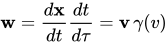
where t is coordinate time or "map time". For unidirectional motion, each of these is also simply related to a traveling object's hyperbolic velocity angle or rapidity η by
- .

Introduction
[edit]In flat spacetime, proper velocity is the ratio between distance traveled relative to a reference map frame (used to define simultaneity) and proper time τ elapsed on the clocks of the traveling object. It equals the object's momentum p divided by its rest mass m, and is made up of the space-like components of the object's four-vector velocity. William Shurcliff's monograph[1] mentioned its early use in the Sears and Brehme text.[2] Fraundorf has explored its pedagogical value[3] while Ungar,[4] Baylis[5] and Hestenes[6] have examined its relevance from group theory and geometric algebra perspectives. Proper velocity is sometimes referred to as celerity.[7]

Unlike the more familiar coordinate velocity v, proper velocity is synchrony-free[1] (does not require synchronized clocks) and is useful for describing both super-relativistic and sub-relativistic motion. Like coordinate velocity and unlike four-vector velocity, it resides in the three-dimensional slice of spacetime defined by the map frame. As shown below and in the example figure at right, proper-velocities even add as three vectors with rescaling of the out-of-frame component. This makes them more useful for map-based (e.g. engineering) applications, and less useful for gaining coordinate-free insight. Proper speed divided by lightspeed c is the hyperbolic sine of rapidity η, just as the Lorentz factor γ is rapidity's hyperbolic cosine, and coordinate speed v over lightspeed is rapidity's hyperbolic tangent.
Imagine an object traveling through a region of spacetime locally described by Hermann Minkowski's flat-space metric equation (cdτ)2 = (cdt)2 − (dx)2. Here a reference map frame of yardsticks and synchronized clocks define map position x and map time t respectively, and the d preceding a coordinate means infinitesimal change. A bit of manipulation allows one to show that proper velocity w = dx/dτ = γv where as usual coordinate velocity v = dx/dt. Thus finite w ensures that v is less than lightspeed c. By grouping γ with v in the expression for relativistic momentum p, proper velocity also extends the Newtonian form of momentum as mass times velocity to high speeds without a need for relativistic mass.[8]
Proper velocity addition formula
[edit]The proper velocity addition formula:[9][10][4]

where is the beta factor given by .

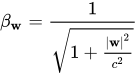
This formula provides a proper velocity gyrovector space model of hyperbolic geometry that uses a whole space compared to other models of hyperbolic geometry which use discs or half-planes.
In the unidirectional case this becomes commutative and simplifies to a Lorentz factor product times a coordinate velocity sum, e.g. to wAC = γABγBC(vAB + vBC), as discussed in the application section below.
Relation to other velocity parameters
[edit]Speed table
[edit]The table below illustrates how the proper velocity of w = c or "one map-lightyear per traveler-year" is a natural benchmark for the transition from sub-relativistic to super-relativistic motion.
| Condition/Parameter | Coordinate velocity v dx/dt in units of c |
Velocity angle η in i-radians |
Proper velocity w dx/dτ in units of c |
Lorentz factor γ dt/dτ = E/mc2 |
|---|---|---|---|---|
| Traveler stopped in map-frame ⇔ 1 map-year/traveler-year |
0 | 0 | 0 | 1 |
| Momentum = 1/2mc ⇔ 0.5 map-lightyear/traveler-year |
1/√5 ≅ 0.447 | ln[(1 + √5)/2] ≅ 0.481 | 1/2 | √5/2 ≅ 1.118 |
| Rapidity of 0.5 hyperbolic radian | (e − 1)/(e + 1) ≅ 0.462 | 1/2 | 1/2(√e − 1/√e) ≅ 0.521 | 1/2(√e + 1/√e) ≅ 1.128 |
| Coordinate velocity = 1/2c ⇔ 0.5 map-lightyear/map-year |
1/2 | 1/2ln[3] ≅ 0.549 | 1/√3 ≅ 0.577 | 2/√3 ≅ 1.155 |
| Momentum = mc ⇔ 1 map-lightyear/traveler-year |
1/√2 ≅ 0.707 | ln[1 + √2] ≅ 0.881 | 1 | √2 ≅ 1.414 |
| Rapidity of 1 hyperbolic radian | (e2 − 1)/(e2 + 1) ≅ 0.761 | 1 | 1/2(e − 1/e) ≅ 1.175 | 1/2(e + 1/e) ≅ 1.543 |
| Kinetic energy = mc2 ⇔ 2 map-years/traveler-year |
√3/2 ≅ 0.866 | ln[√3 + 2] ≅ 1.317 | √3 ≅ 1.732 | 2 |
| Momentum = 2mc ⇔ 2 map-lightyears/traveler-year |
2/√5 ≅ 0.894 | ln[2 + √5] ≅ 1.444 | 2 | √5 ≅ 2.236 |
| Rapidity of 2 hyperbolic radians | (e4−1)/(e4+1) ≅ 0.964 | 2 | 1/2(e2 − 1/e2) ≅ 3.627 | 1/2(e2 + 1/e2) ≅ 3.762 |
| Coordinate velocity = c ⇔ 1 map-lightyear/map-year |
1 | ∞ | ∞ | ∞ |
Note from above that velocity angle η and proper-velocity w run from 0 to infinity and track coordinate-velocity when w << c. On the other hand, when w >> c, proper velocity tracks Lorentz factor while velocity angle is logarithmic and hence increases much more slowly.
Interconversion equations
[edit]The following equations convert between four alternate measures of speed (or unidirectional velocity) that flow from Minkowski's flat-space metric equation:
- .

Lorentz factor γ: energy over mc2 ≥ 1
[edit]
Proper velocity w: momentum per unit mass
[edit]
Coordinate velocity: v ≤ c
[edit]
Hyperbolic velocity angle or rapidity
[edit]
or in terms of logarithms:
- .

Applications
[edit]Comparing velocities at high speed
[edit]
Proper velocity is useful for comparing the speed of objects with momentum per unit rest mass (w) greater than lightspeed c. The coordinate speed of such objects is generally near lightspeed, whereas proper velocity indicates how rapidly they are covering ground on traveling-object clocks. This is important for example if, like some cosmic ray particles, the traveling objects have a finite lifetime. Proper velocity also clues us in to the object's momentum, which has no upper bound.
For example, a 45 GeV electron accelerated by the Large Electron–Positron Collider (LEP) at Cern in 1989 would have had a Lorentz factor γ of about 88,000 (45 GeV divided by the electron rest mass of 511 keV). Its coordinate speed v would have been about sixty four trillionths shy of lightspeed c at 1 light-second per map second. On the other hand, its proper speed would have been w = γv ~ 88,000 light-seconds per traveler second. By comparison the coordinate speed of a 250 GeV electron in the proposed International Linear Collider[11] (ILC) will remain near c, while its proper speed will significantly increase to ~489,000 lightseconds per traveler second.
Proper velocity is also useful for comparing relative velocities along a line at high speed. In this case

where A, B and C refer to different objects or frames of reference.[12] For example, wAC refers to the proper speed of object A with respect to object C. Thus in calculating the relative proper speed, Lorentz factors multiply when coordinate speeds add.
Hence each of two electrons (A and C) in a head-on collision at 45 GeV in the lab frame (B) would see the other coming toward them at vAC ~ c and wAC = 88,0002(1 + 1) ~ 1.55×10¹⁰ lightseconds per traveler second. Thus from the target's point of view, colliders can explore collisions with much higher projectile energy and momentum per unit mass.
Proper velocity-based dispersion relations
[edit]
Plotting "(γ − 1) versus proper velocity" after multiplying the former by mc2 and the latter by mass m, for various values of m yields a family of kinetic energy versus momentum curves that includes most of the moving objects encountered in everyday life. Such plots can for example be used to show where the speed of light, the Planck constant, and Boltzmann energy kT figure in.
To illustrate, the figure at right with log-log axes shows objects with the same kinetic energy (horizontally related) that carry different amounts of momentum, as well as how the speed of a low-mass object compares (by vertical extrapolation) to the speed after perfectly inelastic collision with a large object at rest. Highly sloped lines (rise/run = 2) mark contours of constant mass, while lines of unit slope mark contours of constant speed.
Objects that fit nicely on this plot are humans driving cars, dust particles in Brownian motion, a spaceship in orbit around the Sun, molecules at room temperature, a fighter jet at Mach 3, one radio wave photon, a person moving at one lightyear per traveler year, the pulse of a 1.8 MegaJoule laser, a 250 GeV electron, and our observable universe with the blackbody kinetic energy expected of a single particle at 3 kelvin.
Unidirectional acceleration via proper velocity
[edit]Proper acceleration at any speed is the physical acceleration experienced locally by an object. In spacetime it is a three-vector acceleration with respect to the object's instantaneously varying free-float frame.[13] Its magnitude α is the frame-invariant magnitude of that object's four-acceleration. Proper acceleration is also useful from the vantage point (or spacetime slice) of external observers. Not only may observers in all frames agree on its magnitude, but it also measures the extent to which an accelerating rocket "has its pedal to the metal".
In the unidirectional case i.e. when the object's acceleration is parallel or anti-parallel to its velocity in the spacetime slice of the observer, the change in proper velocity is the integral of proper acceleration over map time i.e. Δw = αΔt for constant α. At low speeds this reduces to the well-known relation between coordinate velocity and coordinate acceleration times map time, i.e. Δv = aΔt. For constant unidirectional proper acceleration, similar relationships exist between rapidity η and elapsed proper time Δτ, as well as between Lorentz factor γ and distance traveled Δx. To be specific:
- ,
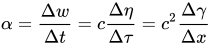
where as noted above the various velocity parameters are related by
- .
These equations describe some consequences of accelerated travel at high speed. For example, imagine a spaceship that can accelerate its passengers at 1 g (or 1.03 lightyears/year2) halfway to their destination, and then decelerate them at 1 g for the remaining half so as to provide Earth-like artificial gravity from point A to point B over the shortest possible time. For a map distance of ΔxAB, the first equation above predicts a midpoint Lorentz factor (up from its unit rest value) of γmid = 1 + α(ΔxAB/2)/c2. Hence the round-trip time on traveler clocks will be Δτ = 4(c/α)cosh−1[γmid], during which the time elapsed on map clocks will be Δt = 4(c/α)sinh[cosh−1[γmid]].

This imagined spaceship could offer round trips to Proxima Centauri lasting about 7.1 traveler years (~12 years on Earth clocks), round trips to the Milky Way's central black hole of about 40 years (~54,000 years elapsed on Earth clocks), and round trips to Andromeda Galaxy lasting around 57 years (over 5 million years on Earth clocks). Unfortunately, while rocket accelerations of 1 g can easily be achieved, they cannot be sustained over long periods of time.[14]
See also
[edit]- Kinematics: for studying ways that position changes with time
- Lorentz factor: γ = dt/dτ or kinetic energy over mc2
- Rapidity: hyperbolic velocity angle in imaginary radians
- Four-velocity: combining travel through time and space
- Uniform acceleration: holding coordinate acceleration fixed
- Gullstrand–Painlevé coordinates: free-float frames in curved spacetime.
Notes and references
[edit]- ^ a b William Shurcliff (1996) Special relativity: the central ideas (19 Appleton St, Cambridge MA 02138)
- ^ Francis W. Sears & Robert W. Brehme (1968) Introduction to the theory of relativity (Addison-Wesley, NY) LCCN 680019344, section 7–3
- ^ Fraundorf, P. (1996). "A one-map two-clock approach to teaching relativity in introductory physics". arXiv:physics/9611011.
- ^ a b Ungar, Abraham A. (2006). "The Relativistic Proper-Velocity Transformation Group". Progress in Electromagnetics Research. 60: 85–94. doi:10.2528/PIER05121501.
- ^ W. E. Baylis (1996) Clifford (geometric) algebras with applications to physics (Springer, NY) ISBN 0-8176-3868-7
- ^ D. Hestenes (2003) "Spacetime physics with geometric algebra", Am. J. Phys. 71, 691–714
- ^ Bernard Jancewicz (1988) Multivectors and Clifford algebra in electrodynamics (World Scientific, NY) ISBN 9971-5-0290-9
- ^ Oas, Gary (2005). "On the Use of Relativistic Mass in Various Published Works". arXiv:physics/0504111.
- ^ Ungar, Abraham A. (1997). "Thomas precession: Its underlying gyrogroup axioms and their use in hyperbolic geometry and relativistic physics". Foundations of Physics. 27 (6): 881–951. Bibcode:1997FoPh...27..881U. doi:10.1007/BF02550347. S2CID 122320811.
- ^ Analytic hyperbolic geometry and Albert Einstein's special theory of relativity, Abraham A. Ungar, World Scientific, 2008, ISBN 978-981-277-229-9
- ^ B. Barish, N. Walker and H. Yamamoto, "Building the next generation collider" Scientific American (Feb 2008) 54–59
- ^ This velocity-addition rule is easily derived from rapidities α and β, since sinh(α + β) = cosh α cosh β (tanh α + tanh β).
- ^ Edwin F. Taylor & John Archibald Wheeler (1966 1st ed. only) Spacetime Physics (W.H. Freeman, San Francisco) ISBN 0-7167-0336-X, Chapter 1 Exercise 51 page 97–98: "Clock paradox III"
- ^ Calle, Carlos I. (2009). Superstrings and Other Things: A Guide to Physics (2nd revised ed.). CRC Press. p. 365. ISBN 978-1-4398-1074-3. Extract of page 365
External links
[edit]Proper velocity
View on GrokipediaDefinition and Fundamentals
Definition
In special relativity, proper velocity (also known as celerity) is defined as the vector , where is the coordinate (three-)velocity relative to an observer and is the Lorentz factor, with the speed and the speed of light in vacuum. Proper velocity represents the derivative of the position vector with respect to proper time: , where is the proper time measured by a clock comoving with the object. As the spatial components of the four-velocity , proper velocity has time-component counterpart , yielding magnitude . Proper velocity shares units of velocity (length per unit time) but, unlike coordinate velocity, admits magnitudes exceeding ; for instance, as nears , grows without bound such that .[3] The concept of proper velocity was introduced by Francis W. Sears and Robert W. Brehme in 1968.[4]Physical Interpretation
Proper velocity represents the velocity experienced by an object in its instantaneous rest frame, quantifying the rate at which spatial displacement accumulates relative to the object's proper time rather than coordinate time in an external frame. This interpretation arises from the spatial components of the four-velocity, where proper time serves as the natural parameter for describing the object's worldline, ensuring that the measure remains frame-invariant in its temporal aspect while capturing relativistic motion.[5] In this sense, proper velocity provides an intuitive gauge of how the object "feels" its own progress through space, adjusted for the effects of time dilation that distort external observations.[6] Analogous to non-relativistic velocity, which is simply distance over coordinate time, proper velocity adapts this concept by substituting proper time in the denominator, thereby incorporating the relativistic slowing of the object's clock as speed increases. In the object's instantaneous rest frame, proper velocity aligns directly with the local coordinate velocity, both vanishing for a momentarily stationary object, but in other frames, it scales with the Lorentz factor to reflect the full relativistic transformation. This adjustment ensures that proper velocity remains unbounded, allowing it to exceed the speed of light in magnitude without violating causality, unlike the capped coordinate velocity.[5][6] For a particle at rest relative to an observer, the proper velocity vector satisfies , mirroring the absence of motion in that frame. As the coordinate speed increases toward , the magnitude grows hyperbolically according to , where , diverging to infinity as while the object never exceeds light speed in any frame.[5] This hyperbolic behavior highlights proper velocity's utility in visualizing relativistic limits, such as in spacecraft propulsion where accumulated proper velocity can reach enormous values over extended proper times.[7] Unlike proper acceleration, which measures the instantaneous rate of change of proper velocity and corresponds to the "felt" force in the rest frame, proper velocity itself integrates the history of motion, representing the total spatial progress per unit proper time elapsed.[5] A key conceptual advantage of proper velocity lies in its additivity within the framework of rapidity: successive Lorentz boosts along the same direction combine linearly in rapidity space, making proper velocity compositions more straightforward and Euclidean-like than the nonlinear addition of coordinate velocities.[5] This property facilitates clearer analyses of multi-stage relativistic journeys, such as in particle accelerators or interstellar travel scenarios.[7]Mathematical Properties
Components and Magnitude
Proper velocity is defined as the three-vector , where is the ordinary (coordinate) three-velocity of an object and is the Lorentz factor, with the speed and the speed of light.[2] The components of proper velocity are thus , , and .[2] This formulation scales the coordinate velocity components by while preserving the direction of . The magnitude of proper velocity is .[2] Unlike coordinate speed , which is bounded by , the magnitude has no upper limit and diverges as approaches .[2] Proper velocity exhibits a hyperbolic relation to rapidity , defined such that , where parameterizes the object's boost in a way analogous to angles in hyperbolic geometry.[2] This connection highlights the intrinsic hyperbolic structure of velocity space in special relativity, with growing exponentially for large . At low speeds (), , so , recovering the classical velocity.[2] However, at relativistic speeds near , becomes much larger than , scaling approximately as .[2] Under Lorentz boosts, the magnitude of proper velocity transforms in a manner that preserves its role as the spatial part of the invariant four-velocity, ensuring consistency across inertial frames (detailed further in the context of Lorentz invariance).Lorentz Invariance
Proper velocity, defined as the spatial components of the four-velocity , where and is the coordinate velocity, inherits the covariant transformation properties of the four-velocity under Lorentz boosts.[1] The four-velocity is a Lorentz four-vector, meaning its components mix linearly according to the Lorentz transformation matrix while preserving the Minkowski norm , which remains invariant across inertial frames.[8] This invariance underscores the fundamental role of proper time in the definition, ensuring that proper velocity quantifies motion relative to the observer's proper time measurement.[9] Consider a Lorentz boost along the x-direction with velocity , characterized by the boost Lorentz factor . The parallel component of proper velocity transforms as where is the particle's Lorentz factor in the unprimed frame.[10] The perpendicular components remain unchanged: This transformation arises directly from the four-velocity boost formulas, where the spatial parallel component mixes with the time component , while perpendicular spatial components are unaffected in a collinear boost.[10] Such behavior reflects the hyperbolic geometry of Minkowski spacetime, preserving the overall four-vector structure without altering the invariant norm.[8] In one dimension, where motion aligns with the boost direction, this structure simplifies the transformation: for a particle with proper velocity in the original frame, the boosted proper velocity follows the linear mixing formula above, facilitating intuitive handling of relativistic motion composition compared to nonlinear coordinate velocities.[10] Unlike coordinate velocity , which undergoes nonlinear transformations (e.g., ) that prevent simple vector addition and lead to paradoxes in classical intuition, proper velocity's four-vector nature ensures linear covariance, avoiding such issues.[9] This covariant property makes proper velocity particularly useful in relativistic kinematics for maintaining consistency across frames.[1]Velocity Composition
Addition Formula
The addition formula for proper velocities under collinear boosts is derived from the composition of four-velocities using Lorentz transformations. The four-velocity of an object is the four-vector , where is proper time, , and the spatial part is the proper velocity . For two collinear boosts with proper velocities and , the composed proper velocity is given by where and . This formula arises from applying the Lorentz transformation to the four-velocity in the intermediate frame and extracting the spatial component in the original frame.[11] The derivation follows from the fact that proper velocity is the spatial component of the four-velocity, which transforms linearly under Lorentz boosts. Consider an object at rest in frame S'', with four-velocity . Frame S' moves with velocity relative to S'', so the proper velocity in S' is , and the four-velocity in S' is . Frame S moves with velocity relative to S', so the Lorentz transformation from S' to S applied to yields , for the x-component (assuming collinear motion along x), simplifying to the spatial part . This simple form highlights the hyperbolic geometry underlying special relativity, where proper velocities correspond to sinh of rapidities, and collinear rapidities add directly.[11] For the general three-dimensional case, vector addition of proper velocities is not commutative or associative due to the non-commutativity of non-collinear Lorentz boosts, which introduce a Thomas rotation. The resulting proper velocity must be computed using the full composition of the four-velocity via the Lorentz group representation or by parameterizing with rapidity vectors, where the total rapidity is found from the gyrogroup structure of velocity space.[12] Unlike the coordinate velocity addition formula , which becomes highly nonlinear at relativistic speeds, the proper velocity addition remains structurally linear in the terms, facilitating calculations in high-speed scenarios such as particle accelerators where proper velocities exceed significantly.[11] In the non-relativistic limit, where , the Lorentz factors and , so , reducing to classical vector addition.[11]Relation to Coordinate Velocity Addition
In special relativity, the addition of collinear coordinate velocities and is given by the formula which arises from the Lorentz transformation between inertial frames and guarantees that .[13] In contrast, the composition of proper velocities for successive collinear boosts simplifies due to the definition , where . For boosts with coordinate velocities and (the latter measured in the frame moving at ), the total proper velocity is with and the respective Lorentz factors. This form emerges because proper velocity scales with (where is the rapidity, , ), and collinear rapidities add linearly: . The factors thus incorporate the hyperbolic geometry of velocity space, avoiding the nonlinear denominator of the coordinate formula while preserving relativistic invariance.[14][15] A numerical illustration highlights the handling differences. Consider two successive boosts, each with coordinate speed . The coordinate sum is To compute the proper velocity sum, first find for each boost. Then, This linear accumulation in proper velocity facilitates iterative calculations for multiple high-speed boosts, as the values grow unbounded above without requiring repeated nonlinear corrections. For non-collinear velocities, both approaches involve projecting components parallel and perpendicular to the relative motion. The coordinate method uses the full velocity addition for the parallel part and aberration for the perpendicular: . Proper velocity transforms the parallel component as (adjusted for frames) and the perpendicular as , but avoids division by near-zero terms in the denominator that arise in coordinate addition for nearly antiparallel relativistic speeds (e.g., head-on collisions where ), enabling more stable numerical treatment with large scalar values.[14][12] This relation to coordinate addition underscores the utility of proper velocity in accelerator physics, where particles undergo numerous near-c boosts and proper speeds reach (e.g., 50 GeV electrons at LEP2 with ), simplifying momentum and energy computations over traditional methods, as emphasized in pedagogical treatments since the 1960s.[14]Interconnections with Relativistic Parameters
Links to Lorentz Factor and Rapidity
The proper velocity connects fundamentally to the Lorentz factor and rapidity through the geometry of hyperbolic functions in special relativity. For motion along a single direction, the magnitude of proper velocity satisfies , the Lorentz factor is , and the coordinate velocity is , where is the speed of light.[16] These relations obey the fundamental hyperbolic identity , which ensures consistency with the Minkowski metric and the invariance of the spacetime interval.[16] This parametrization arises naturally from the four-velocity in Minkowski space, where the proper time along the worldline yields the hyperbolic form. The link to the Lorentz factor follows directly from the definition . Substituting the relativistic relation yields , providing an explicit expression that highlights how proper velocity extends beyond the speed-of-light limit on while remaining bounded by .[2] This formula underscores the role of proper velocity as a measure that linearly tracks at high speeds, unlike coordinate velocity. The additive property of rapidity, for successive collinear boosts, simplifies the composition of velocities in relativistic kinematics and explains the structure of proper velocity addition. In terms of proper velocity, the composition for collinear motion becomes , where the hyperbolic addition of rapidities ensures a straightforward algebraic form that avoids the nonlinear complications of coordinate velocity addition.[16] Geometrically, in a Minkowski space diagram, the worldline of constant proper acceleration traces a hyperbola, such as , with asymptotes parallel to the light cone. The proper velocity corresponds to the spatial component of the four-velocity, which is tangent to this hyperbola, representing the instantaneous direction and magnitude of motion in the observer's frame while preserving Lorentz invariance.[16] This framework extends naturally to relativistic momentum, given by , where is the rest mass, linking proper velocity directly to the dynamics of massive particles in high-energy contexts.[16]Interconversion Formulas
The proper velocity of an object is related to its coordinate velocity by the equation , where is the Lorentz factor and is the speed of light.[2][3] This relation arises because proper velocity is defined as the spatial derivative of position with respect to proper time , while coordinate velocity uses coordinate time , and .[2] To convert from proper velocity to coordinate velocity, start with (considering magnitudes for simplicity in one dimension). Substitute the expression for : , which follows from squaring the defining relation and using , yielding .[2] Thus, . In vector form, , where .[2] Conversely, to obtain proper velocity from coordinate velocity, rearrange the relation: .[2][3] This can be derived by solving the quadratic equation from : let and , then , so , , and , confirming the inverse form above.[2] Proper velocity connects directly to rapidity , defined such that and . Since , it follows that .[2] The relativistic energy and momentum also express in terms of proper velocity. The energy is , where is the rest mass, derived by substituting .[2][3] The momentum is , a particularly simple form that highlights proper velocity's role in relativistic mechanics.[2][3] For low speeds where , the distinction between proper and coordinate velocities diminishes. Expanding , the inverse relation yields , recovering classical velocity to leading order.[2]Comparative Table of Velocities
To compare proper velocity with other relativistic velocity parameters, the following table presents numerical values for coordinate velocity (as a fraction of the speed of light ), the Lorentz factor , proper velocity magnitude (as ), and rapidity across a range of speeds. These values are computed using the standard relations , , and .[2]| (rad) | |||
|---|---|---|---|
| 0 | 1.000 | 0.000 | 0.000 |
| 0.10 | 1.005 | 0.101 | 0.100 |
| 0.50 | 1.155 | 0.577 | 0.549 |
| 0.90 | 2.294 | 2.065 | 1.472 |
| 0.99 | 7.089 | 7.018 | 2.647 |