


Community hub
Recent from talks
Contribute something
Nothing was collected or created yet.
The Prospect Studios
View on Wikipedia
The Prospect Studios (also known as ABC Television Center [West]) is a lot containing several television studios located at 4151 Prospect Avenue in the Los Feliz neighborhood of Los Angeles, at the corner of Prospect and Talmadge Street (named in honor of silent screen star Norma Talmadge), just east of Hollywood.
Key Information


For over fifty years, this facility served as the home to ABC's West Coast headquarters before the network moved its main headquarters to Walt Disney Studios in 1996. After being there since 1949, ABC's Los Angeles station KABC-TV has moved to a new state-of-the-art facility located on a portion of Disney's Grand Central Creative Campus (GC3) in nearby Glendale, California, in December 1999.
Having acquired ABC's parent company in the mid-1990s, The Walt Disney Company continues to own and operate the facility to this day.
History
[edit]
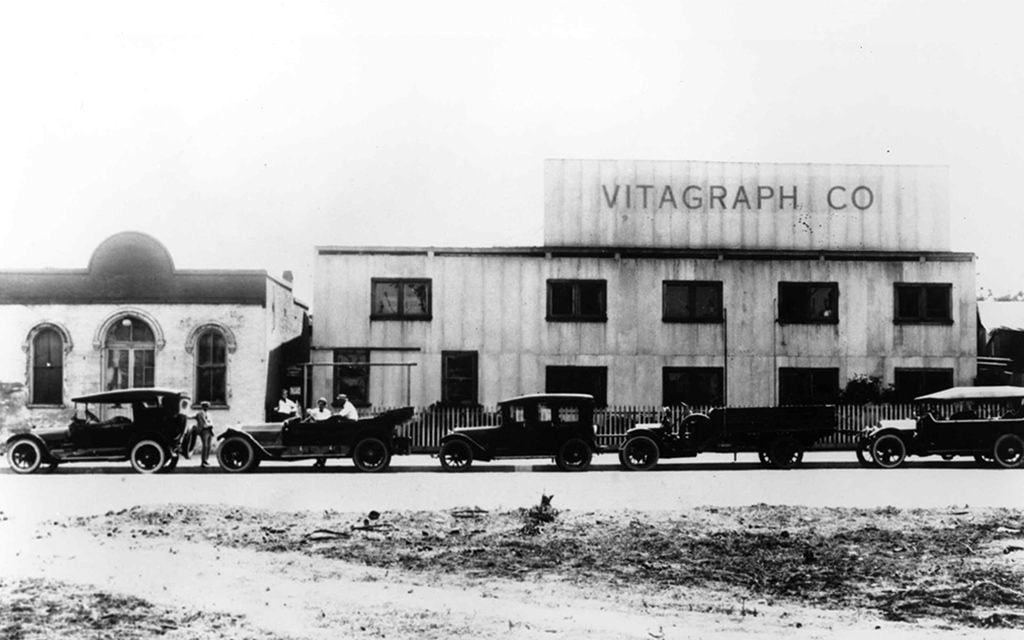
In 1911, the Vitagraph West Coast studio[1] was established at the beach, at William Rapp's Los Angeles Beer Garden (1875[2]),[3] at 1438 2nd Street,[4] in Santa Monica, but subjected to persistent fog which made filming so difficult that they moved.[5]
In 1913, the Vitagraph Studio at 4151 Prospect Avenue and Talmadge Street opened, replacing the prior Santa Monica site.[6] Originally, the silent film plant included two daylight film stages, support buildings and many exterior film sets. The company added another 10 acres to the lot in 1920. In the 1920s, production was moved from its East Coast studio.[5]
In April 1925, one of Vitagraph's founders, Albert Smith, sold control in the company to the Warner Brothers.[5] In 1927, the facility became The Warner East Hollywood Annex and was used for many large-scale films. Here, in 1927, Warner Bros. shot portions of The Jazz Singer,[7] the first film with synchronised sound, using the Vitaphone process. The "interior" club scenes for the film were shot in Stage 5, still located today in the center of the Studio Lot. In the 1930s and '40s, Warner Bros. continued to shoot on the Lot using large water tanks, ship and backlot sets.
In 1948, the property was sold to the newly formed American Broadcasting Company,[7] and the lot was re-equipped for television as the ABC Television Center. ABC proceeded to base their new Los Angeles television station, KECA-TV (now KABC-TV) in the newly purchased lot, a year later. Construction on the studio lot to bring it to its current form took place in 1957. ABC still uses the Prospect facility as a network retransmission center for its programming. Many memorable television shows, including those produced for ABC, other networks or syndication, have been produced in the studios. The third JFK/Nixon debate was partially held in this studio on October 13, 1960, with Kennedy in a New York studio, while Nixon and the interviewing panel were based at the Prospect lot, albeit in separate studios to insure fairness between the candidates. American Bandstand started recording there in 1964 (moving from Philadelphia). ABC's longest running program, General Hospital, now in its 59th year on the air, has been taped at this location since the mid-1980s after relocating from the Sunset Gower Studios in Hollywood. Many other classic television shows were also produced there including The Lawrence Welk Show, Barney Miller, Fridays, Mr. Belvedere, Welcome Back, Kotter, Benson, and Soap. Barney Miller, Benson and Soap were also shot at Sunset Gower Studios.
Four of the most well-known game shows in television history were recorded at ABC Television Center: Family Feud (1976–85, hosted by Richard Dawson), Let's Make a Deal (1968–76, hosted by Monty Hall), The Dating Game (1965–74, hosted by Jim Lange), and The Newlywed Game (1966–74, hosted by Bob Eubanks). Other game shows taped there included The Better Sex (1977–78, hosted by Bill Anderson and Sarah Purcell), Break the Bank (1976–77, hosted by Tom Kennedy for the daytime and Jack Barry for syndication), Match Game (1990–91, hosted by Ross Shafer), Password and Password All-Stars (1971–75, both hosted by Allen Ludden).
John Davidson, along with Pro Football Hall of Fame quarterback Fran Tarkenton and Cathy Lee Crosby co-hosted That's Incredible!, an ABC show that ran from 1980 to 1984, and considered one of the first true shows of the reality television genre. ABC's long-running show, America's Funniest Home Videos, taped here from 1990 to 1993 during the era of Bob Saget.
The Los Angeles Bureau of ABC News was also located at The Prospect Studios until it was moved to the KABC-TV studios in Glendale in 2011. The facility also served as broadcast headquarters for ABC's coverage of the 1984 Los Angeles Summer Olympic Games.
In 1996, ABC became part of The Walt Disney Co. As the television and film industry entered the next millennium, the lot by 2002 was renamed The Prospect Studios.[7] In 2002, the property underwent a major renovation to position its facilities for the future and new technical innovation.
Current shows besides General Hospital produced here include ABC's medical drama Grey's Anatomy.[8]
Films produced at the studio
[edit]- Captain Blood (1935)[7]
- The Jazz Singer (1927)[7]
- Sea Hawk (1940)[7]
- Noah's Ark (1928)[7]
Shows produced at the studio
[edit]- 1984 Summer Olympic Games
- ABC World News Tonight (periodically anchored out of Los Angeles; segments also produced here)
- All-Star Blitz (1985)
- Amanda's
- American Bandstand (1957-1987)[7]
- America's Funniest Home Videos (1990–1993, 1996–1997)
- America's Funniest People (1990–1992)
- Animal Crack-Ups (1987–90)
- American Journal (1993–94)
- AM Los Angeles (shown locally on KABC-TV)
- Bargain Hunters
- Barney Miller
- Benson
- The Better Sex
- Break the Bank (1976 on ABC Daytime; 1976–77, syndicated nighttime version)
- Bruce Forsyth's Hot Streak (1986)
- The Dating Game (1965–73)
- The Dick Cavett Show
- Dick Clark's New Year's Rockin' Eve (musical performances)
- Diff'rent Strokes (final season, 1985–86)
- Dolly (1987-1988)
- Double Talk (1986)
- The Ernie Kovacs Show
- Eyewitness News (KABC-TV edition)
- Family Feud (1976–1985)
- Faerie Tale Theatre (1982 - 1985)
- Fridays
- General Hospital (1963–present)
- Grey's Anatomy (2005[7]–present)[8]
- Hail to the Chief
- High Rollers (1986 pilot only)
- Hot Seat
- It's a Living (1st 2 seasons only)
- It's Garry Shandling's Show (first two seasons)
- The Krypton Factor (1981 US Version)
- Let's Make a Deal (1968–76 seasons)[7]
- The Lawrence Welk Show (some seasons; others were at the Hollywood Palladium)[9]
- Live with Regis and Kelly (a week of shows in Los Angeles, March 2007)
- Love Connection (1984–87)
- Married... with Children (Seasons 1 and 2 episodes only)
- Match Game (1990–1991)
- Moesha (season 1 only)
- Mr. Belvedere (1985–1990)
- The New Treasure Hunt (1973–74)
- The Newlywed Game (1966–74)[10]
- Night Court (1984)
- Off the Rack (1985 sitcom)
- The Oprah Winfrey Show (periodic West Coast shows)
- Password (1971–75)
- Port Charles
- Rhyme and Reason
- Robotica (TV series) 3 seasons (2001-2002)
- Run for the Money (1987 pilot produced by Reg Grundy Productions; later became Going for Gold in Great Britain)
- Second Chance
- The Shield (2006)[7]
- Seven Keys with Jack Narz (1960–65)
- Showoffs (1975)
- Sister Kate (TV Series) (1989–90)
- Soap
- Soap Talk
- The Sonny and Cher Show (1976–1977)
- Space Patrol (1950–1955)
- Split Second (1972–75)
- That's Incredible!
- That's My Mama (some Season 1 episodes taped at CBS Television City)
- Three's a Crowd
- Three's Company (Some of 1st season)
- Trivia Trap
- The View (periodic West Coast shows)
- Welcome Back, Kotter
- We Got It Made (1987-88 syndicated version)
- What's Happening!!
- You Asked for It
External links
[edit]References
[edit]- ^ "(1912)* – View showing early model cars parked in front of Vitagraph Film Company and Rapp Saloon located on the 1400 block of 2nd Street in Santa Monica". Early_Views_of_Santa_Monica_(Page_2). Water and Power Associates. Retrieved 2 May 2025.
- ^ Murphy, Cynni (2001). "Rapp Saloon, 1438 Second Street, the oldest masonry building in Santa Monica built in 1875 for William Rapp". calisphere.
- ^ "The Rapp Saloon". Santa Monica History Spotlight. santamonica.gov. Retrieved 2 May 2025.
- ^ Turnbull, Martin (November 20, 2018). "The Vitagraph Motion Picture Company, 2nd St, Santa Monica, 1912". Martin Turnbull .com. Retrieved 2 May 2025.
- ^ a b c Slide, Anthony (1976). The Big V: A History of the Vitagraph Company. Scarecrow Press. pp. 91, 108. ISBN 9780810809673. Retrieved May 23, 2019.
- ^ Stephens, E. J.; Wanamaker, Marc (2014). Early Poverty Row Studios. Arcadia Publishing. p. 76. ISBN 9781439648292. Retrieved May 23, 2019.
- ^ a b c d e f g h i j k Wanamaker, Marc (April 13, 2009). Hollywood 1940-2008. Arcadia Publishing. p. 1959. ISBN 9781439620809. Retrieved May 23, 2019.
East Hollywood Annex.
- ^ a b Ng, Philiana (April 10, 2018). "'Grey's Anatomy' Star Jessica Capshaw Shares Nostalgic Tweet From Last Day on Grey Sloan Set". Entertainment Tonight. Retrieved May 11, 2019.
- ^ Kaufman, Dave (1968). TV 69: Who's Who, What's What in the New TV Season (mass market paperback). New York: Signet. p. 123.
- ^ Kaufman, p. 131
The Prospect Studios
View on GrokipediaHistory
Origins and Early Film Production (1915–1920s)
The Prospect Studios site began as the West Coast production facility for the Vitagraph Company of America, opening in 1915 at 4151 Prospect Avenue in Los Angeles' Los Feliz neighborhood, on the corner of Prospect and Talmadge streets.[4] [5] This location replaced an earlier Vitagraph operation in Santa Monica and was developed on a former sheep ranch to support the growing demand for film production in Hollywood, where consistent sunlight and diverse outdoor settings facilitated efficient shooting.[4] The initial infrastructure consisted of two daylight film stages—relying on natural light through large glass-paneled roofs—along with support buildings for editing, wardrobe, and administration, and expansive exterior sets for period dramas and comedies.[4] These facilities enabled high-volume output of silent shorts and features typical of the era, with Vitagraph leveraging the site to produce content featuring early stars like Stan Laurel, who appeared in comedies there before his later fame.[6] The studio's design emphasized scalability, accommodating the rapid evolution of film techniques amid competition from East Coast rivals and the influx of talent to California. Throughout the late 1910s and early 1920s, the Vitagraph Studio at Prospect focused on silent film manufacturing, contributing to the company's reputation for quality one- and two-reelers that emphasized narrative innovation and special effects, such as those pioneered by founder J. Stuart Blackton.[7] Production emphasized cost efficiency, with the site's proximity to urban Los Angeles allowing quick access to extras and props while its acreage supported elaborate outdoor sequences. By the mid-1920s, however, financial pressures in the consolidating industry led Vitagraph's founder Albert E. Smith to sell the company—and thus the Prospect facility—to Warner Bros. in 1925, shifting control to the emerging major studio.[6] [7] This acquisition preserved the site's operational continuity, making it one of Los Angeles' earliest enduring film plants.[4]Warner Bros. Ownership and Silent Era Challenges (1920s–1940s)
In 1925, Warner Bros., then a modestly scaled operation focused on distribution and low-budget productions, acquired the Vitagraph Company for expansion into major film manufacturing, gaining its 23-acre Prospect Avenue facility in Hollywood alongside a Brooklyn site.[8] [9] This move, financed via $4 million in three-year notes arranged by Goldman Sachs at 6.5% interest, burdened Warner with over $5 million in debt amid intense competition from vertically integrated giants like MGM and Paramount, which dominated silent film output through superior resources and star contracts.[8] [10] The Prospect lot, established in 1915 with two daylight stages, administrative buildings, and expansive backlots for exteriors, had already hosted dozens of silent shorts and features, but under Warner, it underscored the studio's precarious finances, as silents required costly physical sets and distribution battles against established exchanges geared for shorter formats.[11] By 1927, the site was rebranded the Warner East Hollywood Annex, serving as a key venue for scaled-up silent and early sound experiments, including segments of The Jazz Singer, Warner's Vitaphone-equipped feature that premiered synchronized dialogue and music on October 6, 1927, at the Warner Theatre in New York.[11] [4] This innovation stemmed from Warner's silent-era vulnerabilities—limited access to top talent and theaters forced reliance on vaudeville acts and shorts—but demanded risky capital for sound-on-disc technology and a dedicated Vitaphone stage at Prospect, converting what had been a silent plant into a hybrid facility with water tanks and ship mockups for spectacles.[12] The gamble paid off modestly at first, with The Jazz Singer grossing $1.9 million domestically against a $500,000 cost, yet it highlighted causal pressures: without sound differentiation, Warner risked obsolescence in an oversaturated market where production costs averaged $200,000–$300,000 per feature for independents versus majors' efficiencies. Into the 1930s and 1940s, Prospect supported Warner's talkie surge with films like The Public Enemy (1931), Gold Diggers of 1933, and Captain Blood (1935), leveraging backlots for urban and period sets amid Depression-era contractions that halved industry attendance from 1929 peaks and triggered bankruptcies among smaller players.[6] Safety hazards exemplified operational challenges; the 1928 production of Noah's Ark at Prospect's flood tank claimed three extras' lives during a scripted deluge, prompting scrutiny of on-set protocols in an era of minimal regulation.[6] Warner navigated these through genre shifts to gritty realism and musicals, but the lot's role diminished post-1940 as Burbank centralized major features, culminating in the 1948 sale to ABC for $3.5 million to pivot toward television amid waning theatrical viability.[11]Transition to Television under ABC (1948–1990s)
In 1948, Warner Bros. sold the former Vitagraph Studios property at 4151 Prospect Avenue in Los Angeles to the American Broadcasting Company (ABC), which had recently separated from NBC and was expanding into television amid the post-World War II boom in the medium.[13][6] The acquisition marked ABC's strategic shift toward owning dedicated West Coast facilities for live and taped programming, converting the aging film lot—equipped with soundstages from the silent era—into a television production hub renamed the ABC Television Center West.[4] This transition involved retrofitting stages for broadcast needs, including installing lighting rigs, control rooms, and audience seating to accommodate the demands of early network TV, which prioritized quick-turnaround shows over feature films.[7] By 1949, ABC announced plans to invest $6.25 million in the site, allocating $2.5 million specifically for converting approximately 20 acres into operational TV studios, enabling the network to produce content for its growing affiliates. The facility quickly became ABC's primary Los Angeles base, hosting a range of programming from variety shows and dramas to the network's signature game shows, which thrived due to the lot's central location and infrastructure suited for audience-participation formats.[14] Notable early productions included game shows like Stop the Music (1949–1954) and The Name's the Same (1951–1955), which leveraged the stages' flexibility for live broadcasts, helping ABC compete with rivals CBS and NBC in the nascent TV market.[4] Throughout the 1950s and 1960s, the studios supported ABC's expansion into prime-time hits, such as westerns like The Adventures of Ozzie and Harriet (1952–1966) and sitcoms, while also serving as a venue for news and specials.[13] The 1970s and 1980s solidified its role in game show production, with tapings of Family Feud (ABC run, 1976–1985) and Match Game (1973–1979 revival), which drew large studio audiences and capitalized on the era's popularity of daytime TV.[14] Sitcoms like Who's the Boss? (1984–1992) and Mr. Belvedere (1985–1990) were also filmed there, utilizing multiple stages for multi-camera setups typical of ABC's family-oriented programming.[15] By the late 1980s, ongoing upgrades maintained the facility's viability for high-volume TV output, though increasing costs and competition from newer lots began to diversify ABC's production footprint.[7]Disney Acquisition and Renaming (1996–2002)
The Walt Disney Company completed its acquisition of Capital Cities/ABC Inc. on February 9, 1996, integrating ABC's assets including the ABC Television Center at 4151 Prospect Avenue in Los Angeles, which had served as the network's primary West Coast production facility since 1949.[16][7] This $19 billion transaction, announced on July 31, 1995, marked Disney's largest purchase to date and brought the 23-acre lot under corporate oversight aimed at consolidating media operations.[17] Following the acquisition, Disney initiated operational shifts at the facility, including the relocation of KABC-TV, ABC's owned Los Angeles station, which vacated the premises in December 2000 for a new state-of-the-art studio at Disney's Grand Central Business Centre in Glendale.[18][19] This move reduced on-site network broadcasting activities, transitioning the lot toward greater reliance on independent productions and rentals while continuing to host long-running ABC shows such as General Hospital. The changes reflected Disney's broader strategy to centralize certain functions at its Burbank headquarters and optimize underutilized properties for revenue generation through leasing.[7] In 2002, Disney invested in a comprehensive renovation of the aging infrastructure, updating soundstages, technical equipment, and support facilities to accommodate modern film, television, and commercial productions.[4] Concurrently, the lot was rebranded as The Prospect Studios, named after its Prospect Avenue address, signaling its evolution into a versatile, tenant-focused rental venue detached from primary ABC affiliation.[7] This renaming and upgrade positioned the property as a competitive independent studio in Hollywood, emphasizing flexibility over network-specific use.[4]Recent Developments and Renovations (2002–Present)
In 2002, The Prospect Studios underwent a major renovation to modernize its infrastructure and accommodate emerging technical innovations in television and film production.[4] This update transformed the 22-acre facility into a versatile rental lot optimized for diverse projects, including scripted series, commercials, and independent productions.[4] Following the overhaul, the studios shifted to a full rental operation model under Disney ownership, divesting from direct ABC network programming activities. This transition capitalized on the lot's central Los Angeles location in Los Feliz, drawing external tenants while preserving its historic stages for contemporary use.[4] By December 2000, ahead of the renovation, KABC-TV had relocated its operations to a new broadcast center in Glendale, California, reducing on-site network presence and emphasizing the site's role as a neutral production venue.[18] No significant structural renovations have been documented since 2002, with the facility maintaining its post-upgrade configuration for ongoing rental demand.[2]Facilities and Infrastructure
Studio Layout and Stages
The Prospect Studios comprises a 22-acre production facility at 4151 Prospect Avenue in Los Angeles' Los Feliz neighborhood, originally developed as Vitagraph Studios in 1915 with early support buildings, exterior sets, and water tanks that facilitated silent film production.[4] Under subsequent ownership by Warner Bros. and ABC, the layout evolved to prioritize television infrastructure, including sound stages, control rooms, and technical centers, with a 2002 renovation by Disney enhancing modern production capabilities without expanding the core footprint.[4] [7] The site lacks a dedicated backlot today but includes workshops and post-production spaces integrated around the primary stages.[20] The facility houses seven sound stages optimized for television and film, totaling 99,500 square feet, with features such as cycloramas in multiple colors (vinyl, green, blue, white) for chroma key effects across all stages.[20] Historical designations shifted from lettered studios (A–E) under ABC to numbered stages post-renovation, with some retaining specialized elements like fly lofts added in the 1920s for overhead rigging.[7] Key stages include rebuilt facilities from 1988–1989 expansions, such as one measuring 20,000 square feet over three stories with integrated dressing rooms and offices.[7]| Stage | Dimensions (Width × Length in ft) | Area (sq ft) | Notable Features |
|---|---|---|---|
| 68 | 74 × 35 | 11,000 | Cyclorama (V, G, B, W) |
| 74 | 106 × 22 | 7,800 | Cyclorama (V, G, B, W) |
| 97 | 216 × 40 | 21,000 | Cyclorama (V, G, B, W); largest stage |
| 87 | 121 × 56 | 10,000 | Cyclorama (V, G, B, W) |
| 127 | 144 × 19 | 19,700 | Cyclorama (V, G, B, W) |
| 100 | 150 × 43 | 15,000 | Cyclorama (V, G, B, W) |
| 100 | 150 × 43 | 15,000 | Cyclorama (V, G, B, W) |