


Community hub
Recent from talks
Contribute something
Nothing was collected or created yet.
Protoceratidae
View on Wikipedia
| Protoceratids Temporal range:
| |
|---|---|

| |
| Synthetoceras | |
Scientific classification 
| |
| Kingdom: | Animalia |
| Phylum: | Chordata |
| Class: | Mammalia |
| Order: | Artiodactyla |
| Family: | †Protoceratidae |
| Subfamilies, Tribes and Genera | |

| |
| Range of Protoceratidae based on fossil record. | |
Protoceratidae is an extinct family of herbivorous North American artiodactyls (even-toed ungulates) that lived during the Eocene through Pliocene. While early members of the group were hornless, in later members males developed elaborate cranial ornamentation. They are variously allied with Ruminantia or Tylopoda.[2]
Classification
[edit]Protoceratidae was erected by Othniel Charles Marsh in 1891, with the type genus Protoceras and assigned to the Artiodactyla.[3][4][5] It was later assigned to Pecora,[6] and more recently to Ruminantia[7][8] or Tylopoda.[9] However, recently a relationship to chevrotains in the infraorder Tragulina has been proposed.[8]
Morphology
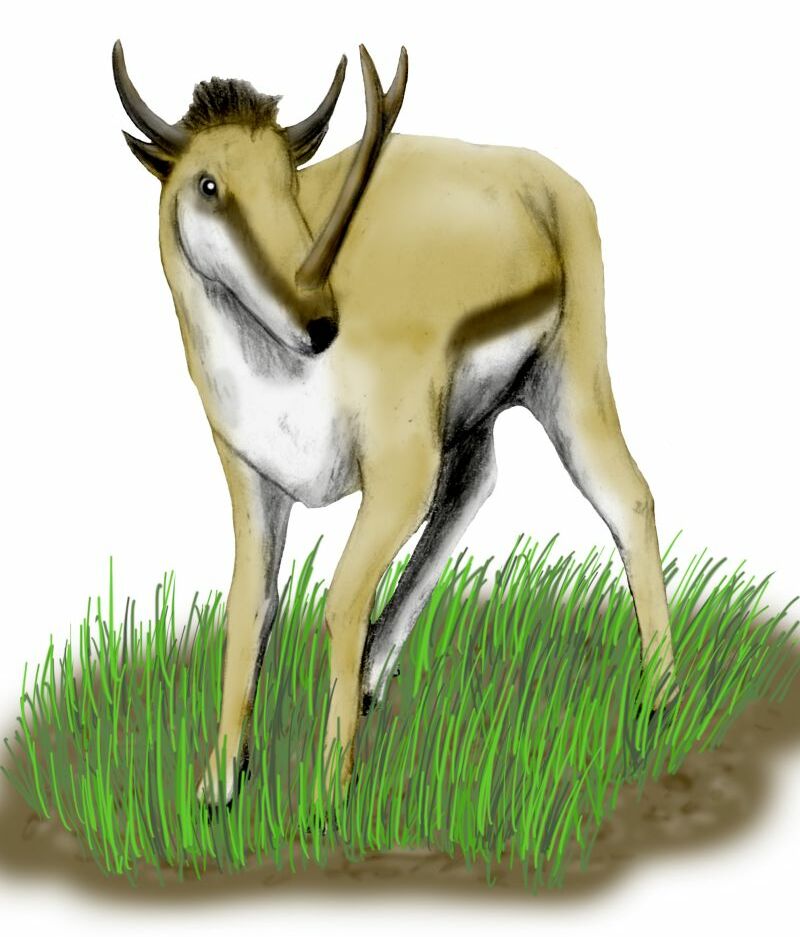
[edit]When alive, protoceratids would have resembled deer, though they were not directly related. Protoceratids ranged from 1 to 2 m in length, from about the size of a roe deer to an elk. Unlike many modern ungulates, they lacked cannon bones in their legs. Their dentition was similar to that of modern deer and cattle, suggesting they fed on tough grasses and similar foods, with a complex stomach similar to that of camels. At least some forms are believed to have lived in herds.[10]
The most dramatic feature of the protoceratids, however, were the horns of the males. In addition to having horns in the more usual place, protoceratids had additional, rostral horns above their noses. These horns were either paired, as in Syndyoceras, or fused at the base, and branching into two near the tip, as in Synthetoceras. In life, the horns were probably covered with skin, much like the ossicones of a giraffe. The females were either hornless, or had far smaller horns than the males. Horns were therefore probably used in sexual display or competition for mates. In later forms, the horns were large enough to have been used in sparring between males, much as with the antlers of some modern deer.[11]
Genera by epoch
[edit]References
[edit]- ^ Prothero, D.R. (1998). "Protoceratidae". In Janis, C.M.; Scott, K.M.; Jacobs, L.L. (eds.). Evolution of Tertiary mammals of North America. Cambridge: Cambridge University Press. pp. 431–438. ISBN 0-521-35519-2.
- ^ Robson, Selina Viktor; Seale, Brendon; Theodor, Jessica M. (2021-07-29). Louys, Julien (ed.). "The petrosal and basicranial morphology of Protoceras celer". PLOS ONE. 16 (7) e0251832. doi:10.1371/journal.pone.0251832. ISSN 1932-6203. PMC 8321106. PMID 34324518.
- ^ O. C. Marsh. 1891. A horned artiodactyle (Protoceras celer) from the Miocene. The American Journal of Science and Arts, series 3 41(241):81-82
- ^ S. D. Webb, B. L. Beatty, and G. Poinar, Jr. 2003. New evidence of Miocene Protoceratidae including a new species from Chiapas, Mexico. Bulletin of the American Museum of Natural History 279:348-367
- ^ D. R. Prothero and J. A. Ludtke. 2007. Family Protoceratidae. in D. R. Prothero and S. Foss (eds.), The Evolution of Artiodactyls 169-176
- ^ H. J. Cook. 1934. New artiodactyls from the Oligocene and Lower Miocene of Nebraska. American Midland Naturalist 15(2):148-165
- ^ Thurmond and Jones (1981) [full citation needed]
- ^ a b Spaulding, Michelle; O'Leary, Maureen A.; Gatesy, John (2009). "Relationships of Cetacea (Artiodactyla) among mammals: increased taxon sampling alters interpretations of key fossils and character evolution". PLOS ONE. 4 (9) e7062. Bibcode:2009PLoSO...4.7062S. doi:10.1371/journal.pone.0007062. PMC 2740860. PMID 19774069.
- ^ Carroll and by Webb et al., 2003 [full citation needed]
- ^ Palmer, D., ed. (1999). The Marshall Illustrated Encyclopedia of Dinosaurs and Prehistoric Animals. London: Marshall Editions. pp. 272–273. ISBN 1-84028-152-9.
- ^ Savage, RJG & Long, MR (1986). Mammal Evolution: an illustrated guide. New York: Facts on File. pp. 222–225. ISBN 0-8160-1194-X.
Protoceratidae
View on GrokipediaOverview
Etymology and history of study
The family Protoceratidae was established by American paleontologist Othniel Charles Marsh in 1891, based on fossils of the type genus *Protoceras* recovered from the White River Formation in South Dakota. The name derives from the Greek roots "proto-" (first) and "keras" (horn), alluding to these as the earliest known horned artiodactyls.[5] Initial studies of Protoceratidae occurred in the late 19th century, with Marsh's description marking the group's formal recognition amid broader investigations into North American Tertiary mammals. Early 20th-century work by O.A. Peterson advanced understanding of Oligocene representatives, including detailed descriptions of cranial features and stratigraphic contexts from White River deposits. Comprehensive revisions in the mid-20th century came from Childs Frick, who in 1937 analyzed extensive collections to delineate subfamilies within Protoceratidae, emphasizing variation in horn-like structures and dentition. More recent phylogenetic analyses have integrated Protoceratidae into broader artiodactyl evolutionary frameworks, with Spaulding et al. (2009) incorporating morphological and molecular data to explore ties to tylopods and ruminants. Key early fossil discoveries include Eocene specimens from Wyoming's Bridger Basin, such as elements of Leptotragulus, representing primitive members of the family, alongside abundant Oligocene material from Nebraska's White River Formation.[2][6]Temporal and geographic distribution
The Protoceratidae, an extinct family of North American artiodactyls, are known from the fossil record spanning the Middle Eocene to the Early Pliocene, approximately 46 million years ago (Ma) to 4.9 Ma, representing a temporal duration of roughly 41 million years. The earliest records come from primitive forms such as Leptotragulus in the upper Middle Eocene of the western United States, marking the initial appearance of the family. The latest occurrences are represented by Kyptoceras amatorum in early Pliocene deposits of the southeastern United States, indicating persistence into the Neogene.[2][1] Fossils of Protoceratidae are confined to North America, with no evidence of occurrences elsewhere on the continent or globally. The core of their distribution centered on the western United States, where key localities in Wyoming (e.g., Uintan stages), Nebraska (White River Group), Colorado, Utah, and South Dakota have yielded abundant material from Eocene through Miocene horizons. This region hosted diverse assemblages reflecting the family's radiation during periods of climatic stability in the Paleogene and Neogene.[7][8] The family's range extended eastward and southward, with isolated records in Florida (Kyptoceras from Pliocene sites) and Mexico (Paratoceras tedfordi from early Miocene amber-bearing sands in Chiapas), highlighting a broader continental footprint during the Miocene. Further south, early Miocene protoceratid remains have been reported from Panama, including partial dentitions from the Lirio Norte Local Fauna in the Panama Canal basin, indicating presence in tropical Central American environments.[1][8] These peripheral finds suggest adaptability to subtropical environments along the Gulf Coast and into northern Central America.[9] The fossil record exhibits notable gaps, with Eocene occurrences being rare and limited to basal taxa, a peak in abundance and diversity during the Oligocene and Miocene across multiple formations, and sparse Pliocene remains confined to a single genus. This distribution pattern underscores an endemic North American lineage with temporal fluctuations likely tied to environmental changes, such as the transition from forested Paleogene habitats to more open Neogene landscapes.[8][2] A significant expansion of the known southern range came with the 2003 description of Paratoceras tedfordi from early Miocene sediments near Simojovel, Chiapas, Mexico, based on cranial material recovered from amber-associated deposits, providing evidence of protoceratid presence in tropical lowlands.[9]Taxonomy
Classification and subfamilies
Protoceratidae is an extinct family of artiodactyls classified within the order Artiodactyla, with debated placement as a basal tylopod (suborder Tylopoda) or as a stem group to Ruminantia, with some studies suggesting affinities near the base of the suborder.[10] This uncertainty stems from morphological similarities to both camel relatives (Tylopoda) and higher ruminants, leading to historical misclassifications as early camels due to shared primitive features like reduced limb metapodials.[10] The family is diagnosed by the absence of fused cannon bones in the autopodium, selenodont dentition adapted for browsing, and evidence of multi-chambered stomachs inferred from dental and cranial morphology indicative of ruminant-like digestion.[10] The family comprises three subfamilies, reflecting increasing cranial elaboration over time. Leptotragulinae represents the primitive, hornless forms from the Eocene, characterized by simple cranial structures and retention of basal artiodactyl traits without ossicones or protuberances.[10] Protoceratinae includes small to medium-sized taxa from the Oligocene to Miocene with paired, upright horns or ossicones on the frontal and nasal bones, as seen in the type genus Protoceras, typified by the species P. celer from Oligocene deposits in North America.[10] Synthetoceratinae features larger-bodied forms from the Miocene to Pliocene with branched and elaborate horn-like structures, often involving complex nasal and frontal appendages for display or combat.[10] No major synonyms exist for Protoceratidae, though early 20th-century classifications occasionally grouped it with hypertragulids or other stem ruminants before its distinct familial status was solidified in the mid-20th century.[10]Phylogenetic relationships
The phylogenetic position of Protoceratidae within Artiodactyla has long been debated, with early interpretations placing the family as primitive ruminants allied to the infraorder Pecora based on shared selenodont dentition and cranial features.[10] Alternative hypotheses proposed Protoceratidae as basal tylopods closely related to Camelidae, citing postcranial similarities such as the configuration of the astragalus and navicular-cuboid fusion patterns.[11] In contrast, a comprehensive cladistic analysis incorporating molecular and morphological data positioned Protoceratidae within basal Ruminantiamorpha, as a sister group to Ruminantia (including Tragulina and Pecora), supported by dental traits like brachydont molars and postcranial features including limb proportions adapted for cursorial locomotion.[5] Cladistic studies indicate that Protoceratidae branched early from stem artiodactyls, forming a basal lineage of neoselenodont artiodactyls characterized by selenodont cheek teeth but lacking true bony horns, instead developing ossicone-like structures on the skull.[12] This placement contrasts with Oromerycidae, an earlier Paleogene group lacking advanced selenodonty and serving as an outgroup to later tylopods and ruminants, while differing from Camelidae through the absence of pronounced humps and specialized desert adaptations in postcranial skeleton.[13] Recent analyses using CT scans of basicranial morphology have refined the intrafamilial position of Protoceras within Protoceratinae, revealing conserved petrosal features such as a shallow subarcuate fossa that align more closely with ruminant affinities than camelid ones, thereby supporting a placement near the base of Ruminantia rather than Tylopoda.[10] As of 2024, reassessments of features like the vertebrarterial canal continue to leave the phylogenetic position ambiguous, though basicranial evidence favors ruminant relationships.[14]Anatomy
General morphology
Protoceratids were small to medium-sized, deer-like herbivores characterized by a lightweight build suited to forested environments. They typically measured 1 to 2 meters in length and weighed between 20 and 350 kg, with body masses varying across genera and reflecting adaptations to browsing lifestyles.[15] Their overall skeletal structure emphasized agility over speed, featuring slender limbs that supported terrestrial locomotion in woodland habitats. Unlike modern bovids, protoceratids lacked fused cannon bones, instead retaining unfused metapodials that allowed greater flexibility in movement.[1] The postcranial skeleton included elongated metacarpals and metatarsals, which contributed to a cursorial yet not highly specialized gait, enabling quick maneuvers among vegetation. The manus and pes were four-toed, with the central digits bearing most of the weight, a primitive artiodactyl condition that contrasted with the more reduced foot structures in advanced ruminants. Cervical and thoracic vertebrae exhibited features such as the vertebrarterial canal passing through the pedicles, a trait shared with camelids, potentially supporting neck flexibility for reaching browse.[15] This morphology, combined with short overall limb length in some taxa, suggests a posture adapted for selective feeding on leaves and twigs rather than open-ground grazing. Dentition in protoceratids consisted of selenodont molars, generally brachydont to subhypsodont depending on the subfamily, with crenulated enamel suited to grinding fibrous plant material. Upper premolars were elongate and lacked strong protocones in basal forms, while lower premolars showed bulbous hypoconids in derived species for efficient mastication. They lacked upper incisors, relying on a dental pad, and possessed lower incisors and an incisiform canine adapted for cropping vegetation.[15] Sexual dimorphism was pronounced, with males generally larger in body size and exhibiting cranial ornamentation such as ossicones or horns used for display, while females were smaller and lacked these structures, though roughened bone surfaces in homologous positions suggest secondary sexual traits.[15]Cranial features and ornamentation
The skulls of protoceratids are characterized by an elongated rostrum that constitutes approximately two-thirds of the total skull length, providing a narrow preorbital region adapted for browsing. The retracted nasal bones and enlarged attachments for the M. nasolabialis muscle suggest the presence of a tapir-like proboscis for accessing foliage. Large orbits positioned rostrally enable panoramic vision, with a complete postorbital bar present in more derived taxa such as those in Protoceratinae and Synthetoceratinae. The nasal bones are small and meet at a pointed process above the external nares, often expanded to form bases for cranial appendages in males.[16][4] Cranial ornamentation in Protoceratidae evolved from hornless forms in early members, such as those in Leptotragulinae (e.g., Leptotragulus), which exhibit a broad, flattened forehead without appendages and an incomplete postorbital bar. In Protoceratinae, males developed paired ossicones originating from the nasal and maxillary regions, as seen in Protoceras, where simple spike-like horns project from the frontals and parietals. Synthetoceratinae display more complex structures, including Y- or X-shaped fused horns; for instance, Synthetoceras features a distinctive forked rostral horn with a span approaching 1 meter in large individuals. These bony cores show vascular grooves indicative of integumentary covering, and ornamentation is sexually dimorphic, with females typically lacking or possessing reduced forms.[2][16][17] The ornamentation likely served functions in sexual display and intraspecific competition among males, as evidenced by the persistent development of elaborate structures across derived genera like Syndyoceras, which bears paired V-shaped rostral horns fused at the base alongside posterior pairs. Such features parallel those in modern ruminants, where cranial appendages facilitate mate attraction and combat without evidence of defensive roles against predators.[17]Paleobiology
Diet and digestive system
Protoceratids were herbivorous artiodactyls that primarily functioned as browsers, consuming leaves, fruits, and other soft vegetation in forested or woodland environments. Dental microwear analysis of genera such as Lambdoceras reveals patterns consistent with folivory, including low scratch densities indicative of non-abrasive plant material rather than grasses.[19] Their selenodont dentition, with brachydont to mesodont crowns and thick, crenulated enamel, further supported selective feeding on dicotyledonous browse, allowing efficient processing of fibrous leaves through shearing action. Some later Miocene forms, such as those in the Synthetoceratinae subfamily, show increased crown heights (approaching mesodonty) and tooth wear suggesting adaptation to tougher, more abrasive browse in opening habitats.[19] The digestive system of Protoceratidae is inferred to have been complex and pseudo-ruminant-like, based on hypotheses placing them near or within Tylopoda, featuring a multi-chambered forestomach analogous to that of modern tylopods (e.g., camelids) for microbial fermentation of cellulose-rich plant material. This physiology would have enabled efficient nutrient extraction from low-quality forage as selective feeders, without the true omasum-abomasum division seen in pecorans; direct evidence is limited to inferences from cranial and dental morphology.[19] Dental microwear and other evidence indicate a diet dominated by C3 plants (e.g., trees and shrubs). Evolutionary trends in protoceratid paleobiology highlight a progression from strictly folivorous early forms in the Eocene, adapted to soft, non-abrasive vegetation via low-crowned teeth, to more versatile browsers by the Miocene, where relative increases in crown heights indicate tolerance for tougher materials like stems. These adaptations underscore their ecological niche as woodland herbivores before environmental shifts favored open-savanna competitors.Locomotion and habitat preferences
Protoceratids were cursorial artiodactyls with limb morphologies adapted for agility and evasion in vegetated terrains rather than sustained high-speed pursuits across open expanses. Their postcranial skeletons retained primitive features, including four functional digits on both manus and pes, unfused metapodials, and relatively short metapodials comprising less than 25% of overall limb length, paired with elongated zeugopodia (radius and tibia). These traits supported an unguligrade stance with moderate flexibility, suitable for navigating soft substrates in woodlands and avoiding predators through quick maneuvers rather than pronghorn-like velocity. Derived protoceratids, particularly in the Synthetoceratinae, exhibited further specializations for enhanced mobility, such as hind limbs approximately 20% longer than forelimbs and robust articulations at the knee and ankle, enabling rearing postures to reach elevated foliage or bounding gaits for short bursts of speed. Proximal phalanges featured raised dorsal ridges, reinforcing stability on uneven forest floors, while overall limb ratios inferred a gait combining trotting with occasional leaps, ideal for forested or semi-wooded niches. Their slender build further aided maneuverability in dense undergrowth. Habitat preferences of protoceratids evolved in concert with North American paleoenvironments, reflecting broader climatic shifts from humid to increasingly seasonal and arid conditions. Basal forms like Leptotragulus occupied middle Eocene forests of the Bridger Formation in the Green River Basin, characterized by diverse, closed-canopy woodlands under warm, mesic climates with high humidity and year-round precipitation.[20] By the late Eocene to Oligocene, in the White River Formation of the Great Plains, protoceratids inhabited open semi-arid woodlands transitioning to bunch grasslands, as indicated by paleosol profiles with calcic horizons and ichnofossils suggesting seasonal dryness and sparse tree cover.[21] Miocene diversification occurred amid further grassland expansion, with genera in the John Day Formation of Oregon thriving in open, semiarid bunch-grass savannas interspersed with riparian zones, supported by volcaniclastic paleosols evidencing low tree density and pronounced dry seasons. Pliocene records, including Kyptoceras from the Gulf Coastal Plain, point to more arid savanna-woodland mosaics, potentially favoring riparian corridors near water sources in increasingly seasonal, drought-prone landscapes.[22] As mid-sized browsing herbivores (1–2 m in length), protoceratids integrated into multispecies ungulate communities alongside oreodonts, early equids, and camels, influencing browse availability in Eocene forests and Oligo-Miocene woodlands-grassland ecotones through selective foraging on leaves and fruits. Their presence in diverse faunas underscores an ecological niche as forest-adapted generalists, with analogs to modern bushbucks in subtropical thickets, facilitating predator avoidance via agility in group settings inferred from taphonomic patterns in associated bone assemblages.Evolutionary history
Eocene origins
The Protoceratidae emerged in the middle Eocene of North America, with the earliest definitive records dating to approximately 46 million years ago during the early Uintan North American Land Mammal Age.[23] This timing places their origin within the context of a diversifying artiodactyl radiation following the early Eocene, though exact ancestral ties to primitive groups like dichobunoids remain unresolved in current phylogenies.[10] The family's initial appearance is marked by fossils from the Uinta Formation in Uinta County, Utah, and potentially correlated strata in the Bridger Basin of Wyoming, reflecting a restricted distribution in western North America at this stage.[2][24] Early protoceratids were primitive and hornless, exemplified by genera such as Leptotragulus and Leptoreodon, which attained small body sizes suitable for forested habitats.[2][24] These forms lacked the elaborate cranial ornamentation of later relatives, instead featuring broad, flattened skulls with pronounced occipital crests suggestive of incipient agonistic behaviors.[2] They coexisted with early perissodactyls, including primitive equids like Epihippus and brontotheres such as Wickia, in the humid, woodland-dominated ecosystems of the Eocene interior.[25] A key adaptation in these basal taxa was the onset of selenodonty in the upper molars, which exceeded that observed in contemporary homacodont artiodactyls like Bunomeryx and supported a browsing diet amid Eocene vegetation.[2] The Eocene fossil record for Protoceratidae is notably sparse, yielding primarily isolated teeth, limb elements, and rare cranial material from just 3–4 genera, with no evidence of widespread radiation or morphological experimentation beyond these foundational traits.[2][24] This limited early diversity underscores the family's gradual establishment before subsequent expansions in later epochs.Oligocene and Miocene diversification
The Protoceratidae underwent significant radiation during the Oligocene, spanning the Chadronian to Arikareean North American Land Mammal Ages (approximately 37–20 Ma), marking a transition from their late Eocene precursors to more specialized forms. The subfamily Protoceratinae emerged prominently, characterized by simple cranial horns, with Protoceras celer representing one of the earliest and most iconic taxa from the White River Formation in the Great Plains.[23] These early protoceratids exhibited moderate increases in body size compared to Eocene ancestors, adapting to shifting environments through dental modifications suited for browsing in mixed woodland-grassland habitats. Fossil assemblages from this period, such as those in the Brule Formation (Orellan-Whitneyan), indicate a diversification driven by the initial expansion of open savannas following Eocene-Oligocene climatic cooling, which reduced forest cover and promoted herbivore specialization.[26] During the Miocene, particularly the Hemingfordian to Barstovian stages (20–12 Ma), Protoceratidae reached their peak diversity and geographic extent, with over 10 genera documented across subfamilies. The Synthetoceratinae subfamily developed elaborate cranial ornaments, exemplified by Synthetoceras tricornatus, which featured a distinctive unpaired nasal horn and paired supraorbital horns forming a "diving board" structure, likely linked to intensified sexual dimorphism for display or combat. This period saw wider distribution southward, including Paratoceras tedfordi in early Miocene deposits of Chiapas, Mexico, and Prosynthetoceras texanus in Florida's Gulf Coast sites like Alum Bluff, reflecting allopatric speciation along latitudinal gradients. Genera such as Kyptoceras and Syndyoceras further highlight this boom, with fossils from Panama indicating tropical adaptations amid regional connectivity. Key drivers of this diversification included global climate cooling and the Miocene expansion of C4 grasslands, which altered vegetation from closed forests to open savannas, favoring hypsodont dentition and increased mobility in protoceratids.[27] Competition with emerging camelids and other artiodactyls likely intensified selective pressures, promoting cranial innovations and southern range extensions into subtropical zones. By the late Miocene, these adaptations supported a family-wide peak in morphological and ecological variety before subsequent declines.Pliocene decline and extinction
During the Pliocene, particularly within the Blancan North American Land Mammal Age (approximately 5.3 to 1.8 million years ago), the fossil record of Protoceratidae diminishes markedly, reflecting a severe contraction in diversity and geographic range from their Miocene peak.[26] The family persisted in reduced form, limited to one or two genera with evidence of smaller, more localized populations, primarily as holdouts in southern regions of the United States and Mexico.[28] Notable late-surviving taxa include Paratoceras species, such as an indeterminate Paratoceras sp. (possibly a new species) documented from the Santa María Amajac-Charo assemblage in Michoacán and Hidalgo states, Mexico, dated to the early-middle Pliocene (Blancan).[29] Similarly, Kyptoceras amatorum represents a terminal occurrence in the late Hemphillian (earliest Pliocene) of the Upper Bone Valley Formation in Florida, though such records are isolated and indicate marginal persistence in subtropical environments.[30] Fossils from this interval are predominantly fragmentary, underscoring the family's rarity and vulnerability.[8] The decline of Protoceratidae during the Pliocene is attributed to multiple ecological pressures, including intensified interspecific competition from immigrant advanced ruminants such as bovids and cervids, which arrived via the Great American Biotic Interchange and were better adapted to expanding open habitats.[26] These newcomers, with more efficient digestive systems and behavioral flexibility, likely outcompeted protoceratids for browsing resources in increasingly fragmented woodlands.[31] Concurrently, progressive aridification across North America—driven by global cooling and tectonic uplift—led to widespread habitat loss, as closed-canopy forests gave way to grasslands and savannas unsuitable for the family's predominantly browsing lifestyle.[26] There is no paleontological evidence implicating major catastrophic events, such as volcanism or bolide impacts, in their downfall; rather, these gradual environmental shifts and biotic pressures appear sufficient to precipitate the collapse.[32] Protoceratidae became fully extinct by the early Pleistocene, around 2 million years ago, with no confirmed records beyond the late Blancan.[8] Post-extinction fossils remain exceedingly rare and typically consist of isolated teeth or postcranial elements, offering limited insight into their final phases.[30] Although no direct descendants survived, the family may have indirectly contributed morphological innovations like cranial ornamentation to broader artiodactyl diversification, as protoceratids represent an early diverging lineage sister to the ruminants (Ruminantia), though their exact phylogenetic position relative to Tylopoda and Ruminantia remains debated in recent studies.[23][33]Genera
List of valid genera
The Protoceratidae family includes 14 valid genera, encompassing more than 20 described species that document the evolutionary radiation of these horned, camel-like artiodactyls across North America from the late Eocene to early Pliocene. The following alphabetical catalog summarizes each genus's key diagnostic traits, geological epoch, type locality, and relevant synonymy or validation notes, drawing primarily from seminal taxonomic revisions.| Genus | Epoch | Key Diagnostic Traits | Type Locality | Notes |
|---|---|---|---|---|
| Heteromeryx | Late Eocene–Early Oligocene | Small-bodied; lacking prominent cranial ornamentation; primitive dentition with low-crowned molars. | Lower White River Group, Wyoming, USA | Placed in Leptotragulinae; sometimes synonymized with early leptomerycids but confirmed protoceratid.[2] |
| Kyptoceras | Early Pliocene | Small size; paired, upward-oriented ossicones on frontal bone; selenodont dentition adapted for browsing. | Bone Valley Formation, Florida, USA | Last known protoceratid; described as new genus and species in 1981.[1] |
| Lambdoceras | Miocene | Elongate skull; paired vertical spikes on nasal and frontal regions; sexually dimorphic ornamentation. | White River Group, Nebraska, USA | Diagnostic for Protoceratinae; multiple species known. |
| Leptoreodon | Eocene | Hornless; slender build; brachydont molars indicating folivorous diet. | Wind River Formation, Wyoming, USA | Basal leptotraguline; includes species like L. leptolophus. |
| Leptotragulus | Eocene | Primitive, hornless form; short metapodials; low-crowned teeth with simple occlusal patterns. | Wagonhound Member, Uinta Formation, Utah, USA | Most plesiomorphic protoceratid; junior synonymy debates resolved in favor of validity.[2] |
| Paratoceras | Miocene | Paired supraorbital horns and nasal ossicones; robust build; hemisynodont dentition. | Las Cascadas Formation, Panama (for some species); Santa Rosa Formation, Mexico | Includes P. tedfordi, validated as distinct species in 2003 from Chiapas amber deposits. |
| Poabromylus | Eocene | Large size for family; no cranial horns; heavy-bodied with robust limbs. | Washakie Basin, Wyoming, USA | Sometimes considered junior synonym of Heteromeryx but retained as valid in recent analyses. |
| Protoceras | Oligocene-Miocene | Type genus; paired vertical spikes on frontal and nasal bones; V-shaped nasal opening. | White River Group, Nebraska, USA | Iconic with multiple species (e.g., P. celer); established family in 1891. |
| Prosynthetoceras | Miocene | Forked, Y-shaped frontal appendages; elongated snout; advanced selenodonty. | Alachua Formation, Florida, USA | Subgenus of Synthetoceras in some classifications; distinct in Frick's revision. |
| Pseudoprotoceras | Late Eocene | Short facial region; small supraorbital protuberances; primitive cranial sutures. | Chadron Formation, Nebraska, USA | Transitional form; dentition shows early ruminant traits. |
| Syndyoceras | Oligocene | Forked, diverging frontal horns; robust postcranial skeleton for cursorial locomotion. | Gering Formation, Nebraska, USA | Early synthetoceratine; S. cooki well-studied for basicranial anatomy. |
| Synthetoceras | Miocene | Trident-like or Y-shaped ossicones from fused nasals and frontals; large-bodied. | Rincon Formation, California, USA | Advanced ornamentation; includes S. tricornatus as type species. |
| Toromeryx | Eocene | Medium-sized; lacking horns; elongated metacarpals indicating agile terrestrial habits. | Devil's Graveyard Formation, Texas, USA | Uintan stage; basal tylopod affinities confirmed. |
| Trigenicus | Eocene | Small; three-pronged nasal ornamentation precursors; simple dental morphology. | Uinta Formation, Utah, USA | Early divergent; known from fragmentary remains. |
Genera by geological epoch
The Protoceratidae first appeared in the fossil record during the middle Eocene, with a low diversity of primitive, hornless genera primarily distributed across western North America. Representative taxa from this epoch include Leptotragulus, known from the Uintan and Chadronian North American Land Mammal Ages (NALMAs) in localities such as Wyoming, Montana, and Utah, characterized by selenodont dentition and a lack of cranial ornamentation; Heteromeryx, restricted to the Duchesnean of Texas and Chadronian of the Great Plains; Leptoreodon, from Duchesnean and Uintan sites in Saskatchewan, California, and Utah; Poabromylus, occurring in Duchesnean strata of Utah and California; and Toromeryx, a Uintan form from Texas. These early genera exhibit basal artiodactyl features, such as small auditory bullae and no rostral appendages, reflecting the family's initial diversification in forested paleoenvironments.[2][8] During the Oligocene, protoceratid diversity remained moderate, with the emergence of more derived forms and the initial development of cranial horns in some lineages, mainly in the Great Plains and Rocky Mountain regions. Key genera include Pseudoprotoceras, documented from Chadronian NALMAs in Wyoming, Nebraska, and Saskatchewan, representing a transitional stage toward horned taxa; and early records of Protoceras, appearing in the late Oligocene Whitneyan of South Dakota, Nebraska, and Wyoming, notable for the onset of paired nasal and frontal horns in males. Additional Oligocene representatives encompass extensions of Eocene holdovers like Heteromeryx into the Chadronian. This period marks a shift toward open habitats, with genera showing moderate cranial elaboration but still limited overall taxonomic richness compared to later epochs.[8][23] The Miocene represents the peak of protoceratid diversity, with 7–10 genera documented across North America, including extensions into subtropical regions of Mexico and Central America, coinciding with mid-Miocene savanna expansion. Prominent taxa include Protoceras, persisting from the Arikareean into the Hemingfordian of the Great Plains; Syndyoceras, an Arikareean form from Nebraska with Y-shaped frontal horns; Paratoceras, the most widespread Miocene genus, ranging from Arikareean Panama (P. orarius, P. coatesi) and Mexico to Barstovian and Clarendonian sites in Texas and the Gulf Coast (P. wardi, P. macadamsi); Synthetoceras, known from Barstovian to Clarendonian strata in Wyoming and Nebraska, featuring a trident-like nasal horn; Prosynthetoceras, from Arikareean to Clarendonian Gulf Coast localities; and Lambdoceras, a Hemingfordian Great Plains endemic with elongate nasal ossicones. This epoch's ornate cranial forms highlight the family's adaptive radiation, with diversity curving upward to a maximum around the middle Miocene before a gradual decline.[8][34] In the Pliocene, protoceratid diversity became depauperate, with only 1 genus persisting into the early Pliocene (Hemphillian) before the family's extinction, confined to southeastern North America. The primary survivor was Kyptoceras amatorum, from the late Hemphillian Bone Valley Formation of Florida, a small, hornless form with primitive dentition representing the last known protoceratid. Overall, the family's temporal pattern shows low Eocene origins, Oligocene stabilization with horn innovation, Miocene peak diversity in expansive subtropical ranges, and Pliocene rarity leading to extinction around 4.9 million years ago.[30][23][35]References
- https://doi.org/10.1206/0003-0090(2003)279<0348:C>2.0.CO;2