



Community hub
Community hub
Recent from talks
Knowledge base stats:
Talk channels stats:
Members stats:
Prussian Union of Churches
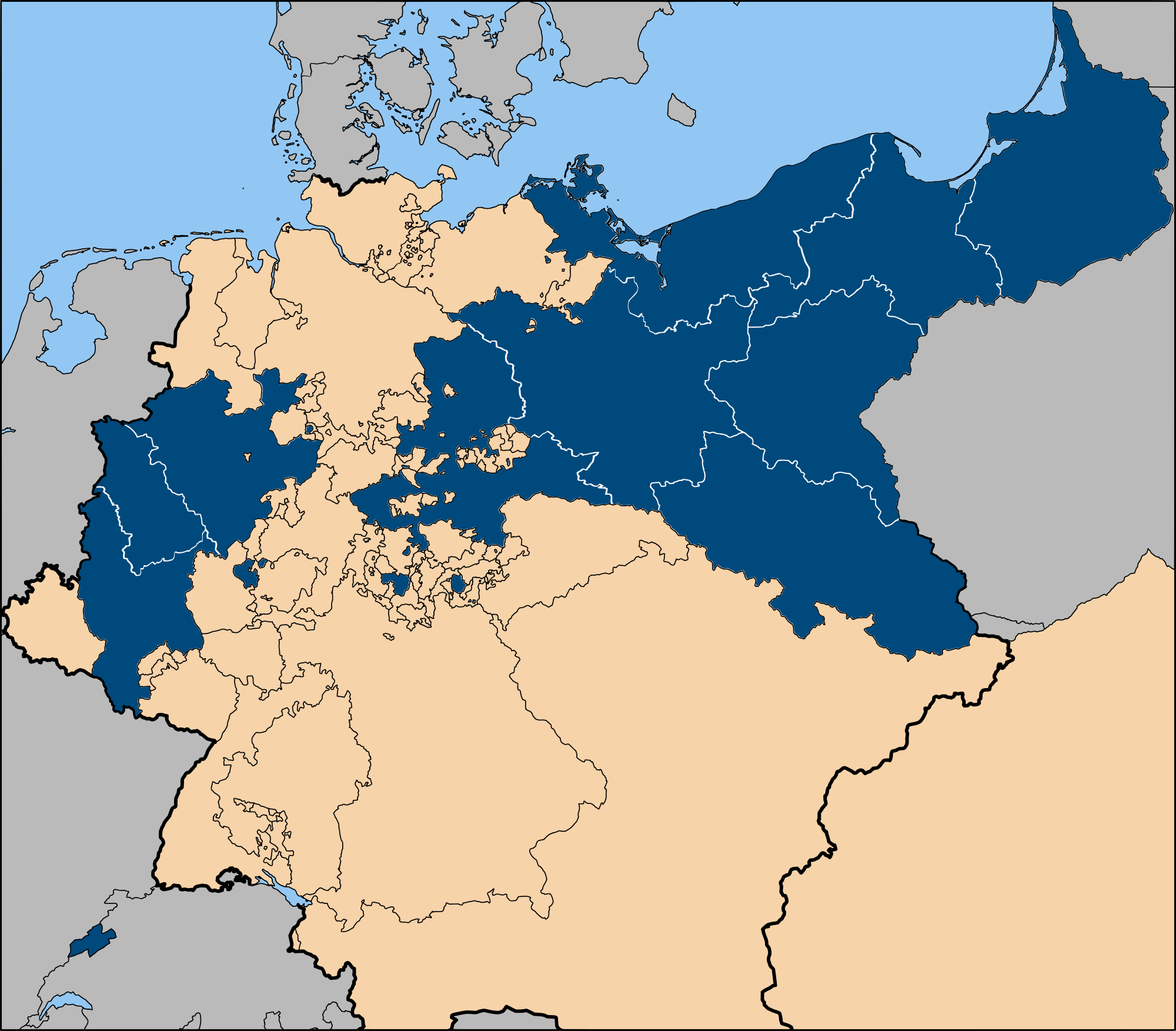
The Prussian Union of Churches (known under multiple other names) was a major Protestant church body which emerged in 1817 from a series of decrees by Frederick William III of Prussia that united both Lutheran and Reformed denominations in Prussia. Although not the first of its kind, the Prussian Union was the first to occur in a major German state.
It became the biggest independent religious organization in the German Empire and later Weimar Germany, with about 18 million parishioners. The church underwent two schisms (one permanent since the 1830s, one temporary 1934–1948), due to changes in governments and their policies. After being the favoured state church of Prussia in the 19th century, it suffered interference and oppression at several times in the 20th century, including the persecution of many parishioners.
In the 1920s, the Second Polish Republic and Lithuania, and in the 1950s to 1970s, East Germany, the People's Republic of Poland, and the Soviet Union, imposed permanent or temporary organizational divisions, eliminated entire congregations, and expropriated church property, transferring it either to secular uses or to different churches more favoured by these various governments. In the course of the Second World War, church property was either damaged or destroyed by strategic bombing, and by war's end, many parishioners had fled from the advancing Soviet forces. After the war, complete ecclesiastical provinces vanished following the flight and expulsion of Germans living east of the Oder-Neiße line.
The two post-war periods saw major reforms within the Church, strengthening the parishioners' democratic participation. The Church counted many renowned theologians as its members, including Friedrich Schleiermacher, Julius Wellhausen (temporarily), Adolf von Harnack, Karl Barth (temporarily), Dietrich Bonhoeffer, and Martin Niemöller (temporarily), to name only a few. In the early 1950s, the church body was transformed into an umbrella, after its prior ecclesiastical provinces had assumed independence in the late 1940s. Following the decline in number of parishioners due to the German demographic crisis and growing irreligion, the Church was subsumed into the Union of Evangelical Churches in 2003.
The many changes in the Church throughout its history are reflected in its several name changes. These include:
The Calvinist (Reformed) and Lutheran Protestant churches had existed in parallel after Prince-Elector John Sigismund declared his conversion from Lutheranism to Calvinism in 1617, with most of his subjects remaining Lutheran. However, a significant Calvinist minority had grown due to the reception of thousands of Calvinists refugees fleeing oppression by the Catholic Counter-Reformation in Bohemia, France (Huguenots), the Low Countries, and Wallonia or migrants from Jülich-Cleves-Berg, the Netherlands, Poland, or Switzerland. Their descendants made up the bulk of the Calvinists in Brandenburg. At issue over many decades was how to unite into one church.
One year after he ascended to the throne in 1798, Frederick William III, being Supreme Governor of the Protestant Churches, decreed a new common liturgical agenda (service book) to be published for use in both the Lutheran and Reformed congregations. The king, a Reformed Christian, lived in a denominationally mixed marriage with the Lutheran Queen Louise, which is why they never partook of Communion together. A commission was formed in order to prepare this common agenda. This liturgical agenda was the culmination of the efforts of his predecessors to unify the two Protestant churches in Prussia and in its predecessor, the Electorate of Brandenburg.
Major reforms to the administration of Prussia were undertaken after the defeat by Napoléon's army at the Battle of Jena-Auerstedt. As a part of these reforms, the separate leadership structures of both the Lutheran Church (with its chief body, the all-Prussian Lutherisches Oberkonsistorium (Lutheran Upper Consistory), 1750–1808, and the Reformed Churches (with their chief bodies, the all-Prussian Französisches Oberkonsistorium /Consistoire supérieur (French Supreme Consistory); 1701–1808, and the all-Prussian German-speaking Reformed Kirchendirektorium (Church Directory); 1713–1808) were abolished and the tasks of the three administrations were taken on by the Sektion für den Kultus und öffentlichen Unterricht (Section for the cult and public instruction), also competent for the Catholic church and the Jewish congregations, forming a department in the Prussian Ministry of the Interior.
Hub AI
Prussian Union of Churches AI simulator
(@Prussian Union of Churches_simulator)
Prussian Union of Churches
The Prussian Union of Churches (known under multiple other names) was a major Protestant church body which emerged in 1817 from a series of decrees by Frederick William III of Prussia that united both Lutheran and Reformed denominations in Prussia. Although not the first of its kind, the Prussian Union was the first to occur in a major German state.
It became the biggest independent religious organization in the German Empire and later Weimar Germany, with about 18 million parishioners. The church underwent two schisms (one permanent since the 1830s, one temporary 1934–1948), due to changes in governments and their policies. After being the favoured state church of Prussia in the 19th century, it suffered interference and oppression at several times in the 20th century, including the persecution of many parishioners.
In the 1920s, the Second Polish Republic and Lithuania, and in the 1950s to 1970s, East Germany, the People's Republic of Poland, and the Soviet Union, imposed permanent or temporary organizational divisions, eliminated entire congregations, and expropriated church property, transferring it either to secular uses or to different churches more favoured by these various governments. In the course of the Second World War, church property was either damaged or destroyed by strategic bombing, and by war's end, many parishioners had fled from the advancing Soviet forces. After the war, complete ecclesiastical provinces vanished following the flight and expulsion of Germans living east of the Oder-Neiße line.
The two post-war periods saw major reforms within the Church, strengthening the parishioners' democratic participation. The Church counted many renowned theologians as its members, including Friedrich Schleiermacher, Julius Wellhausen (temporarily), Adolf von Harnack, Karl Barth (temporarily), Dietrich Bonhoeffer, and Martin Niemöller (temporarily), to name only a few. In the early 1950s, the church body was transformed into an umbrella, after its prior ecclesiastical provinces had assumed independence in the late 1940s. Following the decline in number of parishioners due to the German demographic crisis and growing irreligion, the Church was subsumed into the Union of Evangelical Churches in 2003.
The many changes in the Church throughout its history are reflected in its several name changes. These include:
The Calvinist (Reformed) and Lutheran Protestant churches had existed in parallel after Prince-Elector John Sigismund declared his conversion from Lutheranism to Calvinism in 1617, with most of his subjects remaining Lutheran. However, a significant Calvinist minority had grown due to the reception of thousands of Calvinists refugees fleeing oppression by the Catholic Counter-Reformation in Bohemia, France (Huguenots), the Low Countries, and Wallonia or migrants from Jülich-Cleves-Berg, the Netherlands, Poland, or Switzerland. Their descendants made up the bulk of the Calvinists in Brandenburg. At issue over many decades was how to unite into one church.
One year after he ascended to the throne in 1798, Frederick William III, being Supreme Governor of the Protestant Churches, decreed a new common liturgical agenda (service book) to be published for use in both the Lutheran and Reformed congregations. The king, a Reformed Christian, lived in a denominationally mixed marriage with the Lutheran Queen Louise, which is why they never partook of Communion together. A commission was formed in order to prepare this common agenda. This liturgical agenda was the culmination of the efforts of his predecessors to unify the two Protestant churches in Prussia and in its predecessor, the Electorate of Brandenburg.
Major reforms to the administration of Prussia were undertaken after the defeat by Napoléon's army at the Battle of Jena-Auerstedt. As a part of these reforms, the separate leadership structures of both the Lutheran Church (with its chief body, the all-Prussian Lutherisches Oberkonsistorium (Lutheran Upper Consistory), 1750–1808, and the Reformed Churches (with their chief bodies, the all-Prussian Französisches Oberkonsistorium /Consistoire supérieur (French Supreme Consistory); 1701–1808, and the all-Prussian German-speaking Reformed Kirchendirektorium (Church Directory); 1713–1808) were abolished and the tasks of the three administrations were taken on by the Sektion für den Kultus und öffentlichen Unterricht (Section for the cult and public instruction), also competent for the Catholic church and the Jewish congregations, forming a department in the Prussian Ministry of the Interior.