Hubbry Logo
Psion Series 5Psion Series 5Main
Open search
Psion Series 5
Community hub
Psion Series 5
logo
8 pages, 0 posts
0 subscribers
Be the first to start a discussion here.
Psion Series 5
Psion Series 5
from Wikipedia

Psion Series 5mx
DeveloperPsion PLC
ManufacturerPsion PLC
TypeSubnotebook PDA
Release date1997; 28 years ago (1997)
Availability1997; 28 years ago (1997)
Operating systemEPOC32
CPUCL-PS7110 @ 18–36 MHz[dubiousdiscuss]
Memory4–16 MB
Display5.6", 640 × 240, 16 greyscale LCD
InputKeyboard, touchscreen, microphone
ConnectivityRS-232, infra-red, CompactFlash
Power2 AA batteries (10–20h use)
Dimensions170 × 90 × 23 millimetres
Weight354 grams (battery included)
PredecessorPsion Series 3
SuccessorPsion Series 7
RelatedPlanet Computers Gemini

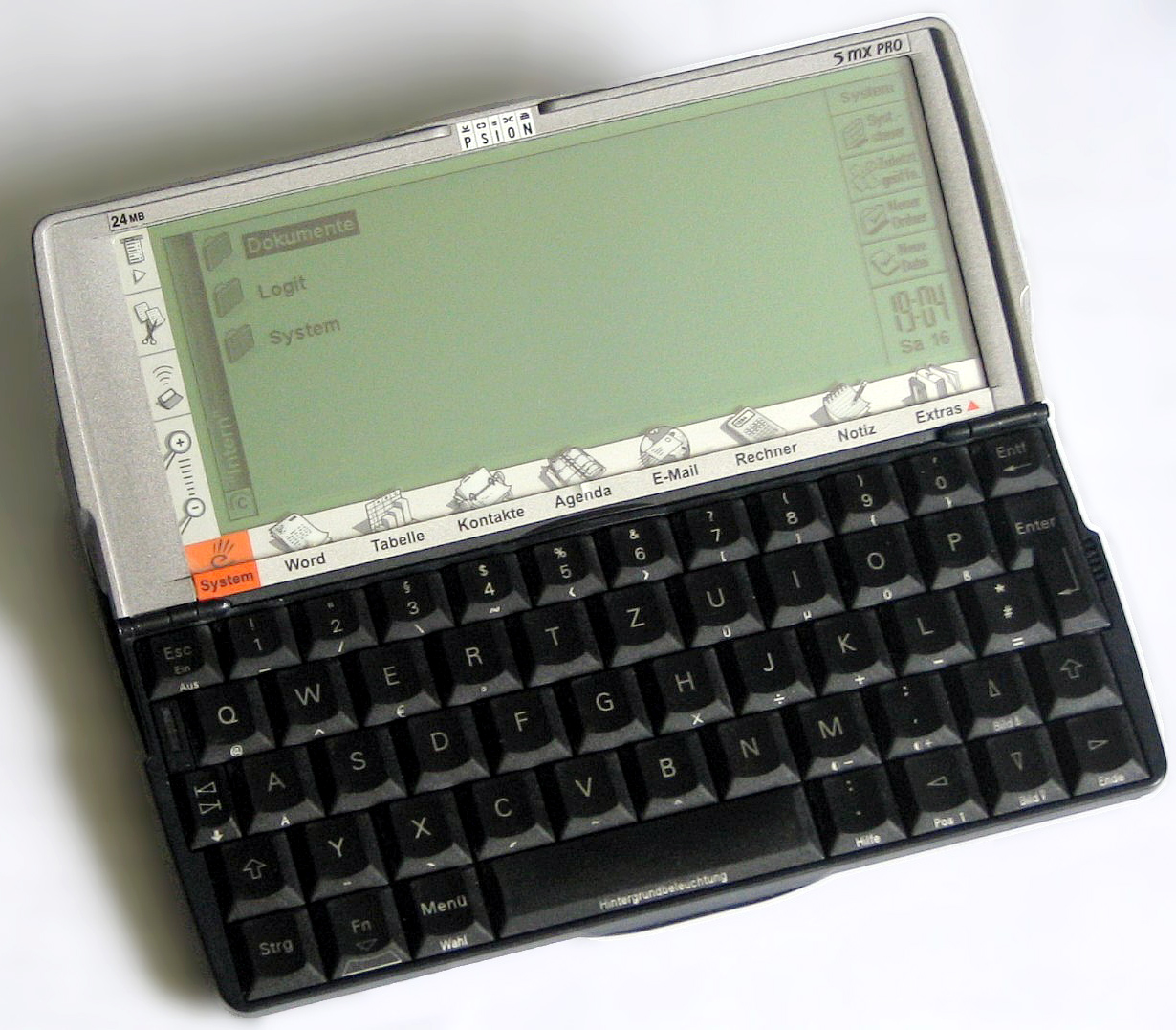
The Psion Series 5 is a personal digital assistant (PDA) from Psion. It was available in two main variants, the Series 5 (launched in 1997) and the Series 5mx (1999), the latter having a faster processor, clearer liquid crystal display (LCD), and updated software. There was also a rare Series 5mx Pro, which differed only in having the operating system (OS) loaded into random-access memory (RAM) and hence upgradeable. Ericsson marketed a version of the Series 5mx renamed as MC218.

The Psion Series 5 was a major upgrade from the Psion Series 3. There was never a Psion Series 4 due to concern about tetraphobia in Asian markets.[citation needed] The external appearance of the Psion Series 5 and the Psion Series 5mx are broadly similar, but their mainboards, screens and other internal components were different and not interchangeable.

The Series 5 was the first to feature a unique sliding clamshell design, whereby the keyboard slides forward as the device opens to counterbalance the display, and brace it such that touchscreen actuation does not topple the device, a feature mentioned in the granted European patent EP 0766166B1.[1] This novel design approach was the work of Martin Riddiford, an industrial designer for Therefore Design. A simplified version of this design was also used in the Psion Revo.

The moving parts and hinges can wear out or break. The most serious common problem arose because of a design fault in the screen cable, where tooling holes caused needless stresses due to extra bending of the cable at this point each time the Psion Series 5 was opened or closed, eventually leading to failure of the cable, which caused a serious display malfunction and horizontal lines appearing. The screen cable to the Psion Series 5 was more durable than the screen cable of the Psion Series 5mx. There was an after-market cable available for the 5mx which aimed to eliminate this problem.

At its heart was the 32-bit ARM710-based CL-PS7110 central processing unit (CPU) running at 18 MHz (Series 5) or 36 MHz (5mx), with 4, 8, or 16 MB of RAM. It was powered by two AA batteries, typically giving 10–20 hours of use. The display is a touch-sensitive, backlit half-Video Graphics Array (VGA, 640 × 240 pixel) LCD with 16 greyscales. The keyboard, which has a key-pitch of 12.5 mm,[2] is generally considered to be amongst the best for its size, with large-travel keys and touch-type capability. Both RS-232 and infrared serial connections were provided. A speaker and microphone were also provided, giving dictation as well as music playing ability. External storage was on CompactFlash.

Psion 5mx — on 5 cm squares

The EPOC operating system, since renamed Symbian OS, was built-in, along with application software including a word processor, spreadsheet, database, email, contact and diary manager, and Psion's Open programming language (OPL) for developing software. A Java virtual machine, the mobile browser STNC HitchHiker[3] and synchronizing software for Microsoft Windows was bundled with the 5mx as optional installations and later, the Executive Edition of the 5mx was bundled with various hardware and software extras, including version 3.62 of the Opera web browser and a mains electric outlet adapter. A wealth of third-party software was also available, including games, utilities, navigation, reference, communication, and productivity applications, and standard programming tools like Perl and Python.

An open-source software project, OpenPsion, formerly PsiLinux,[4] supports Linux on the Psion 5mx and other Psion PDAs.

Psion's experience designing for this form factor and attention to detail made these machines a favourite with power users, many of whom kept using them despite their age and the appearance of Symbian OS for mobile phones and other PDAs with more impressive specifications.

In 2017, a team of original Psion engineers created a startup company, Planet Computers, to make an Android device in a similar form factor, the Gemini (PDA). The Cosmo Communicator is a development of this device, enhancements including an external touchscreen on the rear of the clamshell lid, mainly to facilitate use as a mobile phone without opening. In 2022 they introduced an updated model called "Astro Slide 5G",[5] but according to many backers on the Indiegogo crowdfunding website, have largely failed to deliver the product to many that paid for it and have since 2023 not provided any further updates on the project, leaving the backers disappointed and asking for their money paid to be returned.

See also

[edit]

References

[edit]
[edit]
Revisions and contributorsEdit on WikipediaRead on Wikipedia
from Grokipedia
The Psion Series 5 is a palmtop (PDA) developed by the British company Psion Computers plc and released in 1997, notable for its innovative sliding that integrates a full-sized keyboard with a touch-sensitive display, powered by the EPOC operating system and an ARM710T processor. As a major advancement over Psion's earlier Series 3 models, the Series 5 addressed the growing demand for portable computing devices in the late 1990s by miniaturizing technology for office and mobile use, skipping a "Series 4" designation to avoid cultural superstitions in Asian markets. It featured a 640 x 240 pixel backlit display supporting 16 levels of grayscale, allowing for stylus-based input alongside its ergonomic keyboard with substantial key travel for efficient typing. The device ran on a 32-bit ARM710T RISC processor at 18 MHz, with configurations of 4 MB or 8 MB RAM (expandable to 16 MB in later variants) and 6 MB of ROM, enabling applications for word processing, spreadsheets, databases, and voice recording via its built-in microphone and speaker. Connectivity options included an serial port, IrDA infrared port for wireless data transfer, and a slot for storage expansion, while synchronization with desktop computers was supported through PsiWin software for /98/XP. Powered by two AA batteries for 10–35 hours of operation (depending on usage) and a CR2032 , the Series 5 measured approximately 170 x 90 x 23 mm and weighed 354 grams with batteries, making it highly portable yet robust. A 1999 update, the Series 5mx, doubled the processor speed to 36 MHz and added enhancements like improved battery life and optional 16 MB RAM. The Series 5's EPOC OS laid foundational technology for , which powered millions of mobile phones in the 2000s, influencing modern development through its multitasking capabilities and application ecosystem. Its design innovations, including the sliding mechanism credited to industrial designer Martin Riddiford, prioritized usability for productivity tasks and inspired subsequent PDAs like the Psion Revo, while its durable hardware earned praise for reliability in an era before widespread dominance. Priced at around $599 for the 4 MB model upon launch, it represented a premium option in the PDA market, competing with devices like the but standing out for its keyboard-centric approach.

Development and release

Background and origins

Psion PLC was established in 1980 by David Potter in as a , initially focusing on adventure games and utility programs for early personal computers. The shifted toward portable computing in the mid-1980s, launching the Psion Organiser in 1984, which became the world's first commercially successful (PDA) with features like a built-in keyboard, programmable functions, and expandable memory via cartridges. This device marked Psion's entry into the burgeoning market for handheld organizers, emphasizing battery-powered portability and practical applications such as diary management and database handling, which laid the groundwork for subsequent palmtop innovations. The Psion Series 3, introduced in 1991, served as the immediate predecessor to the Series 5 and represented a significant from the Organiser line by incorporating a , a full keyboard for input, and Psion's SIBO operating system based on EPOC16. Powered by an V30HL x86-compatible processor running at low clock speeds to conserve battery life, the Series 3 offered multitasking capabilities but was constrained by the power-hungry nature of x86 architecture in a portable form factor, limiting its efficiency and expansion potential compared to emerging reduced instruction set computing (RISC) alternatives. Lacking a , it relied entirely on physical keyboard entry and on-screen menus, which, while reliable, restricted intuitive interaction for graphical and pen-based applications increasingly demanded by users. Psion opted to skip the "Series 4" designation entirely, jumping directly to Series 5, primarily to avoid tetraphobia—a cultural superstition in East Asian markets where the number four is associated with due to phonetic similarities in languages like Chinese and Japanese. This decision reflected Psion's growing focus on international expansion, particularly in , where such sensitivities could impact sales. The development goals for the Series 5 centered on addressing the Series 3's limitations through a shift to architecture, which provided superior power efficiency and performance for battery-operated devices, alongside an enhanced version of the EPOC operating system (EPOC32) to support advanced multitasking in a 32-bit environment. This transition, initiated in the mid-1990s by Psion's software team, enabled more sophisticated software integration and paved the way for Psion's influence on ecosystems.

Design and launch

The Psion Series 5 featured a groundbreaking sliding that protected the screen and keyboard when closed, a mechanism patented under European Patent EP 0766166B1 filed by Psion PLC. This innovative approach was led by industrial designer Martin Riddiford of Therefore Design, who crafted the device's ergonomic form to balance compactness with for on-the-go input. The device was officially launched in the UK on 16 June 1997, marking Psion's entry into the next generation of palmtop computing with a focus on enhanced portability and integrated functionality. Initial pricing positioned it as an accessible professional tool, with the 4MB RAM model retailing for around £500 plus VAT in the UK and $600 in the US market upon its North American introduction later that year. Production of early units occurred in England, with shipments beginning in late 1997 to meet growing demand from business users seeking a robust alternative to desktop-dependent devices. Psion marketed the Series 5 as a standalone productivity powerhouse for professionals, highlighting its full QWERTY keyboard and comprehensive software suite to enable independent work away from a PC, in contrast to simpler synchronization-focused competitors like the PalmPilot. The Series 5 lineup achieved substantial market penetration in the palmtop era.

Variants and production

The Psion Series 5, introduced in 1997, represented the initial model in the lineup, offering configurations with 4 MB or 8 MB of RAM and a backlit display. In 1999, Psion released the Series 5mx as a mid-cycle upgrade, with 16 MB of RAM, increasing the processor speed to 36 MHz, improving the backlit for better visibility, and enhancing overall battery efficiency through optimized . Less common variants included the Series 5mx Pro, produced in a limited run primarily for select markets, which featured 32 MB of RAM and loaded the EPOC Release 5 operating system into RAM for easier upgradability rather than fixed ROM. also marketed a rebranded version of the Series 5mx as the MC218, tailored for enterprise applications with minor software customizations while retaining the core hardware design. The entire Series 5 lineup ceased production in 2001, as Psion redirected resources toward developing netBook-style computers amid intensifying competition in the PDA market.

Hardware design

Physical construction

The Psion Series 5 employs a clamshell form factor with a sliding and rotating that folds over a built-in keyboard, creating a compact yet ergonomic device suitable for portable use. This design eliminates screen wobble during typing and allows the unit to close flat for easy pocket or bag storage. The overall build prioritizes robustness through a molded plastic with a matte charcoal finish, which reviewers noted as solid and resistant to creaking under normal handling. Measuring 170 × 90 × 23 mm, the standard model weighs 354 grams including batteries, making it portable while substantial enough to feel durable in hand. The hinge mechanism incorporates spring-loaded wires that provide consistent tension to snap the lid open or closed securely, contributing to the device's reputation for mechanical reliability over extended periods. A backup CR2032 lithium battery safeguards data integrity during main battery swaps. Power is supplied by two AA alkaline batteries, delivering 10–35 hours of runtime based on usage patterns such as backlight activation and application intensity; no built-in rechargeable option was available in the base model. Users could enhance portability and functionality with optional accessories, including leather carrying cases for protection, docking cradles for desktop synchronization via serial or ports, and adapters for expanded storage in bundled configurations.

Processor and memory

The Psion Series 5 utilized a CL-PS7110 system-on-chip (SoC), which incorporated an core based on the architecture, operating at a clock speed of 18.432 MHz. This RISC-based design provided efficient processing for (PDA) tasks, including multitasking and application execution, while prioritizing low power consumption suitable for battery-powered portables. The variant known as the Series 5mx featured an upgraded running at 36 MHz, doubling the performance potential for more demanding operations without significantly increasing power draw. Memory configurations varied by model, with the standard Series 5 offering 4 MB or 8 MB of RAM and 6 MB of ROM, while the 5mx provided 16 MB of RAM as standard and up to 8 MB of ROM. Internal storage relied on a flat file structure in RAM, preserved by a during power-off states, supplemented by OPL (Open Programming Language) scripting capabilities for custom file handling and automation. Expandable storage was limited to a single (CF) Type I slot, supporting cards up to several hundred MB for additional data and applications, though no internal expansion beyond RAM was available. In terms of performance, the ARM-based processor enabled smooth multitasking, allowing multiple applications—such as word processors, spreadsheets, and databases—to run concurrently without noticeable lag, a marked improvement over the slower V30HL (x86-compatible) processor in predecessors like the Series 3, which operated at 7.68 MHz and struggled with heavier loads. Benchmarks from the era highlighted the Series 5's ability to handle typical PDA workloads efficiently, with the 5mx variant further enhancing responsiveness for tasks like . The low (TDP) of the CL-PS7110, averaging around 60 mW in normal operation and dropping to microamp levels in standby, facilitated with no fans or active heat dissipation required, contributing to exceptional battery efficiency. Powered by two AA alkaline batteries, the Series 5 achieved 10–35 hours of runtime depending on usage, outperforming x86-based prior models in and extending usability for mobile professionals. A CR2032 backup battery maintained RAM contents for months when the main power was depleted.

Display and input

The Psion Series 5 utilized a 5.6-inch LCD display with a resolution of 640 × 240 pixels, supporting 16 levels of for enhanced visibility of text and simple . This half-VGA resolution provided sufficient clarity for productivity tasks on a compact form factor, while the enabled direct interaction without requiring excessive pressure. The display is backlit, and the Series 5mx variant featured a clearer screen for improved visibility. User input was facilitated through multiple methods, centered on a full keyboard featuring a 12.5 mm key pitch, which delivered strong tactile feedback and supported efficient touch-typing despite the device's portability. The keyboard's design emphasized in the clamshell form factor, with the 53 keys arranged for comfortable thumb-typing when held in hand, and the screen's adjustable angle via its sliding and rotating hinge further optimized viewing and input posture. Complementing this, a built-in enabled precise operations, including for text entry, drag-and-drop file management, and navigation via on-screen buttons or menus. Additionally, an integrated supported voice note recording directly through dedicated hardware buttons, providing a hands-free alternative for quick annotations without opening applications.

Software ecosystem

Operating system

The Psion Series 5 utilized EPOC32, a 32-bit, preemptive multitasking operating system developed by Psion Software as a successor to the earlier 16-bit EPOC. Written primarily in C++, EPOC32 was optimized for resource-constrained embedded devices, featuring hardware , low latency threading, and a single-user architecture designed for personal digital assistants. The original Series 5 launched with EPOC32 Release 1 in June 1997, providing a robust foundation for multitasking applications on its ARM-based hardware. The upgraded Series 5mx, released in 1999, employed EPOC32 Release 5 (ER5), which introduced enhancements such as improved web browsing support and integration while maintaining with earlier releases. Key architectural features of EPOC32 included preemptive multitasking to ensure responsive performance across multiple applications, dynamic linking through shared libraries for efficient and , and support for the Open Programming Language (OPL), an interpreted akin to that enabled users to develop custom programs directly on the device without external compilation tools. These elements allowed EPOC32 to handle complex tasks like and networking while optimizing for the Series 5's limited RAM, typically 4-8 MB in base models. The OS's event-driven kernel facilitated low-power operation, making it suitable for battery-powered portables. EPOC32 employed a for organizing data into folders, supporting long filenames and efficient storage on internal flash or external cards in later variants. Software distribution and installation relied on .SIS (System Installer) package files, which encapsulated applications, dependencies, and installation scripts to simplify deployment and ensure compatibility across EPOC32 releases. This structure promoted a modular where updates could be applied without disrupting core system files. EPOC32 laid the groundwork for broader as the direct precursor to OS, which powered millions of smartphones in the early 2000s. In June 1998, Psion contributed its EPOC32 technology to the newly formed Ltd. consortium—a with , , and —retaining a significant stake while enabling the OS to be licensed for diverse wireless devices beyond PDAs, thus expanding its reach into the burgeoning smartphone market.

Bundled applications

The Psion Series 5 was equipped with a comprehensive suite of bundled applications tailored for productivity, communication, and personal organization, leveraging the multitasking capabilities of the EPOC operating system to allow seamless switching between tasks. At its core, the device included Epoc Word, a for creating and editing documents with advanced formatting options such as style sheets, tables, borders, and embedded objects like spreadsheets or sketches; it supported spell-checking, thesaurus integration, and export to formats including RTF and 6.0. The Sheet spreadsheet application offered over 105 built-in functions for calculations, data sorting, and visualization through line, bar, or pie charts, with compatibility for importing and exporting files in Excel 97 and formats. Data provided a flexible database tool for managing custom records, such as inventories or address lists, featuring card or list views, field customization, filtering, and support for CSV and file conversions. Agenda served as the central personal information manager, handling appointments, to-do lists, anniversaries, and notes with day/week/year views, repeating events, alarms, and the ability to attach documents or voice recordings. The integrated facilitated sending and receiving messages via SMTP and POP3 protocols, with support for attachments, multiple mailboxes, faxing, and ; IMAP access was available through optional plugins. Complementing these were utility tools for everyday use, including Recorder for capturing and playing back voice memos with compression options to optimize storage (up to 4 minutes per MB), Calc as a versatile calculator with desk-style tape roll and scientific modes featuring 26 memory registers and trigonometric functions, and Time for displaying world clocks across cities, setting up to eight alarms, and accessing international dialing codes. A Java Virtual Machine, based on Sun Microsystems' JDK 1.1.4, was bundled as an optional installation on the Series 5mx model to run basic Java applets and applications, supporting AWT components for lightweight portability across platforms. For desktop integration, Psion Connect synchronization software was provided, with PsiWin handling Windows compatibility for file transfers, backups, and PIM syncing with applications like , while MacConnect offered equivalent functionality for Macintosh systems, including serial or IrDA connections for data exchange. Web access was enabled via the optional STNC HitchHiker browser on the Series 5mx, which rendered pages with support for tables, images, and basic frames, or the Executive Edition for enhanced WAP and viewing with features like cookies and authentication.

Third-party software and extensions

The Psion Series 5 benefited from a vibrant ecosystem of third-party software, expanding its capabilities beyond the core applications through community and commercial developments. Popular games included numerous Tetris clones such as BLOX, PsiTris, and Psetris, alongside classics like PacMan, Snake, and Sokoban, which leveraged the device's responsive keyboard for engaging gameplay. Utilities featured programming interpreters like Perl 5.005 and a Python interpreter, enabling on-device scripting and automation, while tools such as RPNcalc for advanced calculations and CompressDB for file management addressed practical user needs. Navigation software was particularly notable for users pairing the Series 5 with GPS hardware, with applications like AutoGPS, GNAV3a, Mapper, and GPSion5 providing mapping, route planning, and real-time location services. Productivity enhancements included enhanced document readers such as Pdf, Pdf+, and TomeRaider for handling PDFs and compressed texts, as well as specialized tools like Accounts for financial tracking and multiple Expenses apps for expense logging. Hardware extensions primarily revolved around storage and connectivity upgrades. The Series 5mx's built-in slot supported third-party CF cards for expanded storage, with adapters allowing compatibility with SD cards in modern retro setups, though original use focused on CF media up to several hundred MB. External modems connected via the serial port enabled , often using third-party cables and software for PPP connections. Third-party keyboards were less common, but foldable or external variants existed for prolonged typing sessions. The development scene was robust, supported by the availability of OPL (Organiser Programming Language), a built-in BASIC-like environment for rapid application creation with database and GUI access, and the EPOC C++ SDK for more advanced native programming. Open-source efforts culminated in the OpenPsion project, initiated around 2003, which successfully ported 2.4.27 and Sarge) to the Series 5mx, providing full hardware support including sound and X11 graphics for dual-boot configurations via . Software distribution in the late occurred via Psion's online File 'n Go archive for downloads over dial-up or serial connections, supplemented by floppy disks and CD compilations containing hundreds of and titles. Modern preservation relies on community archives aggregating these files.

Reception and usage

Market reception

The Psion Series 5 achieved strong initial sales in , where Psion captured an estimated 59% of the PDA market in the first half of 1998 according to IDC research. Production ramped up quickly after its 1997 launch, reaching 25,000 units per month by September and targeting 40,000 by year-end, allowing it to compete effectively with contemporaries like the Palm III. Adoption was particularly robust among business professionals who prioritized the device's full keyboard for efficient text input and productivity tasks, such as and document editing, over stylus-based alternatives. In contrast, the Series 5 saw lower uptake in the United States, where Palm's dominance in the PDA sector—holding over 70% global by late 1999—limited Psion's penetration. Globally, Psion maintained approximately 19% of the PDA market in early 2000, shipping 78,720 units in the first quarter per Canalys data, before the rise of smartphones began eroding dedicated PDA demand. The device also found favor in some Asian markets, such as , contributing to Psion's overall sales growth, though specific regional figures were not as dominant as in . Critics acclaimed the Series 5 for its innovative and portability, earning it a Millennium Product award from the British Design Council in 1998 for exemplifying forward-thinking British innovation. Reviews highlighted its productivity advantages, with the keyboard enabling touch-typing at 40-50 words per minute, drawing comparisons to later devices like the for on-the-go professional use. A 2015 retrospective by The Verge rated it 6.4/10, praising its utility as a compact writing tool despite limitations like the screen.

Common issues and support

One of the most prevalent hardware problems with the Psion Series 5 is of the screen cable, a flexible connector linking the to the LCD display. This issue stems from a design flaw in which tooling holes along the cable create points of excessive stress during the repeated bending associated with opening and closing the clamshell mechanism, leading to cracks that manifest as intermittent vertical lines, flickering, or total display blackout. The problem commonly emerges after 5 to 10 years of regular use, rendering the device inoperable without repair. Replacement cables, more durable than the originals, are available from specialized aftermarket vendors for around £40, and detailed disassembly guides facilitate user-performed fixes. The Psion Series 5 relies on two AA alkaline batteries for primary power, which provide 10 to 20 hours of operation but are susceptible to leakage over time, especially if left installed in unused units, resulting in corrosion that can damage the battery compartment and adjacent circuitry. To mitigate this risk, enthusiasts recommend substituting alkaline cells with lithium AA batteries or nickel-metal hydride (NiMH) rechargeables, which are less prone to leaking and offer comparable or better longevity. Official support for the Psion Series 5, including software updates and service releases for its EPOC32 operating system, was provided by Psion until approximately 2004. Psion ceased consumer PDA production in late 2001 and sold its stake to in 2004. Thereafter, community-driven initiatives have sustained the platform, with developers offering patched ROM files to address bugs and compatibility issues in the original OS, as well as alternative operating systems like through the OpenPsion project. Repair resources for the Series 5 remain accessible via online marketplaces such as , where donor units and spare parts—including hinges, screens, and cables—are commonly available for £20 to £50, enabling cost-effective restorations. Numerous DIY guides and service manuals detail procedures for hinge reinforcement and screen cable replacement, often emphasizing careful handling of the device's sliding mechanism to prevent further wear.

User community and modern interest

The Psion Series 5 maintains a dedicated user community within the retro computing scene, where enthusiasts collaborate on preservation and enhancement projects. In August 2025, vintage computing developer Colin Hoad released a proof-of-concept language server for OPL, the device's proprietary programming language, implementing the Language Server Protocol to enable auto-completion and syntax support in modern integrated development environments. This open-source initiative, available under the MIT license on GitHub, stemmed from discussions on the Psion Discord server and builds on emulators like WindEmu to run OPL code on contemporary platforms. Such efforts reflect the community's commitment to sustaining the Series 5's software ecosystem for educational and nostalgic purposes. Modern hardware modifications have revitalized the Series 5 for contemporary applications, particularly among makers exploring cyberdeck-inspired designs. A prominent example integrates the Khadas Edge2 single-board computer—powered by a Rockchip RK3588S processor with eight CPU cores, a Mali-G610 GPU, and 6 TOPS of neural processing—into the original clamshell chassis, replacing the 1997-era ARM 7100 CPU. This upgrade, detailed in maker project documentation, runs Ubuntu from 64 GB of eMMC storage, supports microSD expansion for additional software, and incorporates a custom color touchscreen and trackpad while preserving the tactile keyboard. These hacks enable emulation of classic games and execution of productivity tools, transforming the device into a compact, battery-powered platform for offline tasks. Collectibility of the Psion Series 5 has grown among collectors, with functional units commonly listed on marketplaces like for £100 to £400 depending on condition and included accessories as of late 2025. The device frequently appears at vintage computing events, including the Centre for Computing History’s Retrofest, where attendees demonstrate its applications and share maintenance tips to highlight its role in early . As of 2025, the Series 5 retains niche relevance for offline , serving as a distraction-free alternative amid widespread fatigue and the desire for focused, unconnected work environments. Its mechanical keyboard, 25- to 35-hour battery life on two AA cells, and bundled applications like word processors facilitate uninterrupted writing and organization without notifications or web distractions. Reviews emphasize this appeal, positioning the device as a portable tool superior to modern tablets for stream-of-consciousness composition due to its compact form and deliberate .

Legacy and influence

Technical evolution

The Psion Series 5 marked a pivotal shift in Psion's operating system architecture through its adoption of EPOC32, a 32-bit OS designed for resource-constrained mobile environments. This system evolved directly from earlier 16-bit EPOC iterations and emphasized multitasking, preemptive scheduling, and a modular kernel suited for handheld devices. In June 1998, Psion co-founded Ltd. as a with , , and to commercialize and expand EPOC32 into a standardized platform for mobile phones, rebranding it as Symbian OS. This collaboration transformed the OS from a PDA-centric system into a foundation for the era, powering over 100 million devices by 2006 through licensing to major manufacturers. On the hardware front, the Series 5 introduced early widespread use of ARM architecture in consumer PDAs, employing the CL-PS7110 processor—a 32-bit ARM710 core running at 18.432 MHz—which delivered efficient performance with low power consumption compared to prior x86 or 68000-based designs. This choice reflected Psion's focus on extending battery life in portable computing, achieving up to 20 hours of active use on AA batteries, and set a precedent for ARM's dominance in mobile processors. The innovation influenced subsequent low-power chip designs, as ARM's RISC efficiency became the standard for billions of embedded and mobile applications. Connectivity in the Series 5 advanced beyond basic serial links by integrating for wireless data transfer up to 115 kbps and an serial port for direct docking and modem support, enabling , , and early mobile data access via compatible phones. These features represented a step toward seamless device interoperability in pre-smartphone ecosystems, with IrDA serving as a cable-replacement standard for short-range communication. Psion built on this foundation in later models like the Series 7, incorporating as a successor to IrDA for more robust, low-energy wireless networking.

Impact on mobile computing

The Psion Series 5 established a productivity paradigm for personal digital assistants (PDAs) by prioritizing a physical keyboard as the primary input method, positioning these devices as viable tools for serious mobile work rather than mere note-taking gadgets. This keyboard-centric approach, featuring a full-sized QWERTY layout in a compact clamshell form, enabled efficient text entry for tasks like email, document editing, and spreadsheet management, setting it apart from stylus-dependent competitors like the Palm Pilot. Its influence extended to early smartphones, particularly BlackBerry devices, which adopted similar thumb-optimized keyboards to emphasize enterprise productivity and secure messaging in the early 2000s. The Series 5 contributed significantly to the PDA market boom in the late 1990s and early , a period before the iPhone's 2007 debut that saw global PDA shipments peak at approximately 12 million units in 2001. As Europe's leading PDA manufacturer by the mid-1990s, Psion's innovations—such as the Series 5's backlit and integrated applications—highlighted the limitations of stylus-only interfaces, advocating for hybrid input systems that balanced portability with usability. This shift encouraged the industry to view PDAs as extensions of desktop computing, fostering a surge in business adoption and paving the way for converged devices that blended PDA functionality with . Culturally, the Series 5 captured the imagination of tech enthusiasts and media, appearing in contemporary articles as a symbol of British engineering prowess and portable innovation, often praised for its 30-hour battery life and efficient resource use. Publications like lauded its design as a "remarkable achievement" that outperformed power-hungry rivals, embedding it in narratives of minimalist, purpose-built . This legacy resonates in the 2020s' minimalism trends, where retro enthusiasts revive Series 5 units for distraction-free writing and productivity, inspiring modern devices like the that echo its ethos of focused, keyboard-driven interaction. Economically, Psion's involvement in —the evolution of the Series 5's EPOC operating system—generated substantial licensing revenue through its 1998 spinoff of , which licensed the platform to major manufacturers like and . By 2004, Psion had sold its Symbian shares for approximately £136 million (about €200 million at the time), capitalizing on the OS's deployment in nearly 450 million smartphones from 2000 to 2010, with license fees contributing to Symbian's reported revenue growth, including a doubling in the first half of 2003 alone. However, the platform's decline in the 2010s, as Nokia phased it out in favor of by 2011, marked the end of this revenue stream amid competition from and Android. The Psion Series 5's clamshell design and physical keyboard have directly inspired several modern devices from Planet Computers, a company founded by former Psion engineers. The , released in 2017, features a similar folding form factor with a backlit keyboard optimized for thumb-typing, measuring 5.25 by 2.7 by 0.7 inches when closed, and runs primarily on Linux with support for Android and other operating systems. It emulates the Series 5's portability while adding cellular connectivity in select models, appealing to users seeking a pocketable productivity device. Building on the Gemini, the Cosmo Communicator launched in as a more advanced clamshell with dual displays—a 2-inch external color screen and a 5.99-inch internal FHD+ —alongside a 24-megapixel front camera and backlit keyboard directly modeled after the Psion Series 5's layout for efficient input. Powered by a Helio P70 processor with 6GB RAM and 64GB storage (expandable via microSD), it supports dual-SIM 4G and runs Android 7.1 with options for distributions, allowing users to run legacy Psion software through emulation. These features position the Cosmo as a direct homage, prioritizing tactile typing over touch-only interfaces in a modern context. Planet Computers further extended this lineage with the Astro Slide 5G in 2022, a crowdfunded slider device that reveals a 6.39-inch display and keyboard upon extension, echoing the Series 5's focus on compact, keyboard-centric computing. Equipped with a Dimensity 800 , 8GB RAM, 128GB storage, and a 48-megapixel quad-camera setup, it runs stock (upgradable) and includes a "RockUp" hinge for laptop-like use. However, the campaign, which raised over $1.4 million starting in 2020, faced significant delays due to issues and the , with initial shipments not occurring until mid-2022; as of 2025, backers continue to report persistent quality concerns including software bugs, overheating, and inconsistent performance. In parallel, enthusiast communities have pursued custom modifications by integrating modern single-board computers (SBCs) into Series 5 enclosures to revive the original hardware with contemporary capabilities. Projects as recent as 2025 have successfully fitted —compact ARM-based SBCs with 1GHz processors and 512MB RAM—into gutted Psion Series 5mx cases, preserving the iconic keyboard while adding output, , and compatibility for tasks like terminal emulation or lightweight programming. These builds, often shared via open-source repositories, enhance battery life with modern power management and enable connectivity absent in the originals, such as pairing. Original Psion Series 5 units are no longer in production, with limited to refurbished models sold through specialized retailers and online marketplaces, typically priced between $100 and $200 depending on condition and memory capacity. The for these and homage devices remains driven by retro enthusiasts and professionals valuing physical keyboards, with Planet Computers' products serving as the primary new options in this space.

References

Add your contribution
Related Hubs
User Avatar
No comments yet.