Hubbry Logo
Grand Pump RoomGrand Pump RoomMain
Open search
Grand Pump Room
Community hub
Grand Pump Room
logo
8 pages, 0 posts
0 subscribers
Be the first to start a discussion here.
Grand Pump Room
Grand Pump Room
from Wikipedia

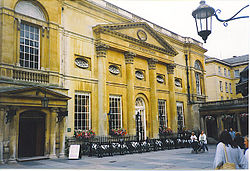
The Grand Pump Room is a historic building in the Abbey Churchyard, Bath, Somerset, England. It is adjacent to the Roman Baths and is named because of water that is pumped into the room from the baths' hot springs. Visitors can drink the water or have other refreshments while there.

Key Information

It has been designated as a Grade I listed building since 1950.[2][5] Along with the Lower Assembly Rooms, it formed a complex where social activity was centred, and where visitors to the city gathered.[6]

History

[edit]

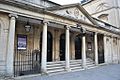
The present building replaced an earlier one on the same site, designed by John Harvey at the request of Beau Nash, Bath's master of ceremonies, in 1706, before the discovery of Roman remains nearby. The main block, built of Bath stone, was begun by Thomas Baldwin, and the foundations of a Roman temple precinct were discovered during preparatory excavations. The North Colonnade of nine bays, with unfluted Ionic columns, was built by Baldwin in 1786–1790.[7]

Pump Room in 1798

Baldwin was dismissed,[8] as a result of financial mismanagement in his handling of the large sums of money allocated to the purchase of raw materials such as timber and stone. Archaeological evidence reveals that he laid the foundations for a portico at the north front of the Pump Room, but this was never completed, and Baldwin was declared bankrupt in September 1793.[9] Another Bath-based architect and Baldwin's long-time rival, John Palmer, took his place as city architect and continued the scheme from 1793, altering Baldwin's design of the northern elevation, moving the location of the capitals that had been intended for the portico.[5] The building was opened by the Duchess of York on 28 December 1795[10] and was finally finished in 1799.[2]

The South Colonnade (completed 1789)[11] is similar to the North Colonnade but had an upper floor added in the late 19th century.[4] The colonnades and side wall of the Pump Room have a facade on Stall Street, with Corinthian half columns thought to have been influenced by the design of the Temple at Bassae. Willey Reveley, a contemporary expert on Greek architecture, was consulted about Palmer's revised plans.[9] However, the aspect of the building was altered by the construction in 1897 of a concert hall designed by J M Brydon.[12]

The interior of the Pump Room was described in Feltham’s Guide to all the Watering and Sea-Bathing Places etc. (1813) as follows:[13]

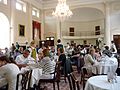
This noble room was built in 1797 under the direction of Mr. Baldwin, architect. It is 60 feet long by 46 wide, and 31 feet high. The inside is set round with three quarter columns of the Corinthian order, crowned with an entablature, and a covering of five feet. In a recess at the West-end is the music gallery, and in another at the East an excellent time-piece, over which is a marble statue of king Nash, executed by Hoare, at the expense of the corporation. In the Centre of the South-side is a marble vase from which issue the waters, with a fire-place on each side.

King's Spring

The marble vase from which visitors could drink the waters for medicinal purposes is also mentioned in Tunstall's 1860 guide to taking the waters, which also gives admission prices for the Pump Room and the adjoining King's and Queen's Baths.[14] Works by local artists William Hoare (died 1792)[15] and Thomas Gainsborough (died 1788) were also displayed there.

Original drawings by Palmer were discovered during the 1990s, which revealed how he and his predecessor Baldwin had planned the Cross Bath, which has since been restored in keeping with their intentions. The Cross Bath is now open to the public as a bathing spa, as part of the Thermae Bath Spa project.[16]

Next to the main street entrance to the Roman Baths, visitors can drink the waters from the warm spring which is the source of the baths. The building now also houses a restaurant, where afternoon tea can be taken.[17]

In music

[edit]

Music in the restaurant is provided by the Pump Room Trio — the longest established resident ensemble in Europe[18] — or by a pianist. There has been music in the Pump Room since the opening of the original building in 1706, when Beau Nash put together his own band to perform there. A "Pump Room Orchestra" later came into being, with Gustav Holst being one of its guest conductors during the early 20th century.[19] Frank Tapp was notable for expanding the repertoire from 1910 and into the war, programming some sixty symphonies during his time there.[20]

In literature

[edit]

The novelist Jane Austen was familiar with the Pump Room, which is used as a setting in her novels Northanger Abbey and Persuasion. It was a meeting place for fashionable people, where "Every creature in Bath [...] was to be seen in the room at different periods of the fashionable hours".[21] In Persuasion, Admiral Croft retires to Bath to take the waters, because of his gout. The Pump Room was used as a filming location in screen adaptations of both novels.[22] Mr Pickwick and his friends retire to a private sitting-room in "The Pickwick Papers" by Charles Dickens, "at the White Hart Hotel, opposite the Great Pump Room, Bath, where the waiters, from their costume, might be mistaken for Westminster boys, only they destroy the illusion by behaving themselves much better".[23]

In film

[edit]

In addition to adaptations of Austen's novels, the Pump Room has been used in films such as The Music Lovers (1969), The Nelson Affair (1973) and television series such as Bonekickers. The neighbouring Abbey Churchyard was used in the filming of Other People's Children (2000) and Bertie & Elizabeth (2002).[22]

[edit]

See also

[edit]

References

[edit]
Revisions and contributorsEdit on WikipediaRead on Wikipedia
from Grokipedia
The is a historic Georgian assembly room in , , situated adjacent to the Roman Baths and renowned as a social and cultural landmark where visitors have long gathered to drink the town's mineral-rich thermal spring waters, believed to possess medicinal properties since Roman times. Designed by Thomas Baldwin and constructed between 1789 and 1799—with completion overseen by John Palmer after Baldwin's death—it replaced an earlier built in 1706 by John Harvey and enlarged in 1751, opening to the public on 28 December 1795 under the patronage of the . As a cornerstone of Bath's 18th- and 19th-century spa culture, the Pump Room functioned as the epicenter of fashionable society, where promenading elites convened for conversation, music, and wellness rituals amid the Georgian that continued social traditions established by figures like Richard ". A Grade I listed building since 1950, the structure exemplifies neoclassical design in , featuring a pedimented with Corinthian columns, oval windows, and an interior graced by a giant , marble fireplaces, a grand chandelier, and the King's Spring fountain from which the spa water still flows. Its historical significance extends to literary fame, with renowned visitors and patrons such as —who immortalized it in novels like Northanger Abbey and —and , underscoring its role as the "social heart of Bath" for over two centuries. In contemporary times, the Grand Pump Room continues as an elegant restaurant and event venue, offering morning brunch, afternoon tea, and light fare daily from around 10:00 a.m. (as of 2025), accompanied by live performances from a resident Trio or pianist, while providing views of the ancient Roman Baths below and accessibility features for all visitors. This enduring function preserves its legacy as a protected heritage site under the Planning (Listed Buildings and Conservation Areas) Act 1990, blending historical preservation with modern hospitality in one of England's premier World Heritage destinations.

Overview

Location and Setting

The Grand Pump Room is situated in the Abbey Churchyard, at the heart of , , with the precise address of Abbey Church Road, . Its geographical coordinates are 51°22′52″N 2°21′34″W, placing it within the National Grid Reference ST 75043 64738. This central position integrates the building into Bath's compact historic core, surrounded by and key landmarks. The Pump Room stands adjacent to the Roman Baths, serving as a direct gateway to the ancient thermal complex, and lies in close proximity to Bath Abbey across the Churchyard. This arrangement underscores its role as a pivotal hub within the City of Bath World Heritage Site, a UNESCO-designated area encompassing the city's neoclassical ensembles and Roman heritage. The site's selection reflects Bath's evolution as a renowned spa destination, where the natural hot springs—emerging at a constant temperature of around 46°C—have drawn visitors since the Roman era, when the town was established as Aquae Sulis around 60 AD. These geothermal springs, the only natural hot springs in the UK, directly influenced the Pump Room's placement to facilitate access to the mineral-rich waters believed to hold curative properties, cementing Bath's identity as a therapeutic and social center amid its verdant valley setting in southwest England.

Description and Facilities

The Grand Pump Room features a rectangular main hall measuring 18 meters in length, 14 meters in width, and 10 meters in height, with apsed ends and four small corner ante-rooms serving as flanking spaces. The hall is divided into five bays along its long walls, supported by giant fluted Corinthian columns—half-columns on the sides and quarter-columns at the corners—creating an open interior space for social gatherings. Adjacent to the main structure are the North and South Colonnades, each comprising nine bays of unfluted Ionic columns that connect directly to the Pump Room, forming an integrated layout that extends the functional area outward. Key facilities within the Pump Room include a spa fountain located in an alcove on the south wall, where visitors can sample the site's natural , a that underscores its role as a historic wellness and social venue. Seating areas are arranged throughout the hall to accommodate diners and observers, positioned beneath a central and near the musicians' gallery at the west end, facilitating both formal meals and informal promenades. An 18th-century equation clock by master horologist , dating to around 1709, stands prominently near its original position, featuring a complex mechanism that adjusts for and remains a focal point for visitors. The building has held Grade I listed status since 12 June 1950, protecting its structure, fixed interior elements such as the columns, fireplaces, and galleries, as well as features predating 1948. The adjacent North and South Colonnades share this Grade I designation, safeguarding their columned bays, railings, and connections to the main hall as integral protected components of the ensemble.

Architecture

Design and Influences

The Grand Pump Room's architectural design was initiated by Thomas Baldwin in 1789 as part of a broader neoclassical town planning scheme for Bath, with John Palmer taking over to complete the structure by 1799, including the northern elevation. Baldwin's approach drew significant influence from the neoclassical style of the Adam brothers, evident in the building's elegant proportions and decorative restraint. Key neoclassical elements define the facade and interior, including engaged Corinthian columns on the northern elevation supporting a inscribed with the Greek phrase "Water is best," alongside Ionic columns in the adjacent north . These features emphasize and classical proportions, inspired by Roman architectural orders and the Palladian revival that shaped much of Georgian Bath's urban aesthetic. The structure's primary material, Bath limestone , was selected for its local quarrying availability in nearby Combe Down and its warm, honey-toned hue, which ensures visual harmony with the surrounding Georgian buildings. This choice not only supported practical construction but also reinforced the building's integration into Bath's cohesive architectural landscape.

Key Structural Features

The exterior of the Grand Pump Room is characterized by its neoclassical design in Bath limestone ashlar, featuring a slate roof and constructed primarily between 1789 and 1799. The principal west elevation along Stall Street presents a blind wall with a rusticated and vermiculated basement, above which rise eight paired three-quarter attached Corinthian columns supporting an and , creating a monumental screen-like appearance that spans the facade. The northern elevation, facing Abbey Church Yard, consists of two storeys and seven bays, with four engaged Corinthian columns rising through the first storey to support an and ; the includes a wreathed blind bull's eye window and the Greek inscription "Water is best" (ὕδωρ ἄριστον). The south elevation incorporates three storeys, including a semi-circular glass-domed dating to 1888 by Major Charles Davis (later replaced) flanked by two six-over-six sash windows, contributing to the building's symmetrical and elegant profile overlooking the Roman Baths. Inside, the main hall measures 18 meters by 14 meters and rises to a height of 10 meters (approximately 60 feet by 46 feet by 34 feet), with apsed ends and four small ante-rooms at the corners, designed to facilitate social gatherings. Giant fluted Corinthian columns dominate the space—half-columns along the sides and quarter-columns at the corners—supporting an , while white Neo-Classical fire surrounds adorn the walls. A serpentine musicians' gallery with a balustrade occupies the west , allowing for live performances that historically animated the room. At the center hangs a glittering , a prominent decorative element that illuminates the elegant interior. On the south side, a alcove with a bulbous balustrade houses the pump mechanism, through which thermal spring water from the nearby King's Spring is dispensed for visitors to sample the mineral-rich waters believed to hold therapeutic properties; the was added in 1888 by Major Charles Davis and is now of a plainer . In 1897, architect J.M. Brydon added a significant extension to the east in the form of a concert room, serving as an eastward continuation of the original structure and now functioning as the primary entrance to the Roman Baths. This addition features intricate decorative plasterwork on the ceilings and walls, enhancing the acoustic and aesthetic qualities for musical performances. A central glass-domed roof, also part of Brydon's design, allows to flood the space while maintaining the building's cohesive neoclassical style.

History

Origins and Early Construction

The origins of the Grand Pump Room trace back to the early , when Bath emerged as a prominent destination under the influence of Richard "Beau" Nash, who served as from 1705. Nash played a pivotal role in promoting Bath's thermal springs to attract affluent visitors seeking health and leisure, transforming the city from a modest medicinal retreat into a fashionable . At his behest, the Bath Corporation commissioned the construction of the first Pump Room in 1706, designed and built by local architect John Harvey. The primary purpose of this initial structure was to serve as a pump house for dispensing the mineral-rich thermal waters drawn from the nearby King's Spring, which fed into the King's Bath complex. These waters, emerging at a constant temperature of approximately 46°C and containing minerals like and calcium, were believed to offer curative benefits for ailments such as and digestive issues, drawing early visitors primarily for therapeutic "taking of the waters" by drinking small glasses served on-site. This practice catered to the growing interest in among the Georgian elite, with providing a dedicated space for social interaction during treatments. The original building was a modest, single-story stone , resembling a simple , which offered basic shelter and elegance without ornate embellishments. This unassuming design reflected the early stage of Bath's development, prioritizing functionality for water dispensing over grandeur. Situated adjacent to the ancient Roman bath ruins, the Pump Room subtly evoked the site's Roman heritage—where the same hot springs had been harnessed for bathing rituals since the AD—while adapting those traditions to contemporary culture and supporting Bath's ascent as a key health and social hub.

Georgian Expansion and Regency Era

The reconstruction of the Grand Pump Room began in 1789 under the direction of architect Thomas Baldwin, as part of broader efforts to modernize Bath's spa facilities following the Bath Improvement Act. Baldwin's design replaced earlier structures to create a more elegant space for visitors seeking the therapeutic mineral waters, with work commencing on the northern elevation in 1791. The building partially opened on 28 December 1795, officiated by the , allowing public access while construction continued. Baldwin's involvement ended in 1793 due to disputes, after which John Palmer took over, completing the project in with refinements to the northern facade and overall neoclassical detailing in Bath limestone. As part of this expansion, the South was constructed in 1788-1789 by Thomas Baldwin along Stall Street, providing a nine-bay Ionic that served as a sheltered promenade for visitors "taking the waters" en route to . This structure, inscribed with references to the King's and Queen's and featuring a with symbolic reliefs of sphinxes and Hygeia, enhanced the monumental approach to and protected promenaders from the elements during their social rituals. During the , the emerged as the epicenter of Bath society, drawing the elite for daily gatherings centered on drinking the spa waters, accompanied by live music from a resident trio or pianist. It functioned as a vibrant social hub where aristocrats and visitors engaged in gossip, promenading, and networking, solidifying Bath's reputation as a premier health and leisure destination under the influence of figures like . This role elevated the city's status, transforming it into a fashionable retreat that attracted visitors from across Britain for both curative and recreational pursuits.

Victorian Additions and 20th Century Developments

In 1897, architect John McKean Brydon extended the Grand Pump Room by adding an adjoining concert hall, designed to accommodate larger audiences for musical performances and social events. Constructed in with a central glass-domed roof, the extension formed an eastward continuation of the original structure, though it obscured the Pump Room's east elevation. Interior modifications to itself included updates to support expanded gatherings, such as enhanced lighting and spatial arrangements, reflecting the era's growing emphasis on public entertainment venues. By the late 19th and early 20th centuries, the therapeutic popularity of Bath's spas, including the Grand Pump Room, began to wane as medical advancements—such as the rise of antibiotics and scientific hygiene practices—shifted trends away from treatments toward clinical interventions. This decline culminated in the closure of the Roman Baths to in 1978 after a girl died from a meningitis-related illness caused by the Naegleria fowleri in the site's polluted waters, effectively halting organized thermal bathing for nearly three decades. During , the Pump Room functioned as a and communal dining space, serving affordable meals to civilians and displaced persons amid wartime , akin to the government's initiative. The building escaped significant damage from the 1942 air raids, preserving its structure for postwar use. Preservation efforts intensified in the mid-20th century, with the Pump Room receiving Grade I listed status on 12 June 1950 to safeguard its , and subsequent restorations reversing some 19th-century alterations to restore original Georgian features. The opening of in 2006 marked a revival of Bath's thermal bathing tradition, integrating the historic mineral springs with contemporary facilities while maintaining the Grand 's role in dispensing the spa water from its iconic fountain. This project, developed adjacent to the Roman Baths complex, drew on the enduring tourist appeal of sites like the to support the resurgence of , ensuring the building's continued relevance in modern spa culture.

Cultural Significance

Role in Music

The Grand Pump Room in Bath has served as a prominent venue for musical performances since the early 18th century, with the establishment of the Pump Room Band in 1709 by Beau Nash marking the beginning of an unbroken tradition of daily live music for spa visitors. This ensemble, initially a small group of musicians hired to entertain patrons taking the waters, evolved into a full orchestra by the 19th century, providing structured concerts that complemented the social rituals of the Georgian and Regency eras. The orchestra's role grew alongside Bath's status as a fashionable resort, offering afternoon performances that became a hallmark of the venue's cultural offerings. In the early , Orchestra attracted notable conductors, including , who guest-conducted performances there around 1911 as part of concerts featuring English folk song arrangements. Under Frank Tapp's direction from 1910 to 1914, the ensemble expanded its repertoire to emphasize waltzes, polkas, and light classical pieces, drawing on Tapp's expertise in British light music to appeal to daily audiences of tourists and locals. These daily concerts, often featuring an orchestra of up to 24 players, enhanced the Pump Room's atmosphere as a leisurely social space, with selections like Strauss waltzes and popular overtures performed to accompany tea and conversations. The addition of a dedicated concert hall in 1897, designed by architect J.M. Brydon, significantly improved acoustics and capacity for these musical events, allowing for more elaborate programs while preserving the venue's elegant setting. This expansion solidified live music as a core attraction, with the delivering regular afternoon and evening performances that continued through the despite wartime disruptions. Today, the tradition persists through the resident Pump Room Trio, formed in the early , which maintains daily classical concerts, ensuring the Grand Pump Room remains a vital part of Bath's musical heritage.

Depictions in Literature

The Grand Pump Room features prominently in Jane Austen's Northanger Abbey (1817), where it serves as a central venue for the protagonist Catherine Morland's introduction to Bath society. In Chapter 3, Catherine and her chaperone, Mrs. Allen, visit the Pump Room, described as a bustling space filled with elegantly dressed visitors promenading and socializing under the watchful eye of the Master of Ceremonies. This setting underscores the room's role as a hub for courtship and observation, as Catherine eagerly anticipates encounters that might advance her social connections, reflecting the gentry's ritualistic pursuit of acquaintances amid the fashionable crowd. The Pump Room's depiction here highlights its function as a stage for subtle flirtations and initial impressions, emblematic of Regency-era leisure among the upper classes. In Austen's (1818), the reappears as a site of restrained social maneuvering and gossip during Anne Elliot's return to Bath. In Chapter 11, Anne accompanies her family to the room, where she witnesses the elite exchanging news and judgments, including snide remarks about social inferiors near Westgate Buildings, adjacent to the . This portrayal emphasizes class distinctions, with the venue symbolizing Bath's hierarchical , where proximity to such spaces reinforces status while enabling whispered intrigues that influence relationships. The thus encapsulates the novel's themes of faded gentility and obligatory civility among the . Charles Dickens incorporates the Grand Pump Room into The Pickwick Papers (1836–1837), using it to satirize the eccentricities of Bath's health-seeking visitors in Chapters 35 and 36. Mr. Pickwick and his companions frequent the room for their daily "quarter of a pint" of the mineral waters, mingling with quirky figures like the pompous Master of Ceremonies, Angelo Cyrus Bantam, and the imperious Dowager Lady Snuphanuph, who demands deference while parading her ailments. The spacious saloon, adorned with Corinthian pillars and a music gallery, becomes a comedic microcosm of pretentious leisure, where the allure of the "healing" waters draws a parade of hypochondriacs and social climbers, poking fun at the era's spa culture. Across these 19th-century novels, the Grand Pump Room recurs as a symbolic microcosm of Regency and early , capturing the interplay of class dynamics, leisurely rituals, and interpersonal drama in Bath's transient elite circles. Austen's works portray it as a refined arena for and subtle hierarchies, while Dickens amplifies its absurdity through exaggerated characters, collectively illustrating the room's enduring literary role in critiquing social vanities.

Appearances in Film and Television

The Grand Pump Room in Bath has served as a prominent filming location in several 20th- and 21st-century productions, particularly those evoking period grandeur and Regency-era settings. In the 1970 biographical drama , directed by , the Pump Room's opulent interior was used to depict scenes set in the , highlighting its elegant Corinthian columns and chandelier to underscore the biographical film's themes of artistic turmoil in Tchaikovsky's life. The location's neoclassical architecture provided a fitting backdrop for the film's lavish musical sequences, emphasizing the venue's historical role as a social hub. The Pump Room continued to appear in historical dramas throughout the and into the , often as a for social spaces. In the 1973 film The Nelson Affair (also known as Bequest to the Nation), a scene features Lady Nelson entering the Pump Room, where she faces social snubs from the fashionable crowd, capturing the venue's atmosphere of Regency exclusivity amid the scandalous affair between Lord Nelson and Lady Hamilton. Similarly, the 2008 series , an archaeological drama, utilized the Pump Room as a key location to blend modern storytelling with Bath's ancient and Georgian heritage, serving as a backdrop for episodes exploring historical mysteries near the Roman Baths. These appearances leveraged the room's timeless elegance to enhance narratives of social intrigue and historical depth. In more recent adaptations tied to Jane Austen's works, the Grand Pump Room has been instrumental in recreating authentic Regency atmospheres. The 2007 ITV adaptation of Persuasion filmed scenes in the Pump Room, using its spa fountain and assembly-like interior to depict social gatherings central to Anne Elliot's story, thereby immersing viewers in the novel's Bath setting. Likewise, the 1987 BBC Screen Two episode Northanger Abbey incorporated the venue to evoke the bustling social scene Austen described, with its architecture underscoring themes of youthful folly and societal observation. Modern documentaries on Bath's history and Austen's life, such as those produced by the BBC, have also featured the Pump Room to illustrate its enduring cultural legacy, often showcasing its role in Georgian social life without scripted drama.

Modern Role

As a Restaurant and Social Venue

The Grand Pump Room has functioned as an elegant since the mid-20th century, building on its pre-World War II role as a dining venue that survived the 1942 air raids and continued to thrive in the era. Operated by Searcys, it serves modern in a neoclassical setting, emphasizing refined experiences that draw on Bath's heritage. Daily offerings include the signature Afternoon Tea, featuring finger sandwiches, scones, and patisserie, alongside brunch, light lunches, and formal evening dinners under crystal chandeliers. These meals are enhanced by live from the resident Pump Room Trio, a ensemble that performs throughout the day, creating an atmosphere of timeless sophistication. The venue accommodates private events such as weddings, conferences, and celebrations, with the main hall supporting up to 200 seated guests for dinners or receptions. Its layout, including an adjoining terrace added in 1897 for outdoor enjoyment, allows flexible configurations for larger gatherings. Integrated with the adjacent Roman Baths visitor center, the Pump Room provides convenient access for ticket holders to enjoy refreshments following their tours of the ancient site, without additional admission fees for entry to the space itself. This connection positions it as a key stop in Bath's tourism itinerary, blending culinary indulgence with historical exploration.

Visitor Experiences and Preservation

Visitors to the Grand Pump Room participate in a longstanding daily ritual by sampling the free thermal spring water dispensed from the King's Fountain, a practice that echoes centuries of tradition in Bath. The water, containing 43 minerals and emerging at approximately 46°C, is served in glasses and is noted for its purported benefits, including digestive and improvements, as promoted in historical culture. This experience allows modern guests to taste the same mineral-rich waters that drew Roman and Georgian visitors, providing a tangible connection to Bath's therapeutic heritage. Guided tours of the adjacent Roman Baths complex, which includes the Pump Room, offer narrated explorations starting daily from the Great Bath, highlighting the site's Roman origins as a sacred thermal spring dedicated to the goddess Sulis Minerva and its evolution into the elegant Georgian social hub during the 18th century. Audio guides and self-paced walking tours further enhance visitor engagement with immersive narratives on these historical layers, often incorporating the Pump Room's architectural grandeur and cultural role. The site's popularity, driven by this linkage, attracts over one million annual visitors to the Roman Baths and Pump Room combined, as recorded in recent years. Preservation efforts for the Grand Pump Room and surrounding Roman Baths are led by Bath & North East Somerset Council, focusing on maintaining the site's integrity as a Heritage component and a Grade I listed structure. Key initiatives include the 2006 reopening of , which revitalized public access to Bath's thermal waters while integrating modern facilities with historic elements to sustain the spa tradition. Ongoing conservation addresses challenges such as stone erosion caused by prolonged exposure to the acidic thermal waters, exemplified by the replacement of deteriorated lead linings in the adjacent King's Bath to protect underlying from further degradation.

References

Add your contribution
Related Hubs
User Avatar
No comments yet.