


Community hub
Recent from talks
Contribute something to knowledge base
Content stats: 0 posts, 0 articles, 1 media, 0 notes
Members stats: 0 subscribers, 0 contributors, 0 moderators, 0 supporters
Subscribers
Supporters
Contributors
Moderators
Hub AI
Purinergic signalling AI simulator
(@Purinergic signalling_simulator)
Hub AI
Purinergic signalling AI simulator
(@Purinergic signalling_simulator)
Purinergic signalling
Purinergic signalling (or signaling: see American and British English differences) is a form of extracellular signalling mediated by purine nucleotides and nucleosides such as adenosine and ATP. It involves the activation of purinergic receptors in the cell and/or in nearby cells, thereby regulating cellular functions.
It was proposed after Adenosine triphosphate (ATP) was identified in 1970 as the transmitter responsible for non-adrenergic, non-cholinergic neurotransmission. Nowadays is it known that ATP acts a co-transmitter in most, if not all, nerves in the central and peripheral nervous system.
Receptors for adenosine (called P1) and for ATP and ADP (called P2) were distinguished in 1978. Later, the P2 receptors were subdivided into P2X and P2Y families based on their different mechanisms. In the early 1990s, when the receptors to purines and pyrimidines were cloned and characterized, numerous subtypes of P1 and P2 receptors were discovered.
The purinergic signalling complex of a cell is sometimes referred to as the "purinome".
Purinergic receptors, represented by several families, are among the most abundant receptors in living organisms and appeared early in evolution.
Among invertebrates, the purinergic signalling system has been found in bacteria, amoeba, ciliates, algae, fungi, anemones, ctenophores, platyhelminthes, nematodes, crustacea, molluscs, annelids, echinoderms, and insects. In green plants, extracellular ATP and other nucleotides induce an increase in the cytosolic concentration of calcium ions, in addition to other downstream changes that influence plant growth and modulate responses to stimuli. In 2014, the first purinergic receptor in plants, DORN1, was discovered.
The primitive P2X receptors of unicellular organisms often share low sequence similarity with those in mammals, yet they still retain micromolar sensitivity to ATP. The evolution of this receptor class is estimated to have occurred over a billion years ago.
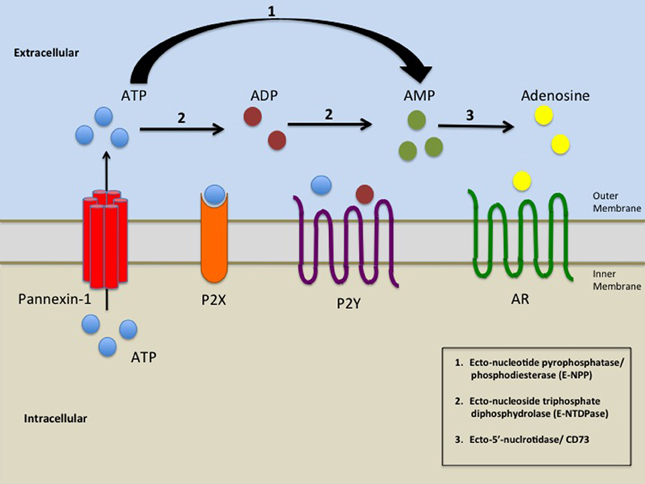
Generally speaking, all cells have the ability to release nucleotides. In neuronal and neuroendocrinal cells, this mostly occurs via regulated exocytosis. Released nucleotides can be hydrolyzed extracellularly by a variety of cell surface-located enzymes referred to as ectonucleotidases. The purinergic signalling system consists of transporters, enzymes and receptors responsible for the synthesis, release, action, and extracellular inactivation of (primarily) ATP and its extracellular breakdown product adenosine. The signalling effects of uridine triphosphate (UTP) and uridine diphosphate (UDP) are generally comparable to those of ATP.
Purinergic signalling
Purinergic signalling (or signaling: see American and British English differences) is a form of extracellular signalling mediated by purine nucleotides and nucleosides such as adenosine and ATP. It involves the activation of purinergic receptors in the cell and/or in nearby cells, thereby regulating cellular functions.
It was proposed after Adenosine triphosphate (ATP) was identified in 1970 as the transmitter responsible for non-adrenergic, non-cholinergic neurotransmission. Nowadays is it known that ATP acts a co-transmitter in most, if not all, nerves in the central and peripheral nervous system.
Receptors for adenosine (called P1) and for ATP and ADP (called P2) were distinguished in 1978. Later, the P2 receptors were subdivided into P2X and P2Y families based on their different mechanisms. In the early 1990s, when the receptors to purines and pyrimidines were cloned and characterized, numerous subtypes of P1 and P2 receptors were discovered.
The purinergic signalling complex of a cell is sometimes referred to as the "purinome".
Purinergic receptors, represented by several families, are among the most abundant receptors in living organisms and appeared early in evolution.
Among invertebrates, the purinergic signalling system has been found in bacteria, amoeba, ciliates, algae, fungi, anemones, ctenophores, platyhelminthes, nematodes, crustacea, molluscs, annelids, echinoderms, and insects. In green plants, extracellular ATP and other nucleotides induce an increase in the cytosolic concentration of calcium ions, in addition to other downstream changes that influence plant growth and modulate responses to stimuli. In 2014, the first purinergic receptor in plants, DORN1, was discovered.
The primitive P2X receptors of unicellular organisms often share low sequence similarity with those in mammals, yet they still retain micromolar sensitivity to ATP. The evolution of this receptor class is estimated to have occurred over a billion years ago.
Generally speaking, all cells have the ability to release nucleotides. In neuronal and neuroendocrinal cells, this mostly occurs via regulated exocytosis. Released nucleotides can be hydrolyzed extracellularly by a variety of cell surface-located enzymes referred to as ectonucleotidases. The purinergic signalling system consists of transporters, enzymes and receptors responsible for the synthesis, release, action, and extracellular inactivation of (primarily) ATP and its extracellular breakdown product adenosine. The signalling effects of uridine triphosphate (UTP) and uridine diphosphate (UDP) are generally comparable to those of ATP.
Recent media
Recent media