Hubbry Logo
Push-pull configurationPush-pull configurationMain
Open search
Push-pull configuration
Community hub
Push-pull configuration
logo
8 pages, 0 posts
0 subscribers
Be the first to start a discussion here.
Push-pull configuration
from Wikipedia
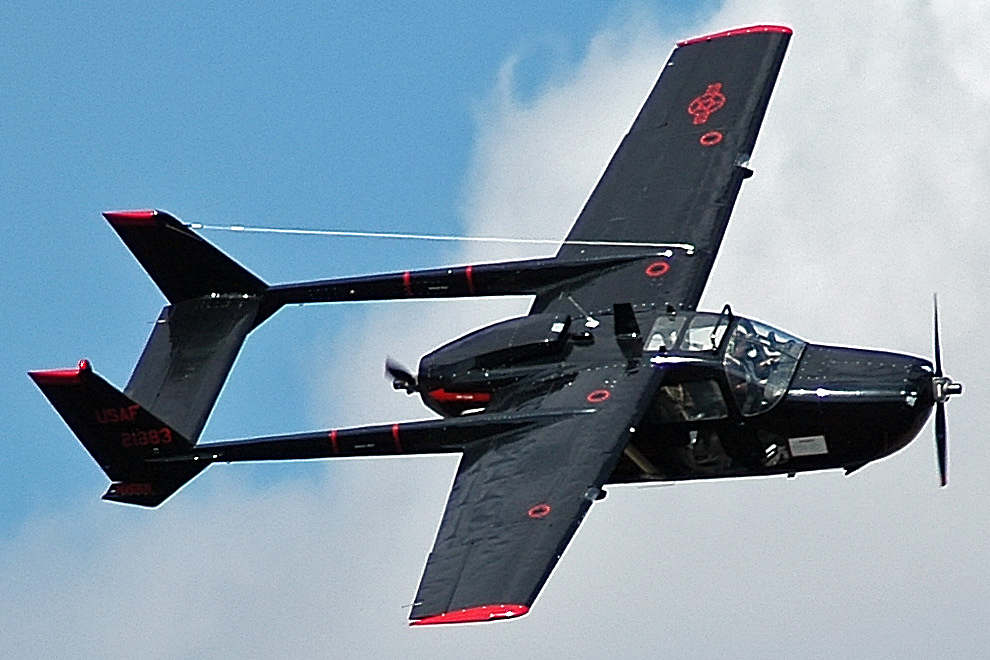
A Cessna O-2 Skymaster, a twin boom push-pull design

An aircraft constructed with a push-pull configuration has a combination of forward-mounted tractor (pull) propellers, and backward-mounted (pusher) propellers.

Historical

[edit]

The earliest known examples of "push-pull" engined-layout aircraft was the Short Tandem Twin.

An early pre-World War I example of a "push-pull" aircraft was the Caproni Ca.1 of 1914 which had two wing-mounted tractor propellers and one centre-mounted pusher propeller. Around 450 of these and their successor, the Ca.3 were built. One of the first to employ two engines on a common axis (tandem push-pull) was the one-off, ill-fated Siemens-Schuckert DDr.I fighter of 1917.

German World War I designs included the only Fokker twin-engined design of the period, the Fokker K.I from 1915; followed by the unusual Siemens-Schuckert DDr.I triplane fighter design of late 1917, and concluding with the laterally-offset "push-pull" Gotha G.VI bomber prototype of 1918.

Claudius Dornier embraced the concept, many of his flying boats using variations of the tandem "push-pull" engine layout, including the 1922 Dornier Wal, the 1938 Dornier Do 26, and the massive 1929 Dornier Do X, which had twelve engines driving six tractors and six pushers. A number of Farmans and Fokkers also had push-pull engine installations, such as the Farman F.121 Jabiru and Fokker F.32.

Configuration

[edit]

Push-pull designs have the engines mounted above the wing as Dornier flying boats or more commonly on a shorter fuselage than conventional one, as for Rutan Defiant or Voyager canard designs. Twin boomers such as the Cessna Skymaster and Adam A500 have the aircraft's tail suspended via twin booms behind the pusher propeller. In contrast, both the World War II-era Dornier Do 335 and the early 1960s-designed French Moynet M 360 Jupiter experimental private plane had their pusher propeller behind the tail.[1][2]

Design benefits

[edit]

While pure pushers decreased in popularity during the First World War, the push-pull configuration has continued to be used. The advantage it provides is the ability to mount two propellers on the aircraft's centreline, thereby avoiding the increased drag that comes with twin wing-mounted engines. It is also easier to fly if one of the two engines fails, as the thrust provided by the remaining engine stays in the centerline. In contrast, a conventional twin-engine aircraft will yaw in the direction of the failed engine and become uncontrollable below a certain airspeed, known as VMC.

Design problems

[edit]

The rear engine operates in the disturbed air from the forward engine, which may reduce its efficiency to 85% of the forward engine.[3][4] In addition the rear engine can interfere with the aircraft's rotation during takeoff if installed in the tail, or they require additional compromise to be made to ensure clearance. This is why they are more common on seaplanes, where this is not a concern.

Piloting

[edit]

Pilots in the United States who obtain a multi-engine rating in an aircraft with this push-pull, or "centerline thrust," configuration are restricted to flying centerline-thrust aircraft; pilots who obtain a multi-engine rating in conventional twin-engine aircraft do not have a similar limitation with regard to centerline-thrust aircraft. The limitation can be removed by further testing in a conventional multi-engine aircraft.[5]

Military application

[edit]
The only surviving Do 335 at the Steven F. Udvar-Hazy Center near Washington, DC

Despite its advantages push-pull configurations are rare in military aircraft. In addition to the problems noted for civil aircraft, the increased risk to the pilot in the case of a crash or the need to parachute from the aircraft also pose problems. During a crash the rear engine may crush the pilot and if bailing out, the pilot is in danger of hitting the propeller. Examples of past military applications include the aforementioned Siemens-Schuckert DDr.I twin-engined triplane and the Gotha G.VI, with its engines mounted on the front and rear ends of two separate fuselages. More successful was the Italian Caproni Ca.3 trimotor, with two tractor engines and one pusher. Between the wars, most push-pull aircraft were flying boats, of which the Dornier Wal was probably the most numerous, while a number of heavy bombers, such as the Farman F.220 used engines mounted in push-pull pairs under the wings. Near the end of World War II, the German Dornier Do 335 push-pull twin-engined, Zerstörer-candidate heavy fighter featured explosive charges to jettison the rear propeller and dorsal tailfin, a manually-jettisonable main canopy, as well as an ejection seat. One of the last military aircraft to use the configuration was the American Cessna O-2, which was used for forward air control during the Vietnam War.

Images

[edit]

See also

[edit]

References

[edit]
[edit]
Revisions and contributorsEdit on WikipediaRead on Wikipedia
from Grokipedia
The push-pull configuration is a propulsion arrangement in aircraft featuring two engines and propellers mounted in tandem: a front-mounted tractor propeller that pulls the aircraft forward and a rear-mounted pusher propeller that pushes it from behind. This twin-engine setup, often aligned along the aircraft's centerline, provides balanced thrust and minimizes yaw in the event of an engine failure, enhancing flight safety compared to conventional side-by-side engine configurations. First developed during and refined through subsequent decades, push-pull designs have been employed in both military and for their aerodynamic and handling benefits. Notable examples include the 337 Skymaster, a light twin used in , and experimental aircraft like the , which completed the first non-stop, non-refueled circumnavigation of the Earth in 1986. While offering advantages in stability and efficiency, the configuration presents design challenges such as propeller interference and maintenance complexity, as explored in dedicated sections of this article.

History

Origins and early experiments

The push-pull configuration emerged in early as a solution to achieve balanced and improved stability in multi-engine , particularly for heavy bombers where uneven power distribution could compromise control during takeoff and flight. Italian aviation pioneer Giovanni Caproni introduced this innovative layout with the Ca.1 bomber, first flown in 1914. The design featured two 80-hp rotary tractor engines mounted on the outboard sides of the twin tail booms to pull the forward, paired with a central 80-hp rotary pusher engine in the rear fuselage to provide counter-. This arrangement addressed the challenges of powering large, multi-crew biplanes by distributing propulsion to minimize effects and enhance , especially in the absence of advanced control systems. Approximately 150 units of the Ca.1 were produced, with immediate variants reaching a total of around 300-400 by the end of the war, marking one of the earliest large-scale adoptions of push-pull propulsion in . In Britain, experimental efforts with push-pull setups predated widespread combat use, focusing on seaplane and prototypes to test multi-engine viability for naval and long-range roles. The Short Tandem Twin, a 1911 conversion by , featured two 50 hp rotary engines in tandem—one front tractor direct-coupled to a central and one rear pusher—for balanced and counter-rotation to cancel gyroscopic moments. This tandem arrangement allowed for side-by-side seating for two crew members while experimenting with balanced power for improved handling over water. Only a single example was built, serving primarily as a for the Royal Navy's early program before being rebuilt and redesignated. Another notable British pioneer was the Kennedy Giant, a massive experimental completed in 1917 by Kennedy Aeroplanes Ltd. under designer Chessborough J.H. MacKenzie-Kennedy. It employed four 200-hp Canton-Unné Z.9 water-cooled radial engines in push-pull pairs—one and one per wing —to propel its 142-foot , aiming to create a capable of long-range missions. Despite its ambitious scale, the underpowered design achieved only brief hops and straight-line flights, with just one constructed before the project was abandoned due to structural and performance issues. These pre-war and early wartime experiments laid the groundwork for refining push-pull systems to counter asymmetric thrust in larger .

World War I and interwar developments

During , the push-pull configuration transitioned from experimental to limited operational use in German military aircraft, emphasizing tandem engine arrangements to enhance firepower and streamline in fighters and bombers. The DDr.I triplane fighter, developed in early 1917, represented one of the earliest attempts at a production-ready push-pull design, featuring two 110 hp Siemens-Halske Sh.I rotary engines mounted in tandem along the centerline—one pulling and one pushing. Intended for single-seat duties with superior climb rates, the crashed fatally on its maiden test flight in April 1917 due to structural issues, preventing any combat deployment or further development. Similarly, the Fokker K.I bomber, refined through 1917 testing despite its 1915 origins, adopted a novel push-pull setup with two 80 hp Oberursel U.I rotary engines in a central , supported by twin booms for stability. This three-seat configuration allowed for forward and rear gunners while positioning the pilot centrally, aimed at escort and light bombing roles on the Western Front; however, control caused handling difficulties, resulting in no production beyond a handful of and minimal evaluation. The experimental G.VI, tested in 1918, featured an asymmetric layout with two 260 hp Mercedes D.IVa inline engines—one in the offset nose and one pusher in a wing —enabling potential with a crew of three and a 660 lb load. Only one was built and saw no frontline use before the , highlighting the layout's potential for heavier payloads despite vibration challenges. In parallel, Italian designs underscored the era's push toward scaled production of multi-engine aircraft, with bombers—with three engines on booms for stability—seeing production of around 250-300 units by war's end, primarily for frontline bombing and with A.12bis engines. Building on these wartime lessons, the saw commercialization, particularly in seaplanes, where the tandem push-pull layout addressed propeller clearance and efficiency for water operations. Claude Dornier, leveraging his pre-war experience, pioneered refined tandem arrangements in flying boats to align lines and minimize drag in all-metal hulls. His Dornier Wal (Do J), debuting in 1922, mounted two 600 hp V-12 engines in a push-pull above the high , facilitating reliable takeoffs from rough seas and supporting roles in , delivery, and naval ; over 400 were produced across for global operators, including transoceanic surveys. Dornier's innovations extended to the ambitious in 1929, which featured six pairs of 524 hp Siemens-built radial engines in tandem push-pull mounts atop the —totaling 6,288 hp for a 52-passenger flying boat. Despite chronic underpowering, it completed transatlantic demonstration flights in 1930–1931, departing for New York via the and , covering over 26,000 miles and validating long-range potential, though only three airframes were completed due to economic constraints.

World War II innovations

During , the push-pull configuration reached a notable peak in through the German "Pfeil" (Arrow), a designed for high-speed interception and bombing roles from 1943 to 1945. This featured two V-12 liquid-cooled engines in a tandem arrangement, each producing approximately 1,750 horsepower, with the forward engine driving a tractor and the rear engine powering a pusher via an extension shaft. The centerline from this layout minimized aerodynamic drag and torque effects, enabling a top speed of 763 km/h (474 mph) at altitude, making it the fastest piston-engined fighter of the war. Key innovations in the Do 335 addressed the unique challenges of the push-pull design, including the world's first operational capable of withstanding 20 G forces for pilot escape, and explosive bolts allowing the jettisonable rear and tail fin to clear the path during ejection. Approximately 38 were completed, including 14 prototypes, 10 A-0 models, 11 initial production A-1 fighters, and three two-seat trainers, though wartime disruptions limited full-scale deployment. The configuration's emphasis on balanced enhanced single- performance, maintaining speeds around 620 km/h even with one engine out, which improved safety in combat scenarios. Beyond the Do 335, push-pull configurations saw rare applications in other WWII fighters and bombers, primarily as experimental efforts to achieve superior speed through reduced drag and aligned thrust lines. These designs, often building on pre-war Dornier concepts, prioritized centerline to counter the inefficiencies of traditional twin-engine layouts, but few progressed beyond prototypes due to resource constraints. Engineering challenges included rear-engine overheating from limited airflow and complex shaft-driven mechanics, compounded by Allied bombing raids on factories like the Manzel plant in , which delayed production and testing. Wartime fuel shortages and shifting priorities toward like the Me 262 further hampered output, with only 38 Do 335s fully assembled despite plans for hundreds.

Postwar and contemporary examples

Following , the push-pull configuration saw limited but notable proliferation in , particularly for utility and multi-role aircraft emphasizing safety and redundancy over outright performance. The 337 Skymaster, introduced in 1965 as an evolution of the earlier Model 336, became one of the most produced examples, with a total of 2,993 units built through 1980. Powered by two 210-hp Continental IO-360-C fuel-injected engines mounted in tandem, the Skymaster offered a cruise speed of around 166 knots and a gross weight of 4,200 pounds, making it suitable for personal and business transport. During the , a militarized variant known as the O-2 Skymaster was adapted for and psychological operations, with 532 units produced for the U.S. between 1966 and 1970. Production of the Skymaster line ended in 1980 primarily due to declining demand for light twin-engine aircraft amid rising fuel costs, increased insurance liabilities, and a market shift toward single-engine efficiency and larger turboprops. In the homebuilt and experimental sector, the Rutan Model 74 Defiant represented a innovative postwar application during the , designed by as a four-seat canard with push-pull engines of 150 hp each for balanced and speed. First flying in 1978, the Defiant achieved true airspeeds up to 186 knots and was offered as plans and kits through the Rutan Aircraft Factory, with approximately 20 kits completed and at least 19 registered with the FAA by the late . Its and centerline layout prioritized single-engine handling characteristics, influencing later experimental designs focused on . Contemporary interest has revived the configuration in niche amphibious roles, as seen with the Dornier Seawings Seastar CD2, a modern twin-engine developed in the 2020s for search-and-rescue, , and missions. Powered by two PT6A-135A engines each rated at 650 shp, the Seastar features a high-wing layout with retractable for water and land operations, achieving a maximum cruise speed of 180 knots and a range of over 1,000 nautical miles. The first flew in 2020, with the second completing maiden flights in 2024, and European targeted for 2025 to enable entry into service. As of November 2025, production remains pre-serial, with final assembly facilities under construction in and to support up to 50 units annually once certified. Recent trends indicate the push-pull layout's enduring but niche role, with no major certified production programs since the 1980s due to prohibitive certification and development costs for manned aircraft. However, emerging applications in unmanned aerial vehicles (UAVs) and explore electric propulsion variants, capitalizing on the configuration's inherent balance for improved battery efficiency and stability in hybrid systems. For instance, conceptual electric push-pull designs for long-endurance UAVs have gained traction in , potentially enabling extended missions without traditional dependencies. Postwar speed-focused designs, such as the , drew brief inspiration from the Dornier Do 335's tandem-engine advantages.

Technical Configuration

Fundamental layout

The push-pull configuration in aircraft propulsion integrates a forward-mounted tractor , which generates by pulling the forward, with a rear-mounted pusher , which produces by pushing the from behind, typically aligned along the aircraft's longitudinal centerline or supported by structural booms to ensure symmetric thrust distribution. This tandem arrangement positions the engines coaxially along the axis, with the front acting as a tractor and the rear as a pusher, creating a balanced propulsive force without inherent in direction. In terms of basic , the are spaced to minimize wake interference, with diameters carefully matched—often identical in experimental setups—to avoid losses from disruption between the rotating disks. Single-engine implementations may employ a single powerplant in via a gearbox, where gearbox ensures proper phase alignment to minimize losses, while twin-engine variants utilize separate engines, each dedicated to one propeller, mounted in line for streamlined integration. The overall layout prioritizes collinear engine placement to align the axes precisely with the aircraft's roll axis, reducing rotational and enhancing maneuverability. Thrust vector alignment is a core principle, with both propellers oriented such that their thrust lines coincide along the longitudinal axis, resulting in zero net yaw moment under normal symmetric operation as the forward pull and rearward push cancel any lateral . This geometry implies a conceptual thrust diagram where vectors from the and propellers superimpose directly, maintaining without requiring corrective inputs. As a prerequisite concept, the push-pull configuration differs fundamentally from pure setups, which rely solely on forward-mounted propellers to draw the aircraft through the air, or pure designs, which use only rear-mounted propellers to expel aft; instead, it synergizes both mechanisms for integrated along a shared axis.

Engine and propeller arrangements

In push-pull configurations, engines are typically mounted along the fuselage centerline to maintain symmetry and minimize asymmetric yaw during engine failure. This arrangement places the forward engine in the nose and the aft engine within or at the rear of the fuselage, as exemplified by the fighter, where the pusher engine drove a from the tail section. Alternatively, some designs incorporate twin tail booms to support the while keeping the engines aligned on the centerline, such as in the Cessna 337 Skymaster, which uses high-mounted nacelles extending forward and aft from the wing. Propeller setups in push-pull aircraft generally feature single propellers on each engine, with the forward unit rotating in the conventional direction and the rear unit often matching to avoid torque imbalances, though variations exist. Contra-rotating propellers, where the aft unit spins opposite to the forward one, can enhance efficiency by recovering rotational energy from the slipstream but add mechanical complexity; this was explored in experimental push-pull designs to improve overall propulsive performance. A range of engine types has been employed in push-pull layouts, adapting to mission requirements from historical to modern applications. Piston engines, such as the fuel-injected six-cylinder horizontally opposed units producing 210 horsepower each, power civil aircraft like the 337 Skymaster for reliable short-field operations. Turboprop engines offer higher power density for amphibious or utility roles, as seen in the , which uses two PT6A-135A engines each delivering 650 shaft horsepower in a flat-rated configuration for efficient takeoff from water. Historically, radial engines provided robust power for large flying boats; the featured twelve Siemens-built nine-cylinder radials in tandem push-pull pairs, each rated at 524 horsepower, to achieve the necessary thrust for its massive 52,000-pound gross weight. The rear pusher in push-pull arrangements operates at reduced , typically around 85%, primarily due to ingestion of the distorted wake from the forward and , which introduces swirl and velocity nonuniformities that lower thrust conversion. In military designs, such propellers sometimes include jettison mechanisms for emergency egress; the employed explosive bolts to detach the aft three-bladed pusher , clearing the path for the pilot's . To mitigate vibrations from mismatched speeds, push-pull aircraft often incorporate synchronization systems that electronically monitor and adjust propeller RPM between engines. These systems use sensors on the primary to signal the secondary's , maintaining precise RPM alignment and reducing structural fatigue and in the centerline thrustline.

Advantages

Aerodynamic and efficiency benefits

The push-pull configuration offers notable aerodynamic advantages by aligning both propellers along the aircraft's centerline, which eliminates the need for wing-mounted engine nacelles typical in conventional side-by-side twin-engine designs. This placement minimizes side forces and profile drag, as the streamlined integration avoids protrusions that disrupt airflow over the wings. As a result, the configuration achieves a cleaner aerodynamic profile, with reported drag reductions stemming from the absence of external engine housings. Propeller efficiency in push-pull setups benefits from the front (pull) operating in undisturbed airflow, maximizing its output, while the rear (push) functions within the generated by the forward unit. Although the rear experiences some loss due to this disturbed flow—typically around 85% relative to the front—the overall balance provides net superior to isolated pusher designs. The net can be approximated as Tnet=Tpull+TpushηrearT_{\text{net}} = T_{\text{pull}} + T_{\text{push}} \cdot \eta_{\text{rear}}, where ηrear\eta_{\text{rear}} accounts for the rear 's reduced effectiveness in the accelerated airflow. This arrangement ensures balanced power contribution without the asymmetric losses common in offset configurations. Cooling for the rear engine is enhanced by the slipstream from the front , which directs high-velocity airflow over the and into the rear intakes, improving heat dissipation compared to pure aircraft where engines rely solely on air. This prop wash augmentation helps maintain optimal operating temperatures, particularly during low-speed operations like takeoff and climb, reducing the risk of overheating without additional ducting complexity. In cruise flight, these aerodynamic refinements translate to improved , with push-pull aircraft demonstrating up to 20% better specific fuel consumption than comparable conventional twins due to the lower induced and profile drag of the . For instance, the 337 Skymaster achieves approximately 21.8 gallons per hour (GPH) total fuel burn at 75% power for a cruise speed of 167 knots (KIAS), yielding higher nautical miles per gallon than the 310's 28 GPH at 183 KIAS under similar conditions. This efficiency gain supports longer ranges and reduced operating costs in applications.

Safety and handling improvements

The push-pull configuration significantly enhances flight safety during single-engine failure scenarios by eliminating asymmetric yaw in conventional wing-mounted twin-engine . In traditional designs, the loss of one outboard engine creates a strong yaw moment toward the failed side, potentially leading to loss of control if drops below the minimum control speed (Vmc). By contrast, the centerline placement of engines in push-pull layouts ensures that both propellers operate along the aircraft's longitudinal axis, producing balanced thrust even with one engine inoperative. This results in minimal or no yaw deviation, allowing pilots to maintain directional control with little to no input. For example, in the Cessna 337 Skymaster, a prominent push-pull , single-engine failure produces no measurable yaw or roll tendency, making it controllable down to stall speeds without the Vmc limitations typical of side-by-side twins, where Vmc often exceeds stall speed by 10-20 knots or more. This benefit is particularly valuable in general aviation, where it simplifies handling for pilots during critical engine-out situations. This inherent balance also improves overall stability and handling characteristics. Symmetric loading from the opposing engines prevents adverse roll tendencies during normal operations and engine-out conditions, contributing to more predictable flight dynamics. Stall behavior is particularly benefited, as the balanced propulsion maintains airflow symmetry over the wings, reducing the risk of wing drop or spin entry compared to conventional twins, where asymmetric thrust can exacerbate stall asymmetry. Pilots report that push-pull aircraft exhibit neutral stability in yaw post-failure, allowing focus on power management and attitude control rather than aggressive rudder coordination. These traits align with certification standards under FAR Part 23, which require multiengine light aircraft to demonstrate safe controllability with one engine inoperative, a threshold easily met by centerline thrust designs without the need for additional aerodynamic fixes like yaw dampers. Emergency procedures are simplified and more forgiving in push-pull configurations, enabling safer engine-out climbs and recoveries. Without asymmetric thrust complications, pilots can execute immediate power reductions on the failed engine, feather the propeller if equipped, and climb at the published single-engine best rate-of-climb speed (Vyse) with reduced risk of departure stall. In the Cessna 337, for instance, single-engine climb rates range from 295 to 450 feet per minute depending on the model and failed engine, often outperforming equivalent conventional twins while maintaining positive control margins. This ease of handling extends to training and operations, where the absence of Vmc rollover threats allows for more realistic engine-failure practice without heightened safety risks. Overall, these aircraft demonstrate lower accident involvement in engine-failure events compared to non-centerline multiengine designs, with data indicating that control-loss incidents post-failure are rare due to the benign handling qualities.

Challenges

Performance drawbacks

The rear engine in a push-pull configuration experiences reduced thrust efficiency due to its operation within the disturbed airflow from the front tractor propeller's wake and the fuselage boundary layer. This wake ingestion alters the inflow velocity and angle of attack to the pusher blades, typically resulting in an efficiency loss of 3-8% depending on the fuselage-to-propeller diameter ratio. Takeoff performance is compromised by the rear propeller's limited ground clearance, which restricts the aircraft's rotation angle to avoid strikes during liftoff and thereby increases the required takeoff distance compared to conventional tractor configurations. For example, the Piaggio Avanti (a related pusher design) requires approximately 1,000 feet longer takeoff distance than the comparable King Air 250 puller configuration. This limitation heightens propeller strike risks, particularly on rough or short runways, as excessive nose-up attitude brings the rear blades perilously close to the ground. The design necessitates a longer to separate the engines and accommodate drive mechanisms, imposing a weight penalty on the empty weight relative to side-by-side twin-engine layouts with equivalent power. This added structural mass reduces overall capacity and . Top speeds in push-pull designs are often capped due to aerodynamic interference between the front and rear propellers, where the slipstream disrupts the pusher's optimal loading and increases drag, limiting cruise performance in high-speed applications. For instance, in the , these effects contribute to observed performance trade-offs. Furthermore, the push-pull configuration remains relatively uncommon in general aviation due to these complexities, including cooling issues for the rear engine arising from disrupted airflow to cooling intakes, increased noise from turbulent propeller interactions, and aerodynamic trade-offs that reduce propulsive efficiency compared to conventional tractor layouts.

Design and operational difficulties

One significant engineering challenge in push-pull configurations, such as the , is the limited access to the rear engine, which is embedded within the rather than mounted on a wing. This placement complicates routine servicing and inspections, often requiring disassembly of interior panels or the use of ladders and specialized equipment to reach components, thereby extending times compared to conventional twin-engine designs with wing-mounted powerplants. Certification processes for push-pull aircraft impose additional hurdles due to their unique centerline-thrust characteristics. In the United States, the mandates a multi-engine rating with a specific centerline-thrust limitation or endorsement for pilots operating these , as their asymmetric dynamics during differ from standard multi-engine setups. Furthermore, synchronizing vibrations between the front tractor and rear pusher propellers adds complexity to airworthiness testing, necessitating rigorous demonstrations of structural integrity and control stability. Noise and vibration issues are exacerbated by the tandem engine arrangement, where the rear pusher propeller directs acoustic energy toward the cabin, resulting in higher interior sound levels than in tractor-only designs. This often requires enhanced insulation materials, such as vibration-damping composites, to mitigate passenger discomfort and fatigue. Mismatches in propeller RPM can also induce harmonic vibrations that resonate through the fuselage, potentially accelerating wear on airframe components if not addressed through synchronizers.

Applications and Usage

Civil and general aviation

In civil and , the push-pull configuration finds practical application in multi-engine designed for personal transport, business operations, and utility roles, offering redundancy and balanced thrust for safer operations in diverse environments. The series, introduced in 1961 and entering production in 1963, exemplifies this layout with its centerline twin-engine setup, where one engine pulls via a tractor at the nose and the other pushes from the rear. A total of 2,993 units were built through 1982, serving primarily in personal transport, services, and in remote areas due to its reliable performance and ability to operate from unprepared strips. Variants like the Turbo Skymaster (T337), equipped with turbocharged Continental TSIO-360 s, enhance high-altitude operations, enabling cruises up to 20,000 feet at speeds of 190-200 knots, which is advantageous for crossing mountainous terrain or avoiding . The configuration's handling benefits, such as reduced asymmetric thrust issues during engine failure, contribute to its appeal in civil operations by simplifying pilot workload during training and routine flights. This elimination of asymmetric yaw in single-engine operation enhances safety, particularly in low-speed scenarios like takeoff and landing, making it suitable for general aviation pilots transitioning to multi-engine aircraft. However, despite these advantages, push-pull designs remain uncommon in general aviation due to several complexities, including increased cabin noise from the tandem propellers, cooling difficulties for the rear engine caused by disturbed airflow from the forward propeller, and aerodynamic trade-offs such as reduced efficiency of the pusher propeller due to interference, which can lead to higher drag and performance penalties. As of 2020, approximately 650 active examples were registered with the FAA, maintaining niche appeal worldwide and favored for reliability in remote and underdeveloped regions where single-engine alternatives may lack sufficient safety margins. Homebuilt and have also embraced push-pull designs for their efficiency and performance potential in recreational and record-setting flying. The Rutan Defiant, a four-seat canard aircraft developed in the 1980s by , features engines in push-pull arrangement, achieving a top speed of 235 mph and setting a class speed record in 1982 during testing by builder Danny Mortensen. Plans for the Defiant remain available for amateur builders, allowing construction of high-performance composites-based kits that prioritize speed and range for cross-country touring. Amphibious applications highlight the configuration's versatility in civil roles, particularly for and near water bodies. The Dornier Seawings Seastar, a modern entering service in the 2020s, employs twin PT6A engines in push-pull setup—one at the nose and one at the tail—for balanced propulsion and short (STOL) capabilities, with a stall speed of 65 knots and short-field performance enabling operations from rough water or coastal runways. As of 2025, the Seastar has achieved EASA and is progressing toward full entry into service. It supports flights, such as scenic coastal tours and fly-fishing charters, while also accommodating patrols for and fisheries protection in archipelagic regions.

Military and special missions

The push-pull configuration found notable application in military aviation through the German Pfeil, a designed primarily for high-speed interception roles against Allied bombers. Powered by two inverted V-12 liquid-cooled engines—one tractor-mounted in the nose and one pusher-mounted in the rear fuselage—the aircraft achieved a maximum speed of 765 km/h at altitude, enabling rapid climbs and evasion maneuvers in contested airspace. This tandem arrangement minimized aerodynamic drag while providing balanced thrust, allowing the Do 335 to serve as a potent Zerstörer () in late-war operations, though production was limited to around 400 units due to wartime constraints. In the Vietnam War era, the push-pull design proved advantageous for low-threat, observation-oriented missions, exemplified by the , a militarized variant of the 337 introduced in 1967 for (FAC) duties. With 532 units built between March 1967 and June 1970, the O-2A model featured two engines in push-pull layout, delivering a top speed of 205 mph but excelling in low-speed loiter capabilities essential for directing and airstrikes over dense terrain. The O-2B variant extended this role to psychological operations (psyops), broadcasting leaflets and loudspeaker messages to enemy forces, leveraging the configuration's inherent stability for prolonged, low-altitude orbits in hostile environments. Postwar, push-pull configurations saw rare but specialized adoption in military drones and trainers, valued for their redundancy in engine-out scenarios critical to contested operations. The RQ-5/MQ-5 Hunter UAV, developed in the 1990s for tactical reconnaissance, employed two heavy-fuel engines in push-pull arrangement to enhance survivability and endurance during surveillance missions, with over 700 units produced for U.S. and allied forces. In trainer roles, examples were limited, but the design's balanced handling supported advanced flight instruction in select programs. By 2025, emerging UAV concepts for surveillance continue to explore push-pull layouts, prioritizing engine-out survival to maintain mission continuity in high-risk areas like border patrols or electronic warfare support. Tactically, the push-pull setup offers superior engine-failure resilience compared to side-by-side twins, as the remaining aligns along the centerline, reducing yaw and enabling safer returns from contested zones—a key factor in the Do 335's interceptor viability and the O-2's FAC/psyops endurance. This redundancy proved vital in , where O-2 pilots frequently operated near anti-aircraft fire, allowing controlled glides back to base even with one compromised.

References

Add your contribution
Related Hubs
User Avatar
No comments yet.