



Community hub
Recent from talks
Knowledge base stats:
Talk channels stats:
Members stats:
Dornier Do 26
The Dornier Do 26 was an all-metal gull-winged flying boat produced before and during World War II by Dornier Flugzeugwerke of Germany. It was operated by a crew of four and was intended, in civilian service, to carry a payload of 500 kg (1,100 lb) or four passengers on the Lisbon to New York route. In military service it carried as many as eighteen passengers.
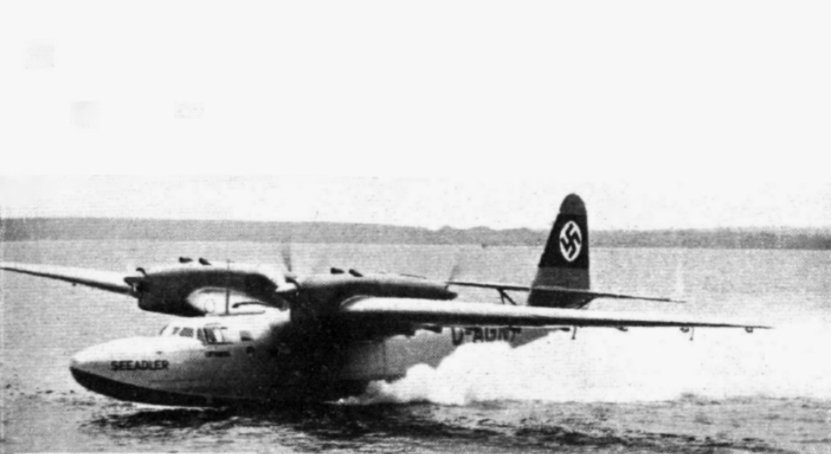
The Do 26 was of all-metal construction. The hull had a central keel and a defined step; the wings were of gull wing configuration, the outer sections being equipped with fully retractable narrow stabilising wing-floats, instead of Dornier's famous "water-wing" sponsons extending from the lower hull for lateral stabilization.
Its four engines, Junkers Jumo 205C diesels, were mounted in tractor/pusher pairs in tandem nacelles located at the joint between the dihedral and horizontal wing sections. The rear (pusher) engines could be swung upwards through 10° during take-off and landing, to prevent contact between the three-blade airscrew and water spray created by the forward propellers.
The tail unit was of conventional design, comprising a horizontal tailplane and a single, vertical fin with rudder.
In 1937, Deutsche Lufthansa ordered three Do 26 aircraft, which were designed to be launched by catapult from special supply ships, for transatlantic air mail purposes. The first, Do 26A D-AGNT V1 Seeadler ("Sea eagle"), was piloted on its maiden flight by Flight Captain Erich Gundermann on 21 May 1938; D-AWDS V2 Seefalke ("Sea Falcon"), followed on 23 November 1938, piloted by Flight Captain Egon Fath. Both were completed and handed over to Deutsche Lufthansa before the outbreak of World War II. Due to opposition from the United States, the German airline was unable to operate these aircraft on the intended transatlantic route; instead, in 1939 they were used to carry air mail between Bathurst and Natal on the Southern Atlantic route.[citation needed] The third aircraft, Do 26B D-ASRA Seemöwe ("Seagull") was completed shortly before the start of World War II.
One Do 26 civilian mission was carried out by V2 Seefalke, when on 14 February 1939 the veteran Deutsche Lufthansa pilot Flight Captain Siegfried Graf Schack von Wittenau embarked on a mercy flight to Chile, taking 580 kg (1,279 lb) of medical supplies for earthquake victims in Chile. The 10,700 km (6,600 mi) flight between Lisbon and Rio de Janeiro lasted 36 hours.
All three Deutsche Lufthansa aircraft were impressed into military service in 1939 at the outbreak of World War II, as P5+AH, P5+BH and P5+CH respectively.
Three other Do 26 aircraft (V4 – V6) were built as Do 26 C for the Luftwaffe with the more powerful 648 kW (880 hp) Junkers Jumo 205D engines; the original three aircraft were similarly converted for military service. Armament consisted of one 20 mm MG 151/20 cannon and three 7.92 mm (.312 in) MG 15 machine guns.
Hub AI
Dornier Do 26 AI simulator
(@Dornier Do 26_simulator)
Dornier Do 26
The Dornier Do 26 was an all-metal gull-winged flying boat produced before and during World War II by Dornier Flugzeugwerke of Germany. It was operated by a crew of four and was intended, in civilian service, to carry a payload of 500 kg (1,100 lb) or four passengers on the Lisbon to New York route. In military service it carried as many as eighteen passengers.
The Do 26 was of all-metal construction. The hull had a central keel and a defined step; the wings were of gull wing configuration, the outer sections being equipped with fully retractable narrow stabilising wing-floats, instead of Dornier's famous "water-wing" sponsons extending from the lower hull for lateral stabilization.
Its four engines, Junkers Jumo 205C diesels, were mounted in tractor/pusher pairs in tandem nacelles located at the joint between the dihedral and horizontal wing sections. The rear (pusher) engines could be swung upwards through 10° during take-off and landing, to prevent contact between the three-blade airscrew and water spray created by the forward propellers.
The tail unit was of conventional design, comprising a horizontal tailplane and a single, vertical fin with rudder.
In 1937, Deutsche Lufthansa ordered three Do 26 aircraft, which were designed to be launched by catapult from special supply ships, for transatlantic air mail purposes. The first, Do 26A D-AGNT V1 Seeadler ("Sea eagle"), was piloted on its maiden flight by Flight Captain Erich Gundermann on 21 May 1938; D-AWDS V2 Seefalke ("Sea Falcon"), followed on 23 November 1938, piloted by Flight Captain Egon Fath. Both were completed and handed over to Deutsche Lufthansa before the outbreak of World War II. Due to opposition from the United States, the German airline was unable to operate these aircraft on the intended transatlantic route; instead, in 1939 they were used to carry air mail between Bathurst and Natal on the Southern Atlantic route.[citation needed] The third aircraft, Do 26B D-ASRA Seemöwe ("Seagull") was completed shortly before the start of World War II.
One Do 26 civilian mission was carried out by V2 Seefalke, when on 14 February 1939 the veteran Deutsche Lufthansa pilot Flight Captain Siegfried Graf Schack von Wittenau embarked on a mercy flight to Chile, taking 580 kg (1,279 lb) of medical supplies for earthquake victims in Chile. The 10,700 km (6,600 mi) flight between Lisbon and Rio de Janeiro lasted 36 hours.
All three Deutsche Lufthansa aircraft were impressed into military service in 1939 at the outbreak of World War II, as P5+AH, P5+BH and P5+CH respectively.
Three other Do 26 aircraft (V4 – V6) were built as Do 26 C for the Luftwaffe with the more powerful 648 kW (880 hp) Junkers Jumo 205D engines; the original three aircraft were similarly converted for military service. Armament consisted of one 20 mm MG 151/20 cannon and three 7.92 mm (.312 in) MG 15 machine guns.