Hubbry Logo
QJY-201QJY-201Main
Open search
QJY-201
Community hub
QJY-201
logo
8 pages, 0 posts
0 subscribers
Be the first to start a discussion here.
QJY-201
QJY-201
from Wikipedia

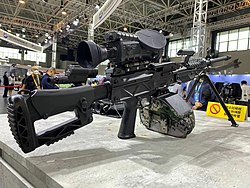
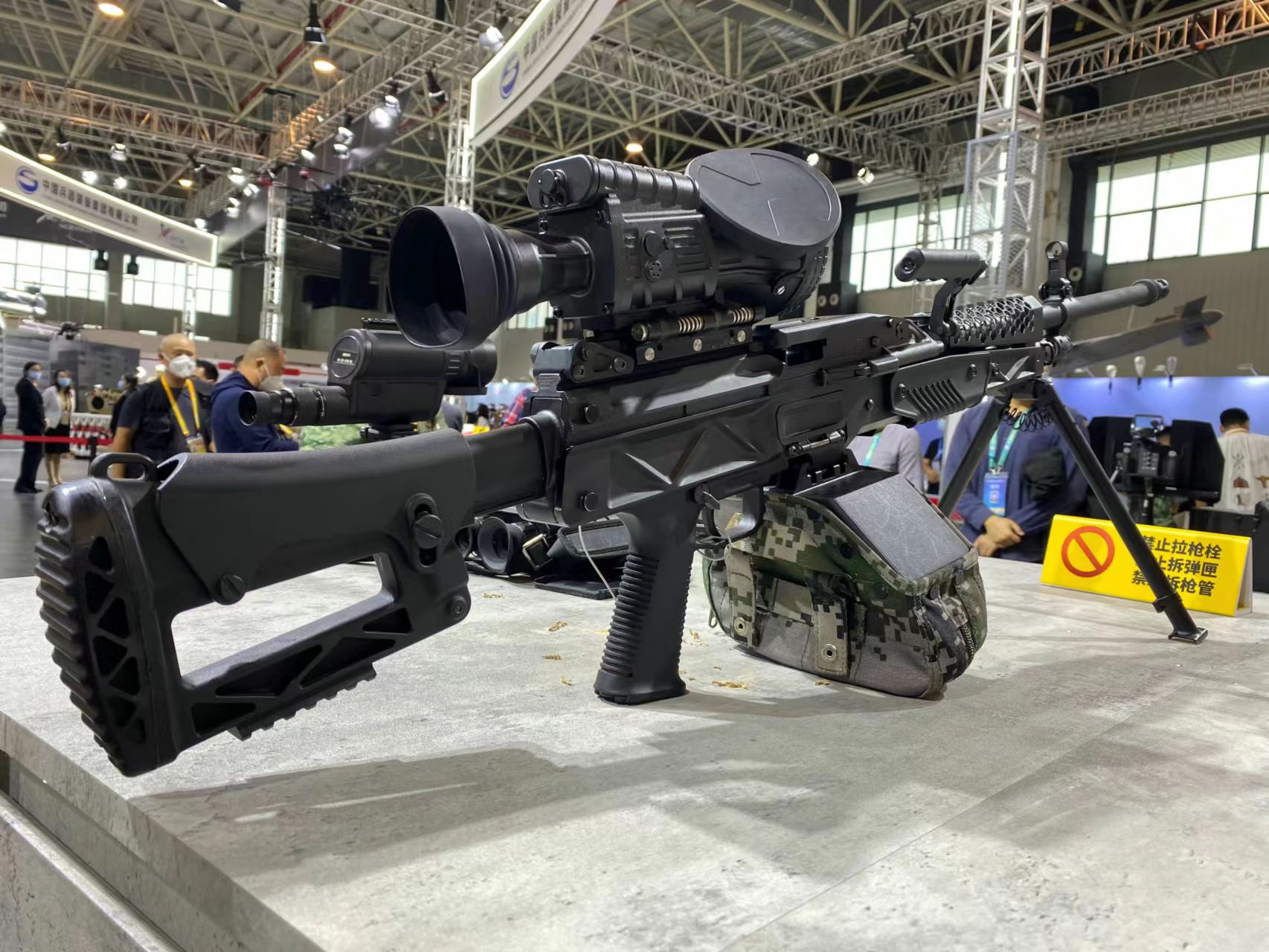
The QJY-201 (Chinese: 201式通用机枪; pinyin: Èr líng yāo shì tōngyòng jīqiāng),[2][3] is a Chinese general purpose machine gun designed and manufactured by Norinco for the People's Liberation Army. It is chambered in the DJP-201 7.62×51mm cartridge,[1][4] and features an unusual open-bolt, hybrid long stroke, short recoil operation. The QJY-201 incorporates weight reduction features, such as lightweight material for the body and a detachable box magazine made of fabric, reducing its weight.

Key Information

The QJY-201 was first publicly unveiled at Zhuhai Airshow in September 2021.

Design

[edit]

The QJY-201 employs a hybrid gas-operated short recoil system, where barrel and bolt mechanics move backward together to absorb recoil. The barrels are cushioned by two springs mounted on the trunnion assembly. The receiver is constructed with aluminum for weight reduction. The barrel supports quick change using the carrying handle. A birdcage-type muzzle device with toothed collar is fitted on the barrel, providing provision for suppressors.[1]

Variants

[edit]
QJY-201
General purpose machine gun chambered in 7.62×51mm
Type 20E 8.6mm
General purpose machine gun chambered in 8.6×70mm, largely based on QJY-201.[5]

Users

[edit]

See also

[edit]

References

[edit]
Revisions and contributorsEdit on WikipediaRead on Wikipedia
from Grokipedia
The QJY-201 is a Chinese general-purpose machine gun designed and manufactured by for the (PLA). Chambered in the 7.62×51mm DJP-201 cartridge, it features an unusual open-bolt, hybrid short recoil operating system that combines gas operation with recoil mechanisms for enhanced control and reduced recoil. First publicly unveiled at the Zhuhai Airshow in September 2021, the QJY-201 supports belt-fed ammunition via steel disintegrating links similar to the U.S. M13 system and is positioned as a lightweight, modern replacement for older Soviet-era designs like the PKM. The development of the QJY-201 reflects China's broader modernization of its small arms inventory, transitioning from the cartridge to the NATO-standard 7.62×51mm for improved and . Adopted by the (PLA) as a and offered for , including a vehicle-mounted variant unveiled in 2025, it incorporates a quick-change barrel for sustained fire and is compatible with tripods, vehicle mounts, and potentially suppressors via its birdcage muzzle device. The weapon's aluminum receiver paired with a steel provides durability without excessive weight, and it includes a folding charging handle and multi-position gas regulator for adaptability in various combat environments. Key specifications include a weight of 8 kg (17.6 lbs), a cyclic between 650 and 750 rounds per minute, an of 800–1,500 meters, and a maximum range of 3,700 meters. Compared to predecessors like the PKM, the QJY-201 offers similar weight but superior mobility due to its hybrid operating system, making it suitable for squads and vehicle integration. Its introduction underscores ongoing PLA efforts to enhance firepower while prioritizing lightweight, versatile platforms for .

Development

Background

The People's Liberation Army (PLA) initiated a comprehensive modernization of its small arms inventory in the late 2010s, driven by the need to enhance combat effectiveness in information-centric warfare and align with global standards. This overhaul included the development of the QBZ-191 rifle family, which debuted in 2019, was fully revealed in 2021, and has been gradually replacing the QBZ-95 series since 2023, emphasizing modularity, ergonomics, and versatility for mechanized forces. As part of this program, the QJY-201 general-purpose machine gun (GPMG) was developed by Norinco to provide sustained fire support within the evolving squad structure. A key strategic motivation was the PLA's transition from Soviet-era 7.62x54R ammunition, used in weapons like the Type 80 GPMG and licensed PKM variants, to the NATO-compatible 7.62x51mm DJP-201 cartridge. This shift aimed to improve logistical compatibility with international allies and captured supplies, while leveraging the cartridge's superior range and penetration over domestic alternatives. The DJP-201, designed to closely match the Western M80 round, facilitates easier integration into global supply chains without compromising performance. The QJY-201 addressed longstanding deficiencies in the PLA's lineup, particularly the need for a lightweight GPMG to succeed the heavier Type 80 and the underpowered 5.8x42mm , both of which limited mobility for units. Requirements prioritized reduced weight and enhanced portability to support rapid deployment in operations, reflecting the PLA's doctrinal emphasis on agile, high-mobility forces. Drawing influences from established designs such as the American M240 for its balanced role and the Russian PKM for elements like the bolt carrier and feed mechanism, the QJY-201 was adapted for efficient Chinese processes. The weapon was publicly unveiled at the 2021 Zhuhai Airshow, marking a milestone in the PLA's small arms evolution.

Design Process

The development of the QJY-201 was led by , China's state-owned defense conglomerate, as part of a broader effort to modernize the People's Liberation Army's inventory in the . This project aligned with the introduction of the rifle series, aiming to integrate modular designs compatible with NATO-standard 7.62×51mm while addressing limitations in earlier Chinese s like the , which suffered from management challenges due to its lighter 5.8×42mm caliber. The QJY-201's focused on enhancing reliability and controllability for squad-level support roles, with early iterations emphasizing a hybrid system to better handle the heavier cartridge's energy. Key innovations during the design phase included the adoption of a gas-operated mechanism combined with short , where the barrel and bolt carrier move rearward in tandem to mitigate forces more effectively than purely gas-driven predecessors. A 2024 analysis of Norinco's filings highlighted these gas-operated advancements, which harness from the firing cycle to reduce wear on components and improve sustained fire performance in varied conditions. Prototypes emerged around 2020, undergoing iterative testing to refine , weight distribution, and integration with the PLA's emerging modular squad weapon ecosystem, including compatibility with and suppressors from the family. Initial photographs of these prototypes leaked online in June 2021, revealing the weapon's design and belt-fed mechanism tailored for both and vehicle-mounted use within unified PLA units. The culmination of this process occurred with the QJY-201's public debut at the Airshow in September 2021, marking the transition from prototype validation to production readiness. This unveiling showcased the final prototype's refinements, such as a lightweight aluminum receiver and quick-change barrel, resulting from extensive engineering iterations to balance portability (under 8 kg unloaded) with capability. By this stage, the design had been optimized for the DJP-201 proprietary 7.62×51mm round, ensuring logistical alignment with potential export markets while fulfilling domestic requirements for enhanced battlefield versatility. Following the 2021 unveiling, the QJY-201 advanced to production and adoption by the PLA, including vehicle-mounted variants deployed as of September 2025.

Design

Operating Mechanism

The QJY-201 utilizes a gas-operated action incorporating a hybrid short-recoil and short-stroke piston system, which combines elements of both mechanisms to optimize reliability and performance. This design fires from an , a configuration that positions the bolt rearward when at rest, thereby enhancing cooling of the chamber and minimizing the risk of during sustained fire or in high-temperature environments. The short-recoil component of the system allows the barrel and bolt to initially move rearward together, absorbing recoil energy before the bolt unlocks and continues cycling via the short-stroke gas piston. This hybrid approach improves controllability by mitigating and felt recoil, particularly beneficial for prolonged automatic fire. Additionally, a multi-position gas regulator enables the operator to adjust gas flow, compensating for factors such as barrel , dust, or cold weather to maintain consistent operation across varying conditions. The weapon employs a belt-feed mechanism using disintegrating steel links similar to the U.S. M13 type, where the belt is pulled from the left side into the receiver. The feed pawl, integrated into the bolt carrier, moves laterally along a track to advance the belt reliably during cycling. The open-bolt design further incorporates a fixed firing pin, which remains stationary relative to the bolt and only strikes the primer upon forward bolt movement, providing an inherent safety feature suited to belt-fed automatic weapons by preventing unintended discharges from inertial forces.

Key Features

The QJY-201 employs a lightweight aluminum alloy receiver reinforced with a , ensuring structural integrity while minimizing overall weight to approximately 8 kg for enhanced portability in support roles. This material combination allows for a durable yet maneuverable suitable for dismounted operations. A key innovation is the quick-change barrel system, which utilizes an integrated carrying handle for safe and rapid barrel swaps without tools, facilitating sustained fire without excessive heat buildup; the barrel terminates in a threaded birdcage-style muzzle device that enables compatibility with suppressors for reduced signature in tactical environments. Complementing this, the weapon features a modular system on the receiver and fore-end, supporting the attachment of optics, vertical foregrips, and bipods to increase adaptability across diverse combat scenarios. Additionally, its hybrid short-recoil operating mechanism contributes to improved recoil control during automatic fire. Ergonomic considerations are evident in the , adjustable buttstock, and integrated foregrip, which collectively optimize handling for prolonged use, whether in prone support positions or vehicle-mounted configurations. The system includes a detachable fabric container for disintegrating link belts holding 100–200 rounds, allowing for convenient reloading and transport without adding unnecessary bulk.

Specifications

Physical Characteristics

The QJY-201 measures approximately 1,150 mm (45 in) in overall length with the extended. Its barrel length is 600 mm (23.6 in). The weapon weighs 8 kg (17.6 lb) unloaded, including the bipod. It is chambered for the 7.62×51mm DJP-201 cartridge and uses belt-fed with a capacity of 100–200 rounds in disintegrating links. The construction features an aluminum receiver for weight reduction and a chrome-lined barrel to enhance heat resistance and durability. The design includes a quick-change barrel mechanism for sustained fire.

Performance Metrics

The QJY-201 exhibits a cyclic ranging from 650 to 750 rounds per minute, which can be adjusted through its multi-position gas regulator to optimize performance across varying types and environmental conditions. This adjustable rate supports both rapid and controlled bursts, enhancing its versatility in combat scenarios. The weapon employs a belt-fed system with steel disintegrating links, allowing for continuous feeding during extended engagements. In terms of range, the QJY-201 achieves an effective firing distance of 800 meters against point targets and up to 1,500 meters for area targets, with a maximum ballistic range of 3,700 meters. These capabilities are supported by a of approximately 830 m/s when using the DJP-201 7.62×51mm , providing sufficient for medium-range engagements while maintaining compatibility with standard NATO-caliber . The design prioritizes accuracy and penetration at these distances through its quick-change barrel system, which facilitates sustained operation without excessive overheating. Reliability is a core aspect of the QJY-201's performance, with the open-bolt firing mechanism and gas regulator enabling consistent function in dusty or adverse conditions. The regulator allows fine-tuning of gas flow to prevent over-gassing or , ensuring consistent function during prolonged fire. Additionally, the hybrid recoil management system—integrating short-recoil operation with gas elements—effectively absorbs and dissipates energy, reducing felt by a significant margin compared to traditional long-stroke designs like the PKM, thereby improving shooter control and follow-up accuracy.

Variants

Standard Infantry Model

The Standard Infantry Model of the QJY-201 is intended as the primary configuration for dismounted troops. Chambered in the 7.62×51mm DJP-201 cartridge, it is designed for compatibility with NATO-standard ammunition while incorporating enhancements for reliability in operations. This configuration weighs 8 kg when equipped with its integral bipod and optics rail, enabling portable deployment without significant burden on squad members. Designed for the squad automatic weapon role, it features a fixed stock for stable shouldering during sustained fire and an integral bipod for prone positioning, with no substantial deviations from the core weapon design. The model is belt-fed using disintegrating link belts to support high-volume . Unveiled in 2021, it is intended as a replacement for older Soviet-era designs like the PKM, addressing limitations such as weight and caliber compatibility with the transition to 7.62×51mm.

Vehicle-Mounted Model

The vehicle-mounted variant of the QJY-201 was unveiled during the 2025 China Victory Day Parade on September 3, marking its debut as a or remote weapon station configuration designed for integration with armored and unmanned platforms. This adaptation addresses the need for a modernized 7.62 mm in vehicular applications, building on the base model's hybrid short-recoil operating mechanism while emphasizing fixed-mount durability over portability. Primarily mounted on lightweight land-based drone platforms and as upgrades for legacy Type 59 main battle tanks, the variant replaces older Type 59T 7.62 mm machine guns to enhance capabilities in mechanized operations. The design incorporates improved absorption via its hybrid short-recoil system, making it suitable for vibration-intensive environments typical of mobile vehicles and unmanned systems. It retains the standard 7.62×51 mm DJP-201 chambering of the QJY-201 family, optimized for sustained fire with ammunition feeds from vehicle-mounted cans typically holding 200 to 500 rounds in disintegrating belts. This variant underscores the People's Liberation Army's (PLA) strategic emphasis on unmanned and networked warfare systems, facilitating remote operation and integration with drone swarms or tank formations for enhanced tactical flexibility. As a recent introduction as of September 2025, it represents a deliberate modernization step in the PLA's ground forces arsenal, though full adoption status remains under evaluation.

Operational History

Introduction and Adoption

The QJY-201 , developed by , remains under consideration for adoption by the (PLA) as of November 2025. It is positioned to modernize the PLA's squad-level firepower, potentially transitioning from legacy systems to a unified family of weapons with compatible logistics, including alongside the and QJB-201 . Public demonstrations have highlighted the weapon's potential, including its debut at the 2022 Airshow where attendees handled the variant. These events have showcased the QJY-201's versatility for both dismounted and vehicular applications. Early evaluations have noted the QJY-201's weight of approximately 8 kg, providing improvements in infantry mobility compared to predecessors like the Type 80 general-purpose machine gun.

Deployment and Use

The QJY-201 has been featured in (PLA) demonstrations and exercises since 2023, including live-fire scenarios in training regimens for border patrols and amphibious operations. These activities highlight the weapon's versatility as a squad support weapon, providing in urban and open terrain environments. As of November 2025, no confirmed instances of the QJY-201 in actual have been reported, though it has appeared in simulated scenarios during joint exercises with allied forces for testing. Adaptations for units include potential compatibility with suppressors for covert operations. In sustained fire roles, the QJY-201 supports the PLA's transition to lighter, modular firepower systems prioritizing mobility and reliability.

Users

Primary Operators

The QJY-201 serves as the standard general-purpose machine gun (GPMG) for the People's Liberation Army (PLA) Ground Force, adopted in the early 2020s following its public unveiling in 2021 to replace older Soviet-era designs like the PK/PKM and provide enhanced compatibility with 7.62×51mm ammunition. Issued primarily to infantry squads and armored units, it delivers sustained suppressive fire at the platoon and company levels, supporting maneuver operations with its belt-fed, gas-operated mechanism. The weapon is also in service with the PLA Navy Marine Corps special operations forces for amphibious assault roles. Produced by at state-owned facilities, the QJY-201 has entered service across PLA branches. Integration into PLA training emphasizes proficiency with 7.62×51mm logistics, including belt handling and barrel changes, as part of broader modernization to improve operational tempo and interoperability. It is occasionally mounted on vehicles such as tanks for or remote applications.

Potential Exports

The QJY-201 has been offered for export by since its unveiling in September 2021 at the Airshow, where it was presented to international visitors as a modern compatible with 7.62×51mm NATO-standard . As of November 2025, no confirmed foreign sales or adoptions of the QJY-201 have been reported, reflecting its relatively recent introduction and the competitive global market for . Its design advantages, including a lightweight construction at approximately 8 kg and compatibility with widely available Western M-80 ball , position it as a cost-effective option for militaries seeking to upgrade from older systems without overhauling logistics. Potential interest may exist among nations in export markets due to the weapon's with NATO-caliber rounds and its suitability for modernization in resource-constrained environments. However, details on trials or evaluations remain unverified in public sources. has continued to promote the QJY-201 at international defense exhibitions, emphasizing its short-recoil operation and quick barrel-change mechanism for sustained fire roles.
Add your contribution
Related Hubs
User Avatar
No comments yet.