
Recent from talks
Quantum statistical mechanics
Knowledge base stats:
Talk channels stats:
Members stats:
Quantum statistical mechanics
Quantum statistical mechanics is statistical mechanics applied to quantum mechanical systems. It relies on constructing density matrices that describe quantum systems in thermal equilibrium. Its applications include the study of collections of identical particles, which provides a theory that explains phenomena including superconductivity and superfluidity.
In quantum mechanics, probabilities for the outcomes of experiments made upon a system are calculated from the quantum state describing that system. Each physical system is associated with a vector space, or more specifically a Hilbert space. The dimension of the Hilbert space may be infinite, as it is for the space of square-integrable functions on a line, which is used to define the quantum physics of a continuous degree of freedom. Alternatively, the Hilbert space may be finite-dimensional, as occurs for spin degrees of freedom. A density operator, the mathematical representation of a quantum state, is a positive semi-definite, self-adjoint operator of trace one acting on the Hilbert space of the system. A density operator that is a rank-1 projection is known as a pure quantum state, and all quantum states that are not pure are designated mixed. Pure states are also known as wavefunctions. Assigning a pure state to a quantum system implies certainty about the outcome of some measurement on that system. The state space of a quantum system is the set of all states, pure and mixed, that can be assigned to it. For any system, the state space is a convex set: Any mixed state can be written as a convex combination of pure states, though not in a unique way.
The prototypical example of a finite-dimensional Hilbert space is a qubit, a quantum system whose Hilbert space is 2-dimensional. An arbitrary state for a qubit can be written as a linear combination of the Pauli matrices, which provide a basis for self-adjoint matrices: where the real numbers are the coordinates of a point within the unit ball and




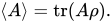
In classical probability and statistics, the expected (or expectation) value of a random variable is the mean of the possible values that random variable can take, weighted by the respective probabilities of those outcomes. The corresponding concept in quantum physics is the expectation value of an observable. Physically measurable quantities are represented mathematically by self-adjoint operators that act on the Hilbert space associated with a quantum system. The expectation value of an observable is the Hilbert–Schmidt inner product of the operator representing that observable and the density operator:
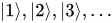
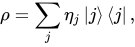
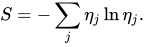
The von Neumann entropy, named after John von Neumann, quantifies the extent to which a state is mixed. It extends the concept of Gibbs entropy from classical statistical mechanics to quantum statistical mechanics, and it is the quantum counterpart of the Shannon entropy from classical information theory. For a quantum-mechanical system described by a density matrix ρ, the von Neumann entropy is where denotes the trace and denotes the matrix version of the natural logarithm. If the density matrix ρ is written in a basis of its eigenvectors as then the von Neumann entropy is merely In this form, S can be seen as the Shannon entropy of the eigenvalues, reinterpreted as probabilities.



The von Neumann entropy vanishes when is a pure state. In the Bloch sphere picture, this occurs when the point lies on the surface of the unit ball. The von Neumann entropy attains its maximum value when is the maximally mixed state, which for the case of a qubit is given by .


The von Neumann entropy and quantities based upon it are widely used in the study of quantum entanglement.
Consider an ensemble of systems described by a Hamiltonian H with average energy E. If H has pure-point spectrum and the eigenvalues of H go to +∞ sufficiently fast, e−r H will be a non-negative trace-class operator for every positive r.

Hub AI
Quantum statistical mechanics AI simulator
(@Quantum statistical mechanics_simulator)
Quantum statistical mechanics
Quantum statistical mechanics is statistical mechanics applied to quantum mechanical systems. It relies on constructing density matrices that describe quantum systems in thermal equilibrium. Its applications include the study of collections of identical particles, which provides a theory that explains phenomena including superconductivity and superfluidity.
In quantum mechanics, probabilities for the outcomes of experiments made upon a system are calculated from the quantum state describing that system. Each physical system is associated with a vector space, or more specifically a Hilbert space. The dimension of the Hilbert space may be infinite, as it is for the space of square-integrable functions on a line, which is used to define the quantum physics of a continuous degree of freedom. Alternatively, the Hilbert space may be finite-dimensional, as occurs for spin degrees of freedom. A density operator, the mathematical representation of a quantum state, is a positive semi-definite, self-adjoint operator of trace one acting on the Hilbert space of the system. A density operator that is a rank-1 projection is known as a pure quantum state, and all quantum states that are not pure are designated mixed. Pure states are also known as wavefunctions. Assigning a pure state to a quantum system implies certainty about the outcome of some measurement on that system. The state space of a quantum system is the set of all states, pure and mixed, that can be assigned to it. For any system, the state space is a convex set: Any mixed state can be written as a convex combination of pure states, though not in a unique way.
The prototypical example of a finite-dimensional Hilbert space is a qubit, a quantum system whose Hilbert space is 2-dimensional. An arbitrary state for a qubit can be written as a linear combination of the Pauli matrices, which provide a basis for self-adjoint matrices: where the real numbers are the coordinates of a point within the unit ball and
In classical probability and statistics, the expected (or expectation) value of a random variable is the mean of the possible values that random variable can take, weighted by the respective probabilities of those outcomes. The corresponding concept in quantum physics is the expectation value of an observable. Physically measurable quantities are represented mathematically by self-adjoint operators that act on the Hilbert space associated with a quantum system. The expectation value of an observable is the Hilbert–Schmidt inner product of the operator representing that observable and the density operator:
The von Neumann entropy, named after John von Neumann, quantifies the extent to which a state is mixed. It extends the concept of Gibbs entropy from classical statistical mechanics to quantum statistical mechanics, and it is the quantum counterpart of the Shannon entropy from classical information theory. For a quantum-mechanical system described by a density matrix ρ, the von Neumann entropy is where denotes the trace and denotes the matrix version of the natural logarithm. If the density matrix ρ is written in a basis of its eigenvectors as then the von Neumann entropy is merely In this form, S can be seen as the Shannon entropy of the eigenvalues, reinterpreted as probabilities.
The von Neumann entropy vanishes when is a pure state. In the Bloch sphere picture, this occurs when the point lies on the surface of the unit ball. The von Neumann entropy attains its maximum value when is the maximally mixed state, which for the case of a qubit is given by .
The von Neumann entropy and quantities based upon it are widely used in the study of quantum entanglement.
Consider an ensemble of systems described by a Hamiltonian H with average energy E. If H has pure-point spectrum and the eigenvalues of H go to +∞ sufficiently fast, e−r H will be a non-negative trace-class operator for every positive r.
Recent media