Hubbry Logo
RV AtlantisRV AtlantisMain
Open search
RV Atlantis
Community hub
RV Atlantis
logo
8 pages, 0 posts
0 subscribers
Be the first to start a discussion here.
RV Atlantis
RV Atlantis
from Wikipedia

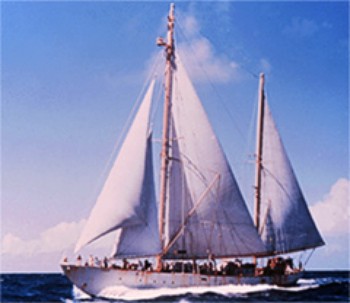
RV Atlantis in 1955 near the Virgin Islands[1]
History
United States
NameRV Atlantis
OwnerWoods Hole Oceanographic Institution
Ordered1930
BuilderBurmeister & Wain, Copenhagen, Denmark
Yard number596
Laid down1930
LaunchedDecember 1930
In service1931
Out of service1966
Argentina
NameEl Austral
OwnerConsejo Nacional de Investigaciones Cientificas y Técnicas (CONICET)
AcquiredJuly 1966
Identification
FateTransferred to PNA
Argentina
NameDr. Bernardo Houssay (MOV-1)
OwnerPrefectura Naval Argentina
Acquired1996
StatusActive
General characteristics
Tonnage312 grt
Displacement334 tons
Length43.5 m (142 ft 9 in)
Beam8.6 m (28 ft 3 in)
Draft3.6 m (11 ft 10 in)
PropulsionMTU 1084 HP
Sail planMarconi Ketch

RV Atlantis was a ketch rigged research vessel operated by the Woods Hole Oceanographic Institution from 1931 to 1966. The Government of Argentina's National Scientific and Technical Research Council acquired her in 1966 and renamed her El Austral, transferring her to the Argentine Naval Prefecture in 1996 as the training and survey ship PNA Dr. Bernardo Houssay (MOV-1). In 2005 it was decided that a replacement vessel with modern capabilities and equipment was required, and a new ship was built in Argentina with a hull and rig along similar lines. Ceremonially incorporating some small parts of the original, she was completed in 2009 and put into full service in 2011, again as Dr. Bernardo Houssay.

Woods Hole history

[edit]

Atlantis was the first research vessel of the American Woods Hole Oceanographic Institution (WHOI) and the first ship built specifically for interdisciplinary research in marine biology, marine geology and physical oceanography. The 460-ton Marconi-rigged ketch originally carried a crew of 17 and had room for 5 scientists.[2] Columbus Iselin II, her first master and a major influence in her design, felt that steadiness, silence and cruising range were of greater importance than speed. After her construction was complete, WHOI searched for an appropriate name for the new vessel. Alexander Forbes (1882–1965), a trustee of WHOI, had recently bought a schooner named Atlantis from Iselin. Forbes rechristened his schooner so the new research vessel could be named Atlantis.

Use of a continuously recording fathometer on Atlantis cruise No. 150 enabled Ivan Tolstoy, Maurice Ewing, and other scientists of the Institution to locate and describe the first abyssal plain in the summer of 1947.[3][4] This plain, located to the south of Newfoundland, is now known as the Sohm Abyssal Plain.[4] Following this discovery many other examples were found in all the oceans.[5][6][7][8][9]

Atlantis made 299 cruises and covered 700,000 miles, carrying out all types of ocean science.

Argentine service

[edit]

In 1964, Atlantis was offered to the government of Argentina and refurbished for the National Scientific and Technical Research Council (Consejo Nacional de Investigaciones Científicas y Técnicas - CONICET). She entered service in 1966 as the research vessel El Austral with CONICET, operated by the Argentine Navy as ARA El Austral (Q-47) and carrying our important investigations in the Argentine Sea. After the purpose-built ice-strengthened research ship ARA Puerto Deseado (Q-20) took over as the platform for CONICET's projects in December 1978, El Austral was decommissioned from the navy and laid up with a skeleton crew at Puerto Madryn. [10]

In 1995, CONICET reached agreement to transfer El Austral to the Argentine Naval Prefecture (Prefectura Naval Argentina - PNA) and renamed PNA Dr. Barnardo Houssay (MOV-1), after the eminent physiologist and director of CONICET.[10] However, she remained berthed in Dock E, Buenos Aires, out of use, until 2005, when she was moved to the nearby Tandanor shipyard with a view to restoring her to active service as a training ship.[10] The PNA reached the conclusion that the ship's condition, after the long periods laid up, could no longer meet its developing requirements, including modern safety and navigation standards, and they decided to build a new ship, albeit largely to the same design, and incorporating some components from the 1930 ship.[10][11]

Tandanor built the new hull, with lower draught incorporating a much increased accommodation for scientists, between 2007 and 2009 at the Tandanor shipyard in Buenos Aires. Also fitted were a new main engine, generators, shaft and propeller, safety equipment, air-conditioning, and all safety and navigation equipment[10][11][12][13] The new ship was commissioned into PNA service in 2011.[10]

References

[edit]

Bibliography

[edit]
Revisions and contributorsEdit on WikipediaRead on Wikipedia
from Grokipedia
RV Atlantis is a Navy-owned oceanographic research vessel operated by the (WHOI) since its delivery in 1997, specifically designed to support the Alvin human-occupied alongside broad marine science investigations in , , and . She is the fourth ship of the Thomas G. Thompson-class research vessels. Measuring 274 feet (83.5 meters) in length with a beam of 52.5 feet (16 meters) and a draft of 19 feet (5.8 meters), the vessel displaces 3,510 long tons and features diesel-electric propulsion with azimuthing stern thrusters, enabling a cruising speed of 11 knots and an endurance of 60 days at sea. Laid down in 1994, launched in 1996, and delivered in 1997 by Halter Marine in , and outfitted to support Alvin operations from delivery, RV Atlantis (hull number AGOR-25) honors WHOI's inaugural research ship of the same name, a 142-foot ketch-rigged vessel that conducted 299 cruises and logged over 700,000 nautical miles from to 1964. As the only U.S. engineered to routinely deploy and recover the Alvin , it plays a pivotal role in , including studies of hydrothermal vents, underwater volcanoes, and seafloor ecosystems, often in the but with global operational capability. The ship accommodates 22 crew members and up to 34 scientists on non-Alvin cruises (or 24 on Alvin missions), with 3,517 square feet of space across six wet and dry labs, a , and facilities for six 20-foot portable vans. Its scientific suite includes seafloor-mapping multibeam , three oceanographic winches capable of deploying cables up to 33,000 feet, two 42,000-pound-capacity cranes, systems, and communications for real-time data transmission. Following a 2021 refurbishment, her service life was extended by 25 years and she remains operational as of 2025. These features enable RV Atlantis to support multidisciplinary expeditions, contributing to advancements in ocean science through collaborations within the University-National Oceanographic .

Construction and Specifications

Design and Features

The RV Atlantis was designed as a versatile oceanographic research vessel to support the Alvin human-occupied vehicle (HOV) and broader multidisciplinary investigations in marine biology, geology, and physical oceanography. It is owned by the United States Navy (hull number AGOR-25) and chartered to the Woods Hole Oceanographic Institution (WHOI) through the Office of Naval Research. The vessel measures 274 feet (83.5 meters) in length, with a beam of 52.5 feet (16 meters) and a draft of 19 feet (5.8 meters), displacing 3,510 long tons (3,200 gross tons). Powered by diesel-electric with two azimuthing thrusters and a 825 kW deployable bow thruster, Atlantis achieves a cruising speed of 11 knots and an endurance of 60 days at sea, with a range of 17,280 nautical miles. Ship service is provided by four generators (two at 2,100 kW and two at 940 kW). The design includes specialized hangars for the Alvin submersible and remotely operated vehicles (ROVs), systems for precise station-keeping, and seafloor-mapping multibeam sonar. Scientific facilities encompass 3,517 square feet of space across six wet and dry labs, a , and accommodations for at least six 20-foot portable vans. Deployable equipment includes three oceanographic es (one traction winch for 30,000 feet of or 9/16-inch wire, and two hydrographic winches for 33,000 feet of electromechanical cable or 1/4-inch wire), two 42,000-pound-capacity HIAB cranes, and two midships hydro booms. Additional features comprise acoustic systems, current profilers, sampling gear (including Sea-Bird thermosalinograph, CTD rosette, and XBT probes), meteorological sensors, two rigid-hull inflatable boats, and an Envirovac sewage treatment system. Satellite communications enable real-time data transmission. The vessel berths 22 crew members and 24 scientists on Alvin missions (or up to 34 on non-Alvin cruises), with a capacity of 267,540 gallons.

Building and Launch

Construction of RV Atlantis began in 1992 at Halter Marine in , as part of a U.S. program to build three similar research vessels (sister ships include RV Thomas G. Thompson and RV ). The design emphasized support for deep-submergence operations, particularly for the Alvin HOV, with modifications completed in 1997 prior to delivery. The vessel was delivered to WHOI in April 1997 and entered service shortly thereafter, named in honor of the institution's original research ship Atlantis (1931–1966). It underwent final outfitting for oceanographic missions and commenced operations as WHOI's primary platform for submersible-supported expeditions.

Woods Hole Service

Operational Overview

The modern RV Atlantis (AGOR-25) has been operated by the (WHOI) since its delivery in April 1997, serving as the primary support vessel for the human-occupied vehicle (HOV) Alvin and conducting broad oceanographic research worldwide. Designed for deep-submergence operations, it routinely deploys Alvin for dives up to 6,500 meters (as of its 2023 upgrade) while accommodating multidisciplinary studies in , , chemistry, and physical oceanography. Primary operational areas include the for and volcanic research, but it has global capability, with cruises lasting up to 60 days and home port at . The vessel supports 22 crew members, 11 technicians, and up to 24 scientists (including Alvin operations personnel), with facilities including six laboratories (3,517 square feet total), a , dynamic positioning systems, multibeam for seafloor mapping, three oceanographic winches (up to 33,000 feet), and two heavy-lift cranes. It operates within the University-National Oceanographic Laboratory (UNOLS), enabling collaborations across U.S. academic institutions, and features satellite communications for sharing. As of November 2025, Atlantis continues active service, with recent maintenance ensuring reliability for extreme deep-sea missions.

Notable Expeditions and Discoveries

Since 1997, RV Atlantis has facilitated hundreds of expeditions, primarily supporting Alvin dives that have advanced understanding of deep-sea ecosystems and geological processes. A landmark achievement was the 2000 expedition to the , where Alvin dives from Atlantis discovered the —a unique, serpentinization-driven vent system at 30°N, featuring towering carbonate chimneys up to 60 meters high and novel microbial communities thriving in high-pH, methane-rich fluids. This off-axis site, unlike typical black-smoker vents, provided new insights into life's origins and subsurface habitability. In 2002, Atlantis led a twelve-day cruise to the Galápagos Rift, marking the 25th anniversary of hydrothermal vent discovery, where scientists used Alvin and remotely operated vehicles to map vent fields, sample chemosynthetic organisms, and study microbial diversity, contributing to long-term monitoring of seafloor ecosystems amid volcanic activity. More recently, in 2024, Atlantis supported Alvin and autonomous vehicles on the Mid-Atlantic Ridge for dives exploring Earth's inner space, including hydrothermal systems and seafloor habitats, yielding data on tectonic processes and biodiversity. In June–July 2025, it conducted a 17-day expedition characterizing high-priority seafloor habitats, enhancing ocean exploration and conservation efforts. Over its nearly 30-year tenure as of 2025, Atlantis has enabled over 1,000 Alvin dives from its deck, logging extensive nautical mileage and generating datasets that underpin advancements in deep-ocean science, from vent to .

Argentine Service

Transfer and Early Use

In 1966, the Woods Hole Oceanographic Institution sold the RV Atlantis to Argentina's National Scientific and Technical Research Council (CONICET) for a base price of $3,000. Upon arrival in , the vessel was renamed El Austral and placed under the operational control of the , where it served as ARA El Austral (Q-47). The ship underwent refurbishment to adapt it for continued research duties, including minor modifications suitable for operations in warmer waters, while preserving its original rig and onboard laboratories. From 1966 to 1996, El Austral conducted oceanographic surveys along the Argentine coast and in the South Atlantic, supporting naval efforts and fisheries in collaboration with institutions like CONICET. Crewed by Argentine naval personnel, it integrated into the nation's scientific framework by facilitating data collection for bodies such as the Hydrographic Service. Key early missions included mapping the Patagonian , as evidenced by ichthyoplankton sampling off in 1993, and monitoring conditions in approaches through broader Southwest Atlantic cruises. These activities contributed to understanding regional marine ecosystems and resource distribution, with the vessel logging extensive mileage in support of multidisciplinary studies. In 1996, El Austral was transferred from CONICET to the (PNA) and renamed PNA Dr. Bernardo Houssay (MOV-1) in honor of the Nobel laureate physiologist. Under PNA operation, the vessel shifted emphasis toward , including chlorophyll evaluations and surface salinity measurements along the Patagonian shelf to assess and variability. This transition marked the beginning of its role in routine coastal and offshore surveillance, building on its hydrographic legacy without major structural alterations at the time.

Refurbishment and Modern Role

In 2005, following its transfer to the (Prefectura Naval Argentina, or PNA) in 1996 and initial operations as the PNA Dr. (MOV-1), the vessel underwent a comprehensive refurbishment at the Tandanor in as part of the CINAR complex. This multi-year overhaul, lasting over three years until approximately 2008, involved the replacement of key structural and mechanical components, including new bow and stern hull sections, modern diesel engines and generators to replace the original MTU systems, updated electrical panels, piping, , and , while preserving original 1931 elements such as the . Electronics were modernized with new cabling and systems, and dedicated spaces were added, including a equipped with , a , a continuous water flow system, an oceanographic rosette, a 2000-meter for deep-sea sampling, and nets; the draft was also reduced by 120 cm for improved stability and accessibility. The refurbished vessel, commissioned into active PNA service around 2008 as a hybrid of its historic design and contemporary capabilities, measures 43.51 in length with a beam of 8.56 and accommodates up to 20 members, 30 scientists, and 33 trainees for sail training missions. It achieves speeds of 10 knots under sail and 8 knots with auxiliary motor power, enabling extended operations with enhanced endurance. Under PNA command, the Dr. Bernardo Houssay serves as a multi-mission platform primarily for oceanographic research, including geophysical and biological surveys, while supporting secondary roles in environmental pollution monitoring, search-and-rescue operations, and Antarctic logistics. Recent activities include a 2025 campaign in the South Atlantic focused on environmental studies and data collection for marine biodiversity and ocean dynamics. It has participated in Antarctic expeditions, such as the 2014 campaign studying southern ocean waters and ecosystems. The ship's legacy as the former RV Atlantis is preserved through its pre-refurbishment service record of over 700,000 nautical miles across 299 cruises. This enduring vessel continues to facilitate international scientific collaborations, contributing to regional marine research initiatives.

References

Add your contribution
Related Hubs
User Avatar
No comments yet.