Hubbry Logo
Jacobson radicalJacobson radicalMain
Open search
Jacobson radical
Community hub
Jacobson radical
logo
8 pages, 0 posts
0 subscribers
Be the first to start a discussion here.
Jacobson radical
Jacobson radical
from Wikipedia
Image of Nathan Jacobson looking off-camera in a sitting position
Nathan Jacobson

In mathematics, more specifically ring theory, the Jacobson radical of a ring is the ideal consisting of those elements in that annihilate all simple right -modules. It happens that substituting "left" in place of "right" in the definition yields the same ideal, and so the notion is left–right symmetric. The Jacobson radical of a ring is frequently denoted by (or the variant ), (or variants like or ), or ; the former notation will be preferred in this article to avoid confusion with other radicals of a ring or a maximal ideal. The Jacobson radical is named after Nathan Jacobson, who was the first to study it for arbitrary rings in Jacobson 1945.

The Jacobson radical of a ring has numerous internal characterizations, including a few definitions that successfully extend the notion to non-unital rings. The radical of a module extends the definition of the Jacobson radical to include modules. The Jacobson radical plays a prominent role in many ring- and module-theoretic results, such as Nakayama's lemma.

Definitions

[edit]

There are multiple equivalent definitions and characterizations of the Jacobson radical, but it is useful to consider the definitions based on if the ring is commutative or not.

Commutative case

[edit]

In the commutative case, the Jacobson radical of a commutative ring R is defined as[1] the intersection of all maximal ideals . If we denote Specm R as the set of all maximal ideals in R then

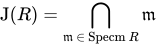
This definition can be used for explicit calculations in a number of simple cases, such as for local rings (R, ), which have a unique maximal ideal, Artinian rings, and products thereof. See the examples section for explicit computations.

Noncommutative/general case

[edit]

For a general ring with unity R, the Jacobson radical J(R) is defined as the ideal of all elements rR such that rM = 0 whenever M is a simple R-module. That is, This is equivalent to the definition in the commutative case for a commutative ring R because the simple modules over a commutative ring are of the form R / for some maximal ideal of R, and the annihilators of R / in R are precisely the elements of , i.e. AnnR(R / ) = .

Motivation

[edit]

Understanding the Jacobson radical lies in a few different cases: namely its applications and the resulting geometric interpretations, and its algebraic interpretations.

Geometric applications

[edit]

Although Jacobson originally introduced his radical as a technique for building a theory of radicals for arbitrary rings, one of the motivating reasons for why the Jacobson radical is considered in the commutative case is because of its appearance in Nakayama's lemma. This lemma is a technical tool for studying finitely generated modules over commutative rings that has an easy geometric interpretation: If we have a vector bundle EX over a topological space X, and pick a point pX, then any basis of E|p can be extended to a basis of sections of E|UU for some neighborhood pUX.

Another application is in the case of finitely generated commutative rings of the form for some base ring k (such as a field, or the ring of integers). In this case the nilradical and the Jacobson radical coincide. This means we could interpret the Jacobson radical as a measure for how far the ideal I defining the ring R is from defining the ring of functions on an algebraic variety because of the Hilbert Nullstellensatz theorem. This is because algebraic varieties cannot have a ring of functions with infinitesimals: this is a structure that is only considered in scheme theory.

Equivalent characterizations

[edit]

The Jacobson radical of a ring has various internal and external characterizations. The following equivalences appear in many noncommutative algebra texts such as Anderson & Fuller 1992, §15, Isaacs 1994, §13B, and Lam 2001, Ch 2.

The following are equivalent characterizations of the Jacobson radical in rings with unity (characterizations for rings without unity are given immediately afterward):

  • J(R) equals the intersection of all maximal right ideals of the ring. The equivalence coming from the fact that for all maximal right ideals M, R / M is a simple right R-module, and that in fact all simple right R-modules are isomorphic to one of this type via the map from R to S given by rxr for any generator x of S. It is also true that J(R) equals the intersection of all maximal left ideals within the ring.[2] These characterizations are internal to the ring, since one only needs to find the maximal right ideals of the ring. For example, if a ring is local, and has a unique maximal right ideal, then this unique maximal right ideal is exactly J(R). Maximal ideals are in a sense easier to look for than annihilators of modules. This characterization is deficient, however, because it does not prove useful when working computationally with J(R). The left-right symmetry of these two definitions is remarkable and has various interesting consequences.[2][3] This symmetry stands in contrast to the lack of symmetry in the socles of R, for it may happen that soc(RR) is not equal to soc(RR). If R is a non-commutative ring, J(R) is not necessarily equal to the intersection of all maximal two-sided ideals of R. For instance, if V is a countable direct sum of copies of a field k and R = End(V) (the ring of endomorphisms of V as a k-module), then J(R) = 0 because R is known to be von Neumann regular, but there is exactly one maximal double-sided ideal in R consisting of endomorphisms with finite-dimensional image.[4]
  • J(R) equals the sum of all superfluous right ideals (or symmetrically, the sum of all superfluous left ideals) of R. Comparing this with the previous definition, the sum of superfluous right ideals equals the intersection of maximal right ideals. This phenomenon is reflected dually for the right socle of R; soc(RR) is both the sum of minimal right ideals and the intersection of essential right ideals. In fact, these two relationships hold for the radicals and socles of modules in general.
  • As defined in the introduction, J(R) equals the intersection of all annihilators of simple right R-modules, however it is also true that it is the intersection of annihilators of simple left modules. An ideal that is the annihilator of a simple module is known as a primitive ideal, and so a reformulation of this states that the Jacobson radical is the intersection of all primitive ideals. This characterization is useful when studying modules over rings. For instance, if U is a right R-module, and V is a maximal submodule of U, U · J(R) is contained in V, where U · J(R) denotes all products of elements of J(R) (the "scalars") with elements in U, on the right. This follows from the fact that the quotient module U / V is simple and hence annihilated by J(R).
  • J(R) is the unique right ideal of R maximal with the property that every element is right quasiregular[5][6] (or equivalently left quasiregular[2]). This characterization of the Jacobson radical is useful both computationally and in aiding intuition. Furthermore, this characterization is useful in studying modules over a ring. Nakayama's lemma is perhaps the most well-known instance of this. Although every element of the J(R) is necessarily quasiregular, not every quasiregular element is necessarily a member of J(R).[6]
  • While not every quasiregular element is in J(R), it can be shown that y is in J(R) if and only if xy is left quasiregular for all x in R.[7]
  • J(R) is the set of elements x in R such that every element of 1 + RxR is a unit: J(R) = {xR | 1 + RxRR×}. In fact, yR is in the Jacobson radical if and only if 1 + xy is invertible for any xR, if and only if 1 + yx is invertible for any xR. This means xy and yx behave similarly to a nilpotent element z with zn+1 = 0 and (1 + z)−1 = 1 − z + z2 − ... ± zn.

For rings without unity it is possible to have R = J(R); however, the equation J(R / J(R)) = {0} still holds. The following are equivalent characterizations of J(R) for rings without unity:[8]

  • The notion of left quasiregularity can be generalized in the following way. Call an element a in R left generalized quasiregular if there exists c in R such that c + aca = 0. Then J(R) consists of every element a for which ra is left generalized quasiregular for all r in R. It can be checked that this definition coincides with the previous quasiregular definition for rings with unity.
  • For a ring without unity, the definition of a left simple module M is amended by adding the condition that RM ≠ 0. With this understanding, J(R) may be defined as the intersection of all annihilators of simple left R modules, or just R if there are no simple left R modules. Rings without unity with no simple modules do exist, in which case R = J(R), and the ring is called a radical ring. By using the generalized quasiregular characterization of the radical, it is clear that if one finds a ring with J(R) nonzero, then J(R) is a radical ring when considered as a ring without unity.

Examples

[edit]

Commutative examples

[edit]
  • For the ring of integers Z its Jacobson radical is the zero ideal, so J(Z) = (0), because it is given by the intersection of every ideal generated by a prime number (p). Since (p1) ∩ (p2) = (p1p2), and we are taking an infinite intersection with no common elements besides 0 between all maximal ideals, we have the computation.
  • For a local ring (R, ) the Jacobson radical is simply J(R) = . This is an important case because of its use in applying Nakayama's lemma. In particular, it implies if we have an algebraic vector bundle EX over a scheme or algebraic variety X, and we fix a basis of E|p for some point pX, then this basis lifts to a set of generators for all sections E for some neighborhood U of p.
  • If k is a field and R = k[[X1, ..., Xn]] is a ring of formal power series, then J(R) consists of those power series whose constant term is zero, i.e. the power series in the ideal (X1, ..., Xn).
  • In the case of an Artinian rings, such as C[t1, t2]/(t14, t12t22, t29), the Jacobson radical is (t1, t2).
  • The previous example could be extended to the ring R = C[t2, t3, ...]/(t22, t33, ...), giving J(R) = (t2, t3, ...).
  • The Jacobson radical of the ring Z/12Z is 6Z/12Z, which is the intersection of the maximal ideals 2Z/12Z and 3Z/12Z.
  • Consider the ring C[t] ⊗C C[x1, x2]x12+x22−1, where the second is the localization of C[x1, x2] by the prime ideal = (x12 + x22 − 1). Then, the Jacobson radical is trivial because the maximal ideals are generated by an element of the form (tz) ⊗ (x12 + x22 − 1) for zC.

Noncommutative examples

[edit]
  • Rings for which J(R) is {0} are called semiprimitive rings, or sometimes "Jacobson semisimple rings". The Jacobson radical of any field, any von Neumann regular ring and any left or right primitive ring is {0}. The Jacobson radical of the integers is {0}.
  • If K is a field and R is the ring of all upper triangular n-by-n matrices with entries in K, then J(R) consists of all upper triangular matrices with zeros on the main diagonal.
  • Start with a finite, acyclic quiver Γ and a field K and consider the quiver algebra K Γ (as described in the article Quiver). The Jacobson radical of this ring is generated by all the paths in Γ of length ≥ 1.
  • The Jacobson radical of a C*-algebra is {0}. This follows from the Gelfand–Naimark theorem and the fact that for a C*-algebra, a topologically irreducible *-representation on a Hilbert space is algebraically irreducible, so that its kernel is a primitive ideal in the purely algebraic sense (see Spectrum of a C*-algebra).

Properties

[edit]
  • If R is unital and is not the trivial ring {0}, the Jacobson radical is always distinct from R since rings with unity always have maximal right ideals. However, some important theorems and conjectures in ring theory consider the case when J(R) = R – "If R is a nil ring (that is, each of its elements is nilpotent), is the polynomial ring R[x] equal to its Jacobson radical?" is equivalent to the open Köthe conjecture.[9]
  • For any ideal I contained in J(R), J(R / I) = J(R) / I.
  • In particular, the Jacobson radical of the ring R / J(R) is zero. Rings with zero Jacobson radical are called semiprimitive rings.
  • A ring is semisimple if and only if it is Artinian and its Jacobson radical is zero.
  • If f : RS is a surjective ring homomorphism, then f(J(R)) ⊆ J(S).
  • If R is a ring with unity and M is a finitely generated left R-module with J(R)M = M, then M = 0 (Nakayama's lemma).
  • J(R) contains all central nilpotent elements, but contains no idempotent elements except for 0.
  • J(R) contains every nil ideal of R. If R is left or right Artinian, then J(R) is a nilpotent ideal.
    This can actually be made stronger: If
            {0} = T0T1 ⊆ ⋅⋅⋅ ⊆ Tk = R
    is a composition series for the right R-module R (such a series is sure to exist if R is right Artinian, and there is a similar left composition series if R is left Artinian), then (J(R))k = 0.[a]
    Note, however, that in general the Jacobson radical need not consist of only the nilpotent elements of the ring.
  • If R is commutative and finitely generated as an algebra over either a field or Z, then J(R) is equal to the nilradical of R.
  • The Jacobson radical of a (unital) ring is its largest superfluous right (equivalently, left) ideal.

See also

[edit]

Notes

[edit]

Citations

[edit]
  1. ^ "Section 10.18 (0AMD): The Jacobson radical of a ring—The Stacks project". stacks.math.columbia.edu. Retrieved 2020-12-24.
  2. ^ a b c Isaacs 1994, p. 182
  3. ^ Isaacs 1994, p. 173, Problem 12.5
  4. ^ Lam 2001, p. 46, Ex. 3.15
  5. ^ Isaacs 1994, p. 180, Corollary 13.4
  6. ^ a b Isaacs 1994, p. 181
  7. ^ Lam 2001, p. 50.
  8. ^ Lam 2001, p. 63
  9. ^ Smoktunowicz 2006, p. 260, §5

References

[edit]
[edit]
Revisions and contributorsEdit on WikipediaRead on Wikipedia
from Grokipedia
In , the Jacobson radical of an associative ring RR with unity, denoted J(R)J(R), is the of the annihilators of all simple left RR-modules, which is equivalently the of all maximal left ideals of RR. This two-sided ideal, introduced by Nathan Jacobson in to extend radical concepts from special classes of rings like Artinian ones to arbitrary rings, measures the "non-semisimplicity" of RR by identifying elements that act trivially on all irreducible representations. The Jacobson radical possesses several key characterizations and properties that underscore its centrality in theory. For instance, xJ(R)x \in J(R) if and only if 1+x1 + x is invertible in RR (i.e., xx is quasi-regular), so that J(R)J(R) consists precisely of the quasi-regular elements of RR. In left Artinian rings, J(R)J(R) coincides with the nilpotent classical radical, and the quotient R/J(R)R / J(R) is semisimple Artinian, providing a decomposition into matrix rings over division rings. For commutative rings, J(R)J(R) reduces to the intersection of all s, linking it closely to the structure of local rings where it equals the unique . Beyond these foundational aspects, the Jacobson radical facilitates the study of ring extensions, homomorphisms, and module categories; for example, it is preserved under direct products as J(Ri)=J(Ri)J(\prod R_i) = \prod J(R_i), and in primitive rings (those with faithful simple modules), it vanishes, highlighting . Its role extends to broader algebraic contexts, such as algebras and group rings, where analogous radicals inform solvability and .

Definitions

Commutative Rings

In a commutative ring RR with identity, the Jacobson radical J(R)J(R), also denoted rad(R)\mathrm{rad}(R), is defined as the intersection of all maximal ideals of RR. This makes J(R)J(R) the largest ideal of RR that is contained in every maximal ideal. An element xRx \in R belongs to J(R)J(R) if and only if it lies in the kernel of every ring homomorphism ϕ:RF\phi: R \to F from RR to a field FF. Equivalently, in the commutative setting, xJ(R)x \in J(R) precisely when 1xy1 - xy is a unit in RR for every yRy \in R; such elements are called quasiregular. This characterization highlights the role of J(R)J(R) in capturing elements that do not generate proper ideals in quotients by maximal ideals. This definition for commutative rings predates the more general noncommutative version and aligns with Wolfgang Krull's foundational work on the structure and intersections of maximal ideals in the and . Nathan Jacobson later extended the concept in his 1945 paper, formalizing the radical for arbitrary rings while building on these commutative foundations.

Noncommutative Rings

In theory, the concept of simple modules plays a central role in defining the Jacobson radical. A left RR-module MM is simple if it is nonzero and has no proper submodules, meaning the only submodules are {0}\{0\} and MM itself. Simple modules are also known as irreducible modules or irreducible representations of the ring RR. For an associative ring RR with unity, the Jacobson radical J(R)J(R) is defined as the intersection of the annihilators of all simple left RR-modules. The annihilator AnnR(M)\operatorname{Ann}_R(M) of a left RR-module MM is the set {rRrM=0}\{ r \in R \mid rM = 0 \}, so J(R)={AnnR(M)M is a simple left R-module}J(R) = \bigcap \{ \operatorname{Ann}_R(M) \mid M \text{ is a simple left } R\text{-module} \}. This means J(R)J(R) consists precisely of those elements rRr \in R that act trivially on every simple left RR-module, i.e., rM=0rM = 0 for all such MM. Equivalently, J(R)J(R) can be formulated in terms of right modules: J(R)={AnnR(N)N is a simple right R-module}J(R) = \bigcap \{ \operatorname{Ann}_R(N) \mid N \text{ is a simple right } R\text{-module} \}, where AnnR(N)={rRNr=0}\operatorname{Ann}_R(N) = \{ r \in R \mid Nr = 0 \}. This definition ensures that J(R)J(R) is a two-sided of RR, as each annihilator AnnR(M)\operatorname{Ann}_R(M) is two-sided and the of two-sided ideals remains two-sided. In the commutative case, J(R)J(R) coincides with the of all maximal (two-sided) ideals, but for noncommutative rings, it is instead the of all maximal left ideals (or equivalently, all maximal right ideals). Thus, elements of J(R)J(R) act trivially on all irreducible representations of RR, capturing the "radical" behavior in a module-theoretic sense.

Historical and Motivational Context

Origins and Development

The Jacobson radical was introduced by Nathan Jacobson in his 1945 paper titled "The Radical and Semi-simplicity for Arbitrary Rings," published in the American Journal of Mathematics. This seminal work defined the radical for arbitrary rings, extending beyond previous restrictions to specific classes like Artinian or Noetherian rings. 1943 monograph The Theory of Rings provided foundational developments in ring structure theory, particularly for rings satisfying chain conditions on ideals, upon which he built in the 1945 paper to introduce the Jacobson radical for arbitrary rings. Jacobson's development built directly on earlier contributions, including 's 1929 studies of radicals in commutative rings, such as the nilradical and prime radical concepts in divisor theory, and Emil Artin's explorations of noncommutative ideals and semisimple structures in the 1920s. By generalizing these ideas, Jacobson created a unified framework applicable to all associative rings with unity, addressing the need for a consistent notion of "quasi-regular" elements across commutative and noncommutative settings. The concept is named after Jacobson to distinguish it from broader historical uses of the term "radical of a ring," which had appeared in earlier works like those of Wedderburn and McCoy for specific ring classes. The primary stemmed from the desire to capture and unify "radical" behaviors—elements that are "small" in the sense that they become zero in quotients by maximal right ideals—thereby facilitating the study of ring structure and . The Jacobson radical has since become a foundational element in noncommutative , with no significant conceptual updates after 2000, remaining central in standard references like T. Y. Lam's A First Course in Noncommutative Rings (2001).

Geometric and Algebraic Applications

The Jacobson radical arises naturally in through its intimate connection to the Hilbert Nullstellensatz, which bridges algebraic ideals and geometric varieties over s. For a finitely generated RR over an algebraically closed field kk, the Nullstellensatz asserts that the maximal ideals of RR correspond bijectively to points of the associated , and the nilradical of RR coincides with the Jacobson radical J(R)J(R). This equality characterizes RR as a Jacobson ring and identifies J(R)J(R) with the ideal of elements that vanish on the entire variety, providing a geometric interpretation of the radical as the set of functions with no common zeros on the variety. In the framework of schemes and affine varieties, the quotient J(R)/J(R)2J(R)/J(R)^2 plays a central role in describing local geometric structures. For a local ring (R,m)(R, \mathfrak{m}) at a point, where J(R)=mJ(R) = \mathfrak{m} is the , the vector space m/m2\mathfrak{m}/\mathfrak{m}^2 dualizes to the at that point, capturing first-order infinitesimal deformations modulo higher-order terms. This construction extends to relative tangent spaces over a base scheme, where J(R)/J(R)2J(R)/J(R)^2 informs the dimension and smoothness of fibers in families of varieties. For the coordinate ring R=k[X1,,Xn]/(f1,,fm)R = k[X_1, \dots, X_n]/(f_1, \dots, f_m) of an defined by polynomials fif_i, the Jacobson radical further characterizes the as those corresponding to points (a1,,an)(a_1, \dots, a_n) on the variety, via the weak Nullstellensatz correspondence between radical ideals and closed subsets. Beyond varieties, the Jacobson radical is instrumental in deformation theory, where it governs extensions of algebraic structures. Artinian local rings, which model small deformations, feature a nilpotent Jacobson radical that encodes the order of nilpotency, allowing control over extensions of modules or schemes by nilpotent ideals. In this context, J(R)J(R) facilitates the study of moduli spaces by parameterizing first-order deformations through associated graded rings. A key application highlighting the utility of J(R)J(R) is , which previews deeper module-theoretic properties: for a finitely generated module MM over RR, if J(R)M=MJ(R) M = M, then M=0M = 0. Geometrically, this is motivated by the existence and local generation of vector bundles on varieties; if global sections generate the fiber of a at every point, they generate the sheaf on an affine open cover, ensuring the bundle is locally trivialized without global obstructions.

Equivalent Characterizations

Module-Theoretic Views

One key module-theoretic characterization of the Jacobson radical J(R)J(R) of a ring RR is as the intersection of the annihilators of all simple right RR-modules. Specifically, for any ring RR, J(R)={AnnR(S)S is a simple right R-module},J(R) = \bigcap \{ \operatorname{Ann}_R(S) \mid S \text{ is a simple right } R\text{-module} \}, where AnnR(S)={rRrS=0}\operatorname{Ann}_R(S) = \{ r \in R \mid rS = 0 \}. This intersection forms a two-sided ideal of RR, and elements of J(R)J(R) act trivially on every simple right module, capturing the "non-representable" core of the ring in terms of its simple module structure. Equivalently, J(R)J(R) can be viewed through irreducible representations of RR as an algebra over its prime subring or a base field when applicable. Here, J(R)J(R) is the intersection of the kernels of all s of RR, where an corresponds to a simple module SS via the action REndD(S)R \to \operatorname{End}_D(S) for some DD, and the kernel is precisely AnnR(S)\operatorname{Ann}_R(S). This perspective emphasizes the role of simple modules as building blocks for indecomposable representations, with J(R)J(R) consisting of elements that vanish under all such faithful actions on irreducibles. The equivalence holds because every simple right module induces an , and conversely, every arises from a simple module. From a broader module category standpoint, J(R)J(R) is the largest two-sided ideal such that the quotient ring R/J(R)R/J(R) is semiprimitive, meaning J(R/J(R))=0J(R/J(R)) = 0. A semiprimitive ring admits a faithful (a of simple modules that is faithful), and its module category is generated in a way that reflects the absence of a nontrivial radical. This quotient property ensures that R/J(R)R/J(R) embeds as a subdirect product of primitive rings, each with a faithful simple module, thereby linking the Jacobson radical to the socle structure across the entire module category: elements outside J(R)J(R) act nontrivially on some simple module, preventing nilpotent obstructions in the semiprimitive quotient. In this sense, relations to simple modules extend beyond direct annihilators, as J(R)J(R) modulates the essential extensions and in modules over RR, with simple modules serving as the minimal objects whose annihilators define the radical's boundaries.

Internal Ideal Descriptions

One key characterization of the Jacobson radical J(R)J(R) of a ring RR is as the of all maximal right of RR. This is a two-sided ideal, and equivalently, J(R)J(R) is the of all maximal left of RR. Another internal description arises from primitive : J(R)J(R) equals the of all primitive of RR, where a primitive ideal is the kernel of an of RR, or equivalently, the annihilator of a simple module over RR. In terms of elements, J(R)J(R) consists precisely of the quasiregular elements of RR; an element xRx \in R is quasiregular if there exists yRy \in R such that x+y+xy=0x + y + xy = 0 and zRz \in R such that x+z+zx=0x + z + zx = 0. Equivalently, xJ(R)x \in J(R) , for every simple left RR-module MM, multiplication by xx induces the zero map on MM. Another equivalent characterization, assuming RR has a unit element, is that aJ(R)a \in J(R) if and only if 1+xaR×1 + xa \in R^\times for all xRx \in R. More generally, aJ(R)a \in J(R) if and only if u+xaR×u + xa \in R^\times for all units uRu \in R and all xRx \in R, since u+xa=u(1+u1xa)u + xa = u(1 + u^{-1}xa) and uu is a unit, so the invertibility is equivalent to that of 1+u1xa1 + u^{-1}xa. As u1R=Ru^{-1} R = R, so this is equivalent to 1+xaR×1 + x a \in R^\times for all xRx \in R. Proof. Suppose aJ(R)a \notin J(R). Then there exists a maximal left ideal m\mathfrak{m} not containing aa. In the quotient R/mR / \mathfrak{m}, which is a simple left RR-module, the left multiplication by aˉ\bar{a} is a nonzero endomorphism, hence an automorphism (since the module is simple). Thus, it is surjective, so there exists xˉR/m\bar{x} \in R / \mathfrak{m} such that aˉxˉ=1ˉ\bar{a} \bar{x} = \bar{1}, i.e., ax1ma x - 1 \in \mathfrak{m}, or 1+a(x)m1 + a (-x) \in \mathfrak{m} (adjusting for the additive inverse). Conversely, suppose there exists xRx \in R such that 1+xaR×1 + x a \notin R^\times. Then the principal left ideal generated by 1+xa1 + x a is proper and contained in some maximal left ideal m\mathfrak{m}. Thus, 1+xam1 + x a \in \mathfrak{m}. Since m\mathfrak{m} is an additive subgroup and 1m1 \notin \mathfrak{m}, it follows that xamx a \notin \mathfrak{m} (otherwise, 1=(1+xa)xam1 = (1 + x a) - x a \in \mathfrak{m}). Now, since m\mathfrak{m} is a left ideal and xamx a \notin \mathfrak{m}, it follows that ama \notin \mathfrak{m} (because if ama \in \mathfrak{m}, then xa=xamx a = x \cdot a \in \mathfrak{m}, as left ideals are closed under left multiplication by elements of RR). Therefore, aJ(R)a \notin J(R). More generally, J(R)J(R) is the largest two-sided ideal of RR such that every element of this ideal is quasiregular in the unitization of RR (the ring RZR \oplus \mathbb{Z} with componentwise addition and multiplication (a,m)(b,n)=(ab+ma+nb,mn)(a, m)(b, n) = (ab + ma + nb, mn)). In this unitization, quasiregularity means that 1+x1 + x is invertible for each such element xx. Unlike the prime radical, which is the intersection of all prime ideals and comprises elements that are nilpotent modulo prime ideals, the Jacobson radical emphasizes quasiregularity and annihilation of simple modules rather than nilpotency, leading to proper containment of the prime radical in J(R)J(R) in general noncommutative settings.

Examples

Commutative Cases

In commutative rings, the Jacobson radical J(R)J(R) is the of all of RR. A fundamental example occurs when R=ZR = \mathbb{Z}, the ; here, the maximal ideals are the principal ideals (p)(p) for prime numbers pp, and their intersection is the zero ideal, so J(Z)=(0)J(\mathbb{Z}) = (0). Local rings provide another straightforward case: if RR is a commutative with unique m\mathfrak{m}, then J(R)=mJ(R) = \mathfrak{m}, as there is only one maximal ideal in the intersection. This aligns with the definition, since the Jacobson radical collects elements that lie in every maximal ideal. In Noetherian local rings, this maximal ideal m=J(R)\mathfrak{m} = J(R) is finitely generated, reflecting the Noetherian property that ensures all ideals are finitely generated. For rings of formal power series, consider R=k[[X1,,Xn]]R = k[[X_1, \dots, X_n]] where kk is a field; the maximal ideal is generated by X1,,XnX_1, \dots, X_n, and thus J(R)=(X1,,Xn)J(R) = (X_1, \dots, X_n), consisting of all series with zero constant term. This ideal captures the "non-unit" elements in the local ring structure of the power series ring. In Artinian commutative rings, the Jacobson radical is nilpotent. A concrete illustration is R=k[X]/(Xn)R = k[X] / (X^n) for a field kk and positive integer nn; here, the unique maximal ideal is (X)/(Xn)(X) / (X^n), so J(R)=(X)/(Xn)J(R) = (X) / (X^n), and this ideal satisfies [J(R)]n=0[J(R)]^n = 0, demonstrating nilpotency. Polynomial rings over fields exhibit a trivial Jacobson radical in many cases. Specifically, for R=k[X1,,Xn]R = k[X_1, \dots, X_n] where kk is an , J(R)=(0)J(R) = (0), as the intersection of all maximal ideals (which correspond to points in via the Nullstellensatz) contains no nonzero . Even without algebraic closure, the nilradical is zero, and since polynomial rings are Jacobson rings where the Jacobson radical equals the nilradical, J(R)=(0)J(R) = (0). A contrasting example where the Jacobson radical is nontrivial and coincides with the nilradical is the quotient ring R=C[x,y]/(x2y3)R = \mathbb{C}[x, y] / (x^2 y^3). Here, rad(C[x,y]/(x2y3))=(bC(x,y+b)aC(x+a,y))/(x2y3).\operatorname{rad}\left(\mathbb{C}[x, y] /\left(x^2 y^3\right)\right)=\left(\bigcap_{b \in \mathbb{C}}(x, y+b) \cap \bigcap_{a \in \mathbb{C}}(x+a, y)\right) /\left(x^2 y^3\right) . The maximal ideals of C[x,y]\mathbb{C}[x,y] are precisely the ideals of the form (xa,yb)(x - a, y - b) for a,bCa, b \in \mathbb{C}, by Hilbert's Nullstellensatz. A maximal ideal M=(xa,yb)M = (x - a, y - b) contains (x2y3)(x^2 y^3) if and only if x2y3Mx^2 y^3 \in M. Since MM is prime, this holds if x2Mx^2 \in M or y3My^3 \in M, which implies xMx \in M or yMy \in M, so a=0a = 0 or b=0b = 0. Therefore, the maximal ideals containing (x2y3)(x^2 y^3) are those of the form (x,yb)(x, y - b) for bCb \in \mathbb{C} (equivalent to (x,y+b)(x, y + b) as bb varies arbitrarily) or (xa,y)(x - a, y) for aCa \in \mathbb{C}. Any prime ideal containing (x2y3)(x^2 y^3) must similarly contain xx or yy, hence (x)(x) or (y)(y). The intersection of these maximal ideals is bC(x,y+b)aC(x+a,y)=(x)(y)=(xy)\bigcap_{b \in \mathbb{C}} (x, y + b) \cap \bigcap_{a \in \mathbb{C}} (x + a, y) = (x) \cap (y) = (xy), so the Jacobson radical of the quotient is (xy)/(x2y3)(xy) / (x^2 y^3). It turns out this coincides with nil(C[x,y]/(x2y3))\operatorname{nil}\left(\mathbb{C}[x, y] /\left(x^2 y^3\right)\right).

Noncommutative Cases

In theory, the Jacobson radical J(R)J(R) of a ring RR is defined as the of all maximal left ideals, though it coincides with the over maximal right ideals and forms a two-sided ideal; this underscores the role of one-sided ideals in noncommutative settings while ensuring in the radical's . Examples from various noncommutative algebras illustrate how J(R)J(R) captures or "obstructive" elements that annihilate simple modules. Consider the full Mn(D)M_n(D) over a DD. This ring is simple Artinian, hence primitive, and thus J(Mn(D))={0}J(M_n(D)) = \{0\}. In contrast, the ring RR of n×nn \times n upper triangular matrices over a field kk has Jacobson radical consisting precisely of the strictly upper triangular matrices; these form a nilpotent ideal of index nn, contained in every maximal left ideal. For the group algebra kGkG, where GG is a and kk a field, the situation depends on the characteristic of kk. If char(k)\operatorname{char}(k) does not divide G|G|, then Maschke's theorem implies kGkG is semisimple Artinian, so J(kG)={0}J(kG) = \{0\}. Otherwise, if char(k)=p>0\operatorname{char}(k) = p > 0 divides G|G|, then J(kG){0}J(kG) \neq \{0\} and equals the kernel of the augmentation (the augmentation ideal) when GG is a pp-group. In , path algebras provide another key example. For the path algebra kQkQ of a finite acyclic QQ over an kk, the Jacobson radical J(kQ)J(kQ) is the ideal generated by the arrows of QQ, equivalently the spanned by all nontrivial paths (of length at least 1); this ideal is if QQ has no oriented cycles. Shifting to operator algebras, unital C*-algebras exemplify semisimple behavior in the noncommutative Banach setting: their Jacobson radical is always {0}\{0\}, as they admit no nonzero ideals. More broadly, rings with J(R)={0}J(R) = \{0\} are called semiprimitive (or Jacobson semisimple), and simple Artinian rings—such as matrix rings over division rings—are canonical instances, being both primitive and semisimple.

Properties and Theorems

Fundamental Properties

The Jacobson radical J(R)J(R) of a ring RR (with unity) is a two-sided ideal, as it can be characterized as the of all maximal left ideals of RR, and this is invariant under left and right multiplication by elements of RR. In general, the nilradical Nil(R)\mathrm{Nil}(R), consisting of all elements, is contained in J(R)J(R), since every element annihilates all simple modules. For commutative rings, equality Nil(R)=J(R)\mathrm{Nil}(R) = J(R) holds if and only if RR is a Jacobson ring, meaning every is the of maximal ideals containing it. The Jacobson radical contains every nil ideal of RR, as any ideal generated by nilpotent elements is superfluous and thus lies inside J(R)J(R). For a direct product of rings R=iRiR = \prod_i R_i, the Jacobson radical satisfies J(R)=iJ(Ri)J(R) = \prod_i J(R_i), reflecting the product structure of maximal ideals in the direct product. In the case of quotient rings, if II is an ideal of RR, the lifting property gives J(R/I)=(J(R)+I)/IJ(R/I) = (J(R) + I)/I, which follows from the correspondence between ideals containing II and ideals of the quotient. In left Artinian rings, J(R)J(R) is the unique minimal left ideal that contains all superfluous left ideals, and it is nilpotent. For any ring RR (possibly without unity), in its unitization R=RZR^\sharp = R \oplus \mathbb{Z} with multiplication (r,n)(s,m)=(rs+nr+ms,nm)(r, n)(s, m) = (rs + nr + ms, nm), the elements of the form (1,0)+(x,0)(1, 0) + (x, 0) for xJ(R)x \in J(R) are units. This property links to quasiregular elements, where J(R)J(R) consists precisely of the elements whose left multiples are left quasiregular.

Key Theorems and Lemmas

One of the central results involving the Jacobson radical is , which provides a criterion for the triviality of finitely generated modules annihilated by the radical. Specifically, let RR be a ring with Jacobson radical J(R)J(R), and let MM be a finitely generated left RR-module. If J(R)M=MJ(R) M = M, then M=0M = 0. In the case where RR is (with unique equal to J(R)J(R)), the converse also holds: if M=0M = 0, then J(R)M=MJ(R) M = M. The proof of Nakayama's lemma proceeds by induction on the number of generators of MM. For the base case with one generator, if M=RxM = R x and J(R)M=MJ(R) M = M, then x=jxx = j x for some jJ(R)j \in J(R), implying (1j)x=0(1 - j) x = 0; since 1j1 - j is a unit (as J(R)J(R) consists of non-units), x=0x = 0 and thus M=0M = 0. The inductive step assumes the result for fewer generators and uses the existence of a short exact sequence to reduce to a quotient module, applying the induction hypothesis and the fact that elements of J(R)J(R) act without producing units outside the radical. An equivalent formulation, Nakayama's criterion, states that a generating set {x1,,xn}\{x_1, \dots, x_n\} for MM generates MM as an RR-module if and only if its image generates the vector space M/J(R)MM / J(R) M. In , the Jacobson radical exhibits strong nilpotency properties. For a left RR, the Jacobson radical J(R)J(R) is , meaning there exists a positive nn such that J(R)n=0J(R)^n = 0. The proof relies on the descending chain condition: the powers J(R)J(R)2J(R)3J(R) \supset J(R)^2 \supset J(R)^3 \supset \cdots stabilize at some J(R)n=J(R)n+1J(R)^n = J(R)^{n+1}, and constructing the annihilator ideal {xRxJ(R)n=0}\{ x \in R \mid x J(R)^n = 0 \} leads to a contradiction unless it equals RR, forcing J(R)n=0J(R)^n = 0. This nilpotency is closely tied to the Hopkins-Levitzki theorem, which characterizes Artinian rings among Noetherian ones via the radical. The theorem states that a ring RR is (left) Artinian if and only if it is (left) Noetherian and J(R)J(R) is nilpotent. In the forward direction, the nilpotency of J(R)J(R) in an Artinian ring implies finite length for RR as a module over itself, as RR decomposes into a finite sum of semisimple quotients J(R)d/J(R)d+1J(R)^d / J(R)^{d+1} up to the nilpotency index. The converse follows from the fact that nilpotency ensures the descending chain condition on ideals. Jacobson's density theorem provides a structural description of primitive rings, with implications for the semisimple quotient by the Jacobson radical. Let RR be a left primitive ring (admitting a faithful simple left module MM), and let D=EndR(M)D = \operatorname{End}_R(M), which is a . Then RR is dense in EndD(M)\operatorname{End}_D(M): for any DD-linearly independent x1,,xnMx_1, \dots, x_n \in M and arbitrary y1,,ynMy_1, \dots, y_n \in M, there exists rRr \in R such that rxi=yir x_i = y_i for all ii. The proof uses induction on nn, with the base case following from simplicity of MM and the inductive step constructing annihilators to ensure linear independence preservation. This density implies that the R/J(R)R / J(R) embeds as a dense subring in a ring of linear transformations over a division ring, revealing the semisimple nature of R/J(R)R / J(R). In Noetherian rings, the Jacobson radical admits a precise description in terms of ideals containing the nilradical. For a (commutative) Noetherian ring RR, J(R)J(R) is the intersection of all maximal ideals containing the nilradical N(R)N(R). Since N(R)J(R)N(R) \subseteq J(R) and every maximal ideal contains N(R)N(R) (as it is the intersection of all prime ideals), this coincides with the standard definition of J(R)J(R) as the intersection of all maximal ideals; however, in the Noetherian setting, the nilpotency of N(R)N(R) (where N(R)k=0N(R)^k = 0 for some kk) underscores the containment without equality in general.

Relations to Other Concepts

Comparison with Nilradical

The nilradical of a ring RR, denoted Nil(R)\mathrm{Nil}(R), is the largest two-sided ideal of RR. In commutative rings, it coincides with the set of elements, equivalently the radical of the zero ideal (0)\sqrt{(0)}
Add your contribution
Related Hubs
User Avatar
No comments yet.