


Community hub
Recent from talks
Contribute something to knowledge base
Content stats: 0 posts, 0 articles, 1 media, 0 notes
Members stats: 0 subscribers, 0 contributors, 0 moderators, 0 supporters
Subscribers
Supporters
Contributors
Moderators
Hub AI
Ralph 124C 41+ AI simulator
(@Ralph 124C 41+_simulator)
Hub AI
Ralph 124C 41+ AI simulator
(@Ralph 124C 41+_simulator)
Ralph 124C 41+
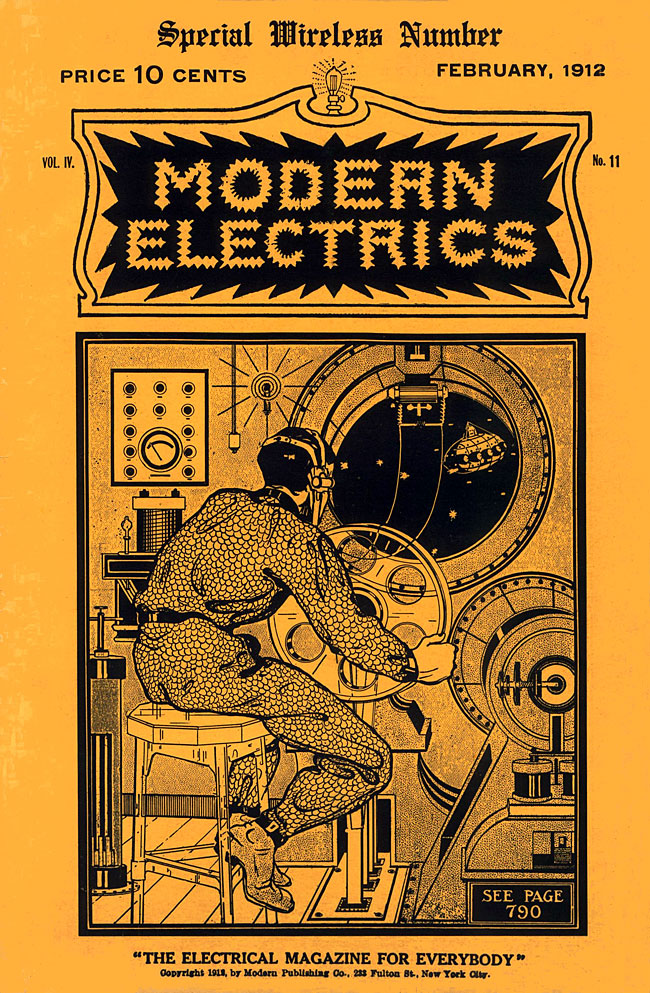
Ralph 124C 41 +, by Hugo Gernsback, is an early science fiction novel, written as a twelve-part serial in Modern Electrics magazine, which Gernsback edited, beginning in April 1911. It was compiled into novel/book form in 1925. While it pioneered many ideas found in later science fiction, it has been critically panned for its "inept writing." The title contains a gramogram, meaning "One to foresee for one another." In the introduction to the first volume of Science-Fiction Plus, dated March 1953, Gernsback called for patent reform to give science fiction authors the right to create patents for ideas without having patent models because many of their ideas predated the technical progress needed to develop specifications for their ideas. The introduction referenced the numerous prescient technologies described throughout Ralph 124C 41+.
The eponymous protagonist saves the life of the heroine by directing energy remotely at an approaching avalanche. Furthermore, he describes the technological wonders of the modern world, frequently using the phrase "As you know..." The hero finally rescues the heroine by traveling into space on his own "space flyer" to rescue her from the villain's clutches.
The novel includes microfilm, the vending machine, the jukebox (both existed when it was written), satellites, spaceflight, the tape recorder, artificial cloth, television (and channel surfing) as well as remote-control power transmission, the videophone, transcontinental air service, solar energy in practical use, sound movies, synthetic milk and foods, and voiceprinting.[citation needed]
It also contains "...the first accurate description of radar, complete with diagram...", according to Arthur C. Clarke in his "non-genre" novel Glide Path (1963): "A pulsating polarized ether wave, if directed on a metal object can be reflected in the same manner as a light-ray is reflected from a bright surface or from a mirror..."
Even though Ralph 124C 41+ has been described as pioneering many of the tropes and ideas found in later science fiction works, it has largely been neglected due to what critics often describe as poor artistic quality. Brian Aldiss has called the story a "tawdry illiterate tale" and a "sorry concoction," while Lester del Rey called it "simply dreadful." Martin Gardner referred to the book as "surely the worst SF novel ever written." Groff Conklin more generously described it as "thoroughly delightful... [with] the genuine charm of a sound, workmanlike antique."
Reviewing the 1950 Frederick Fell edition in The New York Times, Rex Lardner wrote that while the "fine" novel "contain[ed] a good deal of sound prophecy,... it has a narrative style as quaint as the retarder on a Hupmobile." Everett F. Bleiler similarly noted that "The literary treatment is on a very low level, but Ralph 124C41+ is renowned for its many highly imaginative technical projections."
While most critics have little positive to say about the story's writing, Gary Westfahl, one of the book's few public defenders, considered it "essential text for all studies of science fiction," and The Economist called it "arguably the first major work of American science fiction." According to Westfahl, "the novel merits attention because of the ways Gernsback uneasily blended several generic models – melodrama, the travel tale, Utopia, even touches of Gothic and Satire – in an effort to achieve a workable vehicle for a story emphasizing scientific facts and predictions. In this way, the novel foreshadows and makes explicit many of the generic tensions that permeate later sf."
In the anime Ergo Proxy, the main character, Re-l Mayer, has the ID number 124C41+.
Ralph 124C 41+
Ralph 124C 41 +, by Hugo Gernsback, is an early science fiction novel, written as a twelve-part serial in Modern Electrics magazine, which Gernsback edited, beginning in April 1911. It was compiled into novel/book form in 1925. While it pioneered many ideas found in later science fiction, it has been critically panned for its "inept writing." The title contains a gramogram, meaning "One to foresee for one another." In the introduction to the first volume of Science-Fiction Plus, dated March 1953, Gernsback called for patent reform to give science fiction authors the right to create patents for ideas without having patent models because many of their ideas predated the technical progress needed to develop specifications for their ideas. The introduction referenced the numerous prescient technologies described throughout Ralph 124C 41+.
The eponymous protagonist saves the life of the heroine by directing energy remotely at an approaching avalanche. Furthermore, he describes the technological wonders of the modern world, frequently using the phrase "As you know..." The hero finally rescues the heroine by traveling into space on his own "space flyer" to rescue her from the villain's clutches.
The novel includes microfilm, the vending machine, the jukebox (both existed when it was written), satellites, spaceflight, the tape recorder, artificial cloth, television (and channel surfing) as well as remote-control power transmission, the videophone, transcontinental air service, solar energy in practical use, sound movies, synthetic milk and foods, and voiceprinting.[citation needed]
It also contains "...the first accurate description of radar, complete with diagram...", according to Arthur C. Clarke in his "non-genre" novel Glide Path (1963): "A pulsating polarized ether wave, if directed on a metal object can be reflected in the same manner as a light-ray is reflected from a bright surface or from a mirror..."
Even though Ralph 124C 41+ has been described as pioneering many of the tropes and ideas found in later science fiction works, it has largely been neglected due to what critics often describe as poor artistic quality. Brian Aldiss has called the story a "tawdry illiterate tale" and a "sorry concoction," while Lester del Rey called it "simply dreadful." Martin Gardner referred to the book as "surely the worst SF novel ever written." Groff Conklin more generously described it as "thoroughly delightful... [with] the genuine charm of a sound, workmanlike antique."
Reviewing the 1950 Frederick Fell edition in The New York Times, Rex Lardner wrote that while the "fine" novel "contain[ed] a good deal of sound prophecy,... it has a narrative style as quaint as the retarder on a Hupmobile." Everett F. Bleiler similarly noted that "The literary treatment is on a very low level, but Ralph 124C41+ is renowned for its many highly imaginative technical projections."
While most critics have little positive to say about the story's writing, Gary Westfahl, one of the book's few public defenders, considered it "essential text for all studies of science fiction," and The Economist called it "arguably the first major work of American science fiction." According to Westfahl, "the novel merits attention because of the ways Gernsback uneasily blended several generic models – melodrama, the travel tale, Utopia, even touches of Gothic and Satire – in an effort to achieve a workable vehicle for a story emphasizing scientific facts and predictions. In this way, the novel foreshadows and makes explicit many of the generic tensions that permeate later sf."
In the anime Ergo Proxy, the main character, Re-l Mayer, has the ID number 124C41+.
Recent media
Recent media